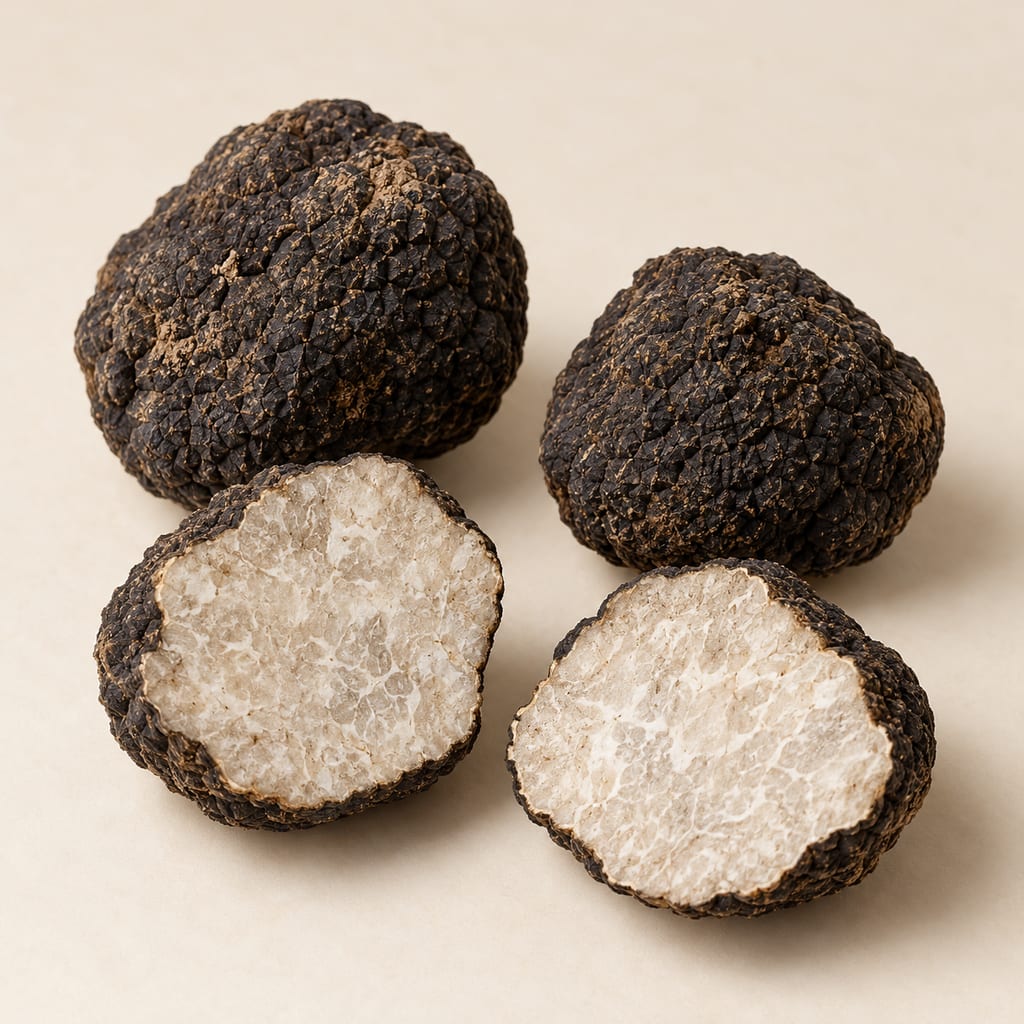
Black desert truffle
The black desert truffle, catalogued as Picoa juniperi, is a subterranean fungus gathered wild in arid and semi-arid lands. Eastern Anatolian households eat it, usually fried with eggs.
 FermenteaWhere food goes to change
Mushrooms
The brown desert truffle, Terfezia boudieri, is an underground fungus of arid soils around the eastern Mediterranean and North Africa, gathered and sold in Turkey and eaten fried with eggs.
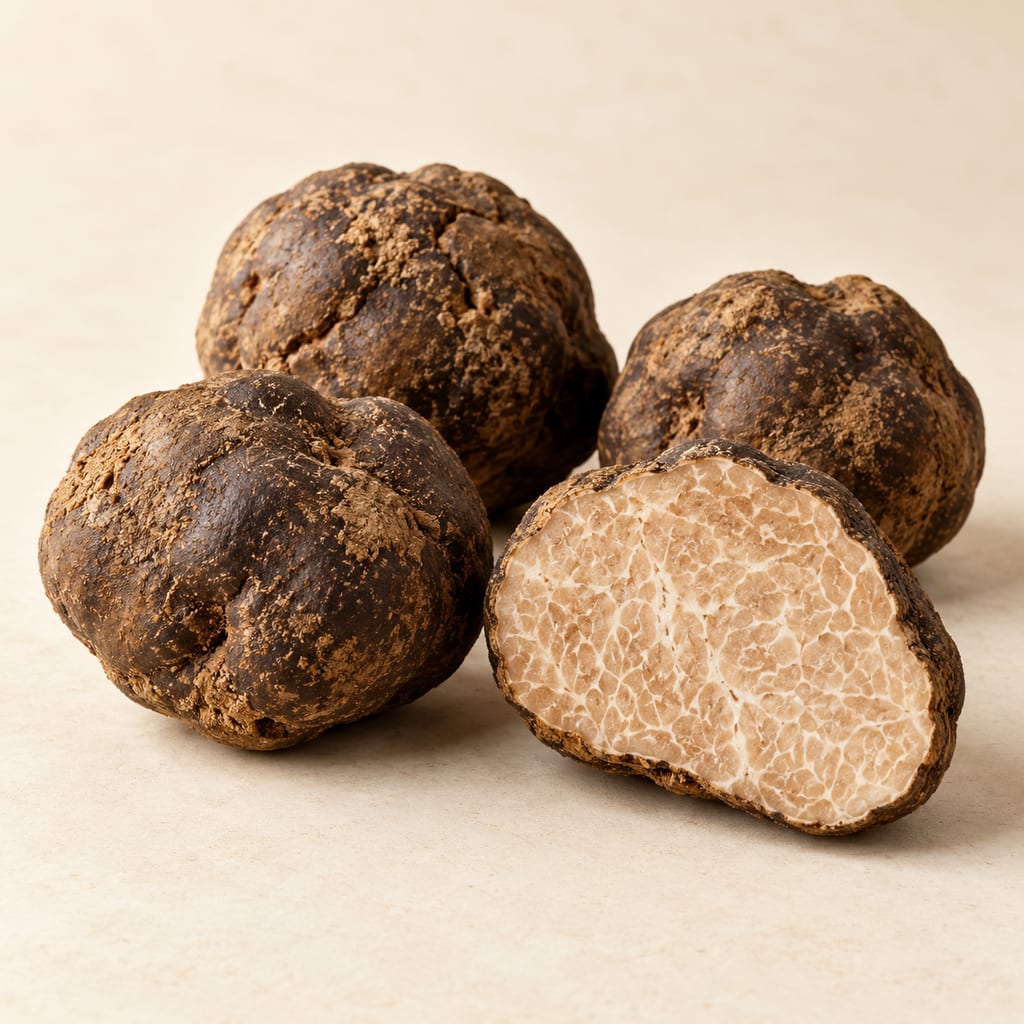
The brown desert truffle, Terfezia boudieri, is a truffle that grows below ground in dry, sandy steppe and semi-desert. Its fruiting body is a fleshy underground ball, which is gathered by digging or by following the soil cracks it makes at the surface. Its common name in the catalogue is brown desert truffle.
It is one of the desert truffles of the Mediterranean and the Near East, a group that is closely related to the true truffles of the genus Tuber but that grows in very different soils and climates.
The fungus is mycorrhizal, living in partnership with the roots of Helianthemum, a low sun-rose shrub of dry ground. The 2017 survey in Eastern Anatolia reports that gatherers find it where the ground bulges and cracks, and in places where a local plant called kumi grows. The text does not explicitly link kumi to Helianthemum.
Gatherers collect from unploughed, barren ground with sandy soil. The survey reports that rain and soil type affect how much grows in a season. Its appearance is in early spring, from March into late April.
The 2017 study interviewed 230 gatherers in Eastern Anatolia. Most gathered for food, citing nutritional value and the truffle as a natural food, and rated the species as edible. Most gatherers collect about two kilograms a day or less, and most consider the income high.
Brown desert truffles are the preferred commercial species. Other local truffles, such as Picoa and Terfezia olbiensis species, were mainly eaten at home because they bring no income. Knowledge is passed down in families and learned from experience in the field.
The survey records that gatherers usually fry the truffles with eggs, and that most keep them in a refrigerator after collecting. The survey describes no other dishes for this region, and the sources reviewed give no cooking method for the species in other countries.
The catalogue lists the cooked use as documented in eastern Turkey. No temperature, time or storage limit is given in the sources reviewed, and none is supplied here.
The survey covers the gatherers' own knowledge of what to pick. It does not describe how the species was identified in the laboratory, and the abstract gives no morphological key. Desert truffles can be confused with other underground fungi, so an identification should be checked by an expert before the fungus is eaten.
The catalogue states that its food-use record is not an identification or preparation guide. This page follows that limit and does not give an identification or a safety verdict.
The sources reviewed do not give a full species description, a list of lookalikes, a lab identification, or cooking details outside eastern Turkey. Those would need the full study text or a monograph of the desert truffles.
Survey of 230 gatherers in Eastern Anatolia; the study covers only this region.
The catalogue records commercial and household use across these areas; the sources reviewed give no detail for them.
The black desert truffle, catalogued as Picoa juniperi, is a subterranean fungus gathered wild in arid and semi-arid lands. Eastern Anatolian households eat it, usually fried with eggs.
No community contributions have been published for this entry yet.
Sign in to contribute. Published comments and photos are free to read.
Gazi University Journal of ScienceFood use · Ecology · Harvest · Market
Ethnomycological Aspects of Traditional Usage and Indigenous Knowledge about the Arid-Semi Arid Truffles Consumed by the Residents of the Eastern Anatolia Region of TurkeySurvey of 230 truffle gatherers in Eastern Turkey, published 11 December 2017 (Vol. 30, No. 4, pp. 57-70).
Gatherers look for truffles where the soil bulges and cracks, often near the plant Helianthemum; truffles appear from early March to late April in unploughed sandy soil.
Truffles are mainly collected for food, usually fried with eggs and kept refrigerated; Terfezia boudieri is preferred for sale.
Read from the article abstract and metadata; figures are self-reported percentages from the survey.
Cited in: Overview; Ecology and where it grows; Eastern Turkish gatherers and the market; Cooking and eating; Identification and safety; Open points
PubMed (NCBI)Ecology · Distribution
Supplied catalogue source for Terfezia boudieri (PubMed 27989114)Supplied catalogue source for the North African and Middle Eastern records. Not retrieved for this revision; the record in the catalogue is cited as the basis for those areas.