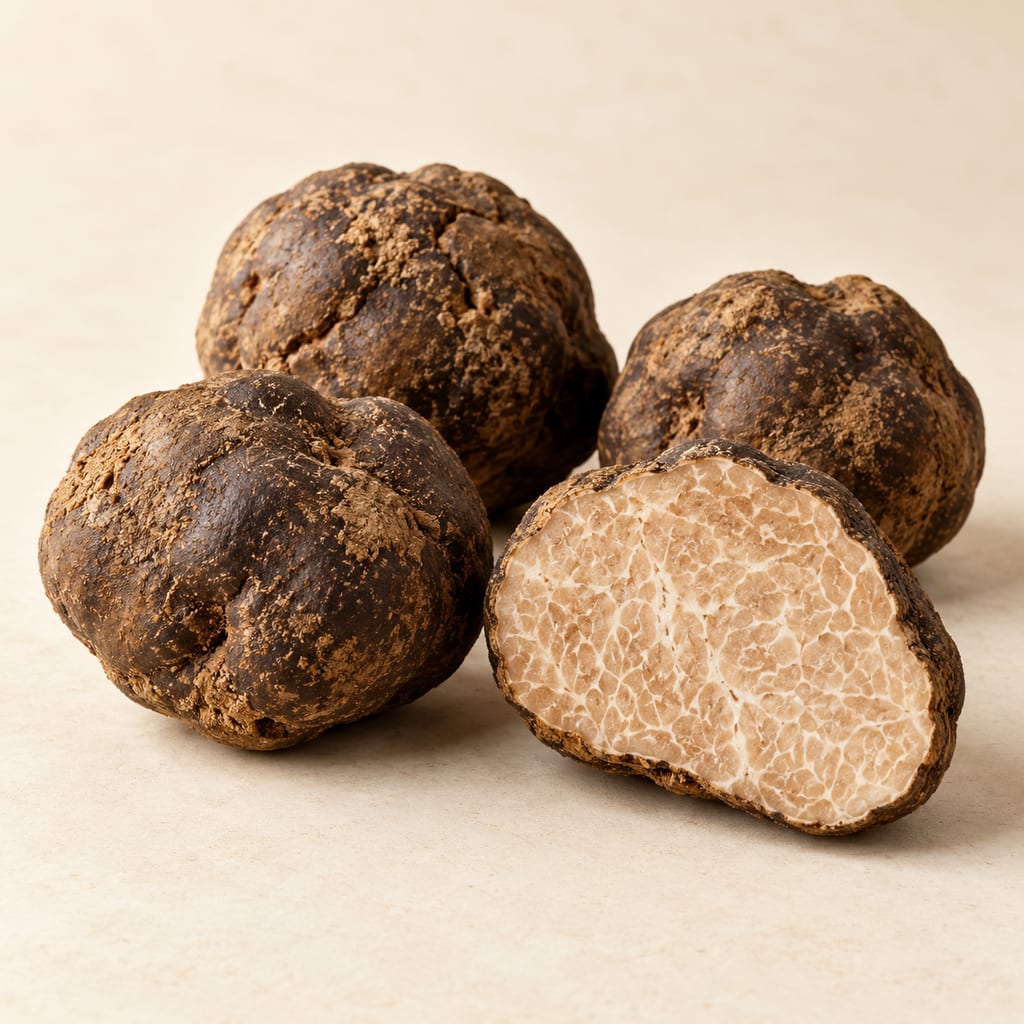
Brown desert truffle
The brown desert truffle, Terfezia boudieri, is an underground fungus of arid soils around the eastern Mediterranean and North Africa, gathered and sold in Turkey and eaten fried with eggs.
 FermenteaWhere food goes to change
Mushrooms
The black desert truffle, catalogued as Picoa juniperi, is a subterranean fungus gathered wild in arid and semi-arid lands. Eastern Anatolian households eat it, usually fried with eggs.
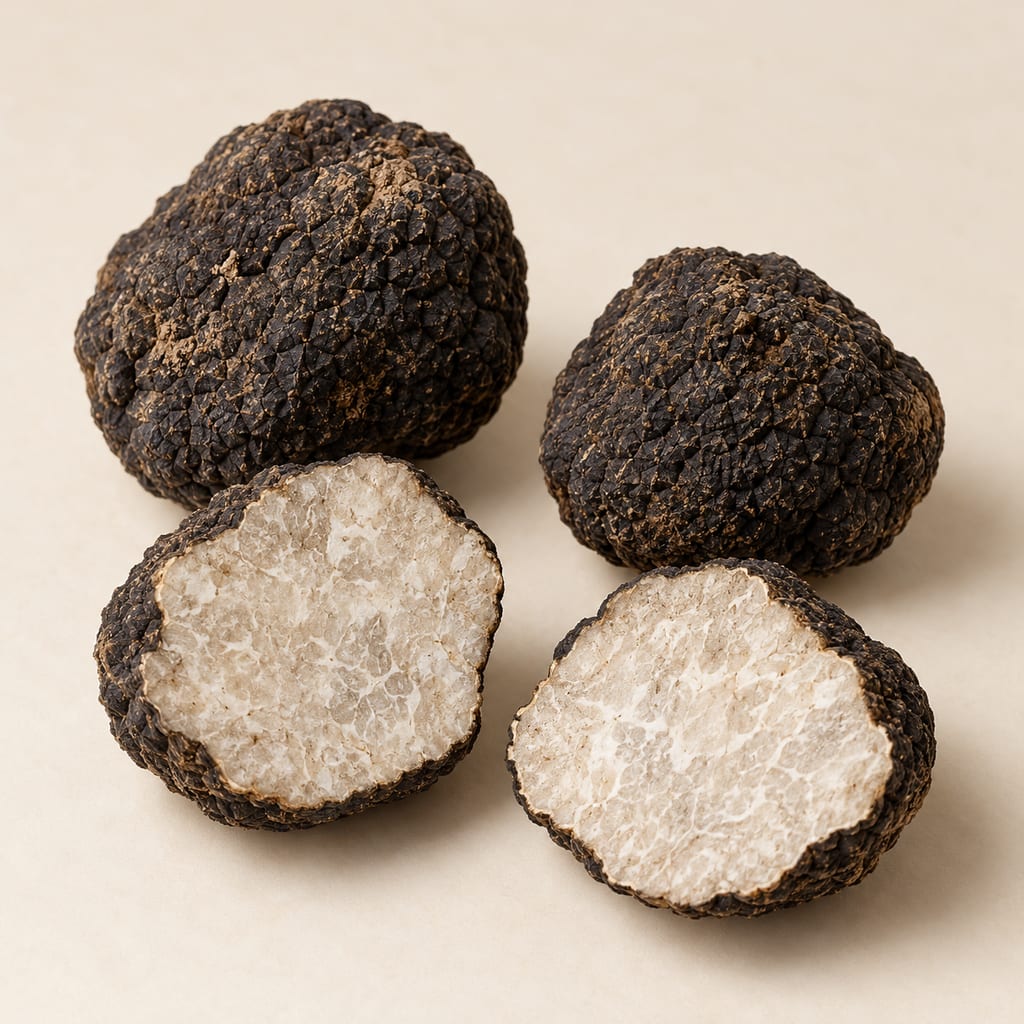
The black desert truffle is a subterranean fungus that forms a mycorrhizal partnership with plant roots in dry ground. Its fruiting body grows below the surface, so gatherers find it by searching the soil rather than by sighting it. The supplied catalogue names it Picoa juniperi and lists the common name black desert truffle.
The name Picoa has been through major taxonomic revision, and older records of desert truffles from the region do not always name a species. For that reason, the identity of a truffle recorded only as Picoa or Terfezia should be checked against the modern species concept before it is taken as Picoa juniperi.
A 2017 ethnomycological study of truffle gatherers in Eastern Anatolia documents the practice in detail. Its 230 interviewees gather desert truffles mainly for their food value and as a natural source of nutrition that brings satiety. Most of the truffles are eaten at home, and only one species, Terfezia boudieri, is preferred for sale, so the other species are gathered largely for the household.
Gatherers appear from early March to late April in unploughed, barren, sandy ground. They usually gather about two kilograms or less a day. The gatherers locate the truffles partly with the help of a plant they call kumi, which the study names but does not describe in detail.
The truffles are usually fried with eggs and that households often keep them in a refrigerator. It does not describe the cooking in more detail, and it gives no recipe, timing or temperature for it.
The abstract records that most respondents rate the edible quality of the truffles highly, but it gives no specific precautions, toxicity information or safety assessment. A favourable opinion of taste and nourishment is not a safety finding.
The supplied catalogue lists records for Turkey, Iran, Morocco and the wider Mediterranean region. Only the Turkish record has a documented food use in the sources read here. The Iranian and Moroccan entries do not describe how the truffles are eaten.
The main open question is the species identity behind the Turkish and wider records. A specimen-level check against a modern Picoa or Terfezia revision would settle which of these records concern Picoa juniperi.
The 2017 study interviewed 230 truffle gatherers in the Eastern Anatolia region of Turkey. The abstract names Picoa and Terfezia there; it does not state a species-level identity.
Listed as a regional record for Picoa juniperi in the supplied catalogue. The catalogue gives no use or preparation for Iran.
Listed as a regional record for Picoa juniperi in the supplied catalogue. The catalogue gives no use or preparation for Morocco.
The brown desert truffle, Terfezia boudieri, is an underground fungus of arid soils around the eastern Mediterranean and North Africa, gathered and sold in Turkey and eaten fried with eggs.
No community contributions have been published for this entry yet.
Sign in to contribute. Published comments and photos are free to read.
Gazi University Journal of ScienceFood use · Method · History
Ethnomycological Aspects of Traditional Usage and Indigenous Knowledge about the Arid-Semi Arid Truffles Consumed by the Residents of the Eastern Anatolia Region of TurkeyInterviews with 230 truffle gatherers in Eastern Anatolia, Turkey (2017)
Gatherers eat truffles mainly for nutrition; most are eaten at home; they are usually fried with eggs and often kept in refrigerators
Collection from early March to late April, in unplowed barren areas with sandy soil
The study names the genera Terfezia and Picoa; the abstract gives no safety warnings
Cited in: What it is; Gathering and household use in Eastern Anatolia; Preparation and storage; Regional records and open questions
MDPI (via supplied fungi catalogue)Distribution · Taxonomy
Supplied catalogue source for Picoa juniperi (desert truffles), MDPI Journal of FungiRegional records for Picoa juniperi in Turkey, Iran, Morocco and the Mediterranean region
Picoa has undergone major taxonomic revision, so historical regional records need species-level checks
Cited in: What it is; Regional records and open questions