Mycoclelandia bulundari
Mycoclelandia bulundari is a hypogeous desert fungus of northern and western Australia, recorded as a cooked food of Aboriginal people. Its identification and modern food safety are not established.
 FermenteaWhere food goes to change
Mushrooms
Calvatia lilacina is a lilac-tinted puffball with regional natural-history records and historical edible listings whose taxonomic and safety limits remain important.
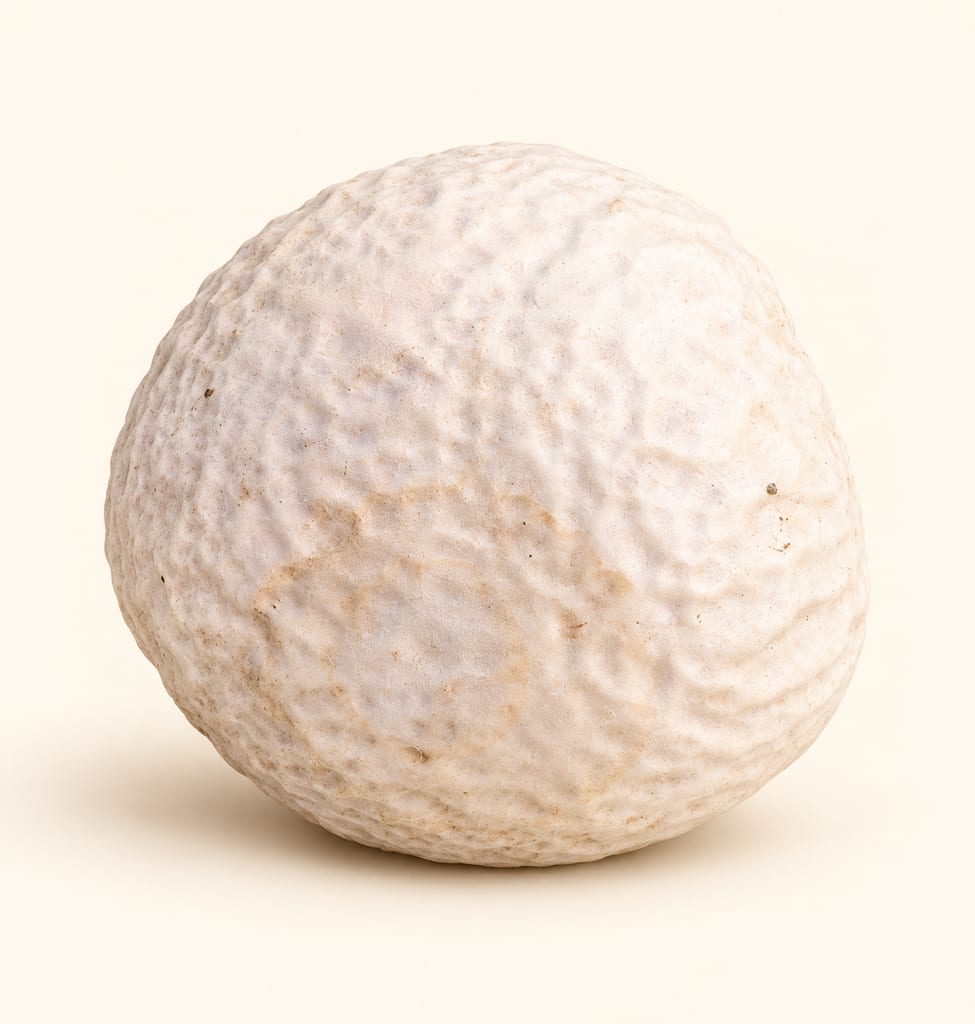
Index Fungorum accepts Calvatia lilacina (Mont. & Berk.) Henn., based on Bovista lilacina, published in 1845, with a type locality in Western Australia. Other historical combinations include Globaria lilacina and Lycoperdon lilacinum. Older authors have disagreed about synonymy with C. fragilis or C. cyathiformis. Modern morphology and molecular work distinguish lineages, but older edible lists cannot always be mapped confidently onto today's species concepts. Preserve the name a source used and treat historic country lists as name-level records, not proof of a present-day population under a strict modern concept.
This is a terrestrial puffball, usually rounded to pear-shaped and sometimes narrowed toward a sterile base. A Queensland Mycological Society account describes a pale fruit body with lilac tones that darkens toward brown or purplish-brown as spores mature. Regional accounts place it in soil among leaf litter, Bunya pine forest, pasture and parkland. These descriptions summarize recorded forms and habitat; they are not a field identification key. A pale, round immature mushroom cannot be declared safe from appearance alone.
The sources do not establish one global season. A Queensland specimen from Paradise Falls Track in Bunya Mountains National Park was collected on 28 March 2009, while a Hunter-Central Rivers guide assigns autumn to its regional account. A Hong Kong reference describes fruiting after rain in grassy lowlands, an observational note rather than a measured calendar. Research-grade community observations labelled C. lilacina include Taiwan records in May 2025 and August 2026 and New Zealand records in February and April 2025. They document dated reports under the platform's taxon concept; they do not prove a continuous fruiting window or resolve identifications. Western Australia is the nomenclatural type locality. FAO historical lists and a 2026 Chinese catalogue mention China/Hong Kong, but do not supply enough locality detail to map them as current range claims.
The FAO 2004 overview includes C. lilacina in an edible list and records edible or medicinal classifications in country annexes, including China and Hong Kong. FAO cautions that a source's edible classification is not always evidence of explicit consumption. A 2026 Chinese catalogue places the species in a food-and-medicinal checklist, but this is a literature catalogue, not a species-specific toxicology study or household survey. An older public-domain mushroom book also calls the lilac puffball edible, though its age and taxon concepts limit its value for present-day safety decisions.
A Hong Kong local reference recounts an anecdote of a Taiwanese person braising sliced specimens and cites literature that calls young fruit bodies edible. It also warns against eating wild mushrooms. This is an attributed anecdote, not a standardized recipe or proof of common Hong Kong practice. A separate medicinal market study of puffballs sold as Ma Bo is not culinary evidence; market names can cover several species and sampled material did not consistently match pharmacopoeial taxa. Keep food, medicinal and checklist evidence separate.
These sources document historical classifications and a limited attributed preparation anecdote, not a universal safe serving, processing method or expert identification criterion. Puffballs may be confused with immature stages of other mushrooms, including poisonous kinds. The reviewed material does not establish a specific exact poisonous mimic for C. lilacina, so none is claimed here. Poison-control guidance warns that cooking does not make poisonous mushrooms safe and that familiarity in one region may not transfer to another. Do not eat a wild specimen based on this page, a photograph, local name or checklist entry; this account offers neither a foraging key nor safety approval.
The nomenclatural type is reported from Western Australia; this is a type locality, not a claim of current abundance.
Field account specimen from Paradise Falls Track; one dated collection, not a seasonal range estimate.
Historical edible listing and local reference; identity concept and direct food use remain qualified.
Country-level checklist classifications only; do not infer a precise locality or current distribution from the entries.
Community observations under the iNaturalist taxon concept; not independently confirmed herbarium records.
Dated community observations; they show occurrence reports under platform identifications, not a complete range.
No community contributions have been published for this entry yet.
Sign in to contribute. Published comments and photos are free to read.
Index FungorumIdentity · Taxonomy
Calvatia lilacina — Names recordAccepted combination, basionym, author, year and type locality.
Cited in: Name and taxonomic limits; Season and mapped records
Persoonia / PubMed CentralTaxonomy
Fungal Planet description sheets: 785–867Historical disagreement over synonymy and modern morphological/molecular distinction among Calvatia lineages.
Cited in: Name and taxonomic limits
FAOHistory · Use · Geography
Wild edible fungi: a global overview — Annex 2 country recordsHistorical edible and medicinal classifications including China and Hong Kong; compiled source-based records rather than current verified range or safety assessment.
Cited in: Season and mapped records; What food listings establish; Attributed preparation and medicinal trade
FAOHistory · Use
Wild edible fungi: a global overview — Annex 3Lists Calvatia lilacina as edible and explains distinction between edible classification and explicit food use.
Cited in: What food listings establish
MycosystemaTaxonomy · Use · Geography
Updated list of edible and medicinal fungi in China2026 Chinese catalogue includes C. lilacina in food-and-medicinal checklist; not direct consumption study or toxicology assessment.
Cited in: Season and mapped records; What food listings establish
Queensland Mycological SocietyDescription · Ecology · Season · Geography
Calvatia lilacina field accountMorphology, habitats and a 28 March 2009 specimen at Paradise Falls Track, Bunya Mountains National Park.
Cited in: Form and habitat; Season and mapped records
Hunter-Central RiversDescription · Ecology · Season · Geography
A Guide to Common Fungi of the Hunter-Central Rivers RegionPasture and grassy habitat, autumn season and regional morphology account.
Cited in: Form and habitat; Season and mapped records
Hong Kong Chinese Wild WingTaxonomy · Use · Geography · Season · Safety
Calvatia lilacina — Hong Kong mushroom accountTaxonomic disagreement with C. cyathiformis, Hong Kong habitat notes and attributed Taiwanese braising anecdote; site discourages wild mushroom eating.
Cited in: Name and taxonomic limits; Season and mapped records; Attributed preparation and medicinal trade; Safety boundary
Poison ControlSafety
Wild mushroom warningWild mushrooms may be misidentified, regional expertise may not transfer, and cooking does not make poisonous mushrooms safe.
Cited in: Safety boundary
iNaturalistDescription · Season · Geography
Calvatia lilacina observation 394904640Community research-grade observation dated 2026-08-27 at Yuanchang, Yunlin County, Taiwan; not a herbarium confirmation.
Cited in: Season and mapped records
iNaturalistDescription · Season · Geography
Calvatia lilacina observation 302528779Community observation dated 2025-05-16 at Pingtung City, Taiwan; taxon concept is platform label.
Cited in: Season and mapped records
iNaturalistDescription · Season · Geography
Calvatia lilacina observation 284459039Community observation dated 2025-05-27 at Liugui District, Kaohsiung, Taiwan.
Cited in: Season and mapped records
iNaturalistDescription · Season · Geography
Calvatia lilacina observation 274198728Community observation dated 2025-04-26 at Mount Peel, Canterbury, New Zealand.
Cited in: Season and mapped records
iNaturalistDescription · Season · Geography
Calvatia lilacina observation 260354179Community observation dated 2025-02-02 at Blenheim, New Zealand.
Cited in: Season and mapped records
