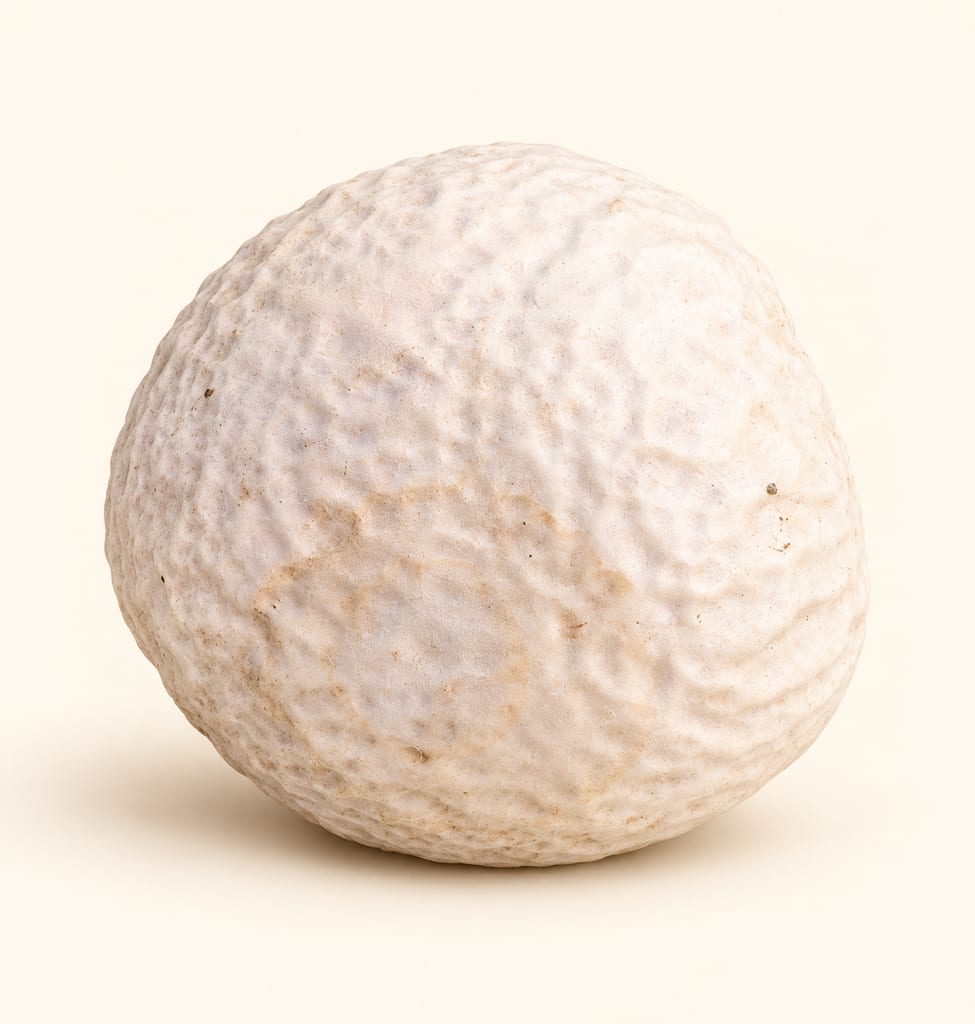
Lilac puffball
Calvatia lilacina is a lilac-tinted puffball with regional natural-history records and historical edible listings whose taxonomic and safety limits remain important.
 FermenteaWhere food goes to change
Mushrooms
Mycoclelandia bulundari is a hypogeous desert fungus of northern and western Australia, recorded as a cooked food of Aboriginal people. Its identification and modern food safety are not established.
Mycoclelandia bulundari is a hypogeous fungus, one that fruits underground, of Australia's desert regions. It grows to about 10 cm across. It is known from the Northern Territory and Western Australia. The catalogue calls it the Australian desert truffle. The English label is a modern one; the early records give no common name.
The fungus was cooked in hot sand and ashes before it was eaten. Its taste is described as a strong mushroom flavour. The catalogue records it as a documented Aboriginal cooked truffle-like food.
Its fluid was reportedly applied to sores and sore eyes as a medicine, and that it was rubbed into the armpits and into the hair. No further detail on these uses is given.
The records do not describe how the fungus was located or harvested. It places the species in desert areas but gives no habitat detail or fruiting season. The soil-cracking method that the same page describes belongs to a different truffle, Choiromyces aboriginum, and is not a method for this species.
The early European accounts are the main written record. Because few details were recorded, the identity of the fungus named in many reports is uncertain. The catalogue marks the record as historical and needing modern verification, and it notes limited modern food-safety evidence.
The source is the chapter by Arpad Kalotas in Fungi of Australia, Volume 1B, which notes that much Aboriginal fungal knowledge may have been lost or is still undocumented.
The catalogue records limited modern food-safety evidence for this species. The sources read here do not establish a safe preparation or a modern edibility verdict, and this page gives none.
Known from the Northern Territory according to the source; the record comes from early European accounts.
Known from Western Australia according to the source.
Calvatia lilacina is a lilac-tinted puffball with regional natural-history records and historical edible listings whose taxonomic and safety limits remain important.
No community contributions have been published for this entry yet.
Sign in to contribute. Published comments and photos are free to read.
Australian National Botanic GardensFood use · Identity · History · Caveats
Aboriginal use of fungi (Australian National Botanic Gardens, after Kalotas)Size about 10 cm; cooked in hot sand and ashes; strong mushroom flavour; medicinal and other recorded uses; known from the Northern Territory and Western Australia; caveats on early records and uncertain identification. Drawn from Arpad Kalotas, Fungi of Australia Volume 1B.