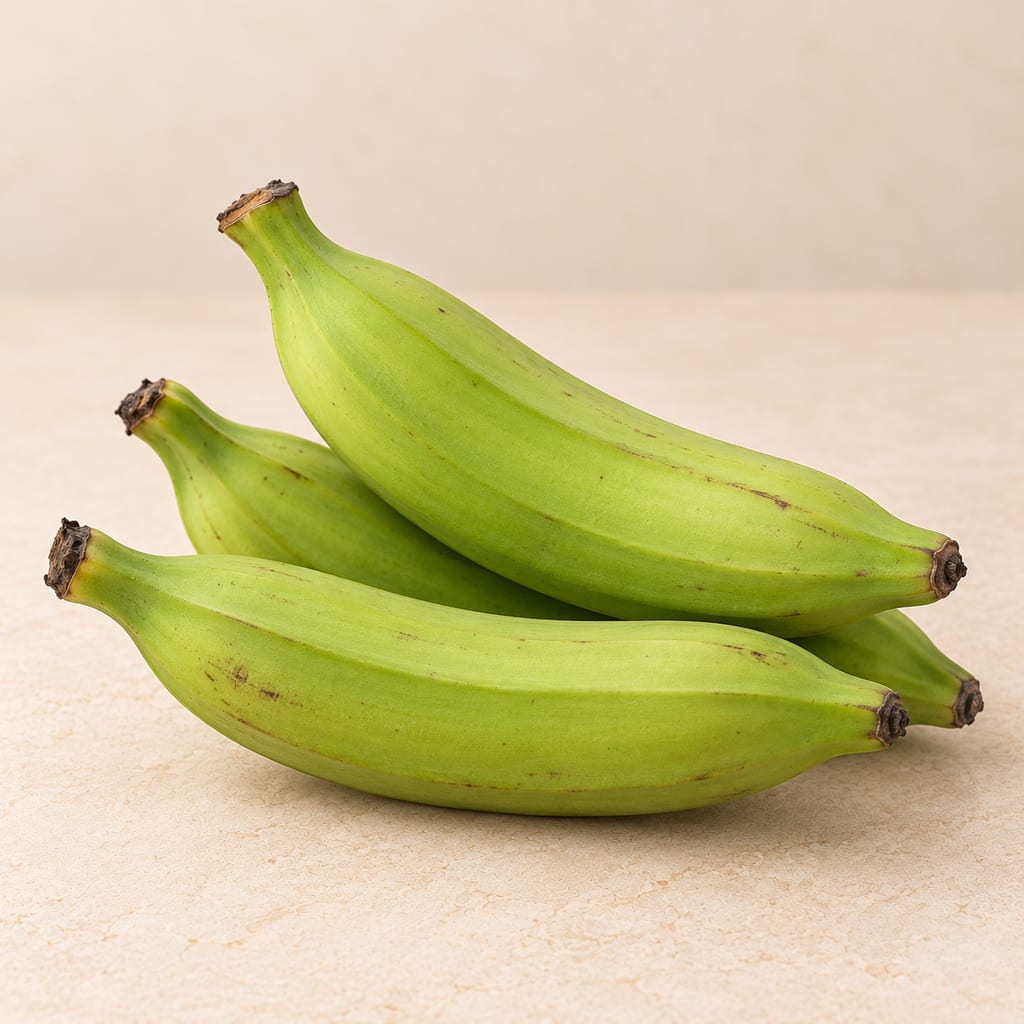
Plantain
Plantains are starchy cooking bananas used green through fully ripe. Their firmness and sweetness shift with maturity, and ripe mashed fruit appears in a University of Rhode Island Liberian rice-bread adaptation.
 FermenteaWhere food goes to change
Mushrooms
Cantharellus isabellinus, the African chanterelle, is a rainforest mycorrhizal fungus of tropical Africa that the catalogue lists in an edible-species inventory, with some regional records still needing confirmation.
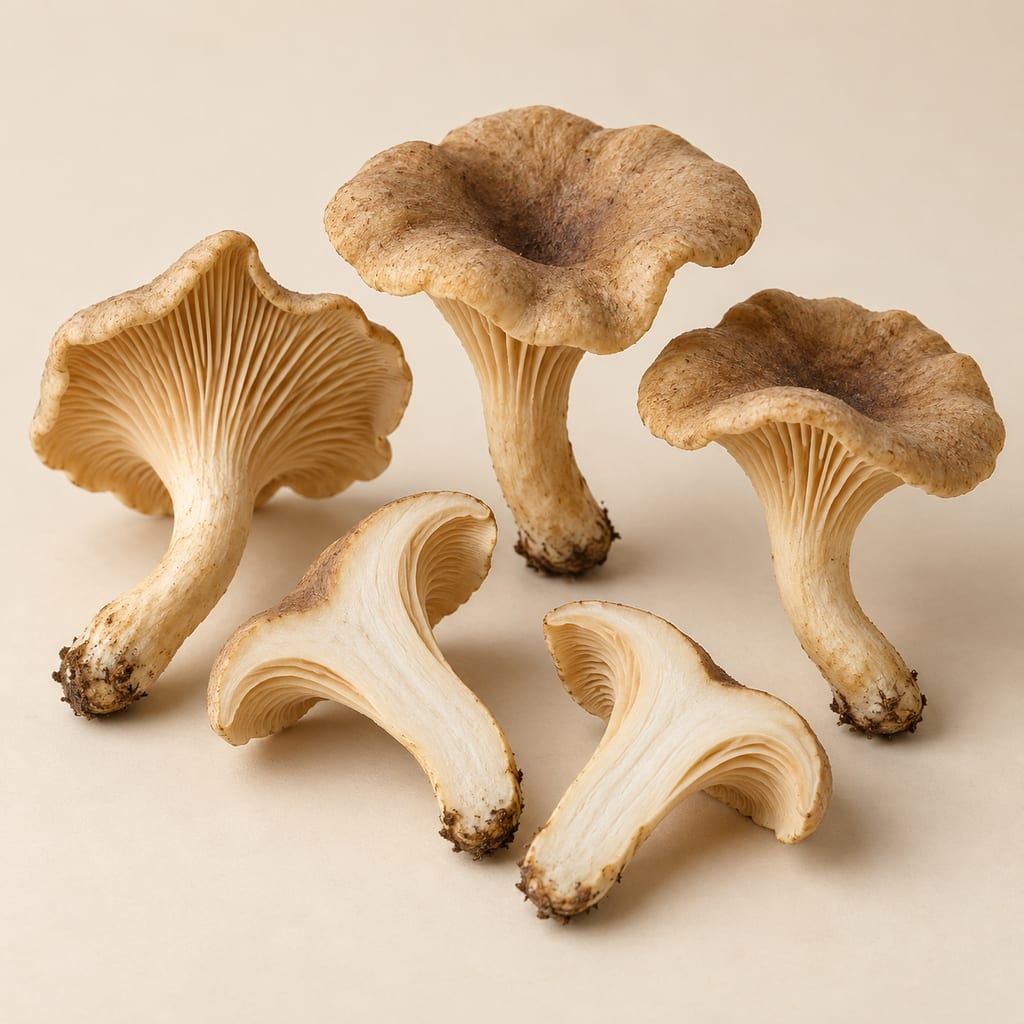
Cantharellus isabellinus, known as the African chanterelle, is a mushroom of the chanterelle genus that grows in dense, humid rainforest. It forms a mycorrhizal partnership with the tree Gilbertiodendron dewevrei, which the EFTA species page describes as its host in this habitat.
The cap is about 4 to 6 centimetres across, brownish dark green at the centre and paler toward the edge. The gills are ochre-pinkish and turn yellowish when wounded. The stem is tinged orange-brown. The spores are short ellipsoid, about 8 to 9 by 5.5 to 6 micrometres, and smooth. The odour is faint and fruity, and the taste is mild to slightly bitter.
EFTA lists the species from Benin, Cameroon, the Democratic Republic of the Congo and Tanzania. Its Benin and Tanzania records, under the host trees Berlinia grandiflora and Uapaca somon, are described by EFTA as still needing confirmation.
The catalogue lists the species as African chanterelle and records it in the edible-species inventory of EFTA. The EFTA species page itself does not state whether the fungus is edible or toxic, so the food status in the catalogue rests on the inventory listing and not on a stated safety assessment.
EFTA names Cantharellus tomentosoides as the only lookalike in dense rainforest. That species has more widely spaced gills and smaller spores. EFTA describes the species as macroscopically well characterised; the spore measurements are given alongside the external features.
This record is not a guide to identifying wild fungi. Identify any specimen with an expert before eating it.
The catalogue records a food status for the species from an inventory listing. The sources read do not give a preparation method, a toxicology result or a quantity, and no safe preparation is established here. Confirm the identity of any collection with a specialist before using it as food.
Region-level distribution from EFTA. The catalogue's food listing is a species inventory entry and does not give a local preparation. Benin and Tanzania records need confirmation according to EFTA.
Plantains are starchy cooking bananas used green through fully ripe. Their firmness and sweetness shift with maturity, and ripe mashed fruit appears in a University of Rhode Island Liberian rice-bread adaptation.
No community contributions have been published for this entry yet.
Sign in to contribute. Published comments and photos are free to read.
EFTA (Ectomycorrhizal Fungi of Tropical Africa)Identity · Food · Ecology · Identification
Cantharellus isabellinusDistribution: Benin, Cameroon, DR Congo, Tanzania; ectomycorrhizal with Gilbertiodendron dewevrei in dense humid forest; faint fruity odour, mild to slightly bitter taste; Benin and Tanzania records under Berlinia grandiflora and Uapaca somon still to be confirmed; lookalike Cantharellus tomentosoides with less widely spaced gills and smaller spores
Cited in: What it is; Distribution and records; Lookalikes and identification; Safety