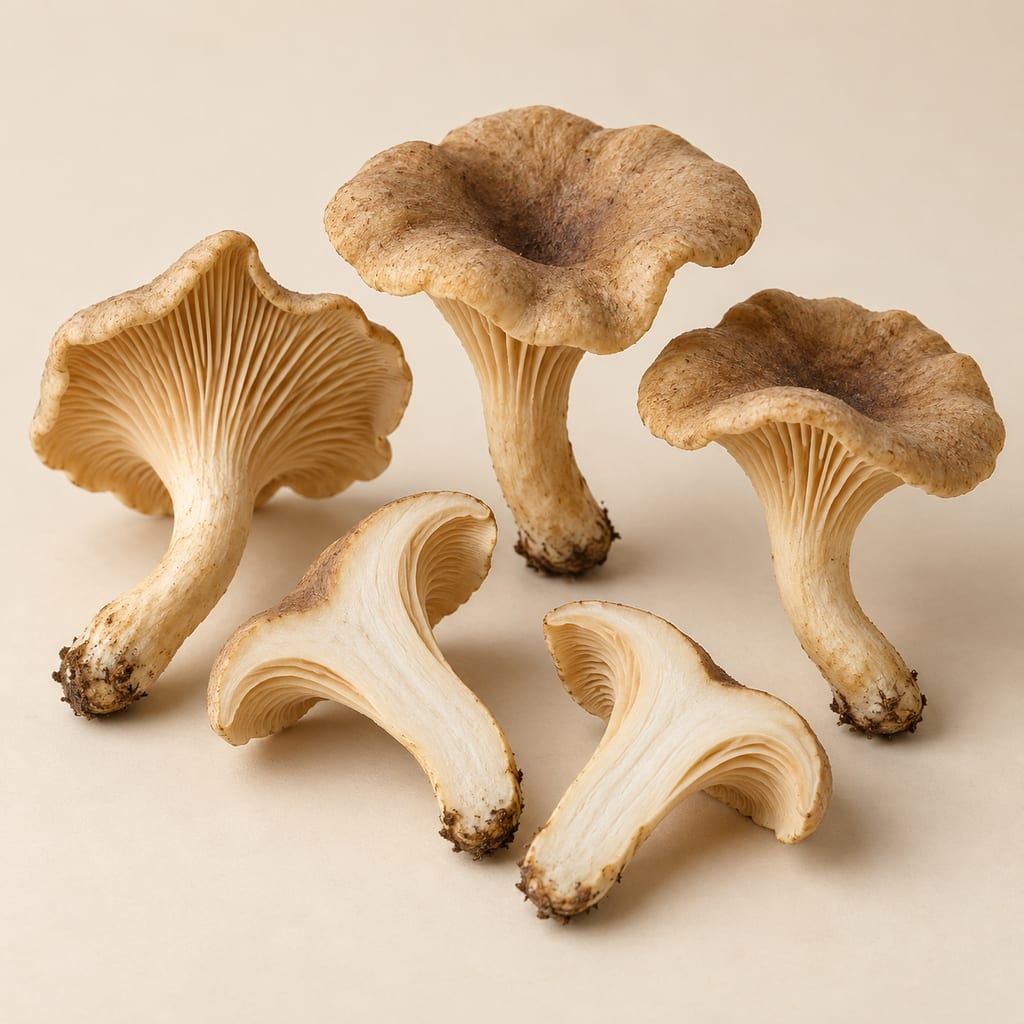
Cantharellus isabellinus
Cantharellus isabellinus, the African chanterelle, is a rainforest mycorrhizal fungus of tropical Africa that the catalogue lists in an edible-species inventory, with some regional records still needing confirmation.
 FermenteaWhere food goes to change
Substrates
Plantains are starchy cooking bananas used green through fully ripe. Their firmness and sweetness shift with maturity, and ripe mashed fruit appears in a University of Rhode Island Liberian rice-bread adaptation.
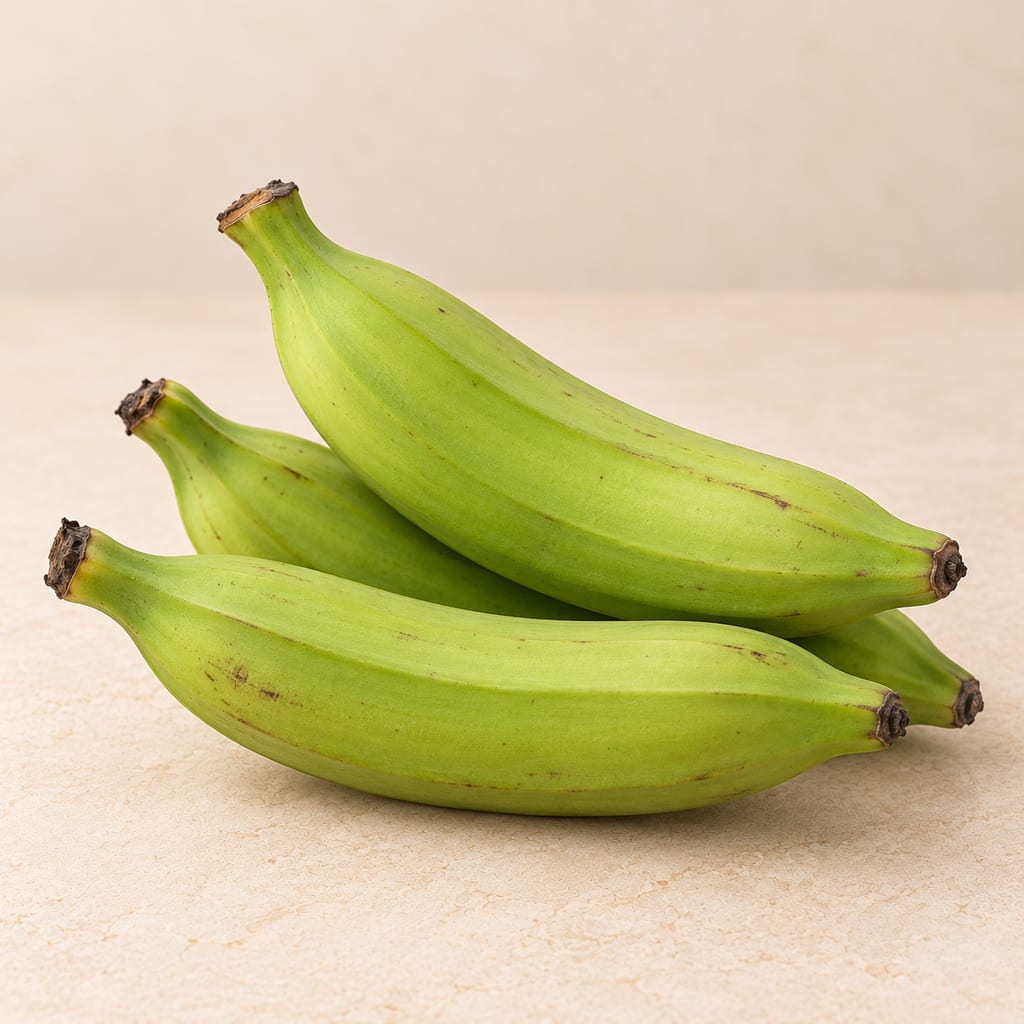
Plantain is a culinary name for starchy cooking bananas in the genus Musa. It describes a food role more reliably than one botanical species: common names cover cultivars with different ancestry. Kew accepts Musa × paradisiaca as a hybrid of M. acuminata and M. balbisiana, but that accepted taxon does not make every plantain one uniform cultivar. The USDA describes plantain as a member of the banana family generally cooked to become palatable, and notes its use from mature and hard through soft yellow and fully ripe dark stages.
The dessert-banana distinction is practical, not a separate genus. FAO describes sweet AAA bananas as low in starch and high in sugar when ripe, while the plantain subgroup is predominantly AAB and remains starchy even when ripe. Other cooking bananas occur in ABB groups, and the line varies by cultivar and local food practice. Green fruit is firm; ripening softens the pulp and can increase sweetness. A study of selected hybrids measured declining starch and dry matter during ripening, but those results are specific to the named varieties.
Musa has a long history of human selection and movement, but the path of plantain cultivars is unsettled. A 2022 review in the American Journal of Botany discusses evidence for domestication and selection in Island Southeast Asia and New Guinea, followed by dispersal into Africa. It notes phytolith finds at Nkang in Cameroon and argues that AAB plantains similar to forms now grown in Central and West Africa may have reached the continent more than two millennia ago. Archaeological, genetic, linguistic and historical evidence inform this reconstruction; the source does not establish a single route or birthplace.
FAO documents plantain as an important cooked staple across parts of tropical Africa, including Ghana and Uganda, and gives examples from Cameroon. Plantains and other cooking bananas are also grown and used in tropical America and Asia. Older production tables describe their period rather than current rankings. Present distribution cannot determine where a particular cultivar began.
Plantain is boiled or steamed, baked or roasted, fried, pounded after cooking, dried and milled into flour. FAO describes cooked green pulp pounded into dough, plantain flour mixed with boiling water, fried ripe or unripe slices, and regional dishes combined with cassava, maize dough, vegetables, meat or fish. In Ghana, its account describes ripe plantain mixed with fermented wholemeal maize dough for fatale. These are regional examples rather than one universal method.
The University of Rhode Island published an educational Liberian Rice Bread adaptation in 2022. It lists one very ripe peeled and mashed plantain and, separately, two very ripe peeled and mashed bananas, combined with wet ingredients before flour, spices and leaveners. This is a contemporary adaptation, not proof of a historic or canonical formula. The ripe pulp can be read as a soft fruit component in the batter; the source does not measure its individual effect on texture.
For this bread, select fruit soft enough to mash; for intact cooked pieces, choose a firmer stage and follow a preparation that names it. UC Davis postharvest guidance gives commercial maturity cues and commercial storage conditions, not a household shelf-life rule. Its cold-storage cautions should not be converted into a home recommendation without domestic guidance. Wash fruit under running water before peeling or cutting, dry it, remove damaged areas and keep hands, tools and work surfaces clean. FDA advises against soap or commercial produce wash. Cooking is common for plantain, but neither smell nor appearance proves safety. The sources reviewed establish no plantain-specific allergen or exact home-storage limit; this is a limit of the evidence, not a claim that no person can react.
FAO describes plantain as a cooked staple in many West African forest regions; this is not an origin claim.
Cameroonian post-harvest research documents plantain uses. Archaeology discussed in the review does not prove a single domestication route.
FAO documents cooked plantain as a staple and names Ghanaian preparations; use is not assumed uniform nationwide.
FAO documents cooked bananas and plantains in Ugandan foodways; some examples concern cooking bananas broadly.
A University of Rhode Island educational adaptation labelled Liberian rice bread uses mashed very ripe plantain with two separately named bananas; not a universal or historical formula.
Cantharellus isabellinus, the African chanterelle, is a rainforest mycorrhizal fungus of tropical Africa that the catalogue lists in an edible-species inventory, with some regional records still needing confirmation.
No community contributions have been published for this entry yet.
Sign in to contribute. Published comments and photos are free to read.
Plants of the World Online, Royal Botanic Gardens, KewTaxonomy
Musa × paradisiaca L.Accepted hybrid M. acuminata × M. balbisiana, native range Malesia; does not mean every culinary plantain is a single cultivar.
Cited in: Identity and ripeness
USDA Agricultural Marketing ServiceIdentity · Selection
Plantain Inspection InstructionsPlantain as a banana-family cooking fruit and its mature-hard, soft-yellow and fully ripe dark stages.
Cited in: Identity and ripeness
American Journal of BotanyHistory · Geography
Looking beyond history: tracing the dispersal of the Malaysian complex of crops to AfricaMusa dispersal into Africa remains uncertain; review discusses phytolith evidence in Cameroon and a possible AAB plantain presence more than two millennia ago.
Cited in: History and geography
FAOClassification · Uses · Geography
Traditional post-harvest technology of perishable tropical staples: Bananas and plantainsAAB plantain subgroup remains starchy at ripeness; FAO describes regional cooking methods and examples.
Cited in: Identity and ripeness; History and geography; Cooking, bread and handling
FAO Post-harvest Compendium; Centre de Recherches Regionales sur Bananiers et Plantains, CameroonUses · Geography
Plantain: Post-harvest OperationsCameroonian source documents plantain food products and use in producing countries.
Cited in: History and geography; Cooking, bread and handling
UC Davis Postharvest Research and Extension CenterSelection · Postharvest
PlantainCommercial maturity cues, quality indices, storage parameters and chilling injury; household storage conditions not established.
Cited in: Cooking, bread and handling
University of Rhode Island Community Nutrition Security Research GroupDocumented use · Bread
Liberian Rice Bread2022 educational adaptation uses very ripe mashed plantain and separately two very ripe mashed bananas in one loaf.
Cited in: Cooking, bread and handling
U.S. Food and Drug AdministrationFood safety
7 Tips for Cleaning Fruits, VegetablesRinse produce before peeling or cutting under plain running water; do not use soap or produce wash; remove damaged areas.
Cited in: Cooking, bread and handling
Journal of the Science of Food and AgricultureRipening
Biochemical changes in new plantain and cooking banana hybrids at various stages of ripeningStarch and dry matter fell as ripening progressed in the hybrids studied; findings are cultivar-specific.
Cited in: Identity and ripeness