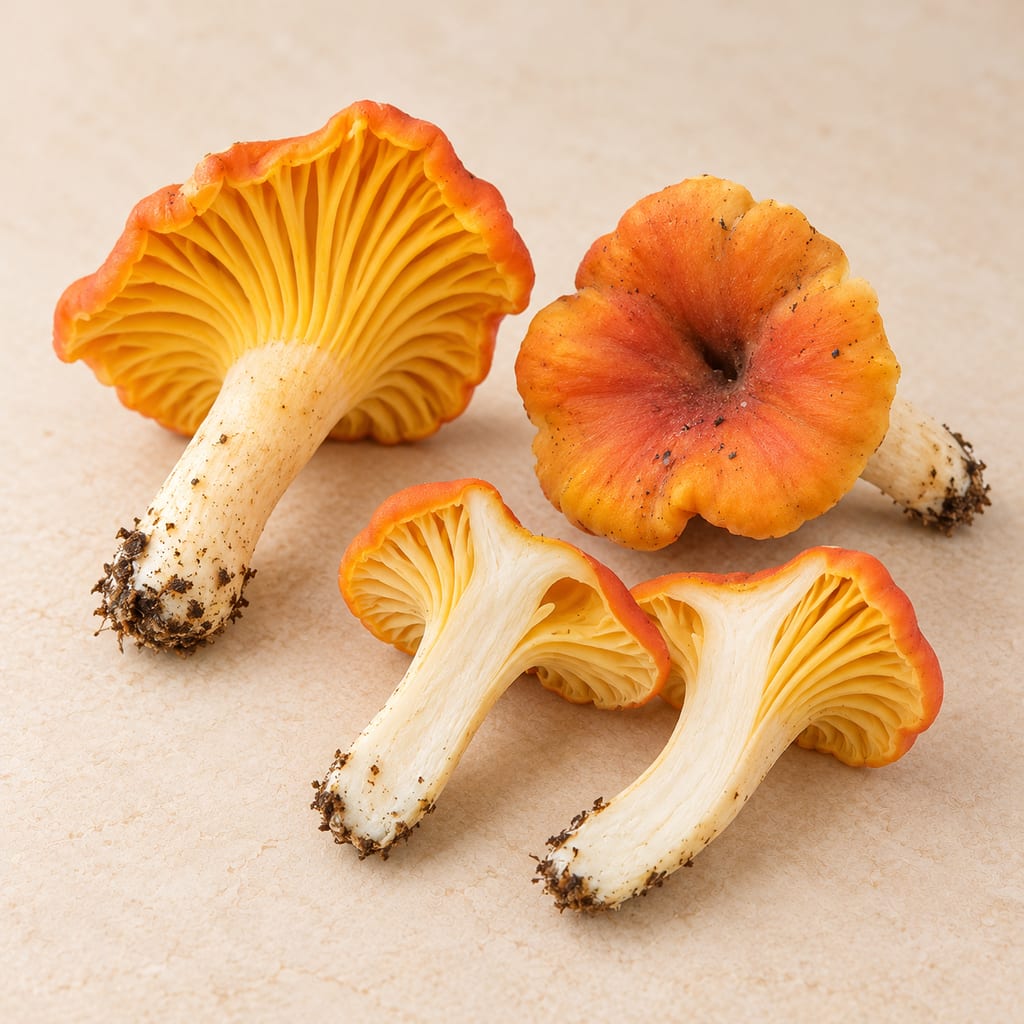
Cantharellus platyphyllus
Cantharellus platyphyllus is a red-to-orange chanterelle of tropical African woodland, gathered and sold locally in several countries. Its edibility rests on local use and literature, not a species-level safety study.
 FermenteaWhere food goes to change
Substrates
A miombo-woodland chanterelle described from Tanzania and called Wipatwe in the Southern Highlands. Food classifications conflict, including within a 2015 community study.
Cantharellus tomentosus Eyssart. & Buyck was described from Tanzania's Morogoro district. Taxonomic sources continue to use the name, and later molecular work lists sequenced Tanzanian vouchers under it. The species account describes a small chanterelle with a depressed, funnel-like cap, dense brown to olive-brown woolly surface, pale decurrent folds and a pale stem; the cap margin may be lobed. These details are a source-based description, not a field identification key. Other chanterelles can be difficult to distinguish, and local names do not by themselves confirm a scientific identification. [Meise Botanic Garden, Edible Fungi of Tropical Africa](https://www.efta-online.org/esp%C3%A8ces-species/cantharellus-tomentosus/); [Buyck, Eyssartier & Kivaisi 2000](https://doi.org/10.1127/nova/71/2000/491); [Tibuhwa et al. 2012](https://pmc.ncbi.nlm.nih.gov/articles/PMC3399100/).
The documented range is sparse. The species was described from miombo woodland in Morogoro District, Tanzania. Museum records identify a holotype collected on 30 April 1998 and a paratype collected on 28 April 1998 from a hill slope near a university campus at 350–400 m; a later study identifies another voucher from Morogoro's SUA Forest. A 2015 field study in Iringa and Njombe, in Tanzania's Southern Highlands, collected mushrooms in January 2014 and includes C. tomentosus in its species account. These are collection observations, not a measured fruiting season. The available evidence spans January and late April at different sites and years; it does not support a reliable seasonal calendar. A published coordinate for the SUA Forest specimen is malformed (37°67′29″ E), so no point coordinate is carried over. [MNHN holotype record](https://science.mnhn.fr/institution/mnhn/collection/pc/item/pc0084732); [MNHN paratype record](https://science.mnhn.fr/institution/mnhn/collection/pc/item/pc0084121); [Tibuhwa 2014](https://www.scirp.org/journal/PaperDownload.aspx?paperID=42185); [Chelela, Chacha & Matemu 2015](https://doi.org/10.5943/cream/5/4/2).
Tanzanian sources report the chanterelle as food, but the evidence is mixed. A 2018 Tanzanian market-focused study includes a C. tomentosus voucher in its table of edible mushrooms. A 2023 review cited by the Global Fungal Red List likewise describes it as thought edible. The 2015 study of Iringa and Njombe contains an internal mismatch: its results narrative includes Wipatwe among locally edible mushrooms, while Table 1 marks C. tomentosus as folk-inedible and scientifically edible. The IUCN assessment summarizes that some local communities may consider it inedible. The disagreement is part of the record; a checklist label is not a consensus food practice or proof that an unidentified specimen is safe. [Tibuhwa 2018](https://scialert.net/abstract/?doi=rjf.2018.1.14); [Chelela, Chacha & Matemu 2015](https://doi.org/10.5943/cream/5/4/2); [Global Fungal Red List assessment](https://redlist.info/iucn/species_view/474510/).
Research on Tanzanian chanterelles describes fresh and sun-dried forms at genus level, and one study analyzed fresh and dried C. tomentosus fruitbodies for laboratory antioxidant measurements. Those experiments do not establish a home preparation, dose, health benefit, or safe preservation procedure for this species. No species-specific recipe or validated handling guidance was found. Because local edibility judgments conflict and identification requires more than a vernacular name or colour description, this account makes no recommendation to collect or eat wild material. The IUCN assessment lists miombo woodland loss from agriculture and charcoal-related logging as a threat; it assesses the species as Least Concern but notes that the documented range remains poorly known. [Tibuhwa 2014](https://doi.org/10.4236/fns.2014.52026); [Global Fungal Red List assessment](https://redlist.info/iucn/species_view/474510/).
Country-level record only; it does not imply continuous occurrence or uniform food use.
The type label says a hill slope near a university campus; a later study names SUA Forest. A published SUA Forest coordinate has invalid minutes, so no specimen point is shown.
The study reports the local name Wipatwe and includes C. tomentosus in its Southern Highlands species account. Its narrative and table conflict about folk edibility; the table's scientific classification is edible. This row is an attestation of the study area, not a local preparation recommendation.
Cantharellus platyphyllus is a red-to-orange chanterelle of tropical African woodland, gathered and sold locally in several countries. Its edibility rests on local use and literature, not a species-level safety study.
No community contributions have been published for this entry yet.
Sign in to contribute. Published comments and photos are free to read.
Nova HedwigiaIdentity · Taxonomy · Locality
Addition to the inventory of the genus Cantharellus (Basidiomycota, Cantharellaceae) in TanzaniaDescribes C. tomentosus as a new species from Tanzania; cited by museum type records and later assessment.
Cited in: Name, form and habitat
Muséum national d’Histoire naturelle, ParisIdentity · Locality · Season
Holotype: Cantharellus tomentosus, MNHN-PC-PC0084732Type label: Morogoro, hill slope near university campus; collected 30 April 1998 at 350–400 m.
Cited in: Range and observed season
Muséum national d’Histoire naturelle, ParisIdentity · Locality · Season
Paratype: Cantharellus tomentosus, MNHN-PC-PC0084121Type label: Morogoro, hill slope near university campus; collected 28 April 1998 at 350–400 m.
Cited in: Range and observed season
Food and Nutrition SciencesEcology · Locality · Season · Image · Laboratory analysis
A Comparative Study of Antioxidant Activities between Fresh and Dry Mushrooms in the Genera Cantharellus and Afrocantharellus from TanzaniaTable 1 lists C. tomentosus voucher DDT68 from Morogoro, SUA Forest, 2007; the published longitude has invalid minutes and is not reused. Figure 2 panel G is an author photograph identified as C. tomentosus. Study analyzes fruitbodies in fresh and dried states; not a preparation guide.
Cited in: Range and observed season; Use, handling and safety limits
Current Research in Environmental & Applied MycologyFood history · Local name · Season · Image · Safety limit
Wild Mushrooms from Tanzania: Characterization and their Importance to the Rural CommunitiesReports the Southern Highlands study was conducted in Iringa and Njombe in January 2014; its results narrative lists Wipatwe among locally edible species, while Table 1 gives conflicting folk-inedible versus taxonomic-edible classifications; Figure 1 panels A–B identified as C. tomentosus.
Cited in: Range and observed season; Food record and disagreement
Research Journal of ForestryFood use · Market context
Edible and Medicinal Mushrooms Sold at Traditional Markets in TanzaniaLists C. tomentosus voucher Tibuhwa 1069.2007 (UPS, DSM) in the edible checklist; the species entry does not pinpoint a specific market or place of sale.
Cited in: Food record and disagreement
Global Fungal Red List Initiative / IUCN Red List assessment mirrorTaxonomy · Range · Habitat · Food use · Conservation
Cantharellus tomentosusAccepted name and Least Concern assessment; Morogoro origin, Southern Highlands name Wipatwe, miombo woodland ecology, uncertain range, edible but some local communities may consider it inedible, and habitat-loss threats.
Cited in: Food record and disagreement; Use, handling and safety limits
Meise Botanic Garden, Edible Fungi of Tropical AfricaIdentity · Morphology · Ecology · Image leads
Cantharellus tomentosusDetailed macroscopic and microscopic description, ectomycorrhizal association with Brachystegia spiciformis in miombo, known distribution; page hosts a multi-image gallery without an explicit open image license.
Cited in: Name, form and habitat
MycologiaTaxonomy · Identity · Locality
Afrocantharellus gen. stat. nov. is part of a rich diversity of African CantharellaceaeLists two C. tomentosus Tanzanian vouchers and molecular sequence accessions; the Morogoro voucher locality is district-level in that table.
Cited in: Name, form and habitat