Cantharellus tomentosus
A miombo-woodland chanterelle described from Tanzania and called Wipatwe in the Southern Highlands. Food classifications conflict, including within a 2015 community study.
 FermenteaWhere food goes to change
Mushrooms
Cantharellus platyphyllus is a red-to-orange chanterelle of tropical African woodland, gathered and sold locally in several countries. Its edibility rests on local use and literature, not a species-level safety study.
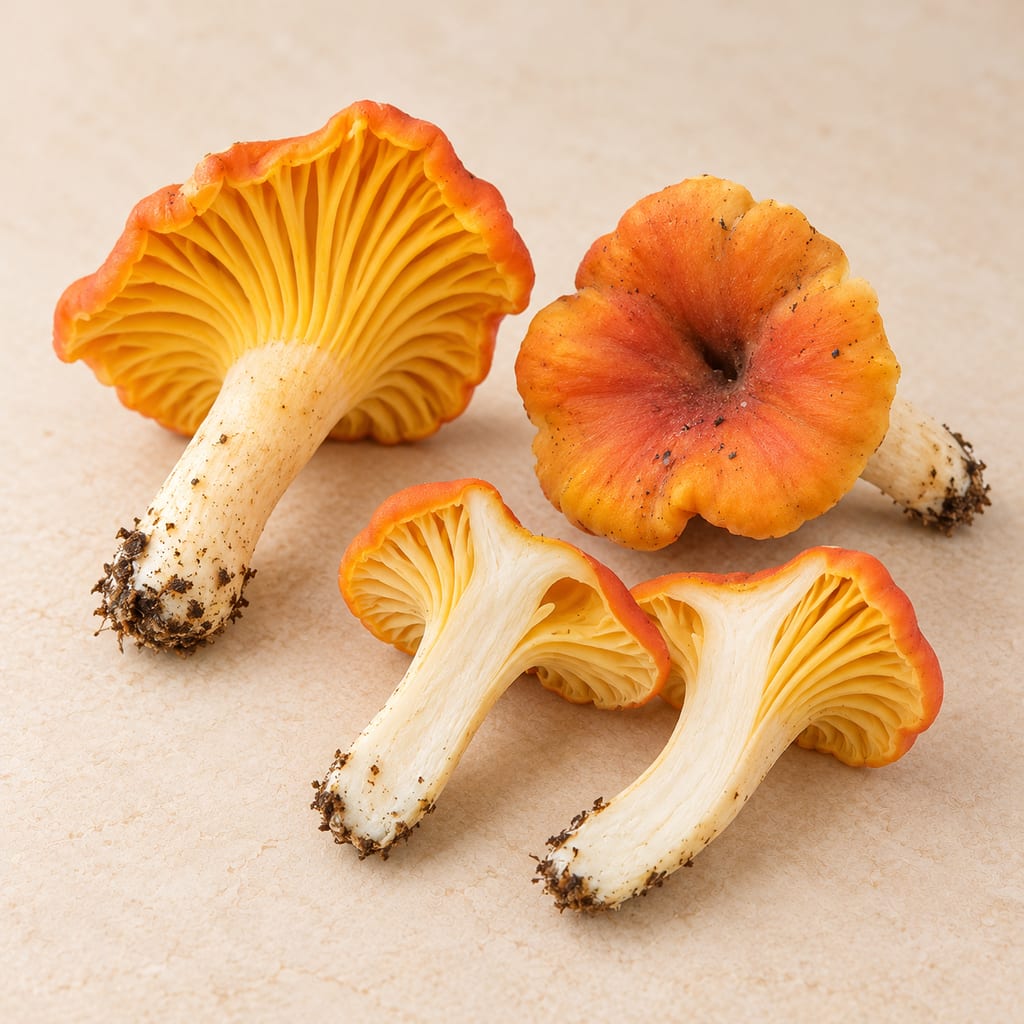
Cantharellus platyphyllus is a chanterelle of tropical African woodland. Its red to orange cap and broad, widely spaced yellow folds are useful group characters in the field. They are not a field-safe identification: other African chanterelles vary in colour and fold shape, and this species is hard to separate from C. symoensii without microscopic spore characters.
The fungus lives in association with woodland trees, mostly in the miombo woodland of southern-central Africa and in gallery or transition forest toward open woodland. It is an ectomycorrhizal species, so its fruiting bodies depend on the trees it partners with and on the rains.
The species was described by Heinemann in 1966. A 2012 molecular study placed the African chanterelles in a separate genus, Afrocantharellus, and made the combination Afrocantharellus platyphyllus. The current EFTA account for tropical Africa treats that group as a subgenus again and uses Cantharellus platyphyllus, which is the name used here. Afrocantharellus platyphyllus is kept only as a former combination.
Names that need care include Cantharellus cyanescens and C. platyphyllus subsp. bojeriensis. EFTA lists these as synonyms or forms. The 2012 paper keeps the blue-tinged cyanescens form as a separate form within the species. A historical record under one of these names is not an independent species record until the underlying specimen or determination is checked.
Country-level records include the Democratic Republic of the Congo, Burundi, Tanzania and Benin, with secondary records in Cote d'Ivoire, Cameroon, Nigeria and Madagascar. EFTA's wider known range also includes Gabon, Mozambique, Togo, Zambia and Zimbabwe. These are literature and checklist records, not abundance estimates, and older reports are sometimes filed under synonyms or misapplied names.
More precise records exist. The type collection was made at Elisabethville, now Lubumbashi, in 1932. The 2012 paper lists Tanzanian specimens from Kisarawe in the Coast region and Madibira forest in Iringa region, with coordinates, and from the SUA forest reserve in Morogoro region, where the published longitude is invalid. The map in this entry uses only the coordinates the source supplies.
Visible fruiting bodies are seasonal and depend on rainfall. Tropical African sources place chanterelle fruiting and collection in the rainy season. A Haut-Katanga synthesis reports that chanterelle production peaks from January to April, and it names C. platyphyllus among the heavily eaten and sold species. The timing differs by locality and by forest type, so the defensible statement is rainy-season fruiting, with timing that varies by locality.
The best quantified productivity evidence pools C. platyphyllus with C. symoensii, so it cannot be read as a figure for this species alone.
Local communities in parts of tropical Africa collect and eat this chanterelle, and it is sold in local markets. The 2017 Haut-Katanga guide describes it as an edible, traded chanterelle of miombo woodland. A 2016 study from Burundi and Rwanda reports chanterelles as an important food and market group in the rainy season, though it discusses several taxa together. A 2023 report from Mozambique describes local harvest and sale of the species under the Lomwe name Eyukuli.
The sources read do not record a traditional recipe, a preparation method, or a cooking practice specific to this species. The food use is documented as harvesting, eating and selling, not as a set of recipes.
The food-use evidence supports documenting how the species is eaten locally. It does not establish that the species is safe for every person or every specimen, it does not establish a preparation rule, and it does not rule out confusion with other fungi. The supplied index classifies the historical edible claims and checklist entries as not independently assessed.
Do not identify or eat a wild chanterelle from a photograph or from this page. Identification of African chanterelles depends on spore characters, and a specialist should confirm any specimen before it is eaten.
No species-specific toxicology study was found in the sources read, and no market volume for this species alone is recorded. The next checks are the primary publications behind the food-use claims, the name used for the species in each local market, and reference photographs whose reuse rights have been cleared.
The type collection is recorded from Elisabethville, now Lubumbashi, in 1932. No coordinates are given for it in the source read.
Specimen locality from a molecular taxonomic paper, given as 06 deg 04 min 32 s S, 039 deg 15 min 48 s E. It is a specimen record, not evidence of local food use.
Specimen locality from the same molecular paper, given as 08 deg 15 min 08 s S, 35 deg 17 min 21 s E.
A specimen locality. The published longitude is invalid as written, so no coordinate is given.
Haut-Katanga food and trade use, and miombo habitat. The 2020 productivity study sites near Kinsangwe are not mapped as species observations.
Country-level. The 2016 study groups several chanterelles together, so its food and market claim is not specific to this species.
Country-level. The regional study groups several chanterelles together; the claim is not specific to this species.
Journalistic reporting of local harvest and sale under the Lomwe name Eyukuli. It is context, not a taxonomic authority.
A herbarium specimen determined as C. platyphyllus. It is a specimen record, not evidence of food use.
Country-level checklist records include Benin, Burundi, the Democratic Republic of the Congo and Tanzania, with secondary records in Cote d'Ivoire, Cameroon, Nigeria and Madagascar. These are literature records, not abundance estimates.
No community contributions have been published for this entry yet.
Sign in to contribute. Published comments and photos are free to read.
EFTA (Fungi of tropical Africa)Identity · Distribution · History
Cantharellus platyphyllusName used as working name, Cantharellus platyphyllus Heinem. (1966).
Afrocantharellus is a subgenus again in the current treatment.
Country-level records include Benin, Burundi, DR Congo, Tanzania; secondary records in Cote d'Ivoire, Cameroon, Madagascar and Nigeria; known wider distribution includes Gabon, Mozambique, Togo, Zambia and Zimbabwe.
West African records are comparatively rare.
Cited in: A red chanterelle of African woodland; Name and classification; Where it is recorded; Safety and identification; Open questions
IMA FungusIdentity · Method · Distribution
Afrocantharellus gen. stat. nov. is part of a rich diversity of African CantharellaceaeThe 2012 molecular study erected Afrocantharellus at genus rank and made the combination Afrocantharellus platyphyllus.
Type collection from Elisabethville (now Lubumbashi), DR Congo, 1932.
Tanzanian specimens at Kisarawe, SUA forest reserve (coordinate invalid as published), Madibira forest and Vigama.
The blue-tinged cyanescens form is treated separately within the species and recorded from Burundi and Tanzania.
Cited in: Name and classification; Where it is recorded
Biotechnologie, Agronomie, Societe et EnvironnementEcology · Season · Production
Edible mushrooms, a vulnerable ecosystem service from African miombo woodlandsMiombo productivity study at Mikembo sanctuary near Kinsangwe, southern DRC, and at Gisagara and Rumonge in Burundi.
Production table pools C. platyphyllus with C. symoensii because the two are hard to tell apart in the field.
Fruiting is linked to the rains.
Cited in: Season and habitat
ABC TaxaFood · Trade · Identification
Champignons comestibles du Haut-Katanga (ABC Taxa 17)Describes the species as an edible, traded chanterelle of miombo woodland in Haut-Katanga.
Gives taxonomic limits and spore-shape differences from C. symoensii.
Cited in: A red chanterelle of African woodland; Season and habitat; Local food use; Safety and identification
ABC TaxaDistribution · Identification
Champignons comestibles d'Afrique de l'Ouest (ABC Taxa 24)West African taxon and illustration references for C. platyphyllus.
The species is comparatively uncommon in West Africa.
Biotechnologie, Agronomie, Societe et EnvironnementFood · Market
Wild edible mushrooms, a valuable resource for food security and rural development in Burundi and RwandaChanterelles are an important food and market group in Burundi and Rwanda in the rainy season.
The study discusses several taxa together; its claims are not specific to this species.
Cited in: Local food use
Museum national d'Histoire naturelle, ParisDistribution
MNHN specimen PC0085575Specimen determined as C. platyphyllus from Ambila Lemaitso, Madagascar; collector Buyck, collection 11044.
MongabayFood · Local name
Wild mushroom harvest helps keep trees standing in MozambiqueLocal name Eyukuli (Lomwe) and local harvest and sale in the Gile National Park buffer context.
Cited in: Local food use