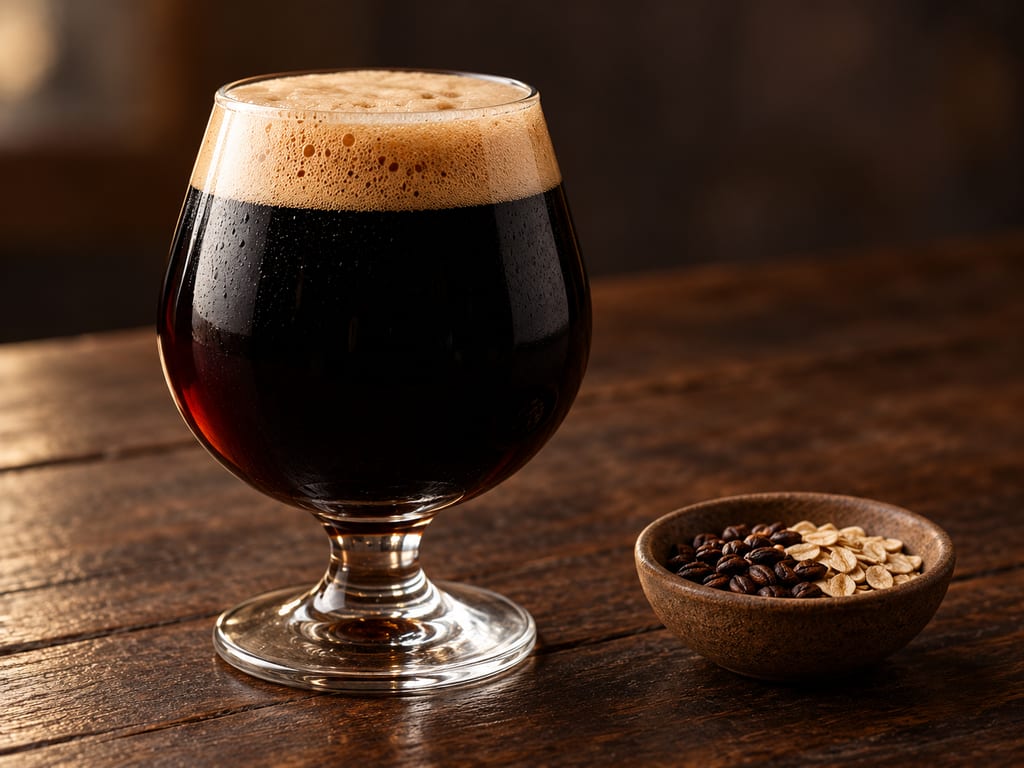
Dark Cellar imperial stout
An all-grain imperial stout with pale malt, roasted barley, dark malts and oats, fermented with an American ale-yeast starter.
 FermenteaWhere food goes to change
Substrates
A caramel/crystal barley malt colour grade that supplies caramel-like flavour, colour and extract; producer and process refine what the 60 label means.
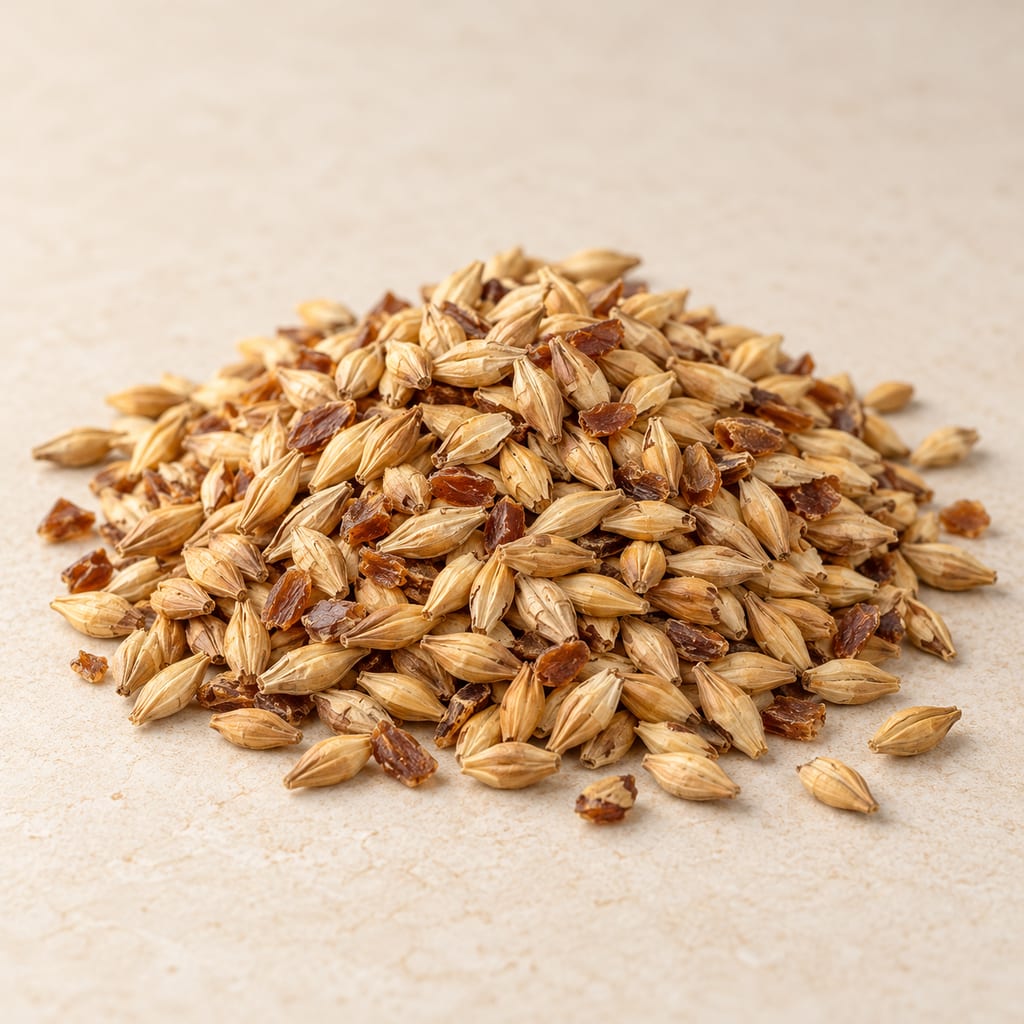
Caramel 60 is a coloured specialty malt used to bring caramel-like flavour, colour and extract into beer. Its name combines a malt family with a commercial colour grade. It is not caramel sauce added to ordinary barley, and it is not a finished malt extract. In a roaster-made crystal version, the important transformation takes place inside the grain: starch is converted into sugars while the kernel is still moist, before drying and further heat develop the characteristic interior.
That control over colour and flavour belongs to a wider history of specialty malting. Brown, black and crystal malts gave brewers different materials to blend rather than one grain for every purpose. French & Jupps' company history describes malt being carried by barge to a London roast house before malting and roasting were consolidated at Stanstead Abbotts. The journey between a malt floor and a roast house was part of the ingredient's commercial life, as well as a sequence of production operations.
Crystal malt developed within that nineteenth-century expansion of coloured malts, but retrospective accounts differ on the precise date and terminology. The present 60 grade is a modern commercial description, not an ancient cultivar or a reliably dated invention. The lasting distinction is practical: a maltster can prepare colour and sweet roasted character within the grain, allowing the brewer to choose that contribution separately from the pale malt that supplies most of the grist.
The number 60 describes a colour grade in the product name. Briess calls its product Caramel Malt 60L and reports a typical colour of 60 SRM. Its sheet identifies the figures as typical analytical values rather than a guarantee for every lot. Read the actual unit on the producer's analysis. A label's familiar shorthand should not be expanded into a numerical conversion between colour scales that the supplier has not supplied.
Colour also does not identify one universal flavour. Briess describes its product as sweet with pronounced caramel character. Blue Ox's Caramel 60 description emphasizes molasses, jammy aromas and pipe-tobacco impressions. These are different makers' sensory descriptions, not extra ingredients automatically present in the malt. A brewer selecting the grade should consider the desired character as well as the number.
The linked Dark Cellar stout lists a one-pound addition of Caramel 60 among several specialty grains. In that formulation, the caramel grade accompanies chocolate, coffee and darker roasted materials, each bringing its own part to the malt profile. A brewer can therefore use the grade within a layered dark beer as well as consider its caramel character on its own. The amount belongs to the balance of that whole grain bill.
Brewers often encounter Caramel 60, Crystal 60 and Crystal/Caramel 60 in shop catalogues. The overlap reflects real trade usage, but the terms do not always specify the same manufacturing method. Briess distinguishes roaster-produced crystal malt from kiln-produced caramel-type malt and notes that naming varies between maltsters. The most useful question is how the purchased product was made and what its analysis and sensory description establish.
In a roaster-made crystal product, the interior can become glassy and consistently converted. A kiln-produced caramel-type product can contain a different balance of glassy and mealy kernels because moisture and temperature vary through the grain bed. Those physical differences help explain why a similar colour description need not guarantee the same behaviour. The name on a retailer's shelf is a starting point for selection, rather than a complete process record.
The glassy interior is especially informative. It reflects the preparation of starch-derived sugars within the kernel, followed by drying and heat treatment. The outer husk may remain comparatively pale while the interior has become glassy and coloured. Breaking a kernel reveals a different part of the malt from the husked exterior. That visible structure and the producer's analytical colour assessment describe complementary features of the finished ingredient.
Barley, Hordeum vulgare, begins with a starch-rich endosperm, an embryo and surrounding tissues. Steeping supplies water, and controlled germination activates the seed's systems for mobilizing stored material. Enzymes modify cell walls, proteins and starch in the endosperm. A maltster guides that development and then stops further growth at the appropriate stage. These biological changes prepare the grain for later processing; they are not an alcoholic fermentation.
For ordinary pale malt, drying stabilizes the product while retaining useful enzyme capacity for brewing. Crystal production uses moist green malt as the material for a different next stage. Simpsons describes green malt entering its roasting drum directly from germination, still wet enough for a stewing phase. The maltster takes advantage of both the grain's enzymes and the water already inside it.
Uniform raw material and controlled handling matter because each kernel must pass through those changes. Grain size, moisture and the state of modification influence how consistently heat and enzymes act. The finished specialty malt is consequently a manufactured ingredient whose quality depends on the earlier crop and malting work, not simply a batch of ordinary dry barley toasted to a chosen outside colour.
During the moist stewing phase, enzymes turn starch within the grain into smaller carbohydrates, including sugars. Briess compares its process with many small mash vessels: the material that would become wort in a brewery is temporarily retained inside the kernel. Simpsons similarly describes the starchy interior becoming liquefied during its crystal process. The grain is doing a particular piece of carbohydrate preparation before it ever enters a brewer's mash tun.
Once that conversion has progressed, the maltster drives off moisture and applies further heat. Water removal concentrates the sugars; heat changes their composition and develops colour and flavour. Time, temperature and moisture must be managed together. The manufacturer is not merely drying an unchanged sweet grain, because the later thermal reactions create new products from its constituents.
The resulting malt can provide sweet caramel and toffee-like impressions on extraction. The maker controls the progression and checks the finished product for consistency. Simpsons describes analysis and blending after roasting, while Briess emphasizes the roaster's judgement during a rapid final stage. These are reasons why a bag of a specified grade can be a repeatable brewing ingredient even though barley is an agricultural material and individual production batches vary.
Caramelization concerns reactions among sugars under heat. Maillard chemistry involves sugars and amino compounds, producing a different set of reactions and products. Both contribute to the wider range of coloured-malt manufacture. Briess's discussion emphasizes caramelization in its crystal-roasting process and contrasts that with the more bready or biscuity character associated with some kilned products. The grain's water content and the way heat reaches its interior help shape which of those characteristics becomes prominent.
The balance of reactions depends on the grain's preparation, water content and heating programme. General roasted-malt research describes a range of coloured and volatile products and the influence of processing intensity. That framework explains why light and dark specialty malts can have different aroma profiles. It does not establish one exact set of molecules or a factory roasting schedule for every malt sold as Caramel 60.
A sensory description is therefore useful alongside the analysis. Caramel, toffee, dried-fruit or darker impressions help a brewer choose a particular effect; they are not a recipe for the malt's chemical composition. The brewing process then extracts part of that prepared character into wort, where other grains, hops and fermentation contribute their own flavours. A pleasant sweetness in the malt does not guarantee a particular sweetness in the finished beer.
The malt supplies extract as well as colour. Some of its carbohydrate material can remain in forms that brewing yeast does not readily ferment, while other extracted sugars can be fermentable. Briess connects non-fermentable structures in its product with viscosity and foam development. This is different from saying that everything extracted from caramel malt is unfermentable or that the malt adds a fixed amount of residual sugar to every beer.
The mixed mash matters. Enzymes supplied by active malts act within the complete grain mixture, and the available carbohydrates depend on the actual product and process. Yeast then consumes the sugars it can use under the fermentation conditions. Body, attenuation and sweetness are related to that complete sequence. They cannot be read directly from the 60 on the bag.
Caramel malt is consequently selected for a balance of contributions. A brewer may want some caramel flavour and colour without making it the dominant part of the grain bill. Another formulation may place more emphasis on malt sweetness or a richer palate. Product-specific recommendations help with those choices, but they are brewing guidance rather than universal safety limits or proof that every maltster's 60 grade should be used at the same rate.
Dark Cellar imperial stout uses 1 pound, or 454 grams, of Caramel 60. The published grist combines it with a large American two-row pale-malt base and separate additions of chocolate malt, roasted barley, Carafa III, coffee malt, oats and black patent malt. That arrangement gives caramel malt a place among several other specialty ingredients. It does not make the malt solely responsible for the stout's body, colour or sweet impression.
The American Homebrewers Association's 2026 Big Brew publication provides both all-grain and extract approaches. In the all-grain version, the mixture is mashed before boiling and fermentation. In the extract alternative, pale malt extract replaces the pale base malt while the remaining grains are milled and steeped. Caramel 60 is already a prepared ingredient in either case; the brewer is extracting its contribution rather than repeating the maltster's green-grain production process.
The finished stout brings together colour and flavour from all its grain additions. Caramel 60 supplies one component alongside a much larger pale base and several other dark grains. Brewing extracts their soluble material into one wort, and fermentation changes that wort into beer. A caramel note may sit within chocolate and coffee impressions rather than announce itself separately. The combined drink consequently gives a different sensory experience from smelling or examining any one of its dry ingredients.
Caramel malts are sold in a range of colours and sensory intensities. A lighter or darker product may move the beer toward a different balance of caramel, toast or darker flavours. Matching colour by changing quantities does not necessarily preserve flavour or fermentability. Consider the producer's descriptions and the role of the ingredient in the whole grist before treating an adjacent grade as equivalent.
Even the same nominal grade can differ between maltsters. The raw grain, production route and house sensory profile contribute to that variation. The useful purchasing information includes producer, complete product name, colour unit, whole or pre-ground form and any available lot analysis. These details help explain why a familiar recipe changes when its specialty malt supply changes.
Whole kernels preserve the grain form until milling, while pre-ground malt offers convenience for immediate brewing. Briess lists both formats for its Caramel 60. Follow the selected recipe's preparation for the form purchased. A crushed-grain extract method and an all-grain mash are different uses of the same ingredient family, with the complete formulation determining the desired outcome.
Keep the malt cool, dry and protected from pests, moisture and foreign material. Briess's product sheet warns that improper storage can reduce freshness and flavour; general homebrewing guidance likewise emphasizes moisture control and distinguishes whole from crushed grain. Follow the actual package's freshness and storage directions. The glassy interior and the husk are parts of a dried cereal product, whose condition between purchase and brewing matters alongside the colour grade chosen at the shop.
The cereal identity remains important after all of this processing. Conventional barley caramel malt contains gluten, and the name crystal does not turn it into a gluten-free sugar ingredient. Check the package for its cereal and other ingredient declarations and keep the complete beer formulation in view. Certifications attached to one producer's product do not automatically apply to every grain sold under the same colour-grade name.
Dark Cellar names no Caramel 60 maltster, cultivar, production place or colour scale. The modern grade’s first appearance is not established by the historical accounts; current maker examples describe their own products.
barley (gluten)
Dark Cellar names no Caramel 60 maltster or growing place. British company history and U.S. product examples do not identify the source of that recipe ingredient.
An all-grain imperial stout with pale malt, roasted barley, dark malts and oats, fermented with an American ale-yeast starter.
No community contributions have been published for this entry yet.
Sign in to contribute. Published comments and photos are free to read.
Briess Malt & IngredientsIngredient context
Caramel Malt 60L: Product Information Sheet, revised April25,2021Briess Caramel Malt 60 L: a drum-roasted crystallized barley malt with typical 60 SRM colour, caramel character, whole and preground forms, and storage guidance. Typical analysis is not a lot guarantee.
Cited in: A small kernel with its own sweet interior; What the number does and does not say; Caramel and crystal are overlapping names; Extract, body and fermentability; Choosing between neighbouring grades; Storage and dietary context
Terry Foster and Bob Hansen; Brewing With BriessIngredient context
Is It Crystal or Caramel Malt?Caramel/crystal terminology, roaster and kiln processing, wet-kernel enzyme conversion, sugar concentration, glassy and mealy structure, and caramelization versus Maillard chemistry.
Cited in: A small kernel with its own sweet interior; Caramel and crystal are overlapping names; The conversion happens inside the kernel; Caramelization and other browning reactions; Extract, body and fermentability; Choosing between neighbouring grades; Storage and dietary context
French & JuppsIngredient context
Coloured Malt – Our SpecialismFrench & Jupps’ company account describes malt transport by barge to a London roast house and later consolidated operations. Its historical account does not establish a single uncontested invention date for caramel/crystal malt.
Cited in: A small kernel with its own sweet interior; Storage and dietary context
Simpsons MaltIngredient context
Malt Roasting ProcessGreen-malt stewing, internal conversion, drying and roasting, followed by cooling, analysis and blending in Simpsons’ crystal-malt process.
Cited in: From a living seed to green malt; The conversion happens inside the kernel
University of Minnesota ExtensionIngredient context
Understanding grain qualityBarley quality and malting: cleaning, steeping, germination, modification, drying and the role of enzymes in mash starch conversion.
Cited in: From a living seed to green malt; Extract, body and fermentability
Marčiulionytė et al.; Journal of the American Society of Brewing Chemists,2022Ingredient context
Roasted Malt for Distilling: Impact on Malt Whisky New Make Spirit Production and Aroma Volatile DevelopmentGeneral roasted-malt chemistry: Maillard reactions, caramelization, thermal breakdown, colour and aroma development. The original study concerns distilling malt; it does not measure the named recipe ingredient.
Cited in: Caramelization and other browning reactions
American Homebrewers Association; Joel McGormleyIngredient context
2026 Official Big Brew Recipes: Dark Cellar Imperial Stout,p3Dark Cellar’s 1 lb(454 g) Caramel 60 addition, its other grains, and the all-grain and extract approaches in the 2026 Big Brew recipe. The recipe gives no maltster or colour scale for that ingredient.
Cited in: What the number does and does not say; A caramel note within a dark grain bill; Choosing between neighbouring grades; Storage and dietary context
Blue Ox MalthouseIngredient context
5lbs Caramel60 MaltBlue Ox Caramel 60:60 SRM colour with the producer’s molasses, jammy and pipe-tobacco sensory descriptions.
Cited in: What the number does and does not say
Lukinac and Jukić; Plants,2022Ingredient context
Barley in the Production of Cereal-Based ProductsBarley identity, Hordeum vulgare, kernel anatomy and changes during malting; a general cereal account rather than identification of the recipe malt’s cultivar.
Cited in: From a living seed to green malt
U.S.Food and Drug AdministrationIngredient context
Gluten and Food LabelingBarley is a gluten-containing cereal; the guidance explains gluten-related food labeling.
Cited in: Storage and dietary context
American Homebrewers AssociationIngredient context
How To Store Homebrew IngredientsMalt storage, moisture protection, whole and crushed forms, and the loss of flavour and aroma under poor conditions.
Cited in: Storage and dietary context