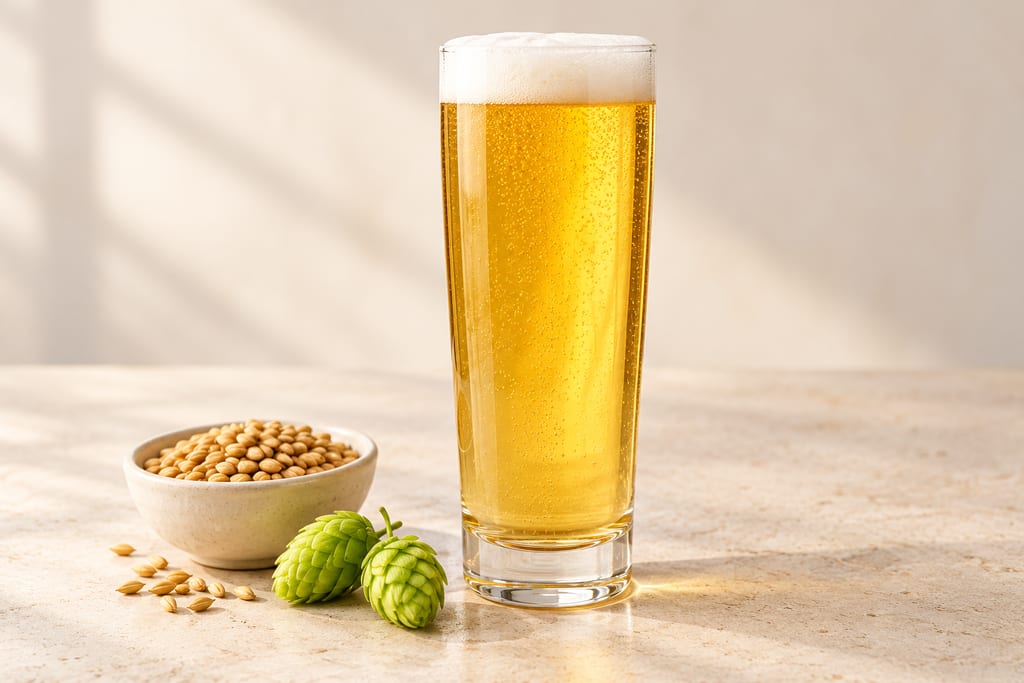
German pils, all-grain
A pale, dry lager with Pilsner malt, Magnum bittering hops and Hallertau Mittelfrüh and Tettnang additions, followed by cold maturation.
 FermenteaWhere food goes to change
Substrates
A pale specialty-malt name used for different commercial products. Briess Carapils and Weyermann CARAPILS have distinct specifications; an unbranded recipe does not identify either one.
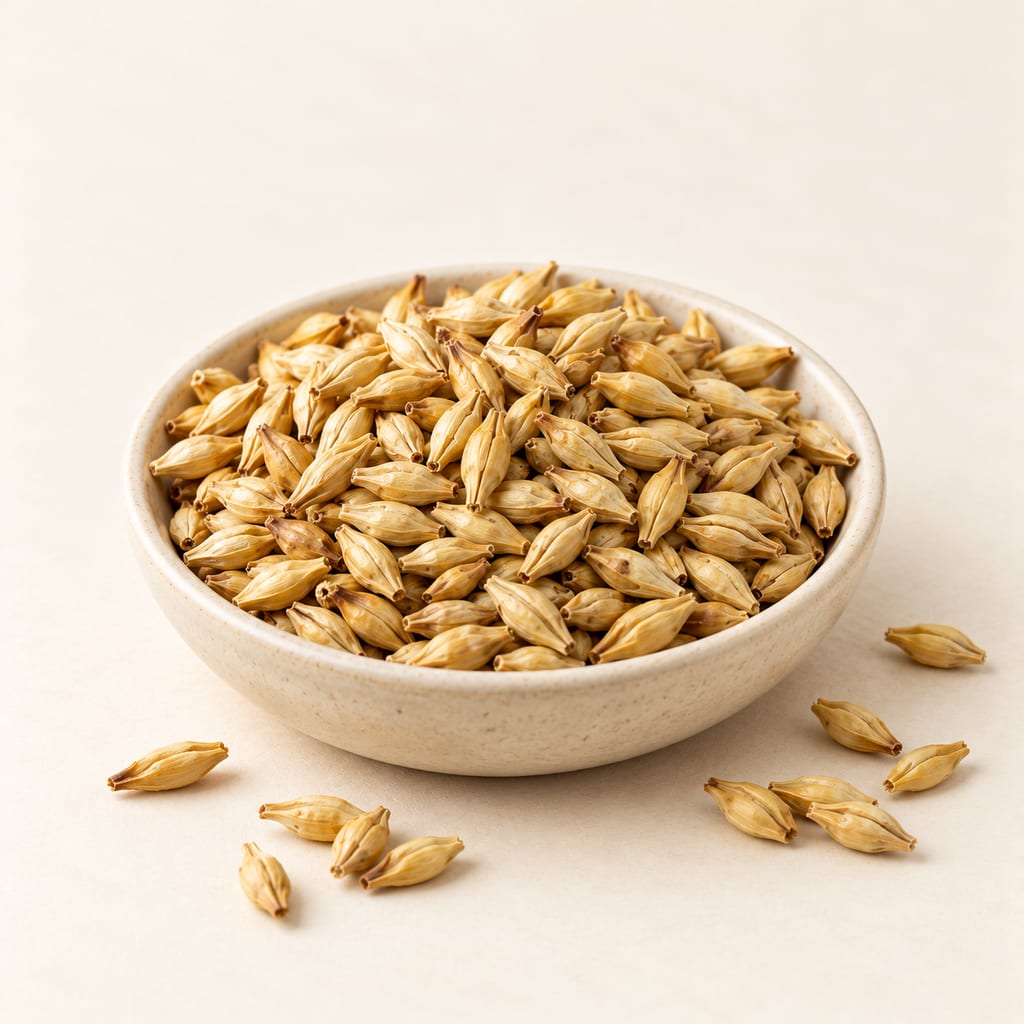
Carapils is a name a brewer can encounter on pale specialty malt intended to influence body and foam. It does not identify one interchangeable product around the world. Briess sells a dextrin-style Carapils, while Weyermann sells CARAPILS, also marketed as CARAFOAM in North America. Their own descriptions differ in enzyme activity, sensory character and recommended use. Knowing the maltster makes the name useful.
The difference matters in a pale beer, where a small specialty-malt addition sits beside a much larger base-malt portion. The brewer may want a particular texture without a strong roasted flavour or dark colour. Both companies present their products for this sort of use, but the bag's identity determines which technical information applies. A familiar word on an ingredient list cannot supply that information by itself.
Bräu Supply's German Pils recipe calls for Carapils without naming a manufacturer. Its ingredient therefore remains Carapils malt here, with the commercial examples distinguished below. The recipe can establish how much is used and when it enters the brew. It cannot establish which proprietary malt was in the author's grain bill.
A malt kernel begins as a grain capable of germination. In the malt house, cleaned barley takes up water during steeping. Germination then activates and develops enzymes and opens the grain's internal reserves for brewing. The maltster manages moisture, air and temperature rather than allowing a seedling to grow without restraint. Drying brings that growth to an end.
This controlled change is called modification. Material around the starch granules breaks down, and the grain becomes more suitable for extracting brewing material. Base malt supplies carbohydrates together with substantial enzyme activity. Specialty malt receives treatment chosen for a particular flavour, colour or function. Adjusting moisture, temperature and time changes the resulting material; stronger heating can also reduce enzyme activity.
Carapils belongs in that specialty-malt setting. A pale appearance does not make it the same as ordinary pale base malt, just as a darker appearance alone would not explain a roasted malt's production. The maltster's process has already shaped the kernel before it reaches a mill. Its role in a mash follows from those changes as well as from the quantity weighed into the grist.
Briess distinguishes its Carapils from its caramel malts. The company's technical account describes kernels with a glassy interior, produced as starch is converted to dextrins and then dried. Dextrins are carbohydrates made from parts of starch molecules. In this product, the resulting grain is intended to contribute material associated with body, mouthfeel and foam rather than the stronger colour and flavour of a caramel malt.
That explanation belongs to Briess's product. Its article explicitly says that suppliers use different processes for dextrin malts and that their finished characteristics and appropriate use can differ. The name is consequently a poor substitute for the supplier's description. A brewer choosing another malt needs that malt's information, even if both retail labels contain the word dextrin.
The same article includes a Briess demonstration of beers made with its product. Such a demonstration explains what the supplier is promoting; it does not establish a universal improvement in every recipe. A commercial claim about body or head retention must be kept separate from an independently tested result, and neither identifies the malt in an unbranded formulation.
Briess's product information sheet describes an enzyme-free malt available as whole kernels or preground grain. The listed barley source is American two-row malting varieties. That is useful information for identifying the named commercial product, though it does not identify the farm, cultivar or crop used in the German Pils recipe.
The sheet gives a typical colour of 1.5 SRM and a typical fine-grind extract of 75% on a dry basis. These numbers answer different questions: colour concerns the malt's contribution to appearance, while extract describes material recovered under an analytical procedure. Extract is not a statement that the same percentage becomes fermentable sugar or alcohol in a home brewery. Briess also explicitly labels the analysis as typical rather than a specification or guarantee.
The whole and preground forms are another practical distinction. A brewer buying milled malt receives grain in a different physical state from intact kernels, although the named product remains the same. The sheet permits steeping or mashing for this product. It does not turn every pale specialty malt into a steeping ingredient with identical behaviour.
Weyermann presents its CARAPILS as a barley caramel malt with low enzyme activity. Its sensory description includes malty sweetness and light caramel notes. Those details make a useful comparison with Briess's explicit separation of its own Carapils from caramel malt. Similar names have not produced identical descriptions.
Weyermann associates the product with dextrins and proteins of relatively large molecular size and recommends it for a range of beers, including pale lager, Pils and wheat beer. These are intended applications supplied by the manufacturer. They explain why the malt appears in a brewer's selection, while leaving the result dependent on the recipe and process.
The manufacturer's recommended proportions also belong to this malt. They are not instructions to increase the amount in the Bräu Supply recipe or to substitute one product without considering the rest of the grist. A recommendation describes how a maker expects its product to be used. A published recipe records a particular formulation. Reading both is more informative than treating either as a rule for all malt sold under a similar name.
Weyermann's crop-2026 specification identifies barley and water and gives Germany and the European Union as source areas. It lists low enzyme activity and a colour range of 2.5–6.5 EBC, also expressed as 1.4–2.9 Lovibond. The sheet notes harvest-related variation. This is documentation for a named product and crop, rather than an analysis of Carapils as a universal category.
A range conveys something a single catalogue number can hide: manufactured grain is still an agricultural material. Product documentation can place limits around its expected characteristics without making every shipment numerically identical. A brewer comparing suppliers should retain the measurement scale, the stated range and whether an entry is typical or specified.
The same sheet gives unopened storage conditions and a minimum shelf life for Weyermann's product. Those conditions refer to that packaging and product, not to an opened bag from another maltster. Retaining the product name, crop information and bag details therefore has practical value beyond purchasing: it keeps later brewing notes connected to the material actually used.
Weyermann's company history traces its CARAPILS registration to 1908 and an international registration to 1926. It explains CARAFOAM as the name used for its product in North America, where another maltster had registered Carapils. These are the company's account of its brand history and regional naming, rather than a claim that every pale dextrin malt shares one origin.
This history helps a reader interpret a bag or an older recipe. A change in market name can leave the manufacturer's product recognisable, while an unchanged-looking name can refer to a different manufacturer. Supplier and product name need to be read together. Capitalisation or punctuation alone cannot resolve an unidentified ingredient.
Registration history also answers a narrower question than invention history. A dated mark records something about a commercial name; it does not, by itself, show when people first made every related malt or prove a precise birthplace for the broader technique. Carapils is best understood through its documented products and uses, without turning a brand chronology into a single invention story.
Beer foam depends on interactions among several components, rather than on one ingredient performing a single isolated task. In a study published in the Journal of the Institute of Brewing, D. E. Evans, M. C. Sheehan and D. C. Stewart compared brewing trials using 25 malts. Their results connected foam stability with several malt, wort and beer characteristics.
The reported relationships included proteins and non-starch polysaccharides, a group of carbohydrates distinct from starch. Some measured properties correlated positively with foam stability and others negatively. The authors' analysis therefore supports a view of foam as the outcome of related properties, rather than a simple consequence of adding a named specialty malt.
The experiment was not a comparison of Briess Carapils with Weyermann CARAPILS, nor a trial of Bräu Supply's Pils. It helps explain why manufacturers discuss proteins and carbohydrates when describing foam-related malt functions. It does not provide a percentage improvement to attach to either bag. A recipe's small addition can have a purpose without a guaranteed, independently measured effect in that particular beer.
Body is a convenient brewing word, but researchers can separate more specific sensations. Rolando César Moreno Ravelo, Martina Gastl and Thomas Becker examined palate fullness and mouthfeel in beers made from 55 experimental malts. Their work varied barley material and modification and combined chemical analysis with a trained sensory panel.
The study considered dextrins alongside beta-glucans, another group of grain-derived carbohydrates. Molecular size and the balance of components mattered to the sensory relationships. Pleasant fullness and an unwanted slimy sensation were not treated as interchangeable descriptions of a beer simply containing more carbohydrate. The material's structure and the beer around it affected interpretation.
This gives substance to the distinction between buying a malt for body and knowing exactly how the beer will feel. The study provides general evidence about barley-derived carbohydrates in defined beers, not a test of either commercial Carapils. It supports explaining the chemistry behind a possible role while leaving product performance and the final drink's sensory quality to the actual formulation and process.
Briess's dry-malt handling guidance focuses on preventing moisture, contamination and pests from reaching stored grain. It advises inspecting arriving bags for damage and foreign material, separating storage from humid or hot working areas, and protecting the space against rodents, insects and birds. The same concerns remain relevant when the quantity is a small home-brewing purchase rather than a pallet.
Milled grain receives particular attention in the guidance: a damp basement or hot attic is a poor storage location. Keeping the bag identifiable and using older stock before newer stock also helps maintain a sensible brewing inventory. Package damage and infestation need attention when grain is received and each time it is used, rather than only on brew day after the mill has been filled.
Inspection can reveal a storage problem; it cannot prove microbiological safety. A normal-looking or familiar-smelling kernel is not a safety test. Follow the actual supplier's package instructions, keep the product away from moisture and contamination, and avoid borrowing a shelf-life statement from a different malt just because its name looks similar.
In Bräu Supply's German Pils formulation, Carapils is a small part of a grist dominated by Pilsner malt. The listed quantity is 0.25 lb, also given as 0.11 kg and approximately 3% of the grain bill. It enters the mash with the other malts. The recipe's larger base-malt portion supplies the main foundation; the specialty addition belongs within that whole formulation.
Keeping the source's unbranded wording preserves a useful distinction. The recipe documents a quantity and a process position, while supplier documentation explains particular products a brewer may encounter when shopping. Those two kinds of evidence work together without requiring an invented manufacturer. Neither American barley sourcing nor German commercial naming establishes where the recipe's grain was grown.
Named commercial examples are barley malts; check the actual product label.
The recipe names Carapils without a maltster, crop or grain-growing location. Named manufacturer examples do not establish this ingredient lot origin.
A pale, dry lager with Pilsner malt, Magnum bittering hops and Hallertau Mittelfrüh and Tettnang additions, followed by cold maturation.
No community contributions have been published for this entry yet.
Sign in to contribute. Published comments and photos are free to read.
Bräu SupplyIngredient identity · Ingredient use
German Pils Recipe, All-GrainExact source use and amount for this ingredient.
Cited in: A pale malt with two commercial meanings; A small part of the German Pils grist
Briess Malt & Ingredients Co.Ingredient identity · Ingredient use
Understanding Carapils® MaltBriess’s own product description and the need to keep supplier identities distinct.
Briess’s distinction and its supplier demonstration, clearly labeled as company evidence.
Cited in: Briess describes a dextrin malt
Briess Malt & Ingredients Co.Ingredient identity · Ingredient use
Carapils® Dextrin MaltsCurrent manufacturer claims for Briess’s product only.
Cited in: A pale malt with two commercial meanings
Briess Malt & Ingredients Co.Ingredient identity · Ingredient use
Carapils® Malt Product Information SheetBriess sourcing statement and caveat about typical values.
Briess product’s typical analysis and listed commercial forms.
Briess-specific handling/use information.
Cited in: Reading the Briess product sheet
Mich. Weyermann GmbH & Co. KGIngredient identity · Ingredient use
TrademarksWeyermann’s account of brand history and regional naming.
Weyermann’s current trademark statements.
Cited in: Why the name changes across markets
Mich. Weyermann GmbH & Co. KG, BambergIngredient identity · Ingredient use
Weyermann® CARAPILS®Weyermann product-specific claims and recommendations.
Cited in: A pale malt with two commercial meanings; Weyermann describes a pale caramel malt
Weyermann Specialty MaltsIngredient identity · Ingredient use
Weyermann® CARAPILS® Product SpecificationCurrent Weyermann product-specific characterization.
Weyermann’s current specification values and storage statement.
What Weyermann says about its product documentation and systems.
Cited in: Crop, colour and the limits of an analysis
Journal of the Institute of Brewing, 105(3), 171–178Ingredient identity · Ingredient use
The Impact of Malt Derived Proteins on Beer Foam Quality. Part II: The Influence of Malt Foam-positive Proteins and Non-starch Polysaccharides on Beer Foam QualityFoam is affected by several malt-derived factors and study-specific variation.
Cited in: Foam involves several malt-derived components
European Food Research and Technology 250, 495–509Ingredient identity · Ingredient use
Influence of dextrins and β-glucans on palate fullness and mouthfeel of beerGeneral, experimentally scoped distinction among polysaccharide-related sensory effects.
Cited in: Fullness and mouthfeel are sensory questions
Briess Malt & Ingredients Co.Processing · Ingredient use
The Malting ProcessManufacturer explanation of malting and specialty-malt differences.
Cited in: The grain has already been changed by malting
Briess Malt & Ingredients Co.Processing · Ingredient use
Handling/Storing Dry MaltDry grain receiving, storage, pest prevention and package inspection; no generic shelf life or safety assurance.
Cited in: Keeping dry malt in usable condition