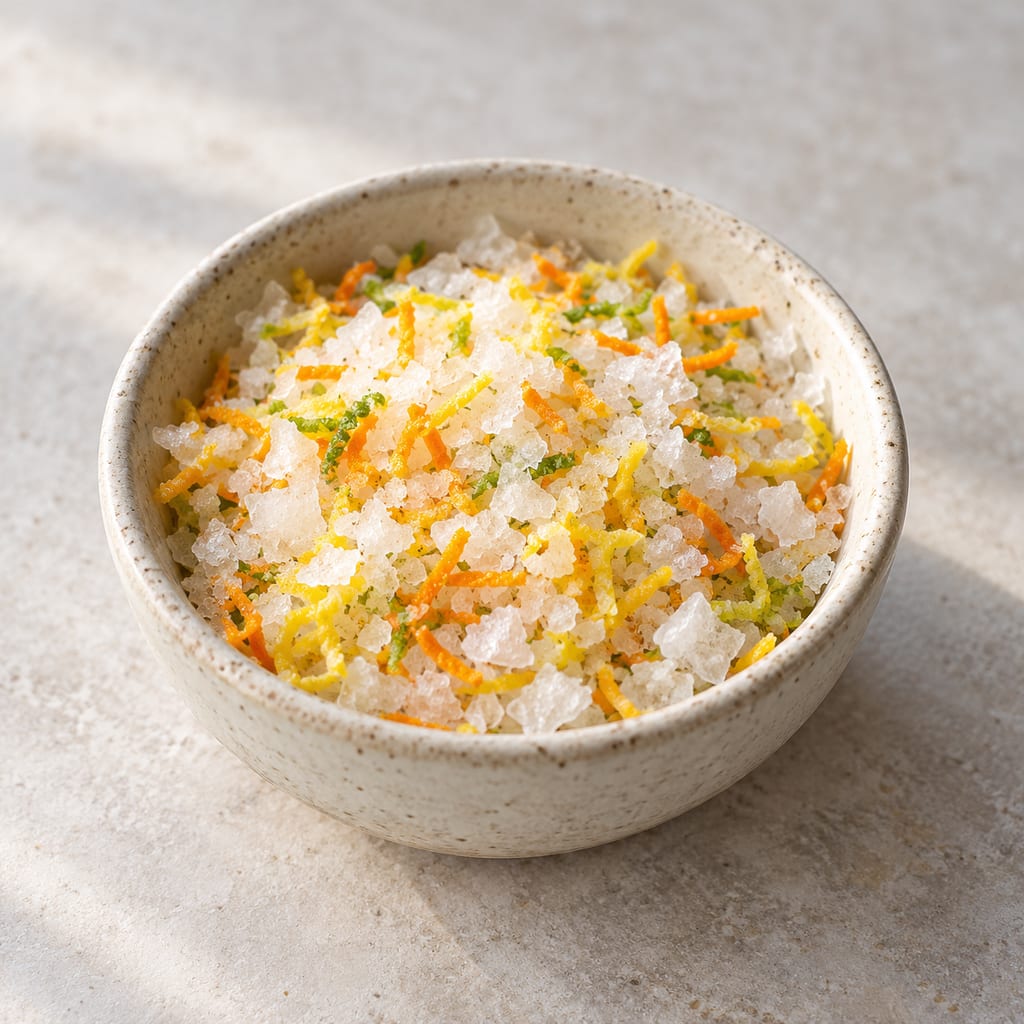
Citrus salt
Citrus zest is rubbed into coarse or flake salt and dried on a tray. This peel-based seasoning preserves the chosen citrus aroma without adding juice.
 FermenteaWhere food goes to change
Spices and aromatics
Citrus zest is the aromatic outer rind, taken separately from the white pith and juice. Its fruit type, cut and fresh or dried form shape its use in food.
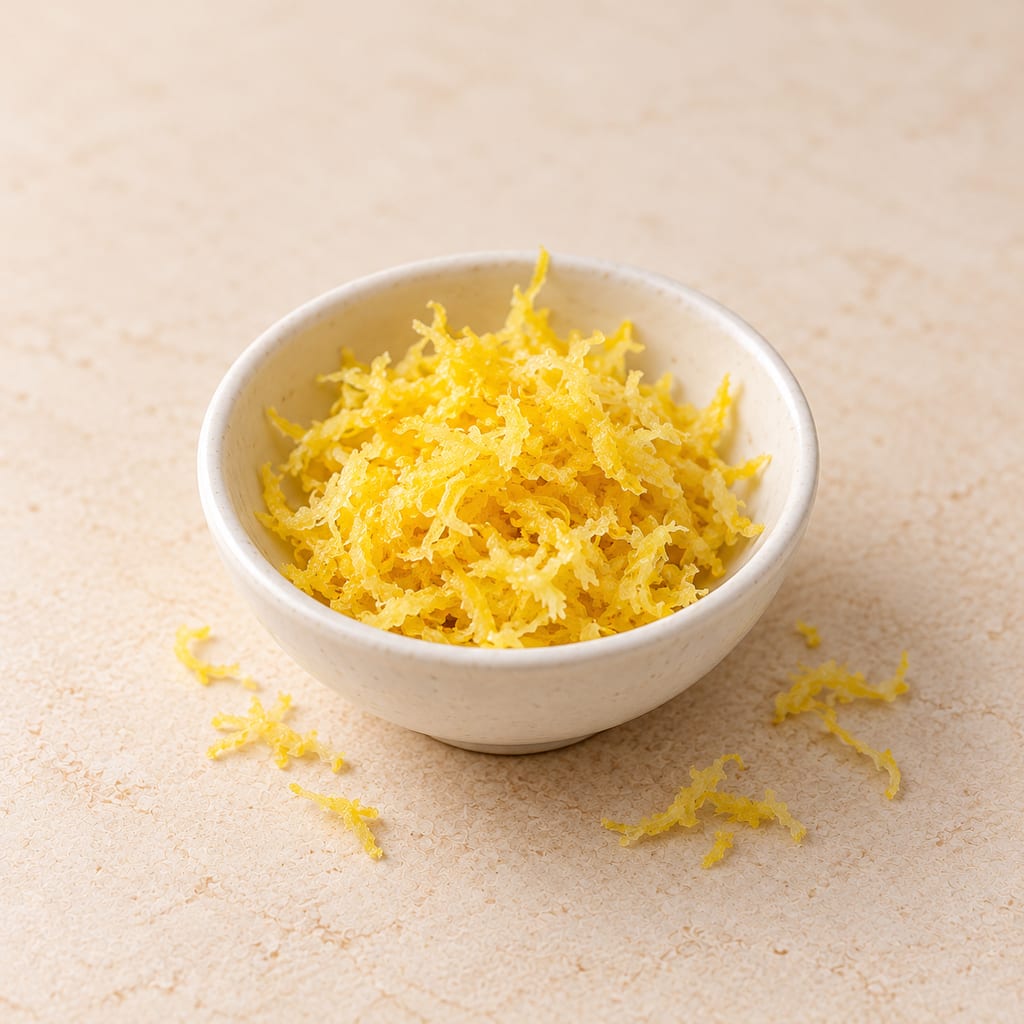
Zest is the coloured outer part of a citrus fruit's rind, removed for its aroma and flavour. It may be a fine grating, slender shreds or a wider piece subsequently chopped. The word identifies a particular part of the fruit rather than all of its peel. That distinction is useful whenever a recipe asks for zest but leaves the species of citrus open.
Botanically, the outer coloured tissue is the flavedo, or exocarp. Beneath it lies the albedo, the spongy white part of the rind. Farther inward are the segments and juice sacs. These tissues have different structures and culinary properties. Removing only the outside takes a different ingredient from cutting a thick piece of rind with its white layer attached.
Lemon provides a familiar example. Its coloured zest can be removed with a zester, paring knife or vegetable peeler, avoiding the bitter white pith beneath. A fine zester collects small particles directly, while a peeler or knife makes broader pieces that can be chopped. The tool and depth of the cut determine how much aromatic surface and underlying tissue end up in the food.
Citrus diversity has a complex history. Genomic work identifies hybrid and mixed ancestry among familiar cultivated fruits, including oranges, lemons, limes and grapefruit. The supermarket names are useful culinary categories, but they do not represent a collection of entirely independent lineages with simple, separate beginnings.
Cultivation can preserve a desirable fruit even when its ancestry is mixed. Clonal propagation keeps a selected genetic combination, including hybrids, rather than producing a new assortment from seed each time. Grafting is one way cultivated citrus has been maintained. The familiar fruit can thus have a stable culinary identity while its deeper botanical relationships remain more complex than the everyday name suggests.
Genomic evidence proposes early citrus diversification in Southeast Asia. The inferred relationships describe plant lineages, including ancestry subsequently combined in cultivated hybrids. A fruit's present culinary name can bring several of those relationships together. This proposed evolutionary account is distinct from the history of scraping aromatic rind into food and does not establish a culinary birthplace for zest.
Variation among cultivated citrus gives a cook a range of aromatic rinds. A preparation allowing any citrus can accommodate that range, while one naming lemon or orange makes a more specific flavour choice. The difference is meaningful even where the same tool and cut are used: similar-looking gratings can come from fruits with different mixtures of volatile compounds.
Citrus fruit develops several tissues together, but they do not become interchangeable. The white albedo forms part of the rind, while the pulp consists of specialised juice sacs growing from the inner tissues. Even a juice sac is not simply a hollow bag of liquid: it is a structure made of cells whose contents become juice when released.
Growth changes the relative importance of these parts. Early fruit development includes thickening of the rind; later expansion involves the juice cells, followed by maturation. The fruit's aroma and flavour also change during development. A piece of zest is therefore taken from a living tissue shaped by the fruit and its maturation, rather than from an inert wrapping around the edible centre.
Skin colour and internal maturation do not always progress together. In hot growing climates, citrus can reach its internal maturity while the external colour develops poorly or remains green. Colour break responds to climatic conditions differently from the decline of acid in the pulp. A green-looking surface is therefore not a universal measure of how the interior will taste.
For zest, that distinction makes the actual fruit and its condition more useful than a rigid expectation of colour. The aromatic outer tissue is the relevant part, whether the culinary fruit is commonly green, yellow or orange. Its colour can help recognise which layer is being removed, but it does not give a measurement of juice acidity or certify a particular flavour profile.
The fruit's internal connections also differ by tissue. Juice sacs arise from the inner segment surface and remain attached by stalks, while vascular tissues end in the albedo. The rind and pulp are therefore connected parts of the growing fruit with different structures. Zesting removes the surface tissue; squeezing breaks the juice-bearing cells farther inside. These operations recover different ingredients even when they begin with the same fruit.
Much of citrus rind's aroma is associated with its volatile oil fraction. Volatile compounds can enter the air and contribute to smell; the mixture includes terpenes and smaller amounts of other compounds. Limonene is often prominent in studied rind oils, but naming it alone does not explain the aroma of every citrus fruit.
The balance differs among citrus types and can vary within them. Minor components can make an important contribution to smell even when they represent a small part of an analysed oil. Lemon, orange and other citrus rinds should therefore not be described as one fixed chemical profile with different colours. A recipe that allows any citrus permits a real flavour variation.
Extraction also influences what is measured. Cold pressing and heated distillation can produce different volatile profiles from the same kind of peel. An extracted essential oil is thus useful evidence about the aromatic material, but it is not identical to fresh grated zest. The kitchen ingredient retains plant tissue and moisture that an isolated oil does not, and it cannot be assigned a concentration from an oil analysis.
The part of the plant matters as well. Flower oils sold as neroli and oils from leaves and small branches sold as petitgrain are distinct from citrus rind oils. Their profiles help explain why a citrus aroma need not come from zest. Within a kitchen, keeping the aromatic rind separate from juice, flower products and extracted oils makes the ingredient choice clearer than treating every citrus-scented material as interchangeable.
The cut determines how zest sits in a food. Fine particles spread through a mixture, while longer pieces remain more distinct. A broad strip can be chopped further if a recipe needs smaller pieces. These choices are physical preparation of the outer rind, and they should remain separate from the choice of fruit.
Depth matters as well as size. Taking a thick slice can include white pith, which contributes a different texture and, in the lemon example, bitterness. Repeatedly cutting into the same patch of rind can therefore change the material being collected. The useful aim is to recognise the boundary between the coloured surface and the underlying white tissue rather than treating any scrap of peel as equivalent.
Working zest into another ingredient can release its aroma. In citrus salt, rubbing the rind with salt is a deliberate part of mixing: crystals contact the cut tissue as the pieces are distributed through the seasoning. The result combines a granular material with softer fragments of rind. Fine gratings disperse differently from broad strips, so the cut remains visible in both the texture of the mixture and the way it reaches the food.
When the rind is to be eaten, its condition deserves attention rather than being treated as packaging to discard. Choose sound fruit and inspect the surface. In lemon selection, firmness and a bright, sound skin are quality clues, but descriptions of one fruit should not become a universal colour rule for all citrus. Limes, oranges and other types have their own familiar appearances.
The fruit named in a recipe provides a starting point for flavour. Where the instruction allows any citrus, a cook can make an intentional choice rather than expect exact interchangeability. The strength and character of the rind's aromatic mixture differ between fruits, while the amount of white tissue accidentally taken changes the cut in another way.
Keep the fruit's identity with notes when a repeatable result matters. Lemon zest and a generic citrus zest are not equally specific descriptions, and a peeled fruit or a finished powder can lose visual clues. Recording the actual fruit and whether its zest was fresh or dried is more informative than inferring a cultivar, grower or growing origin from the dish in which it was used.
Zest contributes citrus aroma where a recipe may not need the liquid supplied by juice. Lemon has documented uses across fish dishes, salads, baking, desserts and drinks. The rind and juice can occur in the same food, but their roles need not be identical: one provides pieces of aromatic tissue, while the other introduces a liquid ingredient.
Texture gives zest another set of choices. Finely chopped rind can be incorporated into a mixture; more visible pieces can remain part of its finish. Dried zest is a further form with different handling properties. These differences should be recognised before a substitution is made, rather than assuming that a spoonful of every form represents the same amount of fresh rind.
The same lemon can provide zest and juice for different uses. Removing the coloured layer first leaves the fruit available for squeezing, while juice can be frozen separately. Keeping the materials apart lets a cook choose whether a dish needs aromatic tissue, liquid acidity or both. A strip in a drink or a grating in baking can give a different physical result from stirring in juice, even though both ingredients began in one fruit.
The UC Master Food Preserver handout combines flake or coarse salt with citrus zest of any kind. It calls for mixing and rubbing, followed by spreading the mixture to dry before airtight storage. The useful ingredient evidence is precise: aromatic rind is the citrus part being used, and the fruit species is intentionally left open.
Its formula belongs to that handout. It does not establish a universal ratio for fresh zest, a measured drying endpoint for every kitchen or a storage life for every citrus mixture. The particular salt, cut and moisture in the rind affect what is being spread out to dry. The formula's printed drying and keeping advice therefore belongs with its own recipe, rather than becoming a generic limit for the raw ingredient.
Mixing, rubbing and drying explain this seasoning without fermentation. Rubbing releases oils into the mixture, while spreading exposes the material for drying. Colour can fade as the mixture dries without necessarily meaning that its flavour has disappeared. Appearance and aroma describe different qualities: a paler seasoning can still carry citrus character, and a strong smell does not measure how much water remains in the rind.
Wash fruit before removing its rind. Plain running water and gentle rubbing are the basic produce-cleaning measures; soap and produce wash are unnecessary. Cleaning before peeling helps avoid carrying dirt or microorganisms from the exterior onto the cut food with a tool. Clean hands and utensils also matter because zest is handled closely during preparation.
Drying the washed surface with a clean cloth or paper towel is another useful step. Washing reduces contamination but does not sterilise produce. A fragrant fruit or an attractive grating cannot show whether pathogens are absent. These ordinary handling measures should remain distinct from any process controls required by the finished dish, especially when zest is mixed with moist ingredients and kept.
For dried lemon zest, cool, dry storage in an airtight container protects the prepared ingredient. Keeping the container closed also keeps the dry material apart from a damp work surface or wet utensil. Fresh rind and dried rind are different forms to label and keep distinct. Follow the directions for the particular purchased product or finished preparation, rather than treating a jar of dry zest as if it were freshly grated fruit.
Generic citrus zest identifies the aromatic outer rind while leaving the fruit choice open. In the documented citrus-salt use, no species, cultivar, grower or batch origin is established. Fresh and dried forms need to be distinguished when used. Those details can be recorded for the actual fruit without inventing a single birthplace or first-use date for zest as a whole.
The citrus-salt handout allows zest of any citrus and identifies no source species, grower or batch origin. Publisher location and citrus evolutionary geography are not a culinary birthplace.
Citrus zest is rubbed into coarse or flake salt and dried on a tray. This peel-based seasoning preserves the chosen citrus aroma without adding juice.
No community contributions have been published for this entry yet.
Sign in to contribute. Published comments and photos are free to read.
UC Master Food PreserverInspiration · Culinary use
Citrus SaltThe handout combines 1 cup of flake or coarse salt with 3 tablespoons of citrus zest of any kind, then calls for rubbing, spreading and air-drying for 8 hours to overnight. Its airtight room-temperature storage advice is up to 2 months for that formula; no measured drying endpoint is specified.
Cited in: Fruit ancestry and the much shorter story of a kitchen cut; Fine gratings, shreds and broad strips; A flavouring for sweet and savoury food; What the citrus-salt example does establish; Clean rind, clean tools and realistic storage expectations; The useful limits of a generic name
Frontiers in Plant ScienceIngredient context
Primary Metabolism in Citrus Fruit as Affected by Its Unique StructureColoured flavedo, white albedo and juice sacs are distinct tissues. Fruit development changes rind thickness, pulp growth and acid/sugar balance; in hot climates, internal maturation and external colour development can differ.
Cited in: The outer rind, kept apart from the juice; Why the rind and pulp behave differently; Fine gratings, shreds and broad strips; What the citrus-salt example does establish
Utah State University ExtensionIngredient context
Fruit and Vegetable Guide Series: LemonsThe lemon example distinguishes coloured zest from bitter white pith, describes zesting tools and chopping, and gives culinary uses and cool, dry, airtight storage for dried zest.
Cited in: The outer rind, kept apart from the juice; Fine gratings, shreds and broad strips; Choosing fruit for the part that will be eaten; A flavouring for sweet and savoury food; Clean rind, clean tools and realistic storage expectations; The useful limits of a generic name
US Food and Drug AdministrationSafety
7 Tips for Cleaning Fruits, VegetablesProduce handling guidance covers washing before peeling, plain running water, rubbing, clean hands and tools, and drying with a clean cloth. Washing reduces contamination without sterilising produce.
Cited in: Choosing fruit for the part that will be eaten; Clean rind, clean tools and realistic storage expectations
Frontiers in Plant ScienceIngredient context
Volatile Compounds in Citrus Essential Oils: A Comprehensive ReviewRind oils contain variable mixtures of volatile compounds, including commonly prominent limonene and aroma-active minor components. Species, plant part and extraction method affect the profiles; extracted oils differ from whole zest.
Cited in: Fruit ancestry and the much shorter story of a kitchen cut; Aroma is a mixture, not one universal citrus note; Choosing fruit for the part that will be eaten
NatureHistory · Botanical context
Genomics of the origin and evolution of CitrusGenomic comparisons support complex cultivated hybrid ancestry and a proposed early diversification in Southeast Asia. These are plant-lineage interpretations rather than evidence for the culinary origin of zest.
Cited in: Fruit ancestry and the much shorter story of a kitchen cut; The useful limits of a generic name
Food Science & NutritionIngredient context
The effects of different extraction methods on essential oils from orange and tangor: From the peel to the essential oilThe abstract and introduction describe how cold pressing and hydrodistillation affect volatile composition in the studied orange and tangor oils. The findings concern extracted oils rather than fresh zest.
Cited in: Aroma is a mixture, not one universal citrus note; A flavouring for sweet and savoury food