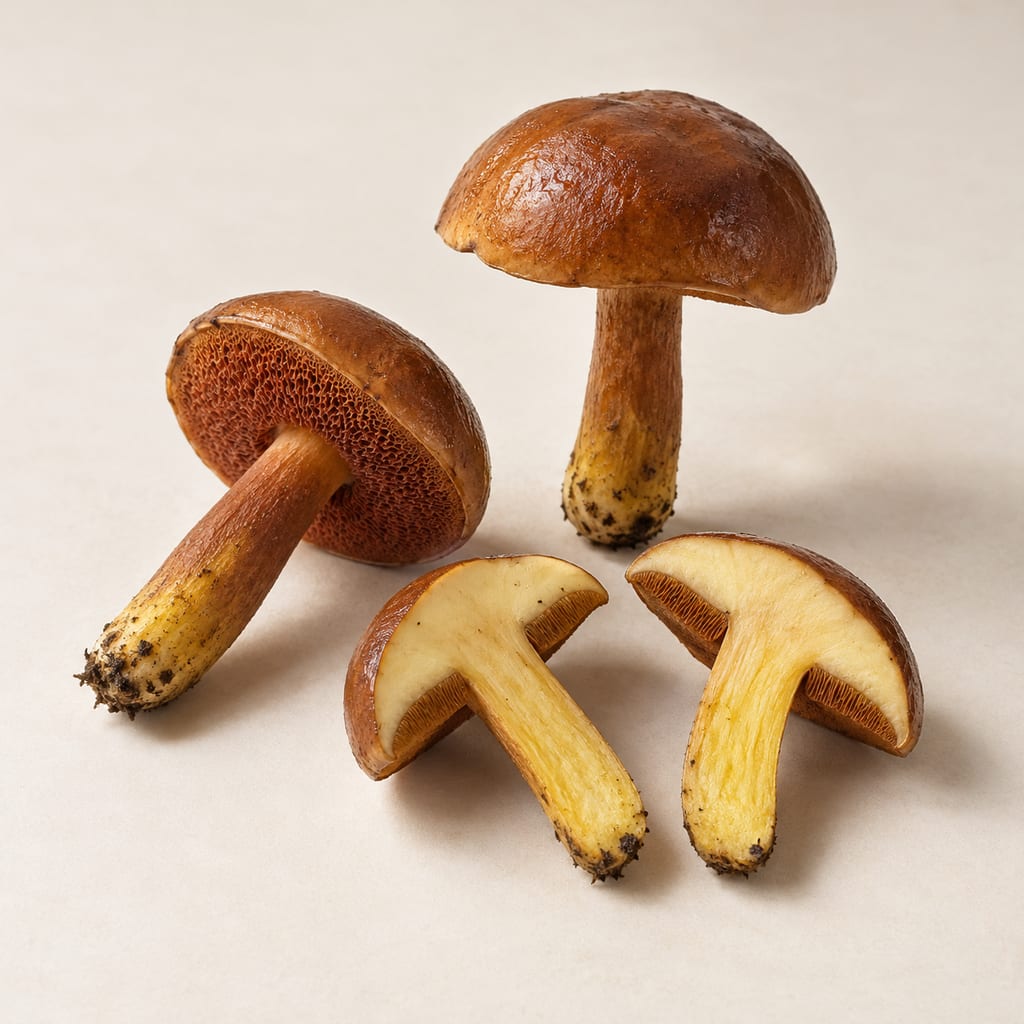
Chalciporus piperatus
A peppery woodland bolete with historical edible labels and reported condiment use in Querétaro. Current mycological references call its edibility suspect or unestablished; this entry does not recommend consumption.
 FermenteaWhere food goes to change
Mushrooms
A violet woodland webcap with conflicting edible classifications. Current field guidance discourages eating it; this entry does not recommend collecting or consuming it.
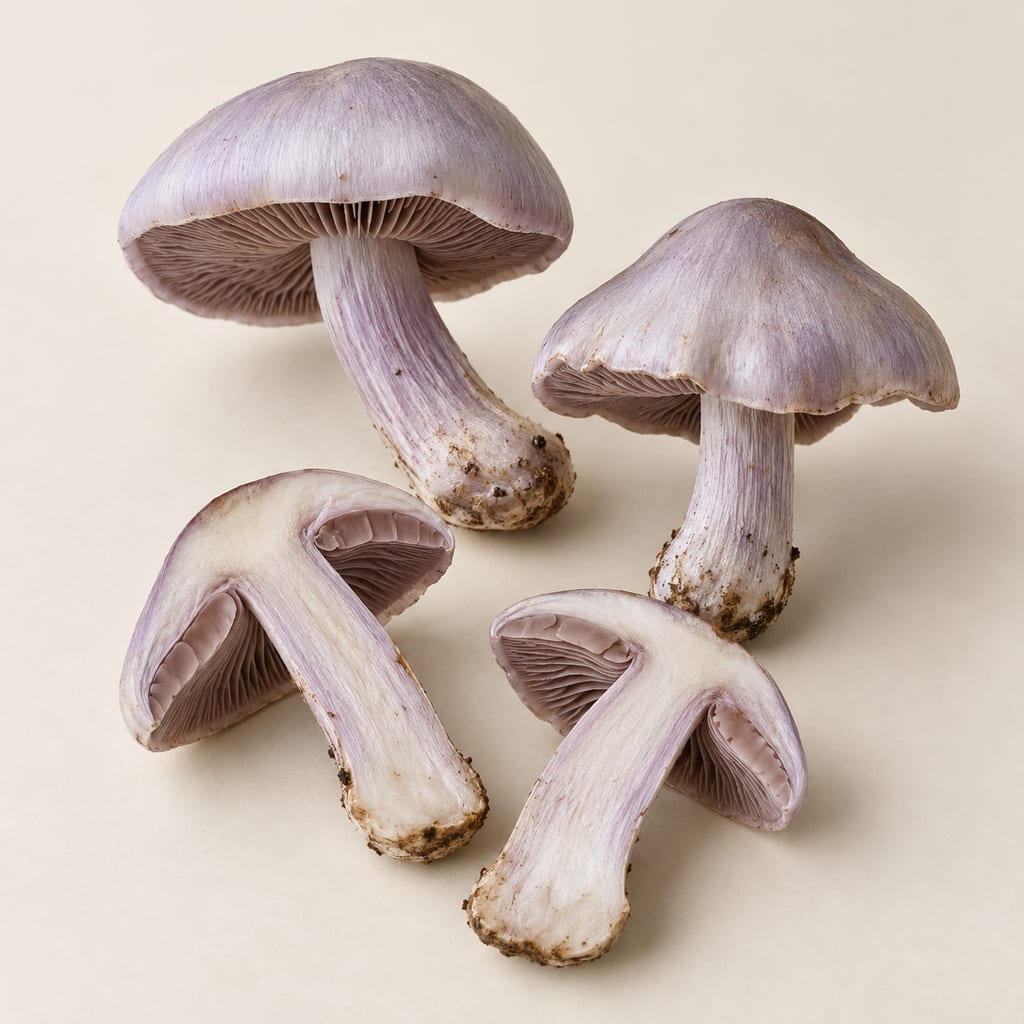
Index Fungorum accepts Cortinarius alboviolaceus (Pers.) Zaw., with Agaricus alboviolaceus Pers. (1801) as its basionym and Fries as sanctioning author. Some older sources use the combination attributed to Fries. English field names include silvery-violet cort and pearly webcap.
Descriptions give a dry, silky, pale gray-violet cap, violet young gills that turn rusty or cinnamon brown, and a fibrous violet stem swollen toward the base. Young mushrooms may show a fine cobweb-like veil, which can disappear or become rust-stained by spores. These variable features are not a safe identification key.
A Kirov Oblast reserve monograph records this fungus on soil in birch-containing stands, identifies it as mycorrhizal with birch, and reports it as frequent. It gives July–August as the local season. Other guides describe mixed woodland, especially beech and other hardwoods, with occasional conifer records; a California account places it under tanoak and conifers.
Reported fruiting windows vary: July–August in the Bylina reserve, August–October in Missouri, July–November in Britain and Ireland, and fall through winter in California. These are regional guide observations, not a universal calendar.
A 2026 Chinese catalogue lists C. alboviolaceus as edible, but its entry does not say how it is gathered, prepared or eaten. Boa’s 2004 FAO country table lists it as edible for the Russian Federation under Vasil’eva (1978), and explicitly says Russian records apply only to the Far East. A separate 2019 reserve monograph calls it edible in Kirov Oblast while describing its local ecology.
These are conflicting or incomplete food-status classifications, not a documented recipe or proof of widespread consumption. The Kirov entry and an older Far Eastern record refer to different regions, so they do not establish one general Russian use.
The Missouri Department of Conservation labels this species “not recommended/not edible” and warns that poisonous Cortinarius species can look similar. California Fungi lists edibility as unknown. This modern caution conflicts with edible labels elsewhere; the sources reviewed do not resolve the disagreement or provide a validated preparation method.
Some other webcaps, including C. rubellus and C. orellanus, cause severe kidney injury after a long delay before symptoms appear. That genus-level evidence does not show that C. alboviolaceus contains orellanine. It does explain why a name or violet colour alone cannot settle identity or safety. This entry does not recommend gathering, tasting, cooking or eating wild webcaps.
The sources reviewed contain no species-specific dish, preparation process, preservation practice or fermentation method. An edible checklist label does not establish a culinary tradition. Do not infer that cooking, drying, pickling, brining or fermentation removes a possible hazard; no process information for this species was found.
If retained in a fermentation reference, the page should explain the conflicting classifications and current safety concerns rather than invite use. Its ecology and taxonomy are documented; a safe culinary role is not.
National 2026 species catalogue lists the species as edible; its species entry gives no preparation or proof of actual consumption.
FAO Annex 2 lists an edible classification and says Russian records apply only to the Far East; not proof of contemporary consumption or safe edibility.
Local monograph reports occurrence in birch stands and an edible label, but no preparation or consumption details.
A peppery woodland bolete with historical edible labels and reported condiment use in Querétaro. Current mycological references call its edibility suspect or unestablished; this entry does not recommend consumption.
No community contributions have been published for this entry yet.
Sign in to contribute. Published comments and photos are free to read.
Index Fungorum, Royal Botanic Gardens, KewTaxonomy
Cortinarius alboviolaceusAccepted name Cortinarius alboviolaceus (Pers.) Zaw.; basionym Agaricus alboviolaceus Pers. 1801; Fries is sanctioning author.
Cited in: The silvery-violet webcap
MycosystemaTaxonomy · Historical use
Species cataloging of edible and medicinal fungi in China2026 catalogue lists the species as edible in China; entry gives no preparation details.
Cited in: What the edible labels establish; No documented culinary or fermentation method
FAOHistorical use · Geography
Wild edible fungi: a global overview — Annex 2Lists the species as edible in the Russian Federation under Vasil'eva 1978; prefatory note restricts Russian data to the Far East.
Cited in: What the edible labels establish; No documented culinary or fermentation method
Institute of Plant and Animal Ecology, Ural Branch RAS and partner institutesEcology · Season · Geography · Historical use
Macromycetes of the State Nature Reserve BylinaKirov reserve report: frequent, birch-mycorrhizal, July–August; its field account calls it edible but provides no preparation.
Cited in: Woodland habitat and regional seasons; What the edible labels establish
Missouri Department of ConservationIdentity · Season · Safety · Geography
Silvery-Violet CortGray-violet cap, pale gills age rusty, clubbed fibrous stem and cobwebby veil; mixed woods, August–October; not recommended/not edible; warns of poisonous Cortinarius lookalikes.
Cited in: The silvery-violet webcap; Woodland habitat and regional seasons; Webcap identification and safety; No documented culinary or fermentation method
California Fungi / MykoWebEcology · Season · Safety · Geography
Cortinarius alboviolaceusCalifornia fall–winter under tanoak/conifers; edibility unknown; notes similar Cortinarius species.
Cited in: Woodland habitat and regional seasons; Webcap identification and safety
First NatureEcology · Season · Identity
Cortinarius alboviolaceus, Pearly WebcapSecondary guide: British/Irish July–November; beech and other hardwoods, occasionally conifers; description.
Cited in: The silvery-violet webcap; Woodland habitat and regional seasons
Helsenorge / Norwegian Poisons Information CentreSafety
Poisonous mushrooms in NorwayDelayed serious kidney injury from C. rubellus and C. orellanus; not evidence this taxon contains orellanine.
Cited in: Webcap identification and safety
North American Mycological AssociationSafety
Mushroom Poisoning SyndromesOrellanine-producing Cortinarius species and delayed renal injury; not species-specific to C. alboviolaceus.
Cited in: Webcap identification and safety