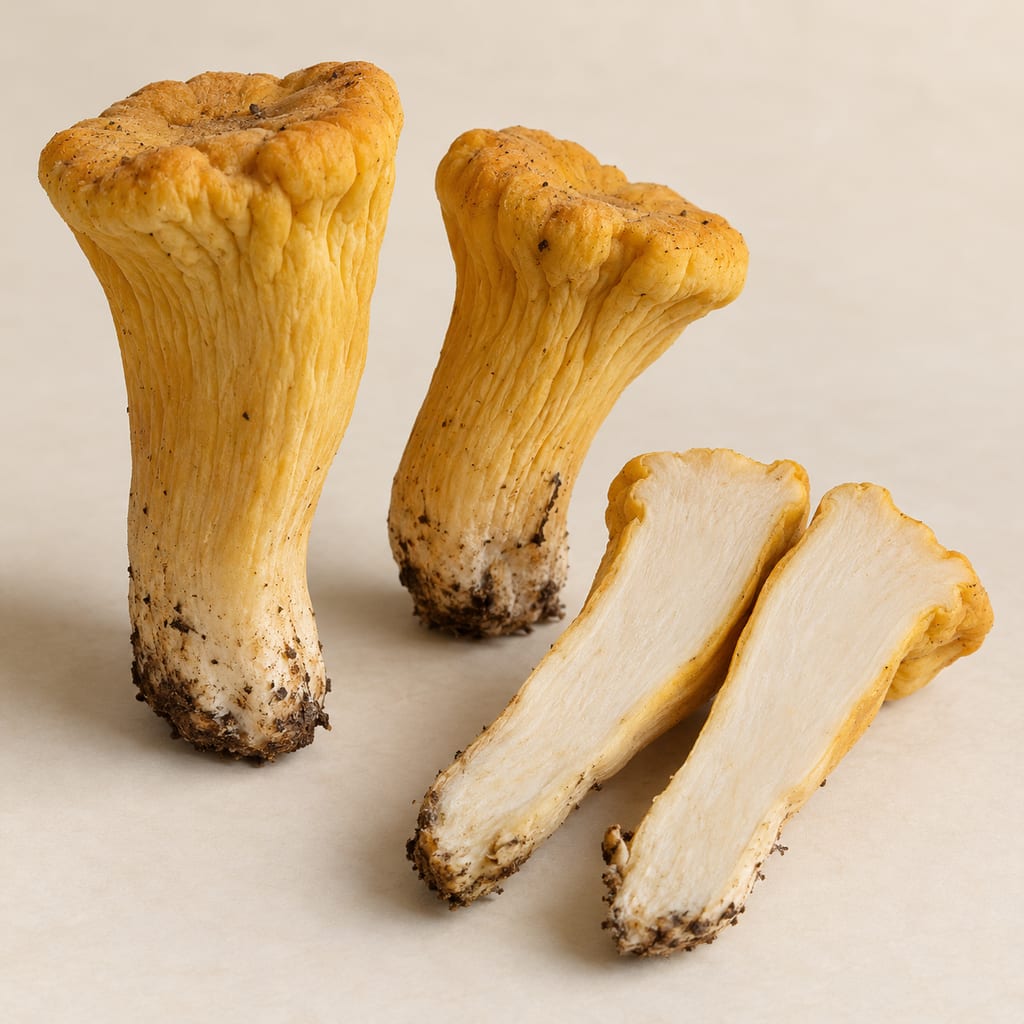
Clavariadelphus truncatus
A yellow to ochre club fungus reported as food in parts of Mexico and in historical country lists. Local acceptance and taxonomy vary, and some Chinese records may refer to Clavariadelphus amplus.
 FermenteaWhere food goes to change
Mushrooms
A peppery woodland bolete with historical edible labels and reported condiment use in Querétaro. Current mycological references call its edibility suspect or unestablished; this entry does not recommend consumption.
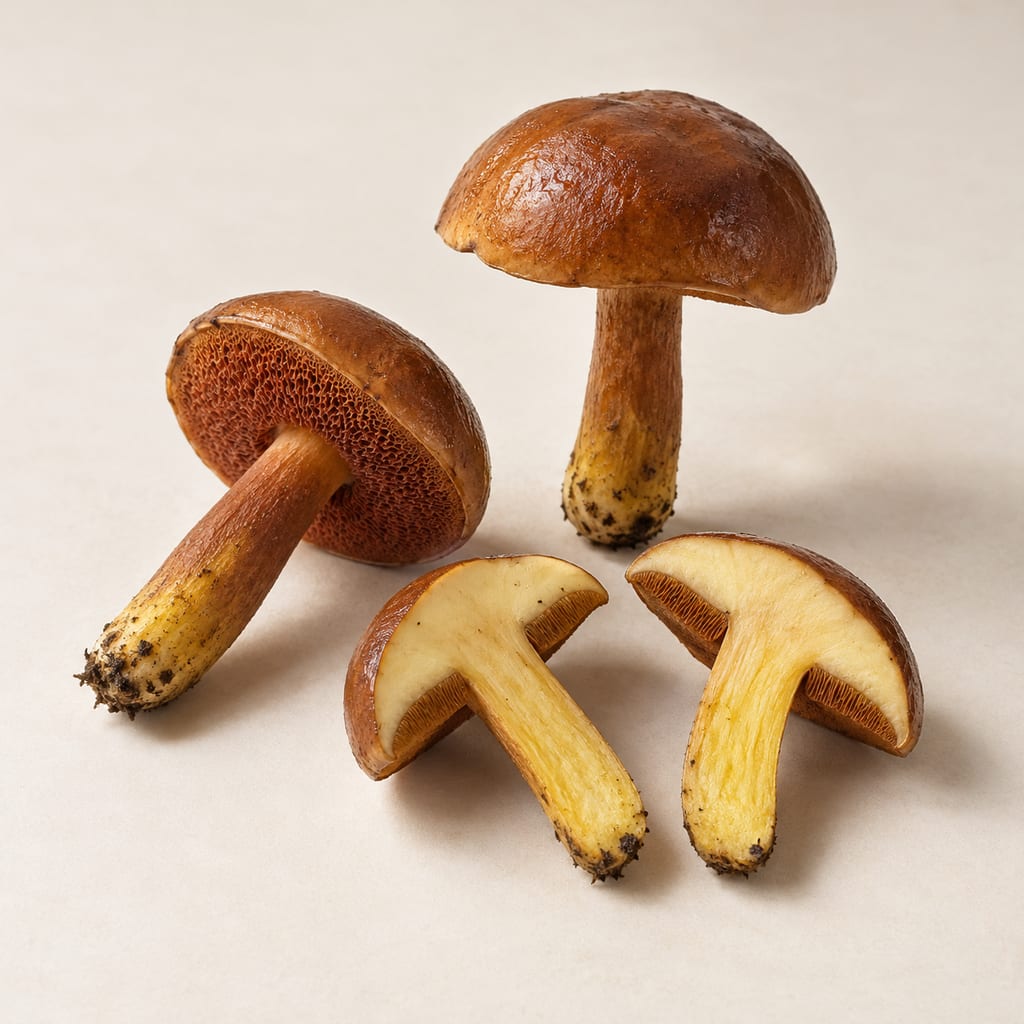
The accepted name Chalciporus piperatus (Bull.) Bataille dates to 1908; its earlier name is Boletus piperatus Bull. The species is placed in Boletaceae, within the order Boletales. Peppery bolete and pepper bolete are common English names. Field accounts describe a small ochre to reddish-brown cap, cinnamon or rust-coloured pores, and a slender stem with a vivid yellow base. A brown or pink-brown spore print is described in taxonomic guides. The details vary across regions and are not enough to identify a specimen for eating.
Guides report the fungus in temperate woodlands, sometimes with both broadleaf and conifer trees. Its ecological relationship is not fully settled in the sources reviewed: some accounts call it ectomycorrhizal, while field observations note its presence with Amanita muscaria. This page does not turn either association into a required identification feature.
European references place fruiting mainly from July to October, with an account from Denmark extending into November and a British/Irish source reporting that it may persist into the New Year in parts of Iberia and the Mediterranean. Alaska Mycoflora records collections in late August. These are region-specific guide windows and collection dates, not a global calendar. The historical country records for Mexico, Russia and Ukraine supply no seasons.
Boa's 2004 country table lists the species as edible for Mexico and for the Russian Far East. It marks Ukraine's entry [edible], which Boa explains signals uncertainty in the cited source. The companion global list includes the species under edible, but Boa warns that some such entries do not show that anyone actually eats the fungus. These classifications preserve what older sources said; they are not current safety advice.
The El Marqués biodiversity catalogue in Querétaro says the species is not considered edible, although it has been used as a condiment because of its strong pepper-like flavour. It records the species from El Pinalito. Naturalis calls it suspect; Alaska Mycoflora says it is not recommended because its edibility is not firmly established; and the University of Washington Burke Herbarium says it is not generally regarded as a good edible. No validated safe-preparation procedure or species-specific toxicology assessment was found in the sources reviewed here. This record therefore does not recommend collecting, tasting or eating wild Chalciporus piperatus.
The Mexico row is a country-level historical edible claim, distinct from the municipal El Pinalito observation and condiment-use note. The Russian entry is explicitly limited to the Far East. The Ukrainian classification is bracketed as uncertain. The project index also links a Brazilian audit whose occurrence confidence varies, but the material reviewed did not establish a locality or food-use claim for Brazil. None of these older tables should be read as a modern distribution atlas.
The sources reviewed describe no fermentation or preservation use. A report of pepper-like condiment use is not evidence that the species is suitable for fermentation. Because contemporary safety sources question its edibility, this record does not propose it for a fermented food.
El Marqués biodiversity catalogue says the species has been observed at El Pinalito and reports condiment use while stating it is not considered edible; no date or coordinates are supplied.
FAO Annex 2 lists an edible claim from source 7 (Villarreal and Pérez-Moreno 1989); this is a historical country-level label, not proof of contemporary consumption or safe edibility.
FAO Annex 2 explicitly limits its Russian Federation records to the Russian Far East and lists an edible label from Vasil'eva 1978; do not generalize to all Russia.
FAO Annex 2 records [edible] under Zerova and Rozhenko 1988; the brackets mean the source's use claim is uncertain.
The supplied project index associates BR2024 with a Brazil occurrence-confidence note, but this review did not confirm a species-level locality or food-use record; do not map Brazil as a verified population.
A yellow to ochre club fungus reported as food in parts of Mexico and in historical country lists. Local acceptance and taxonomy vary, and some Chinese records may refer to Clavariadelphus amplus.
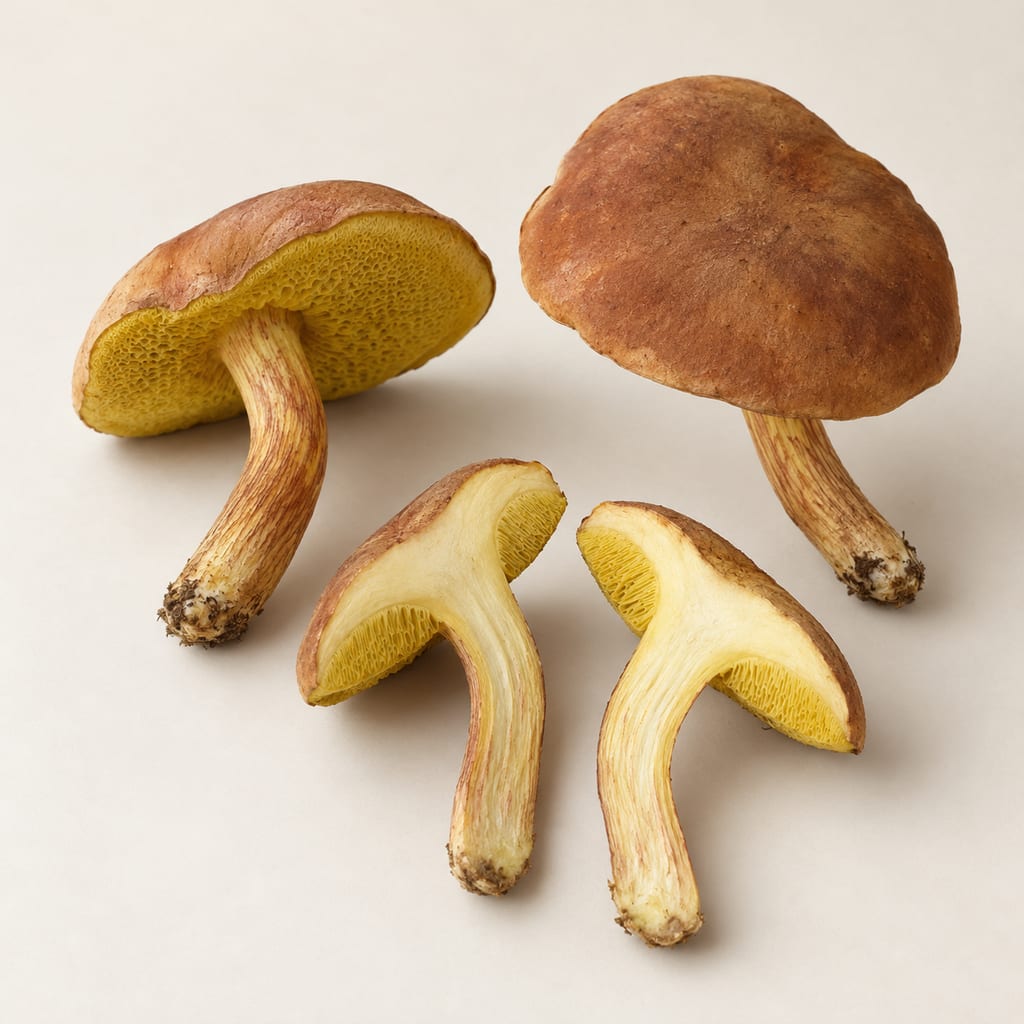
Xerocomus illudens, a forest bolete of Mexico that is gathered by some communities but was ranked low by others, partly because of its sour taste.
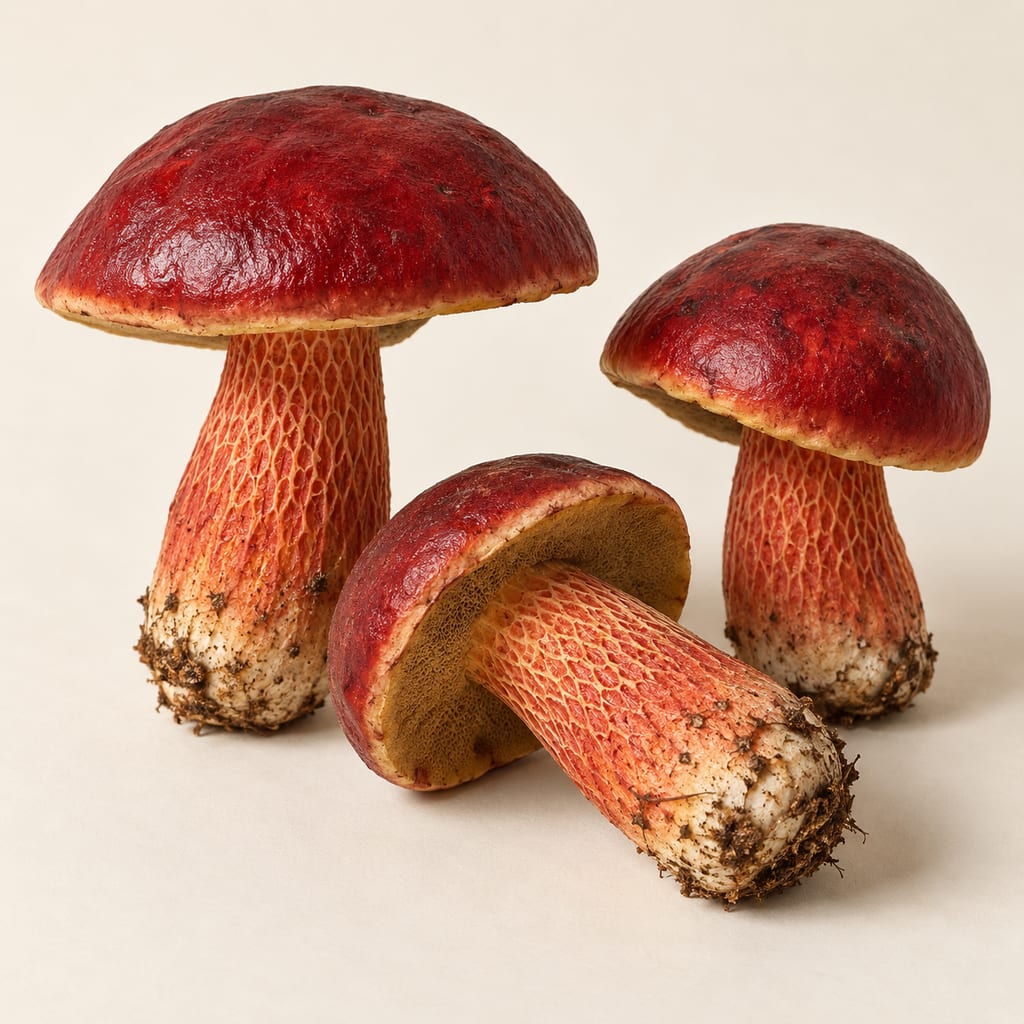
Frost's bolete, Exsudoporus frostii, is a red-pored bolete of oak woodland in eastern North America and Mexico. Its edibility is contested because it can be confused with poisonous red-pored boletes.
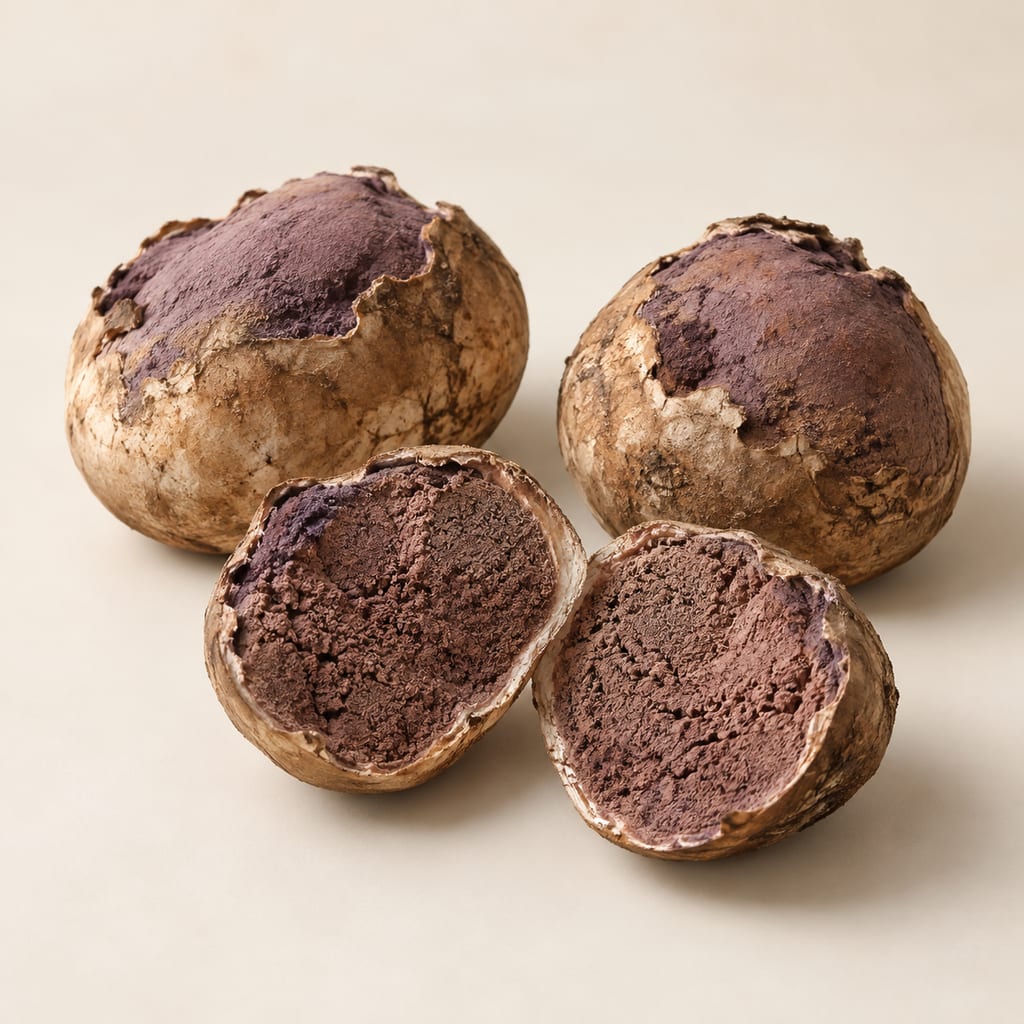
A soil-growing puffball, Calvatia cyathiformis, with white immature gleba that darkens purple as spores mature; food and seasonal records are local and do not establish a universal identification or safety rule.
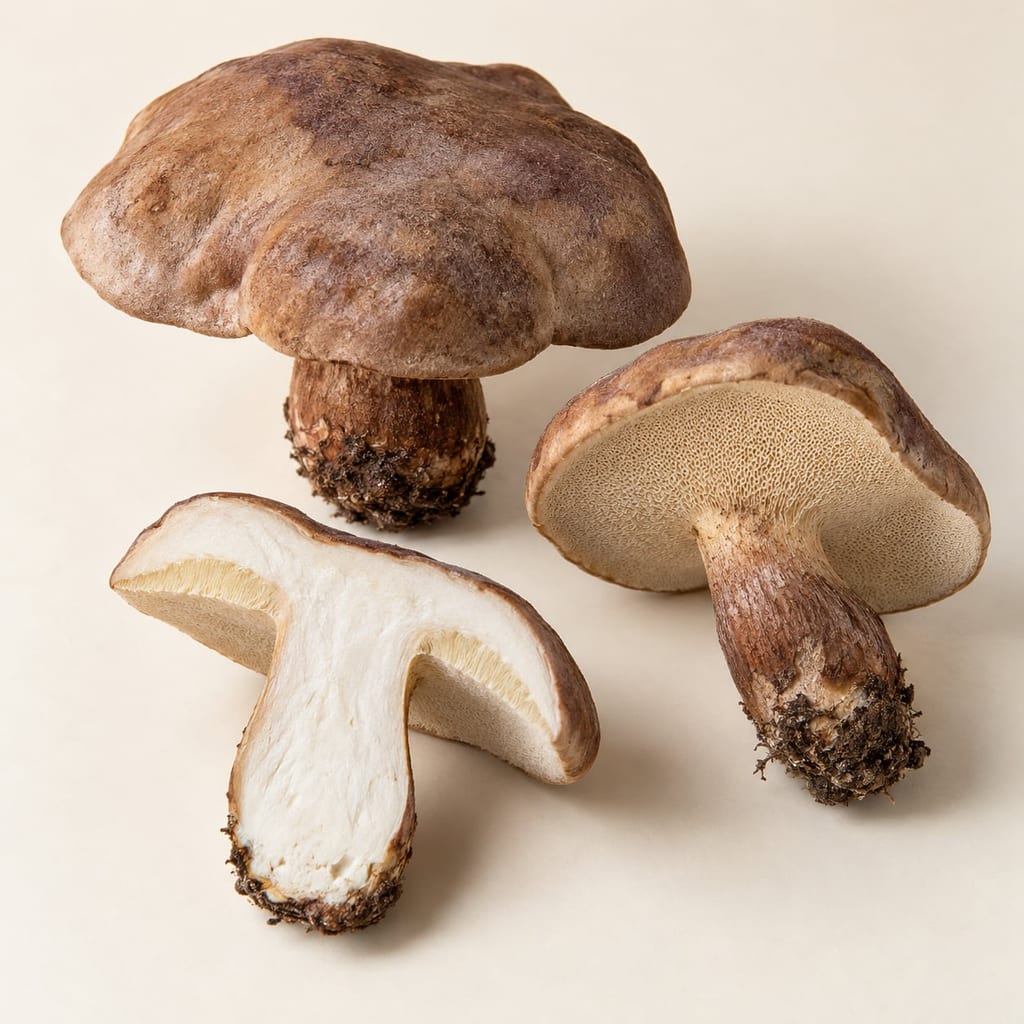
Wolfe's bolete, Fistulinella wolfeana, is a wild bolete of oak and oak-pine forest in eastern and southeastern Mexico, where Otomi communities in Amealco, Querétaro, gather and sell it as food.
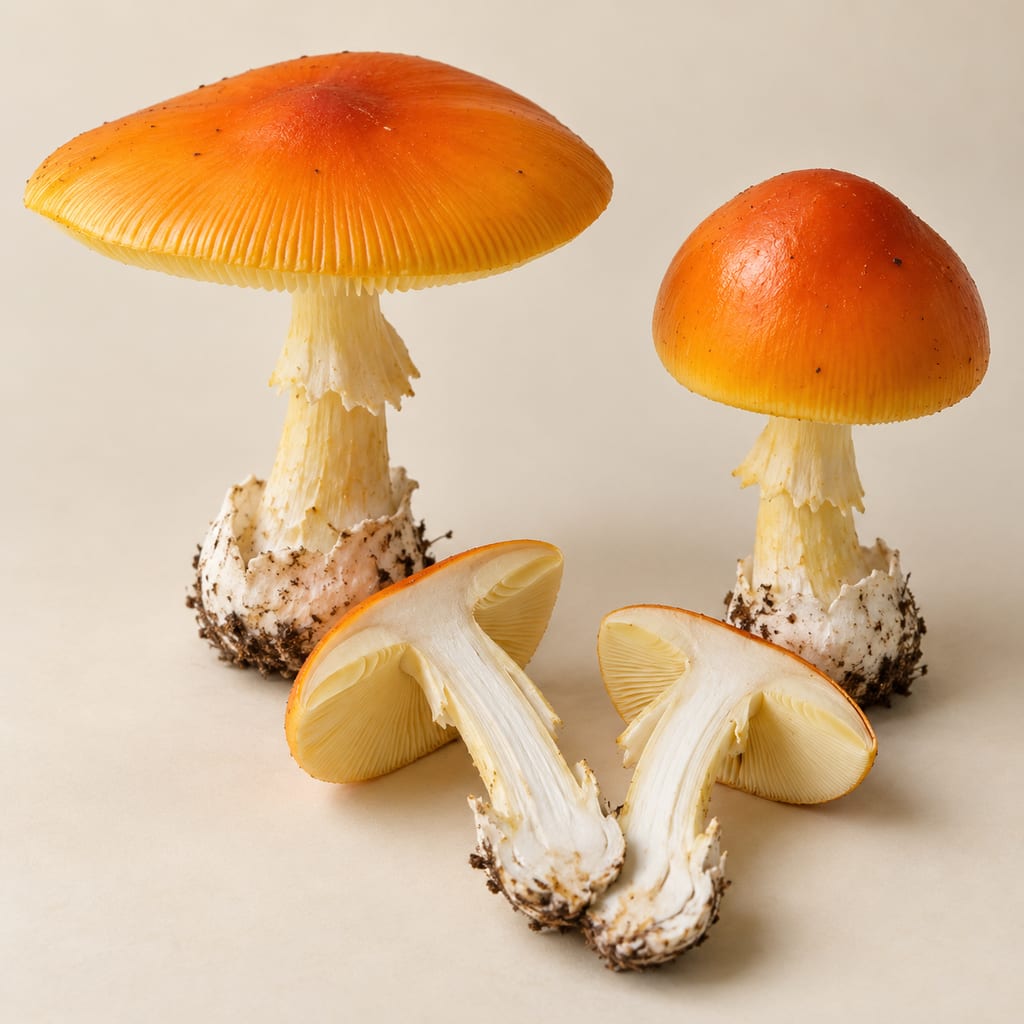
A wild Amanita valued in local foodways of Mexico and Guatemala. Community studies document seasonal gathering, market trade and distinct cooked preparations; species identity and Amanita safety require particular care.
No community contributions have been published for this entry yet.
Sign in to contribute. Published comments and photos are free to read.
FAOHistorical use · Geography
Wild edible fungi: a global overview of their use and importance to people — Annex 2Mexico entry is edible (7), with source 7 Villarreal and Pérez-Moreno 1989.
Russian Federation entry is edible (2), but the section note limits records to the Russian Far East.
Ukraine entry is [edible] under Zerova and Rozhenko 1988; Annex 2 explains brackets flag uncertainty in the source.
Cited in: Historical labels and present-day caution; Places are not interchangeable evidence
FAOHistorical use · Taxonomy
Wild edible fungi: a global overview of their use and importance to people — Annex 3The species is listed as edible in the compiled global list.
The introduction says edible labels do not always mean that a species is actually eaten and requires clear reports for a food-use classification.
Cited in: Historical labels and present-day caution
NCBI Taxonomy BrowserTaxonomy
Chalciporus piperatusAccepted current name, basionym Boletus piperatus, synonyms and taxonomic lineage.
Cited in: A small bolete with a peppery flavour
Species FungorumTaxonomy
Species Fungorum name record 311021Name authority Chalciporus piperatus (Bull.) Bataille, 1908 and basionym Boletus piperatus Bull. 1790.
Cited in: A small bolete with a peppery flavour
Biodiversidad El MarquésDescription · Local use · Geography · Safety
Chalciporus piperatusDescribes peppery bolete morphology and cinnamon-brown spore print.
Says the species is not considered edible but has been used as a pungent condiment.
Says the species has been observed at El Pinalito.
Cited in: A small bolete with a peppery flavour; Historical labels and present-day caution; No documented fermentation use
Naturalis Biodiversity CenterDescription · Ecology · Safety
Interactive Guide to Mushrooms and other fungi: Chalciporus piperatusGives field morphology, ectomycorrhizal context and classifies the species as suspect.
Cited in: A small bolete with a peppery flavour; Woodland habitat and a variable season; Historical labels and present-day caution
University of Washington Burke HerbariumSafety · Identification
Chalciporus piperatusSays the species is not generally regarded as a good edible.
Notes C. piperatoides as a lookalike with blue-staining tubes and olive spore print.
Cited in: Historical labels and present-day caution; No documented fermentation use
The Mycota of AlaskaSafety · Season · Geography · Ecology
Chalciporus piperatusSays edibility is not firmly established and the species is not recommended.
Records Quartz Creek Campground collections on 27 August 2014.
Cited in: Woodland habitat and a variable season; Historical labels and present-day caution; No documented fermentation use
NaturbasenSeason · Ecology
Peberrørhat (Chalciporus piperatus)Danish species page reports July to October, sometimes November, and summarizes pepper-substitute use.
Cited in: Woodland habitat and a variable season
First NatureSeason · Culinary context
Chalciporus piperatus, Peppery BoleteReports summer and autumn in Britain and Ireland and possible fruiting into the New Year in Iberian and Mediterranean areas; secondary field guide.
Cited in: Woodland habitat and a variable season
Université Claude Bernard Lyon 1Season · Culinary context
Chalciporus piperatusIndexed guide content reports occasional condiment use and July to October collection; page returned a maintenance notice when reopened.
Cited in: Woodland habitat and a variable season
IMA Fungus / Springer NatureResearch context · Geography
Over 400 food resources from Brazil: evidence-based records of wild edible mushroomsThe supplied index associates this audit with a Brazil occurrence-confidence note; the reviewed article material does not establish a species-specific locality or consumption claim for this draft.
Cited in: Places are not interchangeable evidence