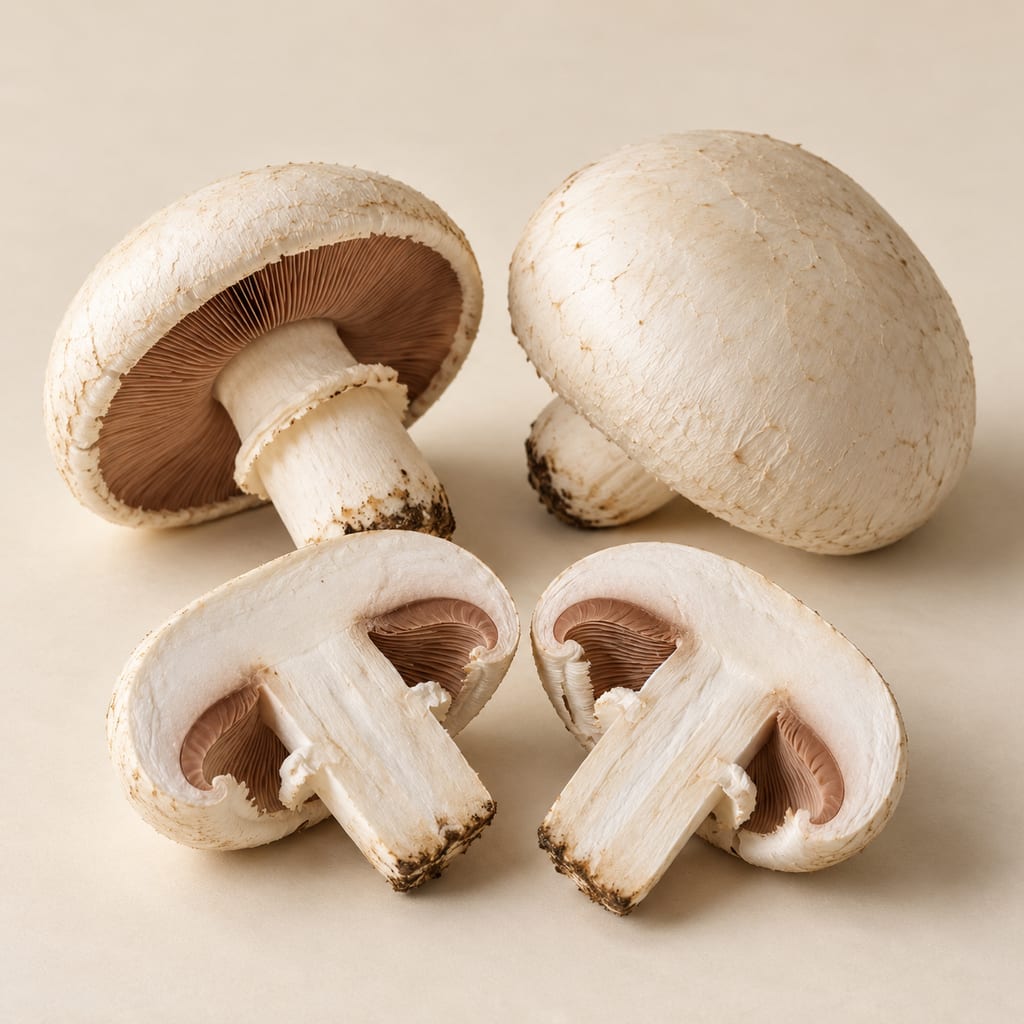
Field mushroom
The field mushroom (Agaricus campestris) is a wild grassland fungus with a long record of cooked food use in several regions. Local names, seasons and practices belong to particular communities.
 FermenteaWhere food goes to change
Mushrooms
A yellow to ochre club fungus reported as food in parts of Mexico and in historical country lists. Local acceptance and taxonomy vary, and some Chinese records may refer to Clavariadelphus amplus.
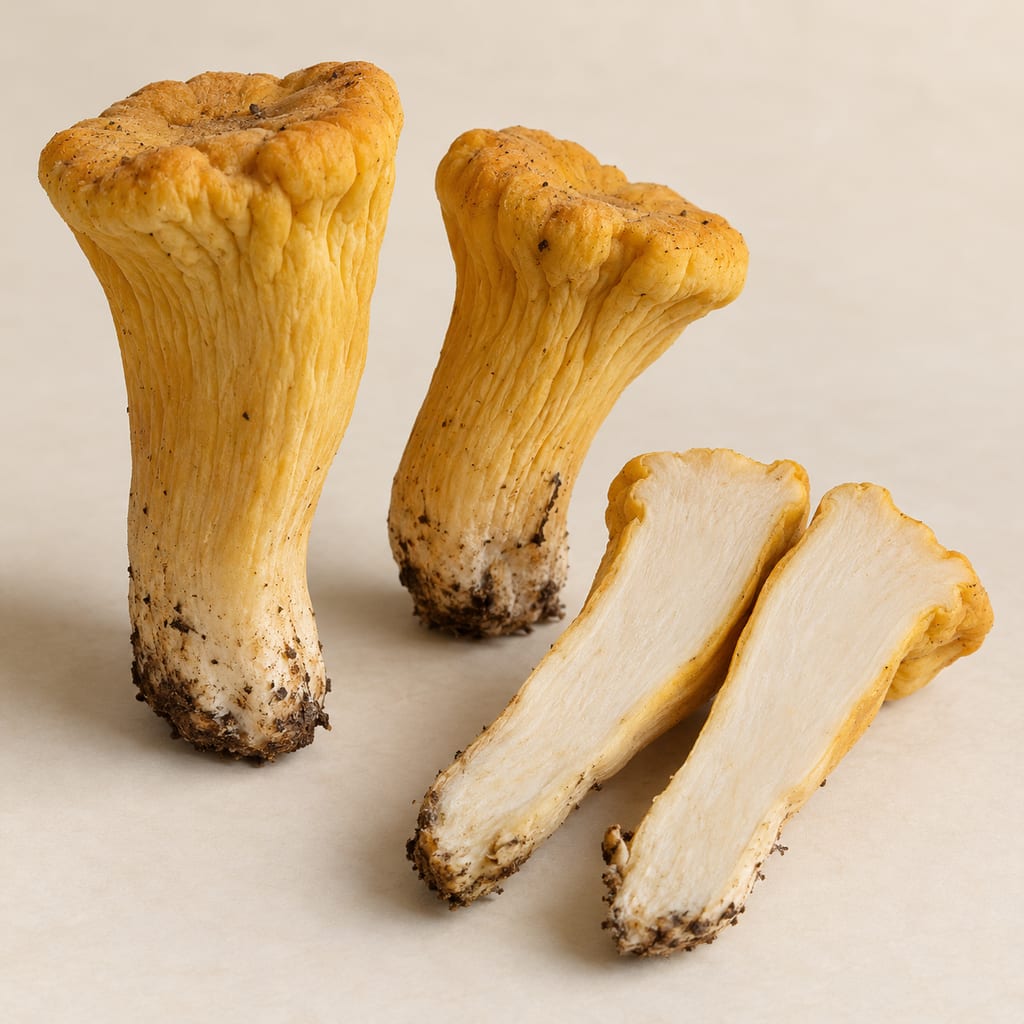
Clavariadelphus truncatus is a large, upright, unbranched club fungus whose fertile surface covers the outside of the fruit body. It is commonly described as yellow, ochre or orange, with a wide, blunt or flattened top and a base that narrows toward the ground. Some caps appear shallowly depressed or truncate; the surface can be wrinkled. Its pale flesh may feel soft or spongy. These descriptions explain the name and the range of forms reported in field guides, but they are not sufficient to identify a wild specimen safely.
It belongs to Clavariadelphaceae in Gomphales in current treatments. Older literature and some catalogues place the group in Gomphaceae, reflecting changing family limits. Clavaria truncata Quél. is a synonym encountered in regional records. Use of that old name should be searchable, but the accepted name and the specimen concept still need to be kept distinct from similar clubs.
Chinese taxonomy makes the name especially important. A modern revision of the genus reports that some earlier Chinese specimens identified as Clavariadelphus truncatus were in fact C. amplus, a similar club with a sterile, flattened apex. The revision therefore casts doubt on older Chinese range and food reports unless the underlying specimens can be checked using the revised characters. A 2014 Yunnan resource paper labels a photograph from Haba Snow Mountain as C. truncatus, but that identification predates the revision and remains provisional.
A 2026 Chinese edible-and-medicinal fungi catalogue includes C. truncatus, and a 2021 checklist of edible ectomycorrhizal mushrooms in China also lists it. These are checklist records; they do not by themselves establish a current local collection, a food market or a preparation method. The 2026 catalogue's full entry context and underlying local evidence were not accessible in this research pass.
The clearest localized field record comes from La Malinche National Park, Tlaxcala. Researchers collected specimens in Abies forest on the west side of Francisco Javier Mina, in the municipality of Trinidad Sánchez Santos, and on the west slope of Malintzi volcano, in San Luis Teolocholco. The voucher dates are in September 1999. In the same study area, only a few people considered the mushroom edible. That account is evidence of local knowledge and limited recognition, not a claim that it was commonly eaten.
A later Mexican biodiversity paper lists the species among fungi reported as edible in Tlaxcala, the State of Mexico, Oaxaca and Michoacán, drawing on previous records. These state-level references should not be turned into individual locality points. A UNAM profile describes it in connection with the Tenango del Valle market, where it has been called mujercita amarilla. The profile also corrects a story that labels it hallucinogenic: C. truncatus accompanies ceremonies in which the neurotropic Psilocybe muliercula is consumed. The effect must not be attributed to this club fungus.
The municipality of El Marqués, Querétaro, reports an observation at El Pinalito and describes a local use in desserts: the soft fruit body is milled or blended. The portal does not give a voucher or a precise collection coordinate, and the reported preparation was not independently corroborated. Keep this claim attached to its place and source rather than generalizing it across Mexico.
In the La Malinche study, the species was collected in August and September during a broader field programme conducted in the rainy season. A Mexican field guide reports August–September fruiting at roughly 2,800–3,200 metres in conifer or mixed pine–oak forest. El Marqués describes summer and autumn fruiting in high pine forest. These accounts are consistent with a warm-season rainy-period pattern at the named Mexican sites, but they do not establish a universal calendar.
A northern Russian conservation account describes rare August–September fruiting in spruce and spruce–birch green-moss forest in Lapland and Kandalaksha protected areas and near Umba, and only in climatically favourable years. That is a regional occurrence observation, not evidence of local food use. No verified China-specific fruiting window was found.
Ecological descriptions disagree about nutritional mode. Mexican sources associate the species with conifers and sometimes oak, while the Russian source calls it a humus saprotroph. Retain the forest and ground associations as observations; a single ecological classification should not be imposed without modern species-specific evidence.
The available food evidence is not uniform. The La Malinche study says only a few residents considered it edible, and Mexican guides describe its culinary value as low. Some local reports value the sweet taste, associated with mannitol, while describing the flesh as soft or spongy. The El Marqués portal's dessert claim is the only preparation-like account located here, and it needs corroboration before it becomes a recipe or a general serving suggestion.
FAO's 2004 global overview lists food or edible reports from Mexico and Russia among its historical records. FAO explains that the country annex is a preliminary compilation of published information and that the label edible does not always establish that people consumed the fungus; its global annex distinguishes clearer food-use reports. The Russian entry cites Vasil'eva (1978) but gives no locality. The 2026 China checklist adds a scientific edible-and-medicinal classification, but does not supply an inspected local preparation in the accessible evidence.
A local municipal source says some people use it in desserts and cautions that larger amounts may have a laxative effect. That statement is not a clinical finding and is not a dose recommendation. No species-specific cooking method, preservation method, storage guidance, fermentation process or validated food-safety procedure was established in the reviewed sources.
C. truncatus is a gathered raw food in the records reviewed here, not a fermented preparation. No source found documents it as a fermentation substrate, starter, enzyme source or preserved ferment. The page can describe the mushroom as an ingredient candidate, but it should not claim that it contributes a known microbial, enzymatic or acidification role to fermentation. A future recipe-specific use would need its own source and method evidence.
This profile is not a field-identification guide or an invitation to collect wild fungi. The strongest geographic and food claims are tied to named source records, and Chinese identity errors are documented. No species-specific toxicological assessment was found. Government food-safety guidance warns generally that wild mushroom misidentification can cause serious poisoning; that warning does not establish that this taxon itself is poisonous.
The history reported here should remain regional and qualified: limited edible recognition at La Malinche, a dessert-use claim from El Marqués that needs confirmation, historical country lists for Russia, and a Chinese edible checklist with unresolved identity context. Do not collapse those claims into a global edible badge or recommend that readers gather and eat a specimen.
Named study locality and voucher; coordinates not established by the cited source. Only a few residents considered it edible.
Named study locality and voucher; coordinates not established by the cited source.
Municipal biodiversity page reports occurrence and dessert use after grinding/blending; no voucher, precise point or independent corroboration.
Country-level historical food references; not a point locality or evidence of uniform use.
Country-level edible listing cites Vasil'eva (1978); not a collection point or evidence of local preparation.
Regional conservation report documents rare occurrence; this source does not establish food use.
Checklist inclusion only; historical names may include C. amplus and the full 2026 entry context was not retrieved.
The field mushroom (Agaricus campestris) is a wild grassland fungus with a long record of cooked food use in several regions. Local names, seasons and practices belong to particular communities.
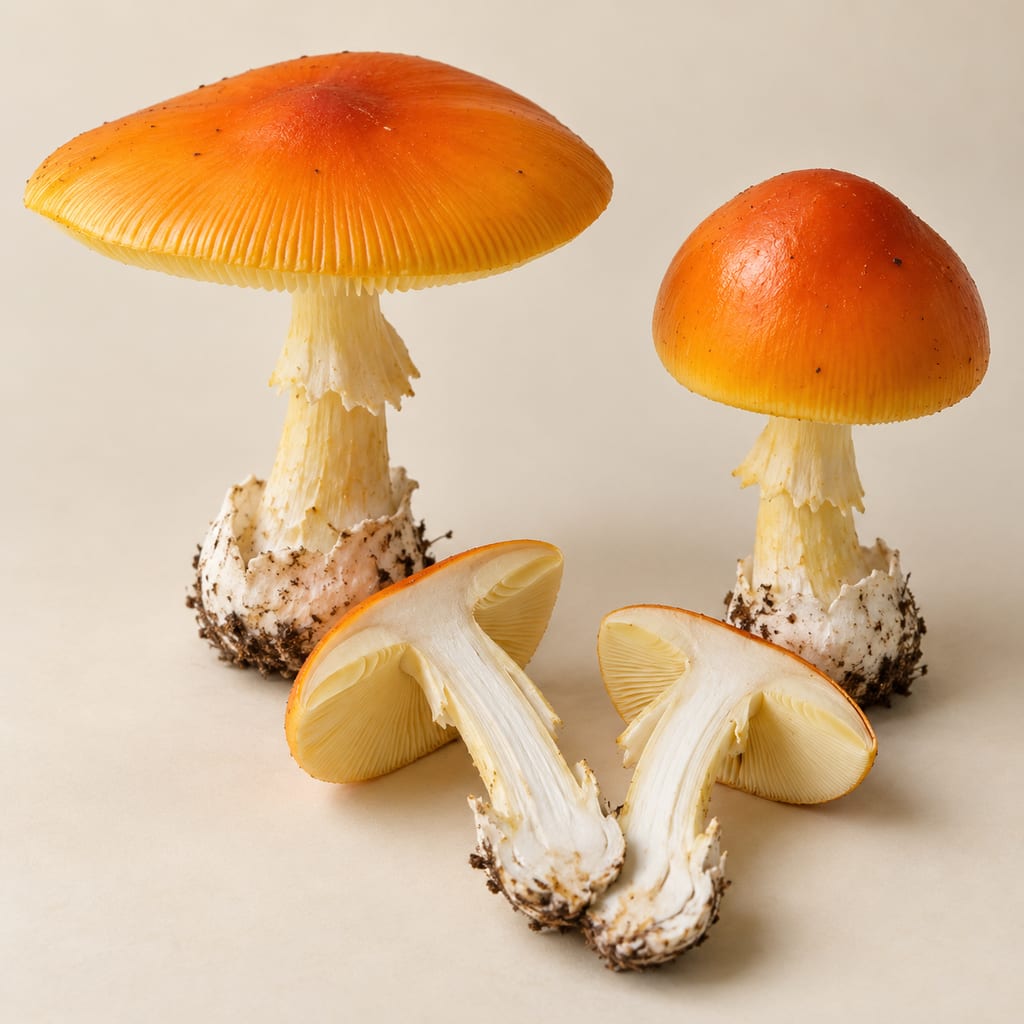
A wild Amanita valued in local foodways of Mexico and Guatemala. Community studies document seasonal gathering, market trade and distinct cooked preparations; species identity and Amanita safety require particular care.
No community contributions have been published for this entry yet.
Sign in to contribute. Published comments and photos are free to read.
Fungal Diversity 17Identity · Geography · Season · Food use
Useful wild fungi of La Malinche National Park, MexicoVoucher localities and September 1999 dates
Abies forest context
Only a few local people considered C. truncatus edible
Cited in: Mexico: forest vouchers and uneven food recognition; Season and habitat depend on region; Food use is local, historical and qualified; What the fermentation record does not show
Food and Agriculture Organization of the United NationsHistorical food use · Historical edible claim
Wild edible fungi: a global overview — Annex 2 country recordsPreliminary country records
Mexico and Russian Federation entries and source references
Limits of country-level record and edible classifications
Cited in: Food use is local, historical and qualified
Food and Agriculture Organization of the United NationsFood history · Historical edible claim
Wild edible fungi: a global overview — Annex 3 global listFAO distinguishes food reports from edible classifications
Cited in: Food use is local, historical and qualified
Revista Mexicana de BiodiversidadTaxonomy · Geography · Season
Riqueza y endemismo de las especies de Clavariadelphus (Clavariadelphaceae: Gomphales) en la Faja Volcánica TransmexicanaMexican state-level reports of edible recognition
Rainy-season reports and species-complex concerns
Cited in: Mexico: forest vouchers and uneven food recognition
Universidad Nacional Autónoma de MéxicoIdentity · Geography · Season · Cultural context
Clavariadelphus truncatus (Quél.) DonkTenango del Valle market name and cultural context
Correction distinguishing accompanying C. truncatus from neurotropic Psilocybe muliercula
High-altitude forest and Aug-Sep reports
Cited in: Mexico: forest vouchers and uneven food recognition; Season and habitat depend on region
Municipality of El Marqués, QuerétaroGeography · Season · Food use
Clavariadelphus truncatusEl Pinalito occurrence report
Summer/autumn observation
Sweetness, dessert milling/blending claim and laxative caution, not independently corroborated
Cited in: Mexico: forest vouchers and uneven food recognition; Season and habitat depend on region; Food use is local, historical and qualified; What the fermentation record does not show; Identification and consumption limits
MycoKeysTaxonomy · Safety
The genus Clavariadelphus (Clavariadelphaceae, Gomphales) in ChinaOlder Chinese C. truncatus reports include C. amplus
Current taxonomic distinction and identification concerns
Cited in: A broad-topped club, not a capped mushroom; A Chinese name history that needs care; Identification and consumption limits
Mycosystema 40(8)Historical edible claim
A checklist of edible ectomycorrhizal mushrooms in ChinaLists C. truncatus in the edible ectomycorrhizal checklist; not recipe or safety validation
Cited in: A Chinese name history that needs care
Mycosystema 45(1)Historical edible claim
Species cataloging of edible and medicinal fungi in ChinaSearch-visible catalogue lists C. truncatus as edible and medicinal; full entry context not retrieved
Cited in: A Chinese name history that needs care; Food use is local, historical and qualified
Kunming Institute of BotanyGeography · Identity
Research progress on fungal resources in the Lancang–Mekong River basinA 2014 image caption labels a specimen/photo from Haba Snow Mountain, Yunnan as C. truncatus; identification remains provisional
Cited in: A Chinese name history that needs care
Russian regional biodiversity publicationGeography · Season · Ecology
Murmansk regional fungal conservation reportRare August-September fruiting in spruce and spruce-birch forest in named protected areas and near Umba
No food use established by this source
Cited in: Season and habitat depend on region
Hong Kong Centre for Food SafetySafety
Wild Mushrooms – Numerous Species and Numerous ToxinsGeneral warning on wild mushroom misidentification; not species-specific toxicology
Cited in: Identification and consumption limits
Index FungorumTaxonomy · Nomenclature
Clavariadelphus truncatus (Quél.) DonkAccepted name and synonym record for Clavaria truncata Quél.
Cited in: A broad-topped club, not a capped mushroom