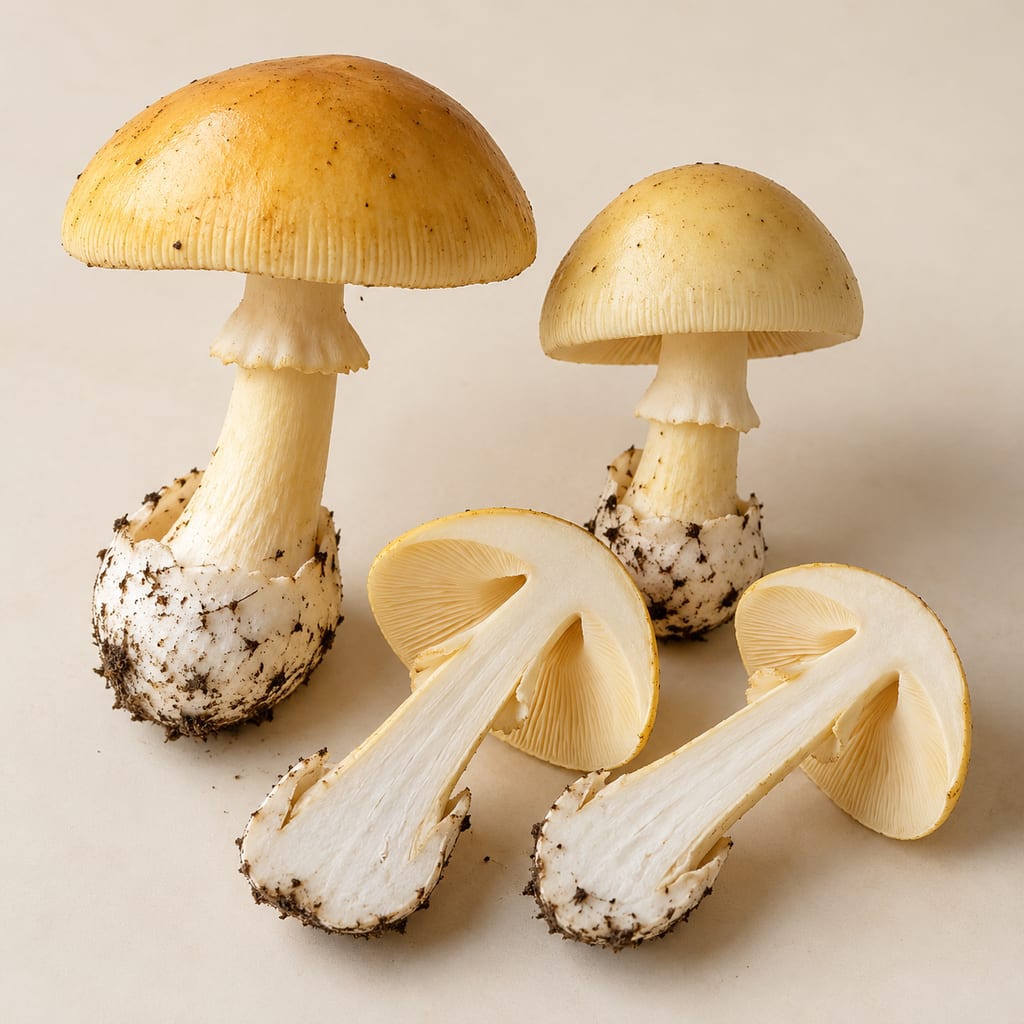
Hongo real
Hongo real is the Spanish name recorded in Mexico for Amanita laurae, a forest mushroom that the Wixaritari of Jalisco have a documented food-use record for. The name is a local label, not an identification.
 FermenteaWhere food goes to change
Mushrooms
The field mushroom (Agaricus campestris) is a wild grassland fungus with a long record of cooked food use in several regions. Local names, seasons and practices belong to particular communities.
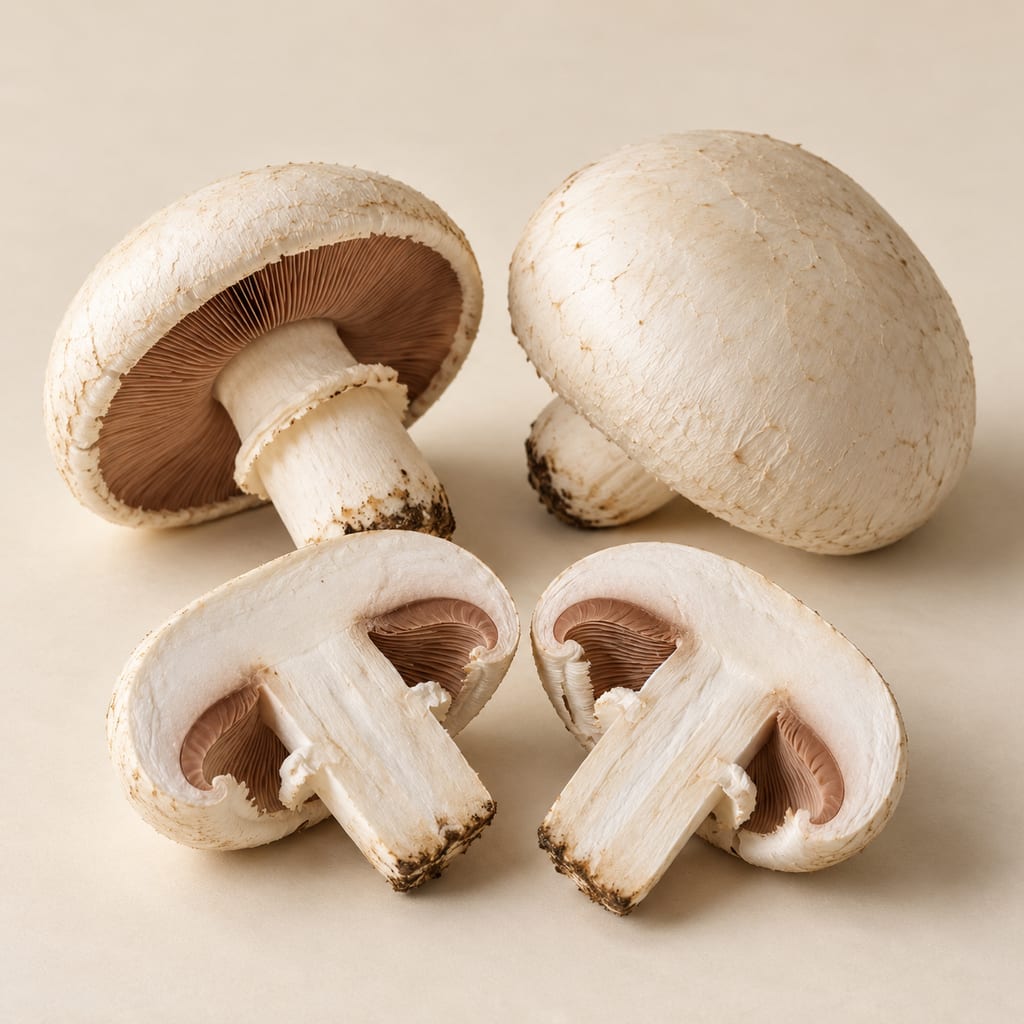
The field mushroom, Agaricus campestris, belongs to the same genus as the cultivated button mushroom, but it is a distinct wild species. English names include field mushroom and meadow mushroom. EPPO also records Feldegerling and Wiesenegerling in German, agaric champêtre and rosé-des-prés in French, champiñón silvestre in Spanish, and prataiolo in Italian. These common names belong to different languages and should not be treated as one uniform culinary tradition.
Its fleshy cap starts rounded and opens with age. Institutional descriptions range from white to off-white, sometimes with pale pink tones and fine brownish fibres. The close gills are free from the stem. They begin pale pink, deepen in colour, and turn dark brown as the spores mature. A thin white ring sits high on a solid stem that can taper toward its base. Cut flesh is white and may show a slight reddish or pink response. These are reported species traits, not enough to identify an individual wild mushroom safely.
Agaricus campestris is saprotrophic: it obtains nutrients from dead organic matter in soil rather than forming a tree-root partnership. It can grow alone or in groups, sometimes in rings, in grasslands and pastures. Mexican records also place it in oak woods, scrub and sub-arid grassland, pine and fir forests, and urban, suburban and agricultural ground in the Valley of Mexico. A species name therefore does not imply one uniform landscape.
The fruiting body is only the brief visible part of a fungus that lives in the soil as a network of hyphae. Its open-ground ecology helps explain why it enters pasture and meadow food traditions, but habitat cannot prove identity. Similar-looking mushrooms can grow in the same place.
People use the field mushroom under names tied to local languages and communities. In Villa Guerrero, Jalisco, a study of Wixarika and mestizo mushroom knowledge recorded 234 specimens of A. campestris and listed it as edible. It recorded the Wixarika names Pɨsɨ and Pixɨxɨitsi and the mestizo names hongos de tierra and sombrillita. These names are not interchangeable translations; each belongs to a particular community and context.
The same study describes terrestrial mushrooms such as A. campestris as among the first fungi consumed locally and notes simple preparations that let the mushroom flavour stand out. A UNAM species account also records sale in Mexico City and other markets and describes the mushroom as culturally important in several regions. This is evidence of specific modern food practices, not a single national cuisine or a history with a known starting date.
Peruvian sources describe A. campestris as an edible mushroom collected and consumed in the Andes. A 2025 nutrition study calls it k’allampa and sampled fruit bodies in Cusco; a 2025 review also reports local gathering for household consumption and market sale in Ancash. Those records add Andean contexts without making Peruvian and Mexican practices the same.
Fruiting follows local weather and habitat. In Villa Guerrero, Jalisco, study participants identified A. campestris as one of the first mushrooms to appear after the first rains, in the last week of June. The UNAM account places fruiting around La Malinche in Tlaxcala around April and May, near the local start of the rains. A Peruvian review reports September–December collection in named Ancash locations, with timing attributed to personal communication cited in that review.
UK field sources give later windows: one guide lists May to November, another July to October. These dates do not conflict so much as describe different climates and local observations. None should be copied into a worldwide harvest calendar.
The field mushroom is an ingredient gathered as a fungus, not a fermentation starter. The sources document cooked mushroom use, household dishes and market trade; they do not establish a species-specific fermentation, curing or drying tradition. A recipe that names a mushroom ferment should not silently treat generic mushroom research as proof that A. campestris was used.
Its documented role here is as food in cooked dishes. Any future fermented preparation would be a modern adaptation requiring its own source and process record. Fermentation is not an identification method and is not shown by these sources to make an unknown wild mushroom safe.
These accounts describe a fleshy mushroom whose gills change from pink to brown as it matures. They record wild supply and several regional uses, but do not establish one universal cleaning method, commercial grade, storage life or cooking schedule. Those details are left open rather than filled with generic instructions.
A wild A. campestris can be confused with other Agaricus species, including poisonous ones, and immature white-gilled Amanitas can be dangerous lookalikes. Pink-to-brown gills, a ring and the absence of a volva are features used in field descriptions, but a photograph or single feature cannot identify an individual specimen. A database entry about an edible species is not approval to eat a wild find. This page documents regional use, not foraging advice; an uncertain mushroom should not be eaten.
The supplied research catalogue keeps Agaricus campestris as a working label and warns that not every catalogue entry has been independently reconciled. EPPO lists A. campestris with Linnaeus authority as its preferred name and records common names across several European languages. Nomenclature, local food use and the safety of a particular specimen are separate questions.
The evidence here supports a wide set of regional records across Mexico, Peru, Europe and other temperate places, while detailed use and season information remains tied to specific sources. It does not establish a single origin, an earliest human-use date or one practice shared by everyone who uses the name field mushroom.
A study documents Wixarika and mestizo food use and names here; this is a locality record, not an origin claim.
The UNAM account reports occurrence and community-associated fruiting in this state; it does not define a universal Mexican season.
The sources describe records across multiple states and local food traditions, not an even national distribution.
The seasonal report is attributed in the review to local personal communication; it is not a range-wide season.
The cited study sampled locally named k’allampa in Cusco; this records documented use and sampling, not a distribution boundary.
Peruvian sources document edible use in the Andes; this country-level association is not a claim of uniform use or origin.
UK field guides document occurrence, season and cooked food use; their month ranges are local guidance, not a global calendar.
Hongo real is the Spanish name recorded in Mexico for Amanita laurae, a forest mushroom that the Wixaritari of Jalisco have a documented food-use record for. The name is a local label, not an identification.
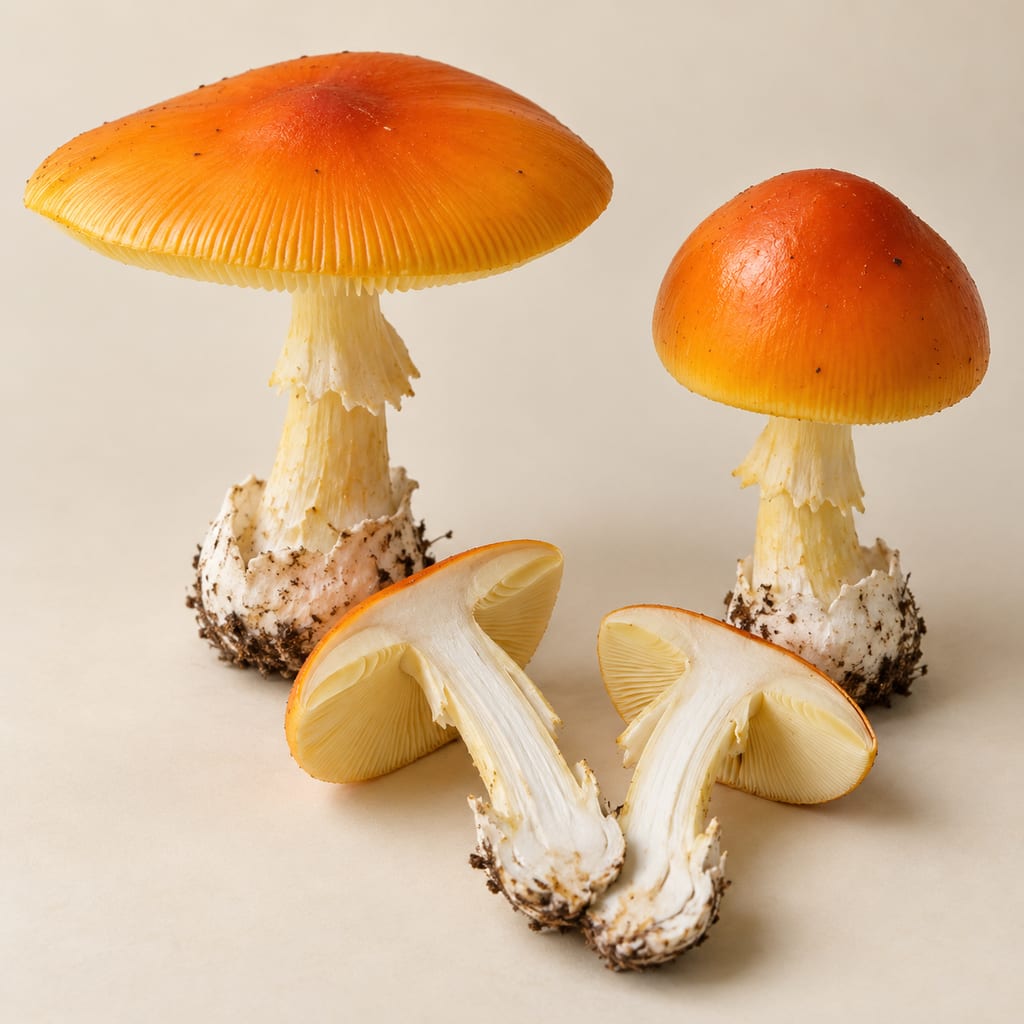
A wild Amanita valued in local foodways of Mexico and Guatemala. Community studies document seasonal gathering, market trade and distinct cooked preparations; species identity and Amanita safety require particular care.
No community contributions have been published for this entry yet.
Sign in to contribute. Published comments and photos are free to read.
Hongos Comestibles de México, Instituto de Biología, Universidad Nacional Autónoma de MéxicoIdentity · Morphology · Habitat · Distribution · Seasonality
Agaricus campestrisTaxonomic name and authority; saprotrophic grassland and other Mexican habitats; state-level Mexican and global distribution; cap, gill, stem and flesh description; community-associated fruiting around La Malinche in Tlaxcala at the rainy-season onset.
Cited in: A grassland Agaricus; A fungus of open ground; Food use and local knowledge; Seasons are local; Choosing and cooking; Names and scope
EPPOIdentity · Taxonomy · Common names · Food use
Agaricus campestris (AGARCA) | EPPO Global DatabasePreferred name and Linnaeus authority; multilingual common names; database edible status.
Cited in: A grassland Agaricus; Names and scope
IMA FungusTraditional use · Local names · Seasonality · Geography
Traditional knowledge, uses, and perceptions of mushrooms among the Wixaritari and mestizos of Villa Guerrero, Jalisco, MexicoTable 1 records 234 A. campestris specimens as edible and gives Wixarika and mestizo names; study describes June fruiting after first rains, regional food use and simple mushroom dishes.
Cited in: Food use and local knowledge; Seasons are local; A raw ingredient, not a starter culture; Names and scope
Lilloa, Fundación Miguel LilloDocumented use · Geography · Seasonality
Los hongos comestibles en el PerúReview places A. campestris among edible fungi gathered and consumed in the Andes; reports local collecting and market use in Ancash, with September–December timing attributed to personal communication.
Cited in: Food use and local knowledge; Seasons are local; Names and scope
Revista Chilena de NutriciónFood use · Geography · Identity
Proximate composition, polyphenol quantification, and antioxidant activity of the edible mushroom Agaricus campestris L. “k’allampa”Article describes A. campestris as widely consumed in the Peruvian Andes, locally called k’allampa; specimens were collected in Kcana Janansaya, Kunturkanki district, Canas province, Cusco.
Cited in: Food use and local knowledge
Wild Food UKMorphology · Seasonality · Habitat · Cooking
Field MushroomUK guide describes pink gills darkening brown, field and pasture habitat, May–November season and recommends cooking before eating.
Cited in: A fungus of open ground; Seasons are local; A raw ingredient, not a starter culture; Choosing and cooking
ForageGBIdentity · Seasonality · Habitat · Safety
Field Mushroom (Agaricus campestris): UK ID guideUK page reports permanent pasture, meadows and lawns; July–October season; pink-to-brown gills and safety limitations of visual identification.
Cited in: Seasons are local; Choosing and cooking