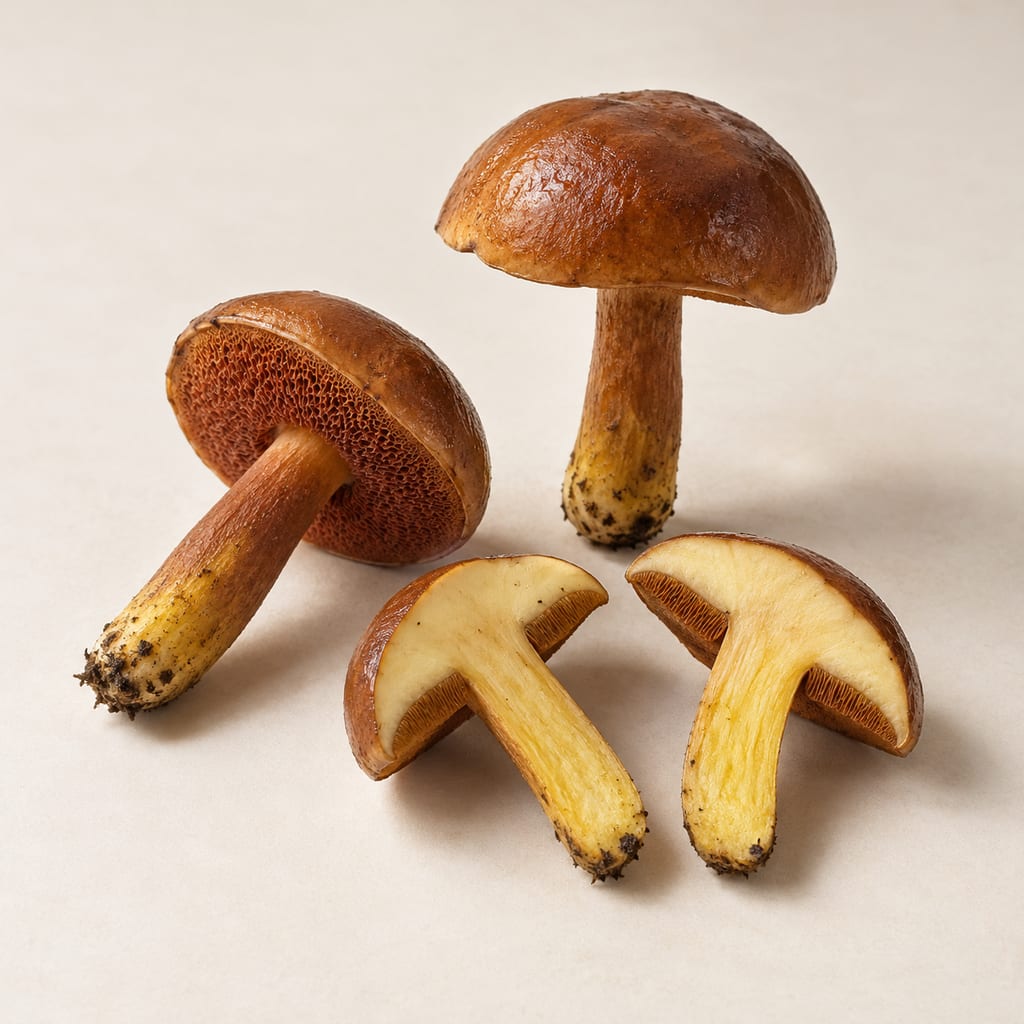
Chalciporus piperatus
A peppery woodland bolete with historical edible labels and reported condiment use in Querétaro. Current mycological references call its edibility suspect or unestablished; this entry does not recommend consumption.
 FermenteaWhere food goes to change
Mushrooms
A wild Amanita valued in local foodways of Mexico and Guatemala. Community studies document seasonal gathering, market trade and distinct cooked preparations; species identity and Amanita safety require particular care.
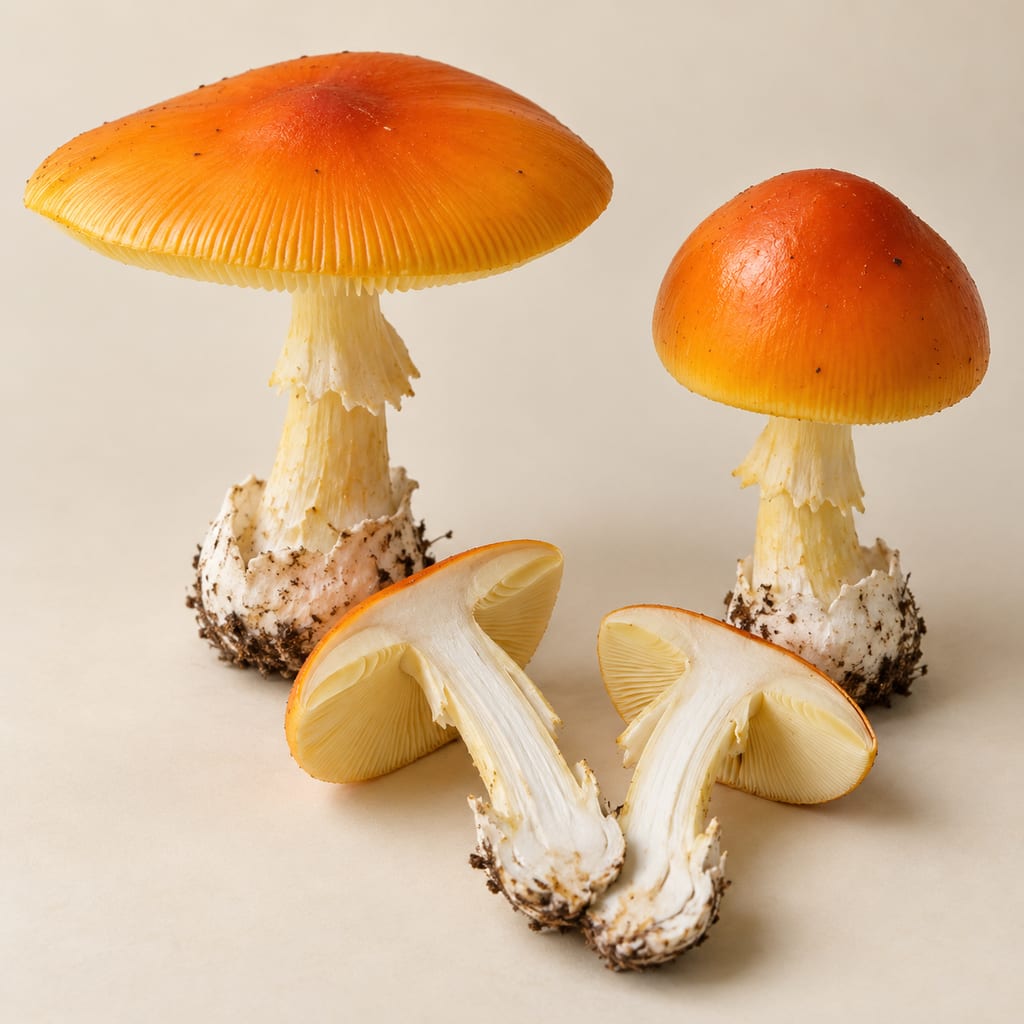
Yema is the name used for this ingredient. It is attached to Amanita basii, the scientific name published by Gastón Guzmán and Florencia Ramírez-Guillén in 2001. Current taxonomic databases list A. basii as a species in the family Amanitaceae. The 2001 treatment examined the broader Amanita caesarea complex and emphasized how earlier names and identifications could cover several distinct species. These points can coexist: the name is currently accepted by taxonomic indexes, while an individual fruiting body sold or described as a caesarea-like mushroom may still be difficult to assign with confidence from a photograph, common name or market label.
Local names are tied to people and places, not interchangeable botanical labels. A study in San Isidro Buensuceso, Tlaxcala, records hongo amarillo and the Nahuatl names āyoh-xōchitl and āquiyoxōchitl for A. basii. GBIF lists hongo de oro and Bas’ Caesar among common-name records. In northern Jalisco, Wixarika sellers translated yekwá as hongo real for A. basii or A. laurae; that phrase does not identify A. basii alone. Yema, hongo amarillo, hongo de oro and hongo real should therefore not be treated as universal synonyms, nor as names that make an unknown mushroom safe to eat.
The taxonomic treatment places A. basii among the Mexican Amanita caesarea-complex species, a group whose members can be confused when names are carried from one region to another. Names such as Caesar’s mushroom or yema de huevo are also used for other species in the complex. Keeping the Latin name beside each documented local name helps preserve the difference between a folk category, a market term and a species determination.
The records describe A. basii as a wild forest mushroom. Species Fungorum links its type collection to humus in a Pinus–Quercus forest in Durango. Ethnomycological work in northern Jalisco describes it as mycorrhizal: its underground growth is associated with tree roots. That relationship is part of what makes this mushroom different from a fungus grown on a prepared bed of sawdust or compost. The reviewed sources do not give a commercial cultivation method or document a dependable cultivated supply.
A mushroom is the brief, visible fruiting body of a fungus whose longer-lived growth is in the soil and connected to its forest partners. For that reason, a market crop cannot be planned from the cap alone. Habitat, tree community, rain and the work of local collectors all shape what appears and what reaches a market. A type locality is evidence of where the scientific name was anchored; it is not proof that the species occurs throughout every pine or oak forest in Mexico.
Field observations and community studies put the mushroom in seasonal forest foodways rather than year-round agriculture. In Amealco, researchers describe mushrooms collected from the forest mainly during the rainy season. At San Juan Sacatepéquez, sellers’ supplies and sales changed with rainfall and abundance. These reports explain why availability can be concentrated into a short local window and why the same market can offer different mushrooms at different points in the season.
In the three Otomí communities studied in Amealco de Bonfil, Querétaro, researchers interviewed 100 people from August 2013 to November 2014. They recorded 33 mushroom species; A. basii ranked among the species with the highest cultural-significance scores. The authors report that forest mushrooms were collected mainly in the rainy season. For this region, that seasonal pattern is a useful account of when mushrooms mattered in household food gathering, not a calendar that can be transferred to every forest or year.
The northern Jalisco study follows Wixarika and mestizo relationships with mushrooms in Villa Guerrero. It describes A. basii as one of the mycorrhizal mushrooms especially valued by Wixarika participants. People gathered mushrooms for their own households, shared them with relatives, or sold them. Researchers recorded sales of A. basii in neighbouring municipalities such as Mezquitic and Bolaños. The study also describes difficult collection sites and uneven local access, so market supply was not simply a matter of demand.
In San Juan Sacatepéquez, Guatemala, a four-year ethnomycological study followed collectors, vendors and the municipal market. Amanita basii appeared among mushrooms sold within the Amanita caesarea complex, alongside A. jacksonii. Sales were associated with the rainy season: June was central, with some years or market records extending into August and September. Vendors sold by baskets or smaller measures, and the paper emphasizes that species availability and price changed with season and abundance. The evidence supports a local market tradition, not a claim that the species is collected or traded uniformly across Guatemala.
In Amealco, A. basii was one of the most frequently mentioned and highly valued mushrooms. Informants described it as especially palatable, and it was one of the few species eaten on its own rather than always mixed with others. The same study reports that the main mushroom preparation in those communities was roasting on a comal, a flat griddle, with a little salt; some people used green or pasilla chilli sauces. The paper does not assign every preparation to every species, so this account describes the local cooking context rather than a species-specific recipe.
The Tlaxcala study gives more direct examples for A. basii, called hongo amarillo there. It reports frying it with strips of chilli and using it in a broth with epazote, onion or chilli. These descriptions show how a seasonal mushroom can move between a simple cooked dish and a more seasoned household preparation. They are records from one community, not a universal formula.
The Wixarika and mestizo study describes mushrooms as valued foods rather than merely emergency substitutes. Participants compared mushroom texture to tender meat, and A. basii was among the favoured species. In parts of northern Jalisco, sales were limited by the effort of reaching collecting sites; many people preferred to gather for themselves, eat the mushrooms at home or share them with family. This helps explain why local knowledge is attached to place and relationship, not only to a named dish.
Food studies also give this mushroom an economic history. In the 2013–2014 Amealco research, A. basii had the highest price measure among the mushrooms assessed, although few respondents sold it. In the Jalisco study, collectors sold it in neighbouring municipalities. Those figures and observations belong to particular field periods; they are evidence of how valued the mushroom was in those local economies, not current market prices.
The Amealco and Tlaxcala accounts support different kinds of culinary detail. One records local valuation, frequency and seasonal use across three communities; the other links specific preparations to hongo amarillo. Neither provides a standardized recipe with weights, cooking time or preservation instructions. These reports document that people prepared and valued the mushroom, but they are not a tested recipe for an unidentified specimen. Their knowledge is situated in particular communities, landscapes and periods, and should be attributed to those communities rather than generalized to all Mexican households.
This page is not a field-identification guide. The genus Amanita includes mushrooms that can cause fatal poisoning. The CDC has documented severe illness after people ate wild Amanita phalloides. Across the Amanita caesarea complex, researchers have also described overlapping names, variable specimens and unresolved boundaries that can require specialist or molecular work. Those facts make it unsafe to treat a yellow or orange cap, a familiar market name, a photograph or a remembered recipe as proof of identity.
A. basii’s traditional food use is a record of specialist and community knowledge in particular places. It is not permission for a reader to collect a similar-looking mushroom, and cooking traditions do not establish that an unidentified Amanita is edible. Do not use this page or its photos to decide whether a wild mushroom is safe to eat. A specimen should not be eaten unless its identity has been confirmed by a qualified local mycologist or other expert who can examine the whole fruit body and the relevant local species. When identity is uncertain, do not consume it.
Market names can also group more than one species. The Guatemalan study identifies A. basii within a local caesarea-complex assemblage that also included A. jacksonii and discusses variation among mushrooms sold under that umbrella. Wixarika hongo real is shared in the sources between A. basii and A. laurae. A label, seller’s term or general resemblance therefore cannot substitute for species-level identification.
The reviewed studies describe A. basii as a fresh forest food and give examples of cooking it, but they do not establish a species-specific storage period, temperature, preservation process or household quality test. They do not say how long a collected fruit body remains safe, whether a particular smell or appearance predicts spoilage, or whether drying or freezing is suitable for this species. Those limits matter: no shelf life or safe endpoint should be inferred from general mushroom advice or from a recipe for another Amanita.
The reviewed studies also do not describe A. basii as a fermentation substrate, starter or preserved product. Its documented place in the foodways covered here is as a wild mushroom cooked for a meal. Fermentation should not be treated as a way to identify, detoxify or make an uncertain Amanita safe. No fermentation role is assigned to it in this ingredient record.
The product is therefore best understood through the sources that establish its local names, seasonal gathering, trade and cooking. They document a valued food and the knowledge surrounding it, while leaving storage and preservation questions unanswered. Any handling advice beyond the specific practices those sources report would need separate evidence.
The species name, its forest association and its documented food use are supported by different kinds of evidence: taxonomic records, type-locality data, community interviews, market observation and regional culinary descriptions. A claim about one should not be used to prove another. The type locality in Durango does not establish where it is eaten; a market photograph does not prove a particular cooking practice; and a local name does not show that every specimen under that name is A. basii.
No source consulted establishes the earliest date people ate A. basii. Its formal publication in 2001 is a date for the scientific name, not for the beginning of food use. The ethnomycology papers record knowledge transmitted across generations but do not give a secure first-attestation date. The historical period for culinary use therefore remains undated.
The available evidence is also uneven by region. Querétaro and Tlaxcala studies describe community food use, Jalisco records collection and sales, and the Guatemala study follows a market category that includes related Amanitas. None creates a complete distribution map, national consumption estimate or modern price series. Taxonomic databases anchor a scientific name, but do not resolve the identity of every traded specimen. These limits prevent a documented local food from becoming an overconfident claim about every place, season or mushroom that shares its name.
A field study in three Hñähñu (Otomí) communities recorded Amanita basii among the most culturally significant edible mushrooms; this does not establish use throughout Querétaro.
Wixarika and mestizo communities in the study area valued Amanita basii as food; the record is specific to those communities and does not map the species across Jalisco.
The study reports Wixarika sales of Amanita basii in neighbouring municipalities; this is evidence of trade, not a complete distribution map.
The study records A. basii as hongo amarillo and documents local cooking uses; the names and preparations belong to this community.
Amanita basii was reported within the local A. caesarea-complex market. Complex-level identification and variation mean this row is not a claim that every mushroom sold under the group name was A. basii.
Species Fungorum associates the type material with humus in Pinus–Quercus forest in Durango. This supports a taxonomic locality and habitat note, not a food-use claim or state-wide range.
A peppery woodland bolete with historical edible labels and reported condiment use in Querétaro. Current mycological references call its edibility suspect or unestablished; this entry does not recommend consumption.
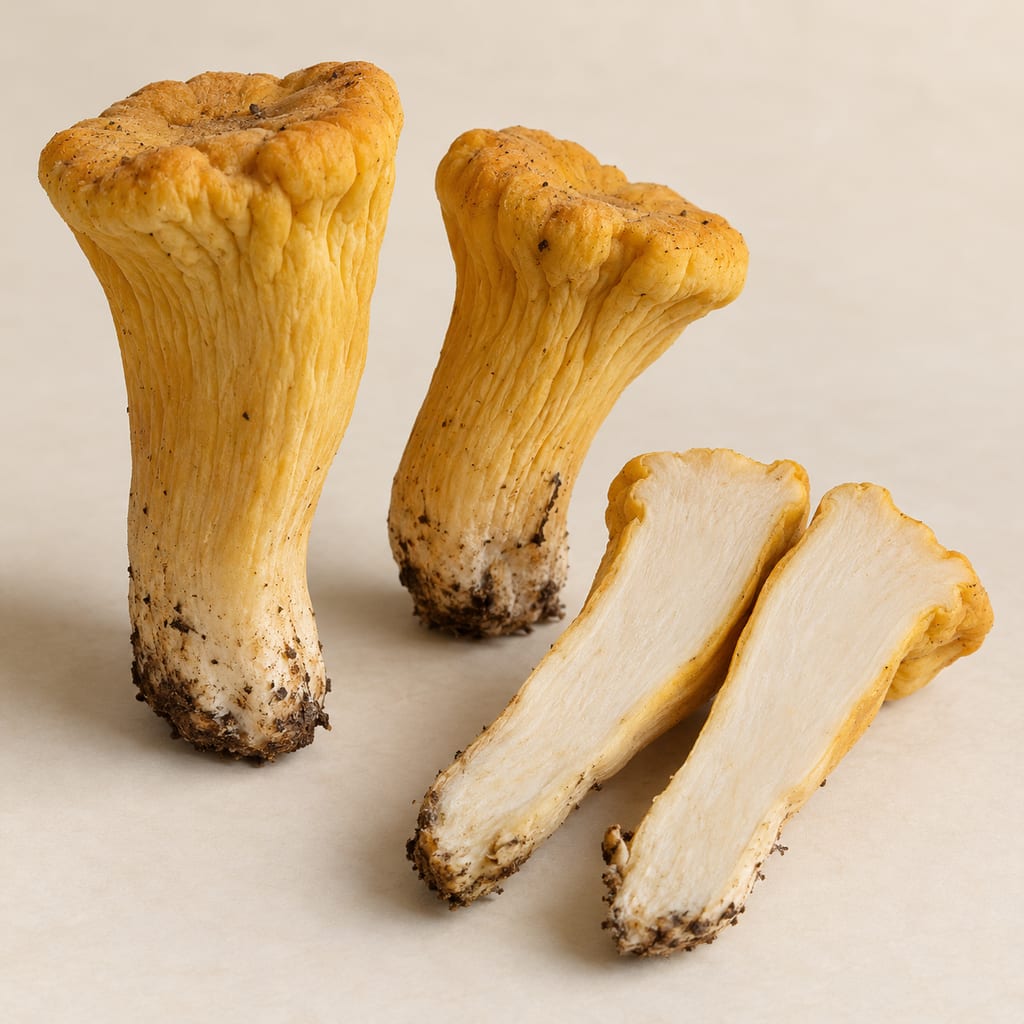
A yellow to ochre club fungus reported as food in parts of Mexico and in historical country lists. Local acceptance and taxonomy vary, and some Chinese records may refer to Clavariadelphus amplus.
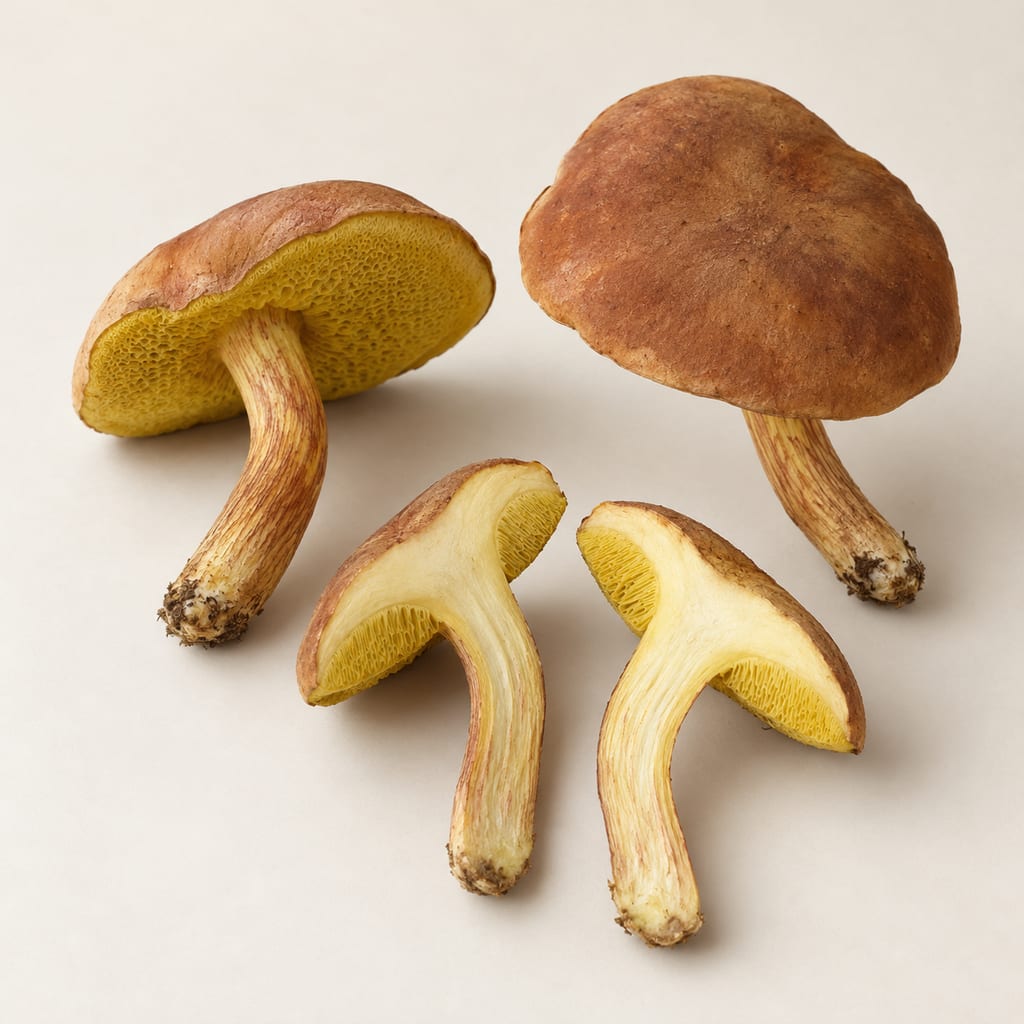
Xerocomus illudens, a forest bolete of Mexico that is gathered by some communities but was ranked low by others, partly because of its sour taste.
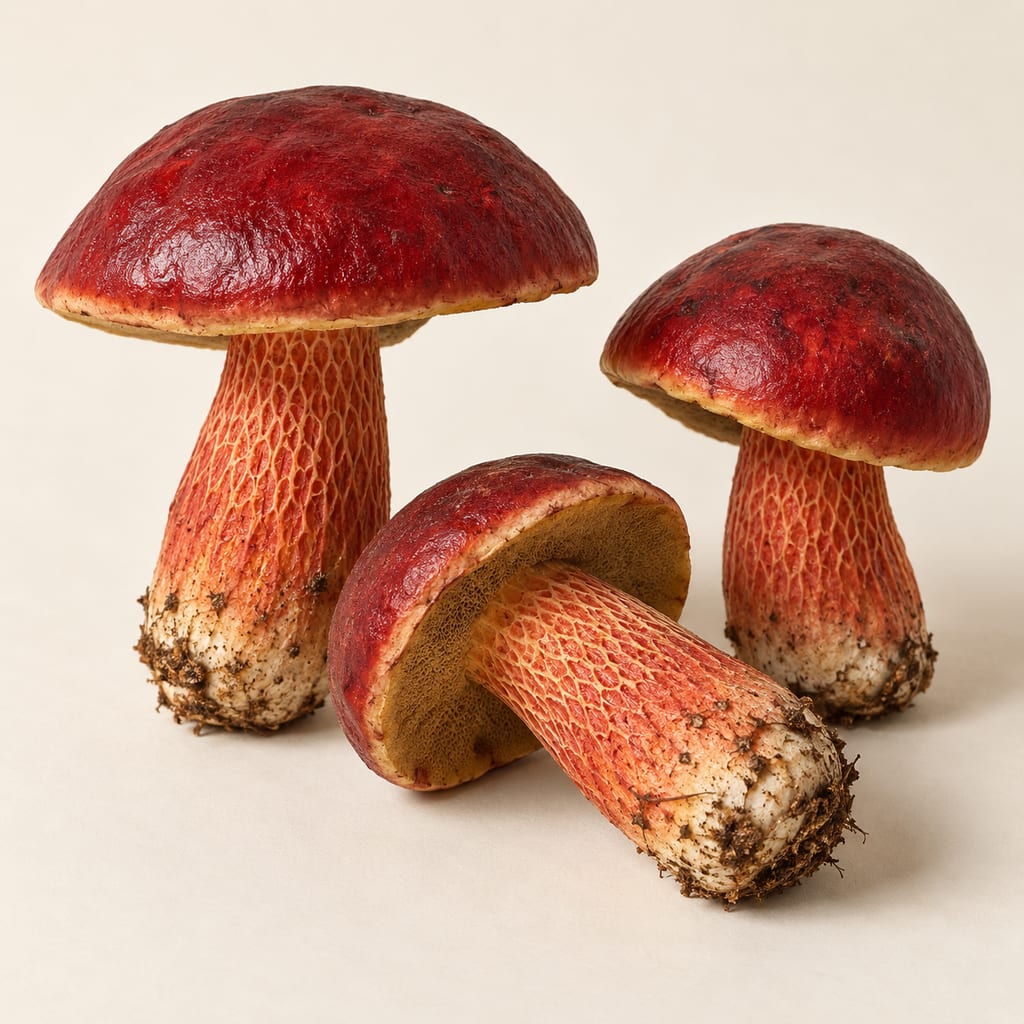
Frost's bolete, Exsudoporus frostii, is a red-pored bolete of oak woodland in eastern North America and Mexico. Its edibility is contested because it can be confused with poisonous red-pored boletes.
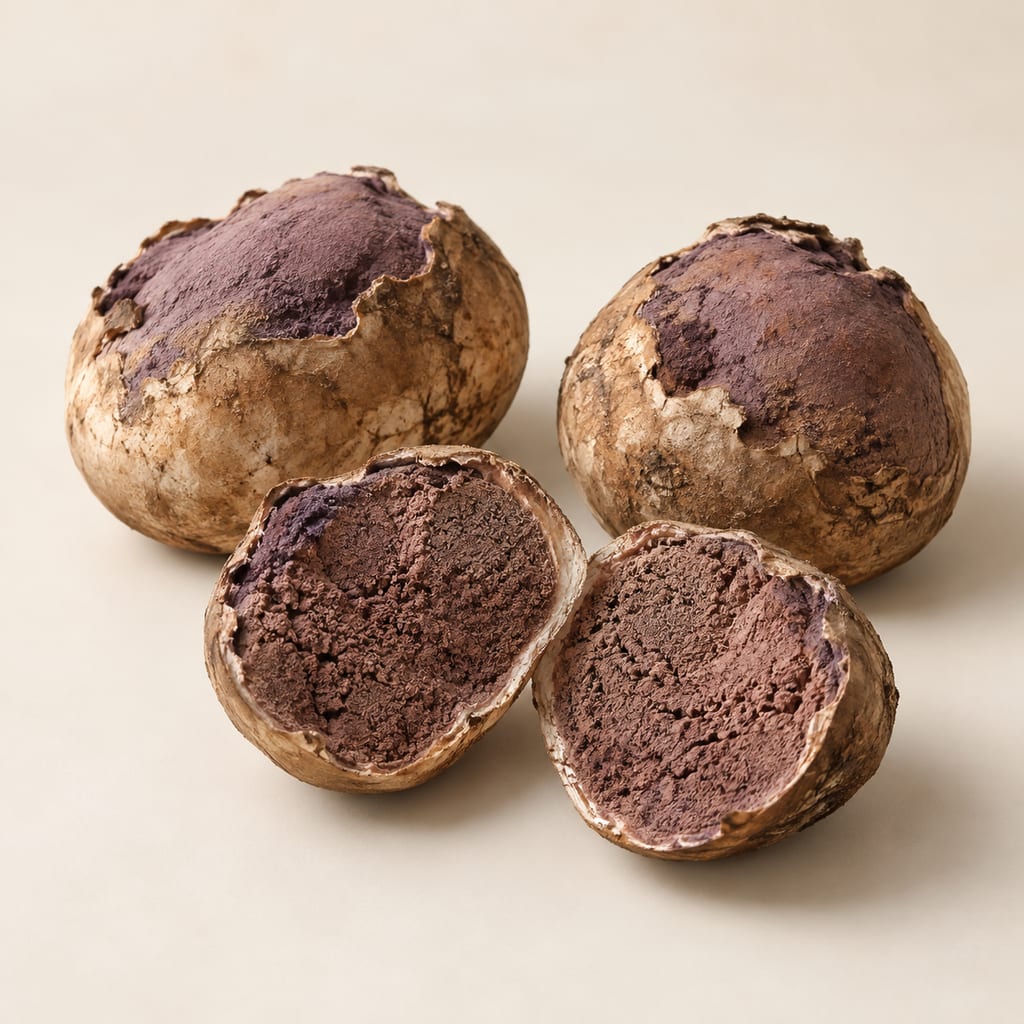
A soil-growing puffball, Calvatia cyathiformis, with white immature gleba that darkens purple as spores mature; food and seasonal records are local and do not establish a universal identification or safety rule.
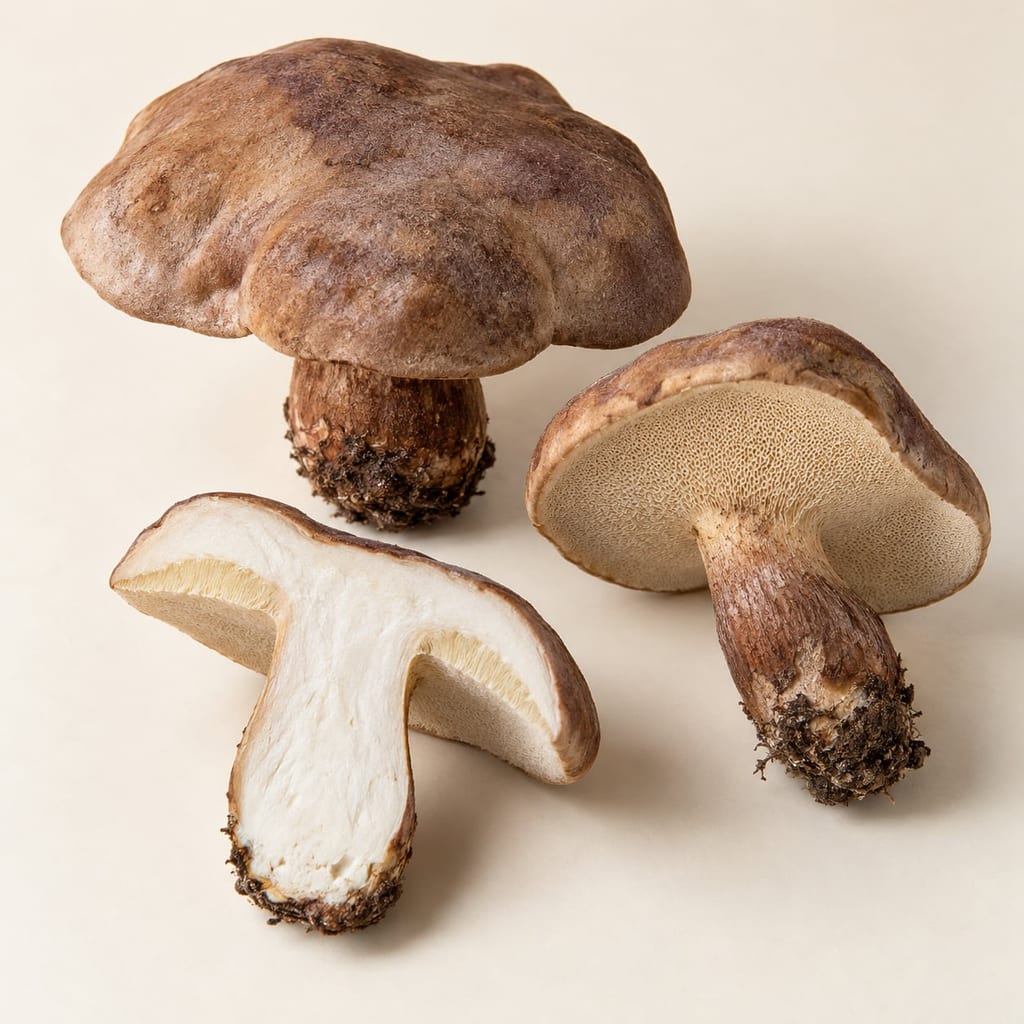
Wolfe's bolete, Fistulinella wolfeana, is a wild bolete of oak and oak-pine forest in eastern and southeastern Mexico, where Otomi communities in Amealco, Querétaro, gather and sell it as food.
No community contributions have been published for this entry yet.
Sign in to contribute. Published comments and photos are free to read.
Species Fungorum, Royal Botanic Gardens, KewTaxonomy · Habitat
Amanita basii Guzmán & Ram.-Guill. — species recordSpecies Fungorum lists Amanita basii Guzmán & Ram.-Guill. as the current name, published in 2001.
The species record associates the type material with humus in Pinus–Quercus forest in Durango, Mexico.
Cited in: A species name, and names that travel; A forest mushroom, not a farmed crop; Handling, storage and fermentation; What the record can and cannot say
National Center for Biotechnology InformationTaxonomy
Taxonomy Browser: Amanita basiiNCBI Taxonomy lists Amanita basii as a current species name in Amanitaceae, order Agaricales.
Cited in: A species name, and names that travel
J. Cramer, Bibliotheca Mycologica 187, 2001Taxonomy · History
The Amanita caesarea-complexThe 2001 taxonomic treatment studied more than 240 herbarium collections across several continents and described taxonomic confusion within the Amanita caesarea complex.
Its catalogue summary identifies cap colour, shape and striation, and stipe traits among the characters used to distinguish species.
The book summary describes the Mexican complex as traditionally and economically important as food, including in Guatemala.
Cited in: A species name, and names that travel; Identity matters: Amanita safety; What the record can and cannot say
Journal of Ethnobiology and Ethnomedicine 14, article 7 (2018)Traditional use · Culinary use · Season · Economics
Ethnomycological knowledge in three communities in Amealco, Quéretaro, MéxicoFieldwork in three Hñähñu (Otomí) communities in Amealco de Bonfil, Querétaro, from August 2013 to November 2014 recorded Amanita basii among the mushrooms with the highest cultural-significance scores.
The study reports forest mushrooms harvested mainly in the rainy season; Amanita basii was frequently consumed and highly valued for taste.
The article describes mushroom roasting on a comal with a little salt as the main preparation pattern in the study area, and says Amanita basii was among the species eaten on its own.
The study reports Amanita basii had the highest price index among the fungi it assessed, while few people sold it.
Cited in: A forest mushroom, not a farmed crop; Rain, collection and the market; How people describe and prepare it; Handling, storage and fermentation; What the record can and cannot say
IMA Fungus 10, article 16 (2019)Traditional use · Local names · Ecology · Economics
Traditional knowledge, uses, and perceptions of mushrooms among the Wixaritari and mestizos of Villa Guerrero, Jalisco, MexicoThe study records Wixarika and mestizo knowledge in northern Jalisco, including Amanita basii as a preferred mycorrhizal food mushroom.
The Wixarika name yekwá was translated by sellers as hongo real for Amanita basii or Amanita laurae, so it is not a species-exclusive name.
Wixaritari sold Amanita basii in neighbouring municipalities including Mezquitic and Bolaños during the study period.
Cited in: A species name, and names that travel; A forest mushroom, not a farmed crop; Rain, collection and the market; How people describe and prepare it; Identity matters: Amanita safety; Handling, storage and fermentation; What the record can and cannot say
Journal of Ethnobiology and Ethnomedicine 16, article 53 (2020)Traditional use · Local names · Culinary use
Folk classification of wild mushrooms from San Isidro Buensuceso, Tlaxcala, Central MexicoThe study identifies Amanita basii as hongo amarillo and records Nahuatl names āyoh-xōchitl and āquiyoxōchitl in one community.
It reports this mushroom fried with strips of chilli and used in a broth with epazote, onion or chilli.
Cited in: A species name, and names that travel; How people describe and prepare it; Handling, storage and fermentation
Journal of Ethnobiology and Ethnomedicine 15, article 36 (2019)Documented use · Market · Season · Taxonomy
Ethnomycological knowledge among Kaqchikel, indigenous Maya people of Guatemalan HighlandsFour years of field research at the San Juan Sacatepéquez market documented Amanita basii among the Amanita caesarea-complex mushrooms sold there.
The authors report market seasonality around the rainy months, with the complex's short season centred on June and sometimes extending to August–September.
The study discusses species-complex uncertainty and variation among Amanita specimens sold under the local complex name.
Cited in: A forest mushroom, not a farmed crop; Rain, collection and the market; Identity matters: Amanita safety; Handling, storage and fermentation; What the record can and cannot say
Global Biodiversity Information FacilityTaxonomy · Common names
Amanita basii Guzmán & Ram.-Guill.The GBIF taxon page lists the scientific name and common-name records including Bas' Caesar and hongo de oro; it presents common names as catalogue records rather than a universal name map.
Cited in: A species name, and names that travel
Centers for Disease Control and Prevention, Morbidity and Mortality Weekly ReportSafety
Severe Illnesses After Consuming Mushrooms from a California Restaurant — 2023The CDC report documents severe poisoning associated with wild death-cap mushrooms, Amanita phalloides, illustrating the consequences of confusion and unsafe mushroom identification.
Cited in: Identity matters: Amanita safety; Handling, storage and fermentation