Bovine colostrum
Bovine colostrum is the changing first secretion around calving, concentrated in proteins and maternal immune components; it feeds newborn calves and appears in seasonal foods and processed products.
 FermenteaWhere food goes to change
Mushrooms
Entoloma sepium is a spring pinkgill associated with Rosaceae. Chinese and European sources list it as edible or conditionally edible, while taxonomic uncertainty and a poisonous lookalike warrant caution.
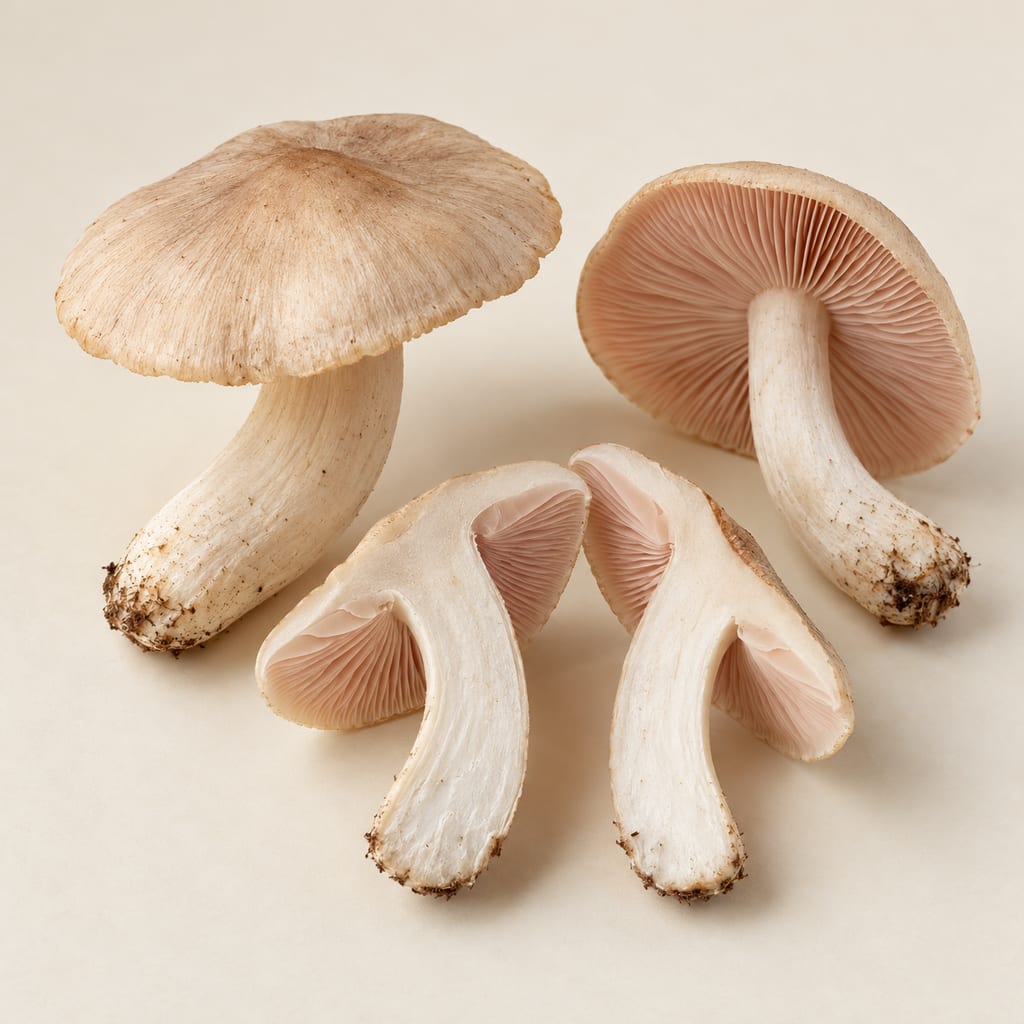
Entoloma sepium (Noulet & Dass.) Richon & Roze is the accepted name in Index Fungorum and the GBIF backbone. Index Fungorum records Agaricus sepius Noulet & Dass. (1838) as the basionym and treats Entoloma saepium as an orthographic-variant name record; Entoloma clypeatum var. sepium and Rhodophyllus sepius are historical combinations. These spellings matter when searching older literature, but they do not denote separate ingredients.
Species limits within the spring-fruiting Entoloma clypeatum group have been difficult. A Swedish molecular and field study found that specimens called E. sepium in its local species concept grew with hawthorn (Crataegus), while the traditionally named sloe-associated mushroom was treated there as E. niphoides. The authors cautioned that further documented collecting was needed to settle names and suspected frequent misidentification with E. clypeatum. Therefore habitat and a pale cap alone cannot establish identity; published regional usages may not all represent the same concept.
This is a terrestrial, spring-fruiting mushroom associated in European accounts with shrubs and trees in the rose family (Rosaceae), including blackthorn, hawthorn, plum and other orchard plants. It is reported from gardens, orchards, hedgerows, parkland and woodland edges. The Swedish study's DNA-backed collections were found under Crataegus at Rörö in Bohuslän; the authors specifically noted how differing species concepts affect host and name records.
Country-level records and observations span China, Sweden, Poland, Italy and Germany. The 2026 Chinese edible-and-medicinal fungi catalogue includes E. sepium as edible within its China-wide scope. Polish atlas records document multiple provinces and exact May collections, including Ładzice and Wojnowo; its species account describes spring fruiting, especially May to June, beneath Rosaceae. A Slovenian mycological society reports it in April and May under blackthorn and plum. An Italian field photograph is dated 11 April 2016 in Veneto, and separate iNaturalist records document May observations in Japan and Germany. These dates and records support a spring season in the Northern Hemisphere, not a fixed calendar or a complete range map.
The Chinese national species catalogue lists E. sepium as edible. European mycological references vary between edible and conditionally edible: a Slovenian society uses the conditional category, while Polish references describe it as edible but advise against collecting because of confusion risk. These sources document food classification and reported use, not a controlled safety assessment, nutritional profile or a universal culinary practice.
The material reviewed did not establish a specific traditional dish, preservation method, cultivation system or fermentation use for E. sepium. It is reasonable to describe the mushroom as a reported food ingredient, but not to attribute a recipe or processing method to a community without a source. No health benefit or medicinal use is supported by this evidence.
Entoloma sepium has been described with a pale cream to greyish cap, pale gills that become pink as spores mature, a pinkish spore deposit, and reddish or yellow-red discoloration reported in damaged tissue. Such traits are descriptive, not a safe identification key. The Swedish molecular study stresses that spring Entoloma species can be difficult to separate and that colour-based descriptions are unreliable.
A serious safety concern is confusion with Entoloma sinuatum, a poisonous species that can cause severe gastrointestinal illness. Regional mycological references explicitly warn that young specimens may be confused and discourage gathering E. sepium for that reason. An online image, season, host plant, mealy smell or a single visible character cannot establish that a wild mushroom is safe to eat. This page records food classifications; it is not foraging or identification advice.
The national edible-and-medicinal fungi catalogue lists E. sepium as edible; this is checklist classification, not a species-specific preparation or toxicology study.
A Swedish paper reports DNA-sequenced E. sepium under Crataegus; authors caution that names and spring Entoloma concepts remain unsettled.
Atlas shows accepted records across several provinces, including Ładzice, Wojnowo and Góra Kamieńska; these do not estimate abundance.
Photo observation captioned E. saepium under cherry trees; identification was by sight, not a voucher-confirmed occurrence.
A regional mycological society classifies the species as conditionally edible and reports spring growth under blackthorn and plum; warns misidentification can be fatal.
Research-grade iNaturalist photo record identified as E. sepium under Prunus; observation, not a collected voucher.
Research-grade iNaturalist photo record; supports an observation in Japan, not local food use or a broader range estimate.
Bovine colostrum is the changing first secretion around calving, concentrated in proteins and maternal immune components; it feeds newborn calves and appears in seasonal foods and processed products.
No community contributions have been published for this entry yet.
Sign in to contribute. Published comments and photos are free to read.
Index Fungorum Partnership / Royal Botanic Gardens, KewTaxonomy · Nomenclature
Entoloma saepium name record (orthographic variant; current name Entoloma sepium)accepted name, basionym, classification, variant and historical combinations
Cited in: Name and species concept
GBIF Backbone Taxonomy / Catalogue of LifeTaxonomy · Distribution
Entoloma sepiumaccepted name and synonym list
Cited in: Name and species concept
Mycosystema 45(1), 250237Food use · Geographic scope · Taxonomy
Species cataloging of edible and medicinal fungi in ChinaChina-wide catalog integrating 2019–2025 research; E. sepium appears as edible in entry 314
Cited in: Ecology, places and season; Food evidence and use limits
Svensk Mykologisk Tidskrift 39(3):2–7Taxonomy · Ecology · Season · Geography · Identification uncertainty
Vårrödlingar – en grupp med stor variation i färg och form (Spring fruiting Entoloma in Sweden)DNA-supported Swedish spring Entoloma distinctions; E. sepium under Crataegus at Rörö; limits on settled names and field identification
Cited in: Name and species concept; Ecology, places and season; Identification and safety
grzyby.plFood use · Season · Ecology · Geography · Safety · Photo provenance
Entoloma sepium (dzwonkówka mącznowonna)spring records and Polish observation localities; edible classification with warning about poisonous E. sinuatum; six credited specimen images with reproduction terms
Cited in: Ecology, places and season; Food evidence and use limits; Identification and safety
Gobarsko društvo Lisička MariborFood use · Season · Ecology · Morphology · Safety · Photo provenance
Entoloma sepium, trnuljina rdečelistkaconditional edibility, April–May under blackthorn/plum, descriptive traits, fatal-misidentification warning, Anton Poler photo page and reuse restrictions
Cited in: Ecology, places and season; Food evidence and use limits; Identification and safety
GrzybariumSeason · Food use · Safety · Photo provenance
Dzwonkówka mącznowonna (Entoloma sepium)conditional-edible warning, April–June Polish season, four distinct CC-licensed photo source credits
Cited in: Food evidence and use limits
Wikimedia Commons / Mushroom ObserverPhoto provenance · Geography · Season
2016-04-11 Entoloma saepium, image 611897CC BY-SA 3.0 photograph, dated 11 April 2016, Vicenza Province, Italy; under cherry trees; identification by sight
Cited in: Ecology, places and season
iNaturalistPhoto provenance · Geography · Season
Photo 499550637: Entoloma sepiumCC BY 4.0 photo observed 3 May 2025 in Yokohama, Japan
Cited in: Ecology, places and season
iNaturalistPhoto provenance · Geography · Season
Photo 129265384: Entoloma sepiumCC BY-SA 4.0 photo observed 15 May 2021 at Hattingen, Germany, under Prunus
Cited in: Ecology, places and season
iNaturalistPhoto provenance · Geography · Season
Photo 12823896: Entoloma sepiumCC BY 4.0 separate photo record dated 11 April 2016 in Belluno Province, Italy
City of Vienna mushroom advisorySafety
Riesenrötling (Entoloma sinuatum)poisonous E. sinuatum causes severe gastrointestinal poisoning and can be confused with spring edible Entoloma
Cited in: Identification and safety