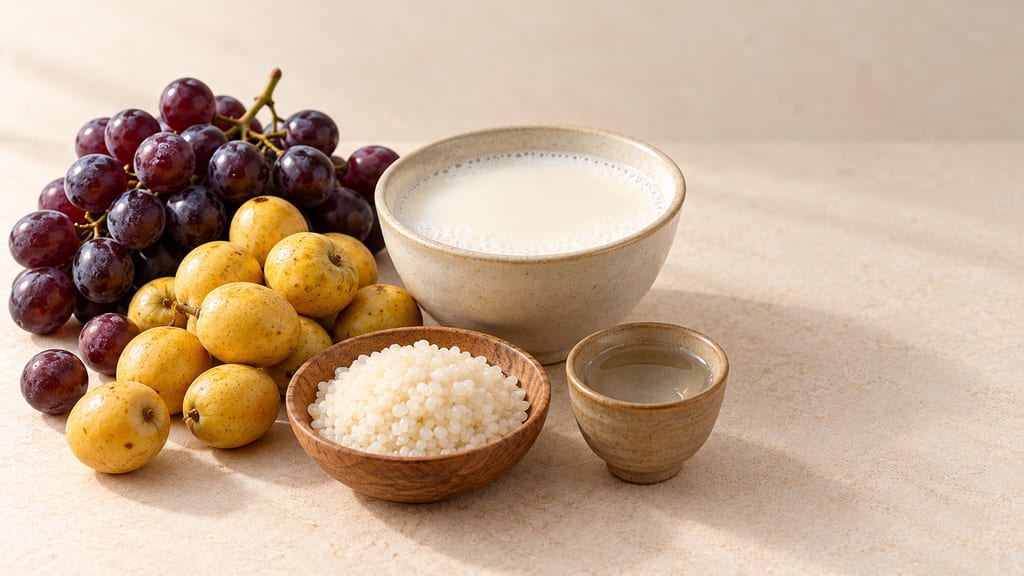
Harvests into drinks: fruit, grain and milk
A marula harvest, a rice mash and a bowl of fermented mare’s milk reveal different ways to make alcohol, and different kinds of knowledge behind the drink.
 FermenteaWhere food goes to change
Substrates
Common hawthorn (Crataegus monogyna), a hedgerow shrub whose red haws and young leaves are reported as food, with sources that disagree on raw fruit and leaves.
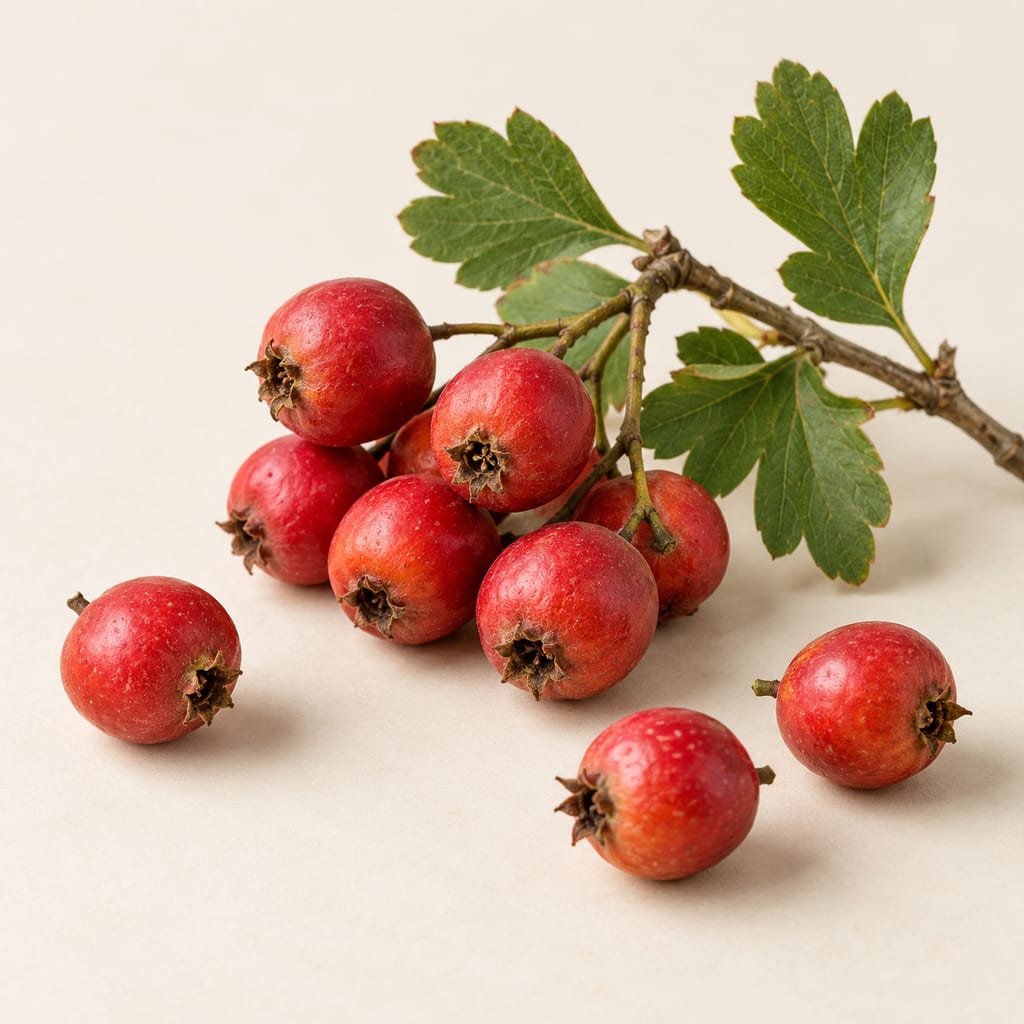
Common hawthorn is a thorny shrub or small tree of hedgerows, scrub and woodland edges. Its autumn fruit, the haw, is a small red fruit that the Royal Horticultural Society describes as edible, and its young leaves appear in some food reports. The species belongs to a genus with several close relatives, so a hedgerow setting or a common name does not settle which plant is meant.
Kew accepts the name Crataegus monogyna Jacq. and gives its native range as Europe to the Caucasus and North Africa to Iraq. Other names in use include May tree and one-seed hawthorn. The Danish Veterinary and Food Administration lists C. laevigata, C. crus-galli and C. rhipidophylla as possible confusions with it, which is one reason the food reports on this page cannot be turned into an identification method.
The Danish authority reports that the berries have been eaten raw, made into jam and used in fermented drinks. Its page says that leaves and flowering shoots should not be eaten and records no known European Union food use for those parts.
The Woodland Trust labels young leaves edible but warns that raw haws may cause mild stomach upset. The RHS profile describes the autumn berries as edible and mentions jelly and herbal tea.
These statements disagree on raw berries and on leaves. None of them sets a universal preparation or safety rule, and this page does not reconcile them.
The Danish species page names fermented drinks, including liqueurs or spirits, as a reported use of the berries. It gives no ingredients, quantities, yield, organism, fermentation conditions, endpoint or storage details. The report therefore names a use but supports no home fermentation procedure.
The RHS seed warning says the seeds contain toxins and should be removed if the fruit is eaten. The Danish authority says that no cyanogenic glycosides are known for the genus Crataegus. That statement does not identify the toxin the RHS warning has in mind, so the sources leave the seed question open.
A separate RHS warning, under its Pets heading, says the fruit is ornamental and not to be eaten. It concerns pets and is not a human food rule, but it adds to the conflict the reader should understand. The reviewed material establishes no safe amount, cooking endpoint, storage duration or collection permission.
The RHS profile lists full sun or partial shade and soils from chalk to clay, loam and sand, with acid, neutral or alkaline pH. It places the species in its H7 hardiness class, which in the RHS scheme means hardy in the severest European continental climates below −20°C. That is a category, not a survival threshold for a particular plant or a guarantee of fruit after frost. The RHS advises against waterlogged ground.
The RHS hawthorn guide describes collecting seed while the haws are still green in late summer, removing the pulp, and sowing outdoors, with erratic germination in the first year. These are propagation notes rather than food processing. The reviewed pages give no productive container or greenhouse method, no fruit yield and no harvest interval.
Reference and research only. Fermenta cannot identify a gathered specimen or guarantee that it is safe to eat. Competent local identification is needed before eating any wild plant.
The sources disagree on raw haws and on leaves, and none gives a safe quantity or a cooking method that can be relied on. The Danish authority advises against eating the leaves and flowering shoots; the RHS warns about the seeds. This page gives no safe-use rule for any part of the plant.
Kew gives the native range of the species; the food reports reviewed here name no region.
A marula harvest, a rice mash and a bowl of fermented mare’s milk reveal different ways to make alcohol, and different kinds of knowledge behind the drink.
No community contributions have been published for this entry yet.
Sign in to contribute. Published comments and photos are free to read.
Royal Botanic Gardens, KewIngredient research
Crataegus monogyna Jacq. | Plants of the World OnlineCited in: Overview
Royal Horticultural SocietyIngredient research
Crataegus monogyna | RHS Plant ProfileCited in: Overview; Food reports and where they disagree; Seeds, toxins and open questions; Growing in the UK; Identification and safety
Danish Veterinary and Food AdministrationIngredient research
Engriflet hvidtjørn (Frugt (bær), blad, blomst og nye skud)Cited in: Overview; Food reports and where they disagree; Fermented drinks are a reported use, not a recipe; Seeds, toxins and open questions; Identification and safety
Woodland TrustIngredient research
Hawthorn (Crataegus monogyna)Cited in: Overview; Food reports and where they disagree; Identification and safety