Xiaoqu (small-form Chinese starter)
Xiaoqu (小曲) is a family of small Chinese grain starters for rice wines and baijiu: mixed moulds, yeasts and bacteria that convert starch and ferment it, not one strain or formula.
 FermenteaWhere food goes to change
Cultures
High-temperature daqu is a formed, mixed-community grain starter used for sauce-aroma (Maotai-flavor) baijiu, made by a separate heat-driven process and sold or kept as dry bricks.
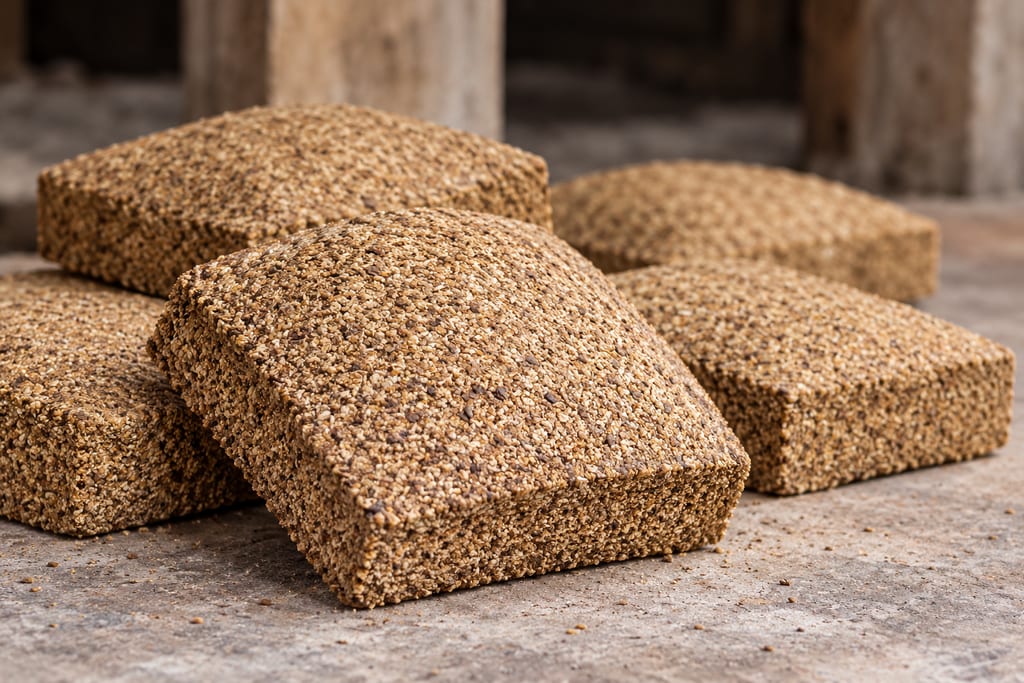
Daqu is a formed grain starter that supplies microbes and enzymes to traditional Chinese liquor fermentation. High-temperature daqu is the production class used for sauce-aroma baijiu, also called Maotai-flavor baijiu. One study gives 60 to 65 °C as the band for the high-temperature category, citing earlier work. That figure is a classification of how the starter is made, not a temperature curve to copy and not a storage setting.
The formed starter, its changing microbial community, individual laboratory isolates, the later fermenting grain and the distilled liquor are different things. High-temperature daqu is the first of these: the brick that is later used to start a liquor fermentation. The published studies describe communities in particular batches. They do not define one required strain or a single universal composition.
The catalogue behind this page describes the community as heat-selected, with prominent bacteria including Bacillus and Saccharopolyspora and thermotolerant fungi. The finished dry bricks are stored after a separate manufacturing and maturation process. Reported peak temperatures around 60 °C or above describe that process; they are not instructions to keep a finished starter warm.
A 2020 comparison sampled handmade and machine-molded high-temperature daqu at a Guizhou distillery. It reports changing bacterial communities during production and differences in the relative abundance of some bacterial groups between the two molding methods. The results describe that study, not every producer or batch.
A 2025 study follows microbial, physicochemical and flavor measurements through one high-temperature daqu production run. Its introduction places the work in Moutai Town, Guizhou, while its sample methods name Guangdong Province, so the production location is not fixed here. Its batch observations give no general process curve.
A 2023 metaproteomics study reports 90 samples of white, yellow and black high-temperature daqu collected in spring, summer and autumn, and found differences among the sample groups and between seasons. The white, yellow and black labels belong to that study's high-temperature samples. They are not the low-, medium- and high-temperature classes of daqu. The seasonal patterns should be read within that sample set.
The reviewed papers do not establish the origin or earliest dated use of high-temperature daqu as a named class. They also give no validated household method, equipment specification, safety endpoint or home storage limit. Producer and laboratory observations should not be read as household instructions, and the page offers none.
Daqu is a starter of Chinese liquor production; no narrower origin is established.
A 2020 study sampled a Guizhou distillery; a 2025 study's location is internally inconsistent and is not used.
No community contributions have been published for this entry yet.
Sign in to contribute. Published comments and photos are free to read.
Frontiers in Microbiology 13:1098268; PubMed recordScience
Quantitative metaproteomics reveals composition and metabolism characteristics of microbial communities in Chinese liquor fermentation starters90 samples of white, yellow and black high-temperature daqu in spring, summer and autumn; differences among groups and seasons
Cited in: Season and colour groups; Limits of the evidence
Annals of Microbiology 70, article 57; Springer NatureScience · Identity
Evaluation of bacterial diversity during fermentation process: a comparison between handmade and machine-made high-temperature Daqu of Maotai-flavor liquor60 to 65 C band for the high-temperature category; handmade versus machine-molded bacterial communities at a Guizhou distillery
Cited in: What it is; What production studies show; Limits of the evidence
Biology 14(10):1324; MDPI / PubMed CentralScience
Microbial, Physicochemical, and Flavor Interactions in High-Temperature Sauce-Flavor DaquMicrobial, physicochemical and flavor measurements through one production run; conflicting provinces for the sample location
Cited in: What it is; What production studies show; Limits of the evidence