
African fermented foods, drinks and preservation
From sour breads and milk to savoury seeds, cassava staples and living beers, African fermentation follows the crop, the community and the work of transformation.
 FermenteaWhere food goes to change
Spices and aromatics
C. genistoides has a species-specific Cape tea history and cultivation evidence, alongside broader genus-level honeybush accounts. Propagation and crop observations vary by source, setting and plant material.
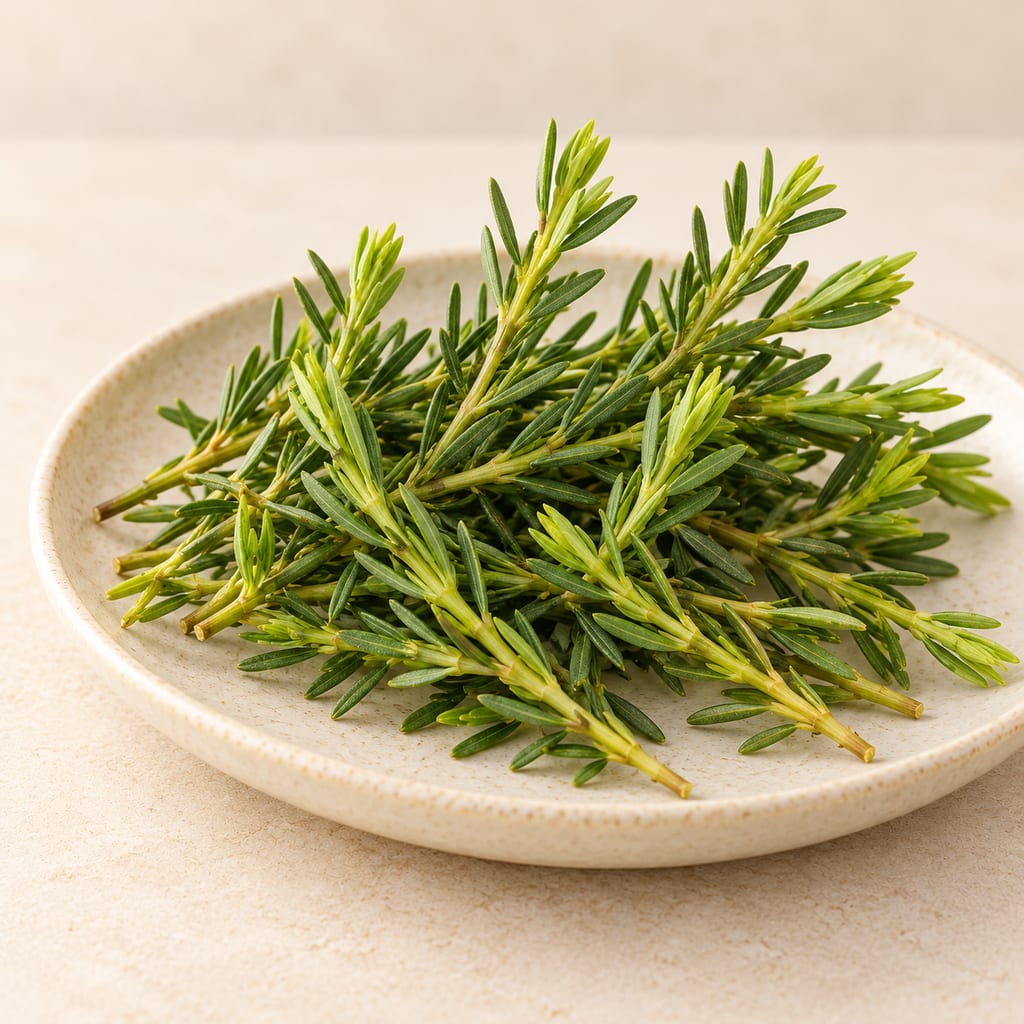
The common ingredient name can refer to more than one plant. The research below concerns the particular taxon and uses named in its sources; it does not identify every ingredient sold under this name.
Kew accepts Cyclopia genistoides (L.) R.Br. and lists Sophora genistoides and Cyclopia heterophylla among its synonyms. It is one species in a genus with several tea species. PlantZAfrica uses “honeybush tea” and Afrikaans “Heuningbos” for C. genistoides. The 2022 cultivation review and the Agricultural Research Council use “kustee,” “coastal tea” or “Cape tea” for this species. Honeybush and Heuningbos can also refer to the genus or its products; a common or trade name alone does not identify a plant.
Kew records a southwestern Cape native range. PlantZAfrica describes C. genistoides on Cape Peninsula mountains and commercial fields on sandy soils in the southern Cape; the 2022 review gives a broader species distribution. These sources do not identify unvouchered tea products.
PlantZAfrica describes traditional tea made from the species' leaves and stems. A 2014 report covers honeybush as Cyclopia species and summarizes literature describing C. genistoides tea near Cape Town. The report also lists jams, iced teas, wines and brandies in interview accounts, but does not consistently assign those uses to this species. They remain genus-level examples, not C. genistoides recipes. The report records differing community and industry views on historical attribution; no exclusive origin or ownership conclusion is drawn.
PlantZAfrica's garden account recommends full sun and well-drained sandy, acidic conditions. It gives pH 3.5–5 for the sowing medium, not a measured plantation-soil optimum, and describes seed or tip-cutting propagation with sowing in summer to autumn. It calls the species sensitive to severe frost but provides no temperature threshold. Its spring flowering note and the 2022 review's October peak-flowering observations refer to different source contexts, not a national crop calendar.
The 2013 cutting paper's selected publisher tables report 74.8% rooting for summer terminal cuttings and 40.8% for summer subterminal cuttings in its study. Its 2 g/L IBA treatment had the highest reported value, but treatment differences were not significant; this is not a hormone recommendation. A 2023 abstract reports more than 90% rooting after six or nine months of stock-plant regrowth in winter or spring, with clone and flowering-stage effects. These distinct studies do not yield a single household propagation rule. No productive container trial or heated/unheated greenhouse crop protocol was established; laboratory plantlet acclimatization is not a tea crop trial.
PlantZAfrica describes chopped and wetted shoots held in heaps and calls the change spontaneous fermentation; it mentions optional oven heating before sun drying. ARC describes commercial shoots, including material from several honeybush species, placed in tanks for high-temperature oxidation, using “fermentation” as an industry term. A 2017 sensory-study abstract likewise calls the high-temperature oxidation stage fermentation. The terminology varies across sources; the reviewed evidence does not establish whether microorganisms participate or are absent. These descriptions are not a household method. No complete measured consumer batch, validated processing endpoint, storage life or safety limit was found.
No complete species-specific household recipe with quantities, yield, ordered steps and storage was verified; genus-level interview products are not assigned to this species.
The 2013 cutting tables were selected publisher text; the 2023 cutting and 2017 processing papers were abstract-only, and the micropropagation source was abstract/indexed excerpts.
No measured crop temperature, rainfall, humidity, frost-survival threshold, field-soil optimum, water schedule, container yield or mature heated/unheated greenhouse trial was established.
No microbial participation conclusion, validated processing endpoint, shelf life, current collection rule or food-safety approval is established.
The underlying plant account received a partial source review. Its review scope is described in the original plant article.
The available research does not establish a single origin for this ingredient.
From sour breads and milk to savoury seeds, cassava staples and living beers, African fermentation follows the crop, the community and the work of transformation.
No community contributions have been published for this entry yet.
Sign in to contribute. Published comments and photos are free to read.
Royal Botanic Gardens, Kew, Plants of the World OnlineIngredient research
Cyclopia genistoides (L.) R.Br.Cited in: Scope of this account; Accepted name and names in use; Cape distribution and food reports; Research gaps
Liesl van der Walt; South African National Biodiversity Institute, PlantZAfrica; archived copy hosted by Agricultural Research CouncilIngredient research
Cyclopia genistoides | PlantZAfricaCited in: Accepted name and names in use; Cape distribution and food reports; Growing and propagation reports; Tea processing terminology and limits; Research gaps
Pippa A. Karsen et al.; Crop Science 62(5), 1702–1733, 2022Ingredient research
Propagation and cultivation practices of honeybush (Cyclopia spp.) for the sustainable production of an export quality indigenous South African teaCited in: Accepted name and names in use; Cape distribution and food reports; Growing and propagation reports; Research gaps
Agricultural Research Council, South AfricaIngredient research
Honeybush Farming and ProcessingCited in: Accepted name and names in use; Tea processing terminology and limits; Research gaps
Siyanda Samahlubi Consulting; commissioned by the Department of Environmental Affairs, 2014Ingredient research
Traditional Knowledge Associated with Rooibos and honeybush Species in South AfricaCited in: Cape distribution and food reports; Research gaps
M. M. Mbangcolo, E. Y. Reinten and G. A. Agenbag; South African Journal of Plant and Soil 30(1), 53–55, 2013Ingredient research
Effect of species, cutting position and exogenous rooting substances on rooting of honeybush (Cyclopia spp.) cuttingsCited in: Growing and propagation reports; Research gaps
Pippa A. Karsen et al.; South African Journal of Botany 163, 45–56, 2023Ingredient research
Rooting dynamics of “kustee” honeybush (Cyclopia genistoides) as affected by seasonality and the manipulation of stock plant characteristicsCited in: Growing and propagation reports; Research gaps
L. M. Erasmus et al.; South African Journal of Botany 110, 144–151, 2017Ingredient research
Optimising high-temperature oxidation of Cyclopia species for maximum development of characteristic aroma notes of honeybush herbal tea infusionsCited in: Tea processing terminology and limits; Research gaps
Adam Kokotkiewicz et al.; Zeitschrift für Naturforschung C67(1–2),65–76 (2012); abstract and selected indexed excerptsIngredient research
Micropropagation of Cyclopia genistoides, an endemic South African plant of economic importanceCited in: Growing and propagation reports; Research gaps
FermenteaResearch provenance
Honeybush (Cyclopia genistoides): original plant researchCited in: Research status