
Spices and aromatics
Epazote (Dysphania ambrosioides)
Mexican food records describe epazote leaves and stems used as a seasoning during cooking. Current taxonomy separates Dysphania ambrosioides from D. anthelmintica, while an older Mexican sheet maps some historical names differently; the culinary records do not support medicinal use, an oil dose or a universal recipe.
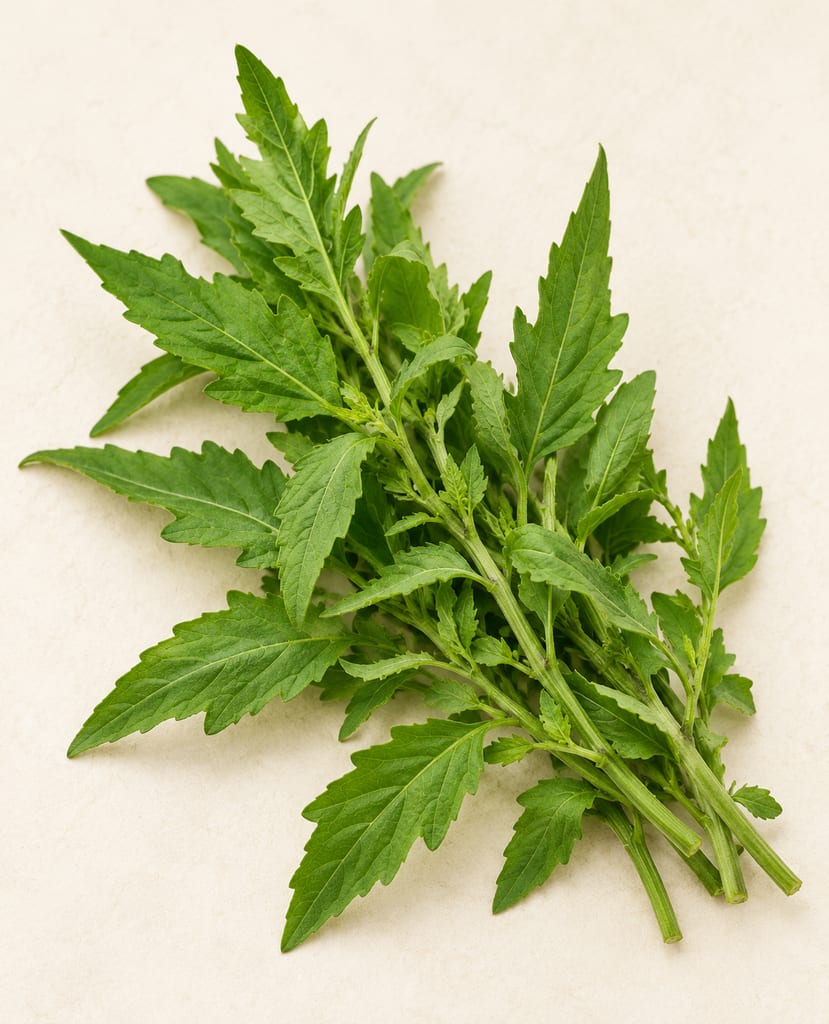
A taxonomy boundary behind the name epazote
Kew currently accepts Dysphania ambrosioides and also accepts D. anthelmintica as a separate species. Kew lists Chenopodium anthelminticum as a synonym under D. anthelmintica. The older CONABIO sheet for D. ambrosioides lists C. anthelminticum among its synonyms, so the source concepts do not match. Historical names should be kept with the publication that used them rather than silently combined.
The Putla thesis prints Teloxys ambrosioides alongside the local name epazote. That is a source-specific label in an Oaxaca household-garden study, not a guarantee that every plant sold or gathered as epazote matches the same species. This article concerns food-use records attributed to D. ambrosioides or to the source's printed Teloxys name; it is not a field-identification guide.
Mexican seasoning accounts
The UNAM study of household gardens in Putla, Oaxaca, records epazote as a condiment. Its appendix says stems and leaves are added as beans, quesadillas or sauces come to a boil; another table lists leaves added to different stews. These are regional food-use descriptions, not a complete formula: no measured amount, serving yield, ordered cooking schedule or storage instruction is supplied.
CONABIO describes the plant as widely used in Mexican cooking, while Prairie View A&M's Spanish specialty-crops sheet lists dried leaves, flowers and seeds as seasonings and fresh leaves for tea. That extension sheet is a separate source context, not a Mexico-specific household practice account. Neither source makes culinary leaf use evidence for a medicinal treatment or an essential-oil dose.
What the grower sheet does and does not say
Prairie View A&M describes direct sowing or transplanting and says seeds need light, while also recommending a shallow sowing depth of 0.2–0.6 cm. It reports germination in 7–21 days, well-drained soil at pH 5.2–8.3, and 15–35°C as an optimum germination range. These are the sheet's production values, not proven mature-plant heat limits or frost hardiness; the two seed-placement statements are retained as printed rather than reconciled into a new instruction.
The sheet mentions containers and indoor or greenhouse starts, late-spring or early-summer planting in its temperate context, water as needed, moderate feeding and leaf harvest. It gives no pot size, container yield, greenhouse setpoint, humidity target, mature photoperiod requirement, frost threshold or Mexico-specific seasonal calendar. Its harvest timing and pest list are production guidance, not a household growing trial.
Sources for this section
Keep food leaves separate from oil and medicine
The Oaxaca entries concern stems or leaves used as seasoning during ordinary cooking. The oil-related literature cited in the research dossier was available only as an abstract during that earlier review, and it does not establish a dose or safety profile for culinary leaves. Concentrated oil, medicinal products and food seasoning are different evidence categories; this article provides no medicinal recommendation or oil-use method.
No complete source-batched recipe, validated preservation method, household storage life or dose-response assessment for the food uses was established. No safe gathered-plant identification procedure or region-specific collection rule was reviewed.
Research gaps
Kew's accepted-name treatment conflicts with the older CONABIO synonym list; the source concepts behind historical C. anthelminticum uses remain unresolved.
The UNAM food entries and PVAMU seasoning list do not supply a complete source-batched recipe with quantities, yield, cooking endpoint or storage guidance.
The seed-light and shallow-depth statements in the PVAMU sheet are not reconciled; no separate household or replicated local crop trial was inspected.
No mature-plant frost/heat threshold, household container size, greenhouse setpoint, food-leaf dose assessment, local collection rule or species identification guide was established.
Sources for this section
- Dysphania ambrosioides | Plants of the World Online →
- Dysphania ambrosioides | Enciclovida →
- Etnobotánica de huertos familiares del distrito de Putla, Oaxaca →
- Epazote Specialty Crops Fact Sheet (Spanish) →
- Dysphania anthelmintica | Plants of the World Online →
- Ethnopharmacological survey of medicinal plants used in the treatment of gastrointestinal disorders in Mexico →
Research status
The underlying plant account received a partial source review. Its review scope is described in the original plant article.
Sources for this section
Places
Unknown
Relationship not established · Place not establishedThe available research does not establish a single origin for this ingredient.
Community
No community contributions have been published for this entry yet.
Share what you made
Sign in to contribute. Published comments and photos are free to read.
Sources
Royal Botanic Gardens, KewIngredient research
Dysphania ambrosioides | Plants of the World OnlineCited in: A taxonomy boundary behind the name epazote; Research gaps
CONABIOIngredient research
Dysphania ambrosioides | EnciclovidaCited in: A taxonomy boundary behind the name epazote; Mexican seasoning accounts; Research gaps
Universidad Nacional Autónoma de MéxicoIngredient research
Etnobotánica de huertos familiares del distrito de Putla, OaxacaCited in: A taxonomy boundary behind the name epazote; Mexican seasoning accounts; Keep food leaves separate from oil and medicine; Research gaps
Prairie View A&M University Cooperative Extension ProgramIngredient research
Epazote Specialty Crops Fact Sheet (Spanish)Cited in: Mexican seasoning accounts; What the grower sheet does and does not say; Keep food leaves separate from oil and medicine; Research gaps
Royal Botanic Gardens, KewIngredient research
Dysphania anthelmintica | Plants of the World OnlineCited in: A taxonomy boundary behind the name epazote; Research gaps
PubMedIngredient research
Ethnopharmacological survey of medicinal plants used in the treatment of gastrointestinal disorders in MexicoCited in: Keep food leaves separate from oil and medicine; Research gaps
FermenteaResearch provenance
Epazote: regional seasoning and source-specific growing notes: original plant researchCited in: Research status