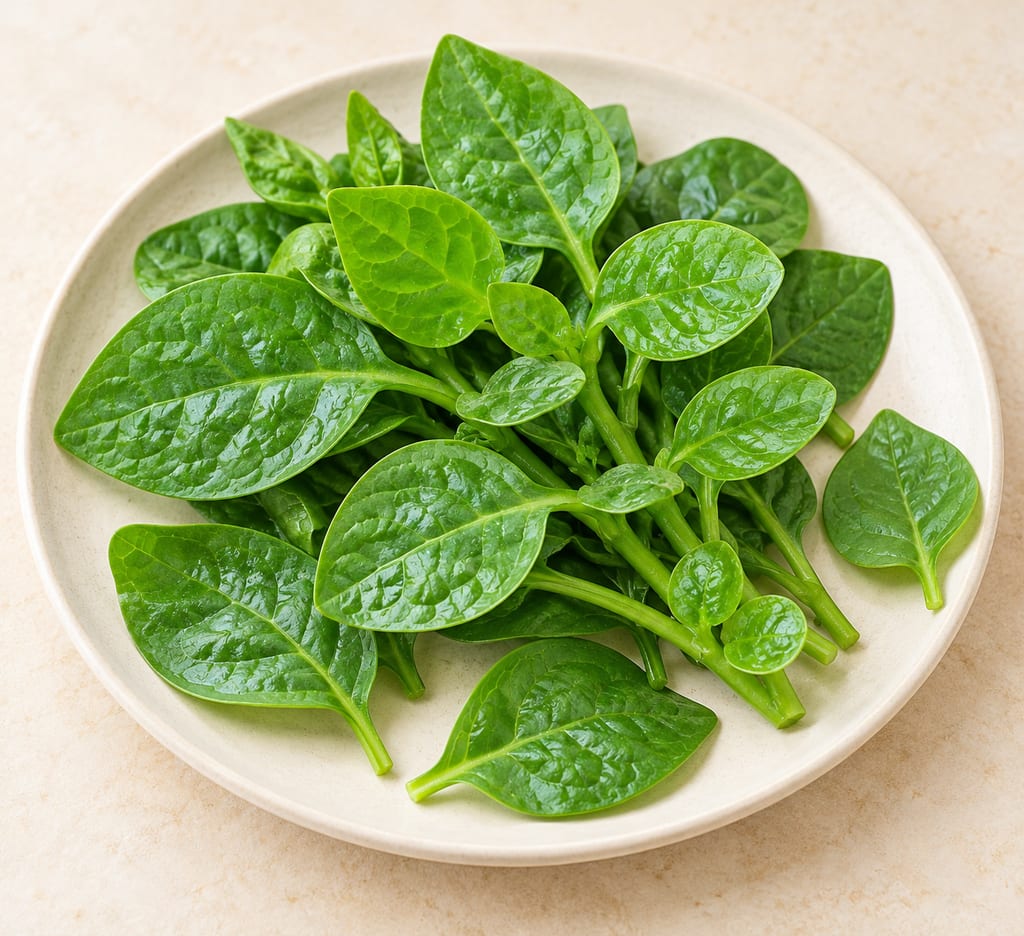
Malabar spinach greens
Malabar spinach, Basella alba, called alugbati in the Philippines, is a climbing leaf vegetable cooked in soups and stews. In New Caledonia an 1872 record shows it grown for dye.
 FermenteaWhere food goes to change
Substrates
Brède morelle is a cooked leaf vegetable of New Caledonia, linked to Solanum americanum but recorded under the broad name Solanum nigrum. Sources conflict on its safety, and no cooking process is validated.
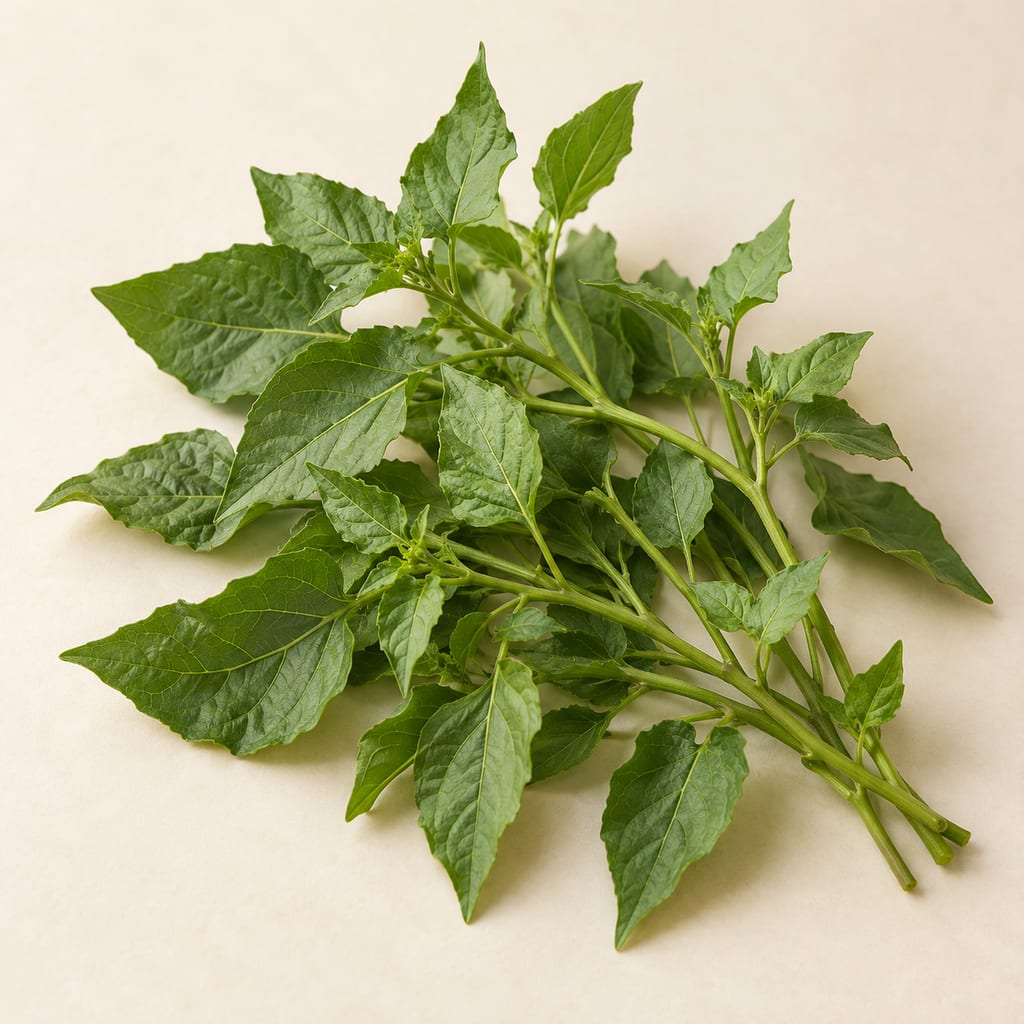
Kew accepts Solanum americanum Mill. and lists New Caledonia as an area of introduction. The 2011 book on Maré instead prints Solanum nigrum L. in the broad sense, calls it a taxonomically difficult complex, and lists S. nodiflorum and S. oleraceum as synonyms used at the time. The names are kept here as each source uses them; the food record is not relabelled as strict S. americanum.
The Maré entry says the leaves, under the broad S. nigrum name, are eaten like spinach and appreciated. It explains the Nengone name Du as meaning culture, because the plant appears by itself on freshly tilled ground. Agripedia glosses Du as sun, which conflicts with the book's explanation. No independent Nengone-language source was reviewed to settle the translation.
The Maré page cites collection number 13745. The Paris natural history museum's catalogue record P00300094 gives the collector as M. G. Baumann-Bodenheim, the locality as Maré: Kuto, the date as 30 May 1951, an earlier S. nigrum determination, and a later S. americanum determination by Sandra Knapp in September 2016. That record is the only crosswalk between the two names. It does not identify every Du or brède-morelle food report, today's plants or any gathered lot.
Agripedia's page is headed S. americanum but also uses S. nigrum in its body, captions and history. It reports young leaves and stems cooked by boiling in salted water or steaming, with the cooking water sometimes changed to reduce bitterness. It gives no complete measured meal and no voucher for the food material. The 2021 leaflet it cites was available only as a search excerpt.
Agripedia describes the plant at low altitude on coastal, urban or wetland-edge sites, in sun or light shade, in varied soils with loose soils preferred, needing irrigation in dry periods and sensitive to drought. It reports seed propagation, nursery or direct sowing in the rainy season, and transplanting at about 15 cm. Leaves are harvested in the rainy season, shoots before flowering, leaving about 5 cm of stem for regrowth. These are extension statements, not accession-linked trials or measured tolerance limits. No frost value, pH range, container system or greenhouse method is given.
Agripedia's text gives 10 to 20 t/ha, but attributes that figure to two other species, S. villosum and S. tarderemotum. Its profile card separately shows 10 to 15 t/ha without that qualification, and the page does not resolve the difference. Neither number is offered here as a yield for S. americanum. The page also states that pest and disease data for New Caledonia are not available.
North Carolina State University Extension rates S. americanum as highly poisonous in severity and describes the leaves and berries as toxic, with all parts potentially toxic. That is North American extension context, not a study of the New Caledonian cooking practice. It conflicts with the regional reports of cooked leaves, and neither side establishes a safe amount, a validated cooking endpoint or a detoxification method. This page gives no cooking instructions and no safety conclusion; the plant should not be gathered or eaten on the strength of a common name.
A 2011 book on Maré records the leaves as eaten like spinach; this is documented use, not an origin claim.
Agripedia describes brèdes as a food crop in New Caledonia; Kew lists New Caledonia as an area where the species is introduced, so this row does not claim a native origin.
Malabar spinach, Basella alba, called alugbati in the Philippines, is a climbing leaf vegetable cooked in soups and stews. In New Caledonia an 1872 record shows it grown for dye.
No community contributions have been published for this entry yet.
Sign in to contribute. Published comments and photos are free to read.
Royal Botanic Gardens, KewIngredient research
Solanum americanum Mill. | Plants of the World OnlineCited in: Names and plant identity
Nicolas Lormée, Pierre Cabalion and Édouard Saikuie Hnawia; IRD Éditions, 2011Ingredient research
Hommes et plantes de Maré: Îles Loyauté, Nouvelle-CalédonieCited in: Names and plant identity; The Maré food account and the name Du; One specimen links the names; Safety: sources disagree
Muséum national d’Histoire naturelle, ParisIngredient research
MNHN vascular plant specimen P00300094, Solanum americanum Mill.Cited in: One specimen links the names
Agripedia / Institut agronomique néo-calédonien, with Agence rurale supportIngredient research
Brèdes: Solanum americanumCited in: The Maré food account and the name Du; How the leaves are cooked; Growing it; Yield figures; Safety: sources disagree
North Carolina State University Extension, Extension Gardener Plant ToolboxIngredient research
Solanum americanum, American Black NightshadeCited in: Safety: sources disagree
Julien Drouin and Nadia Robert; IAC / CADRL / PIL, November 2021 as cited by AgripediaIngredient research
Plante alimentaire traditionnelle: brède morelle, Fiches Construire les Loyauté, p. 50Cited in: How the leaves are cooked