
Spices and aromatics
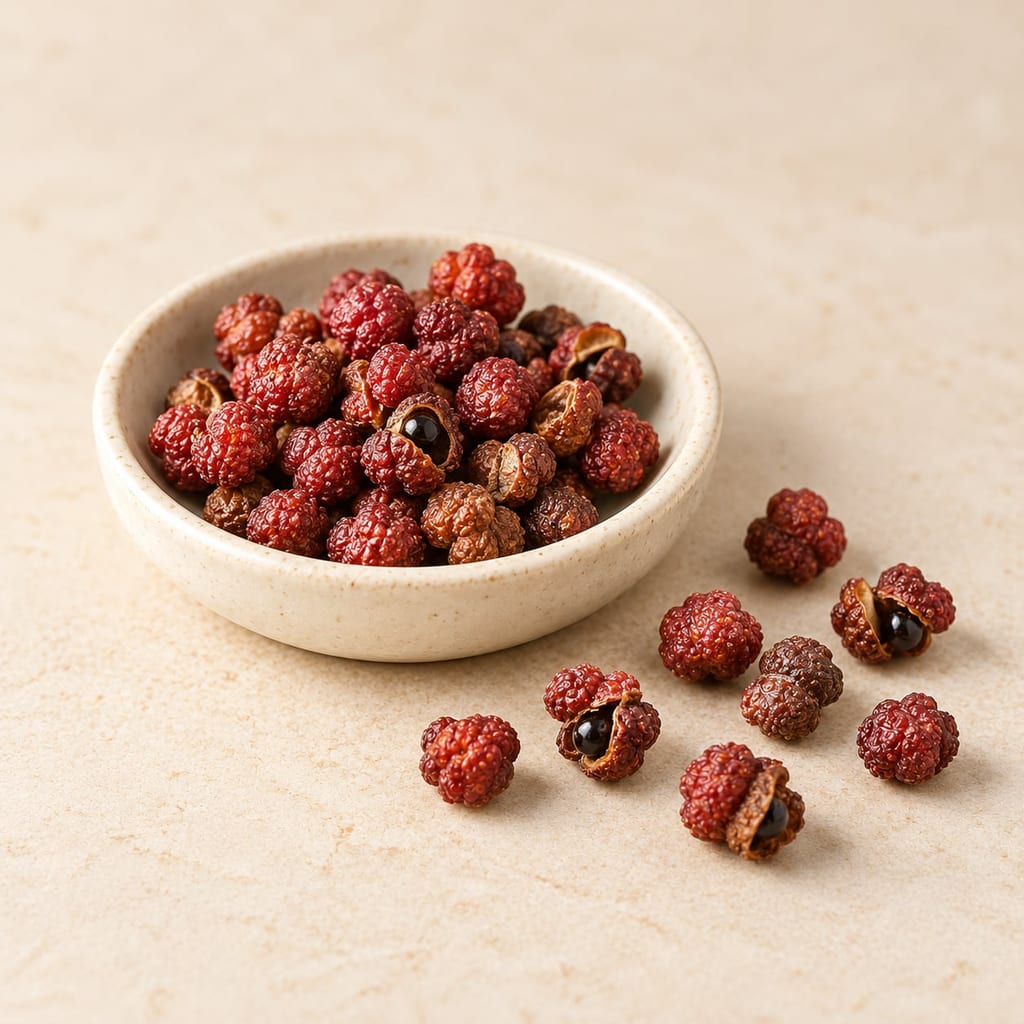
Timur fruit
Timur is recorded as a spice made from fruit in a Nepal study and government growing guide. Sources describe regional cultivation and nursery guidance, but their flowering and planting calendars conflict and do not validate a household food process.
Name and regional boundaries
Kew accepts Zanthoxylum armatum DC., a shrub or tree in Rutaceae, and lists two accepted varieties: var. armatum and var. ferrugineum. Timur is a regional food and trade name, not a variety determination. PLOS Table 1 associates Timur and Gurung name Prumo with its reported collection KSD311; that specimen has not been independently examined. The DPR guide names other Zanthoxylum species as substitutes, so generic pepper or prickly-ash labels should not be treated as proof of this taxon.
A Sikles food-use record
A 2021 ethnobotanical study records Timur in Khilang, Parche and Sikles villages in Kaski. Table 1 row 72 reports Z. armatum collection KSD311, fruit as the part used, August–October as the reported harvest period and fruit used as a spice. The article reports a collection number and says its collected specimens were deposited at TUCH; no specimen was independently re-identified for this article. This is a local interview/table record, not a national harvest calendar or market-lot identification.
Sources for this section
Food uses and process limits
The DPR’s 2011 guide says Timur fruits are used in pickle and vegetables, including mushroom preparations. It does not provide a complete recipe batch. PLOS also reports sun-dried fruit storage, without a drying endpoint, storage duration or safety validation. The sources do not describe a microbial culture or establish that the guide’s pickle mention refers to fermentation. No household preparation or preservation controls are supplied.
Growing conditions in the DPR guide
The 2011 DPR manual describes subtropical-temperate cultivation zones at 1,000–2,500 m. Its preferred-growing-conditions section recommends loamy or clayey soil with medium moisture and fertility at pH 6.5–7, and says red lateritic soil may also be used. These are dated manual recommendations, not experimentally established physiological limits or universal optima. The manual advises regular irrigation during establishment, mulching to retain moisture and avoiding waterlogging; it says established plants may survive rain-fed conditions. These statements do not quantify drought tolerance or guarantee fruit production.
Sources for this section
Regional growing and propagation evidence
A 2000 east-Salyan study describes Timur as occurring under pine and oak forest and reports deep, moist, sun-exposed soils as locally favorable. It documents management across state, community and private lands; on private holdings the authors describe transplanting naturally regenerated seedlings or sowing, thinning, pruning and leaf-litter manure. Those are source-reported local practices, not results from a controlled orchard trial. The DPR guide describes seed and cutting propagation, a dome-shaped plastic cover over nursery beds, and frequent watering of those beds. That cover is for seedling propagation; the sources do not give a mature-tree greenhouse system or productive container method.
Conflicting seasons and unresolved evidence
The DPR guide conflicts with itself. Its species description says flowering March–May and fruiting July–October; its cultivation calendar says flowering March–June, fruiting May–July and harvest October–November. Planting is May–June in the plantation section but April–May in the calendar. PLOS separately reports August–October harvest for KSD311 at Sikles. These statements refer to different source contexts and remain unreconciled. The linked Nepali DPR PDF returned 404, so its calendar could not be compared with the English guide. No complete household recipe, validated storage method, current collection permission or controlled container/greenhouse trial was found.
Research gaps
The English DPR guide has internal planting and phenology conflicts; PLOS’s Sikles harvest window is a separate local report. The official linked Nepali PDF was inaccessible, so no translation comparison is available.
The reported KSD311 voucher and Kew varieties were not independently matched to a specimen or market product.
DPR altitude, soil and propagation figures are manual guidance, not measured tolerance thresholds or replicated crop optima.
The nursery dome and polybags concern propagation only; mature container and greenhouse production conditions are unknown.
The food sources give no complete recipe, validated pickle or drying process, food-safety endpoint, or shelf-life limit. Current collection rights and rules were not reviewed.
Sources for this section
- Zanthoxylum armatum DC., Plants of the World Online →
- Foods from the wild: Local knowledge, use pattern and distribution in Western Nepal →
- Quality Standard, Good Agricultural and Collection Practice: Zanthoxylum armatum DC. →
- Timur (Zanthoxylum armatum) production in Nepal: Dynamics in nontimber forest resource management →
- गुणस्तर मापदण्ड र असल खेती तथा संकलन अभ्यास, टिमुर →
Research status
The underlying plant account received a partial source review. Its review scope is described in the original plant article.
Sources for this section
Places
Unknown
Relationship not established · Place not establishedThe available research does not establish a single origin for this ingredient.
Community
No community contributions have been published for this entry yet.
Share what you made
Sign in to contribute. Published comments and photos are free to read.
Sources
Royal Botanic Gardens, KewIngredient research
Zanthoxylum armatum DC., Plants of the World OnlineCited in: Name and regional boundaries; Research gaps
Khakurel, Uprety, Łuczaj and Rajbhandary, PLOS ONE 16(10), 2021Ingredient research
Foods from the wild: Local knowledge, use pattern and distribution in Western NepalCited in: Name and regional boundaries; A Sikles food-use record; Food uses and process limits; Conflicting seasons and unresolved evidence; Research gaps
Government of Nepal, Department of Plant Resources, 2011Ingredient research
Quality Standard, Good Agricultural and Collection Practice: Zanthoxylum armatum DC.Cited in: Name and regional boundaries; Food uses and process limits; Growing conditions in the DPR guide; Regional growing and propagation evidence; Conflicting seasons and unresolved evidence; Research gaps
F.W. den Hertog and K.F. Wiersum, Mountain Research and Development 20(2):136–145, 2000; ICIMOD repositoryIngredient research
Timur (Zanthoxylum armatum) production in Nepal: Dynamics in nontimber forest resource managementCited in: Regional growing and propagation evidence; Research gaps
Government of Nepal, Department of Plant ResourcesIngredient research
गुणस्तर मापदण्ड र असल खेती तथा संकलन अभ्यास, टिमुरCited in: Conflicting seasons and unresolved evidence; Research gaps
FermenteaResearch provenance
Timur (Zanthoxylum armatum): original plant researchCited in: Research status