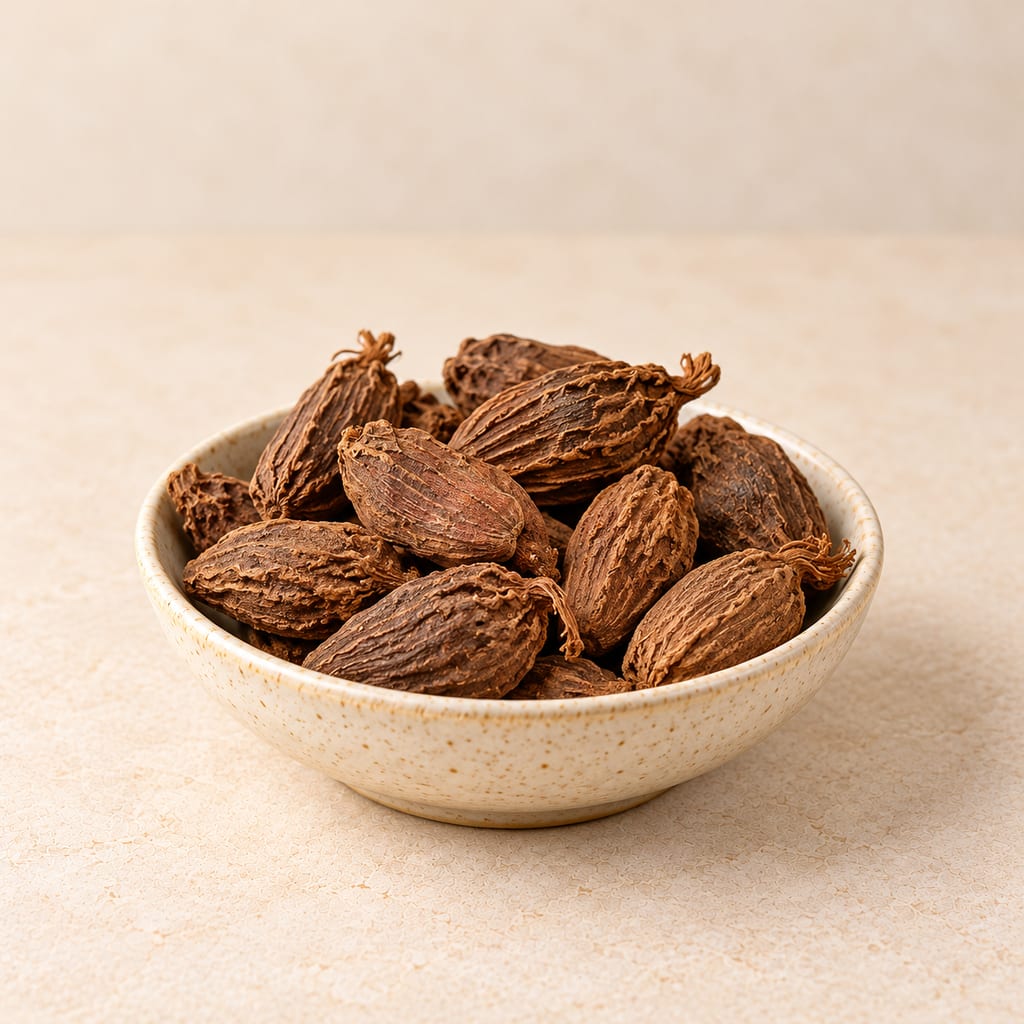
Alainchi (cardamom)
Alainchi is the large or black cardamom of the eastern Himalaya, the dark, smoke-dried pods of Amomum subulatum. Its camphor-cool, smoky seeds season Himalayan and North Indian cooking and a sweet Nepali lapsi achar.
 FermenteaWhere food goes to change
Mushrooms
The milky mushroom is a warm-climate cultivated edible, historically named Calocybe indica and now listed by Species Fungorum as Macrocybe indica. Indian cultivation research centres on straw substrates and a separate casing layer.
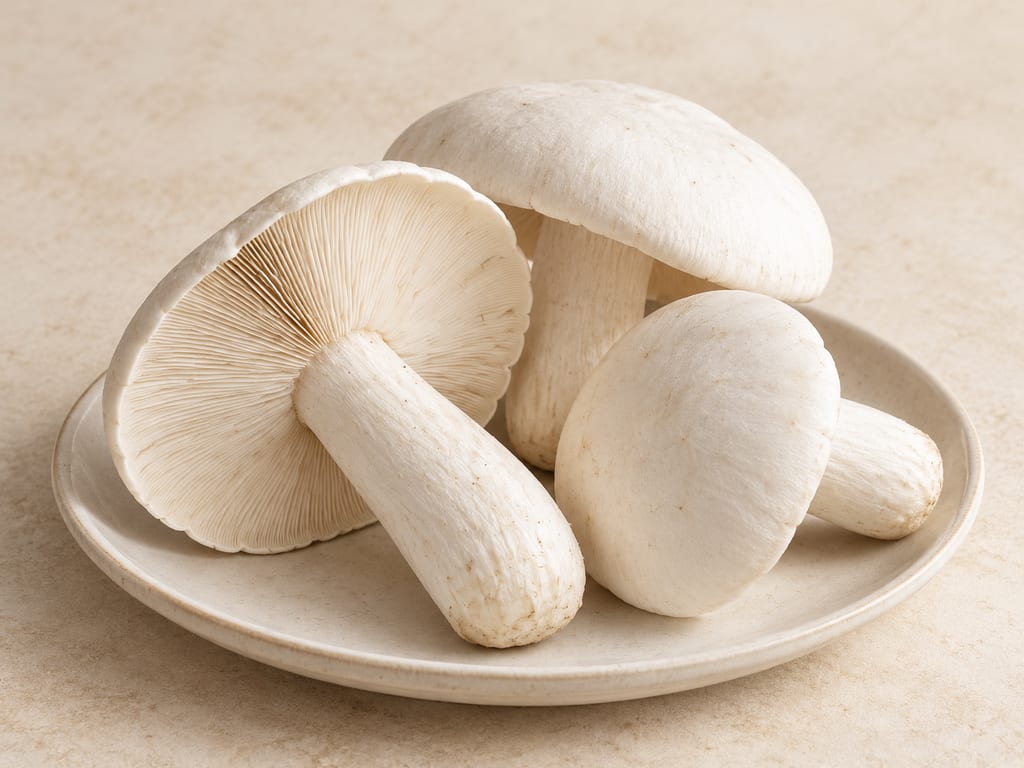
Milky mushroom is the common cultivation and food name for a tropical white agaric historically published as Calocybe indica. Purkayastha and Chandra described that name in 1974; the type record is a University of Calcutta collection from West Bengal dated 20 July 1972. A recent phylogenetic study proposed the combination Macrocybe indica after examining Pakistani material with morphology and ITS sequence evidence. Species Fungorum now shows Macrocybe indica as the current name, while NCBI and much of the cultivation literature still use Calocybe indica. Retaining both names makes the research trail searchable without pretending every database has already adopted the change.
Milky mushroom and the Bengali name Dudhi chatta are useful food names, but common names are not unique taxonomic identifiers. The milky label can be used in cultivation and trade more broadly than a single scientific species. In this account the formal names refer to the taxon tied to the West Bengal type, with the recent Macrocybe treatment and older Calocybe literature kept visible.
Wild milky mushrooms were gathered in West Bengal and sold in Calcutta markets before the crop became a standard cultivated mushroom. In local-language usage, Dudhi chatta evokes its white, milky appearance. The crop is now associated with warm-climate agriculture because it can fruit in conditions that are unsuitable or costly for cool-climate button mushrooms. Indian research stations, agricultural universities and small growers developed spawn and cultivation methods using crop residues, turning a seasonal wild food into a controllable crop.
A notable cultivar milestone was APK2, released by Tamil Nadu Agricultural University in Coimbatore in 1998. Later research has tested selected strains at multiple locations and used different cereal and agro-industrial wastes. Each trial is tied to its inoculum, substrate, casing and local climate; a yield from one study is not a promise for another farm.
Cultivated fruit bodies are robust and fleshy. Young caps are convex and become flatter with age; the cap and thick stipe are white, and the gills remain pale. A farinaceous or flour-like odour is described in taxonomic and cultivation reviews. Mature fruit bodies can be large, but size varies with strain and growing conditions. The clean white form, firm texture and relatively slow visible browning help the crop travel and appeal to consumers.
The 2026 taxonomic paper links the new generic placement to phylogenetic analysis, but the original type is not reported as sequenced in the abstract. Old cultivation photographs and named strains are therefore best read in the historical Calocybe literature, with the accepted-name update attached rather than silently rewriting each culture record.
The fungus grows saprotrophically on organic material, and cultivation research uses lignocellulosic plant residues as the main substrate. Paddy or rice straw is a common base; wheat straw, horse-gram waste, maize straw, sugarcane bagasse and leaves, bamboo leaves, grasses and coir have also been tested. The mycelium's ability to colonise plant-fibre materials makes use of residues that would otherwise have lower value.
Experiments do not give one universal best substrate. In the Bangladesh study, coconut coir supported the highest measured mycelial growth, while rice straw produced the largest biological and economic yield among the tested materials. In the Konkan trial, paddy straw performed best among its test set, including horse-gram waste, bamboo leaves and grass. These outcomes reflect different strains, substrate preparation, room conditions and experiment design, so they are comparisons within trials rather than transferable production guarantees.
Casing is a separate layer placed over a colonised substrate. It gives developing pins a moist, supportive surface and encourages uniform fruiting. Studies have evaluated soil and sand mixtures, cow dung, farmyard manure, vermicompost, and spent mushroom substrate. In one Bangladesh experiment, cow dung mixed with loamy soil at a tested depth performed well; in the Konkan trial, vermicompost and a mixture containing dried spent biogas slurry produced high efficiencies. Those recipes are experimental conditions, not a single required casing formula.
Milky mushroom production is suited to hot, humid settings. Indian institution and field reports commonly place cropping temperatures near 30–35°C, although reviews and experimental studies use other ranges and humidity settings. Spawn run and fruiting are separate stages and can have different environmental conditions. The IIHR cultivation poster describes substrate preparation, heat treatment, spawning, spawn running, casing and cropping as distinct operations; a number reported for one stage should not be copied into another.
Wild fruiting is a different calendar from a controlled crop. A review reports May to August collections in the plains of India, typically after showers following a dry spell, with regional records in West Bengal, Tamil Nadu and Rajasthan. In the Gangetic plain of Bangladesh and West Bengal, summer is also reported as a wild fruiting period. Cultivated bags can be produced under controlled conditions when warm-weather infrastructure is available, so those monsoon-associated collection dates are not a universal farm schedule.
The species has a long food history in West Bengal, where wild mushrooms were collected and sold, and has since become a cultivated crop for household and commercial consumption. Cultivated milky mushrooms are grown in India and warm-climate production systems beyond it. The available sources support the broad food use of identified milky mushroom, but do not establish a single traditional recipe, preparation method or serving size. This record therefore describes it as an edible ingredient without inventing a dish or a cooking instruction.
Studies of nutrient composition and extracts have measured protein, fibre, phenolic compounds and other constituents. These figures vary with substrate, strain, moisture and analytical method. Laboratory antioxidant assays or cell studies do not show that eating the mushroom prevents disease or treats a medical condition; the food evidence and extract research should stay separate.
West Bengal supplies the type locality, regional gathering history and Calcutta market context. Other reported wild occurrence regions include the plains of Tamil Nadu and Rajasthan. Dapoli in Maharashtra and Savar in Bangladesh are research and cultivation contexts, not additions to a wild native range. A voucher-backed 2020 collection from Phu Luong, Phu Vang, Vietnam provides a more recent locality record, while the Pakistan paper supplies the recent taxonomic reassignment. Map coordinates attached to some named cities are municipal or campus display points, never collection GPS where a source gives no coordinates.
White mushrooms can be difficult to distinguish from unrelated agarics. This page describes a cultivated species and does not identify wild specimens. The edible use records belong to correctly named, cultivated or documented material; colour or an online photo match is not enough to establish that an unknown mushroom is this species.
Type locality and historical wild collection, consumption and market sale; the source gives no specimen coordinates.
Historical market context only. OSM city-centre coordinates are not a specific market stall or collection locality.
Regional wild occurrence reported in the plains; TNAU Coimbatore is the cultivar-release institution.
Regional wild occurrence reported in the plains, with no exact locality or specimen coordinates.
APK2 cultivar-release institution. OSM campus coordinates mark the institutional location, not a wild collection or production plot.
Konkan cultivation trial context; coordinates mark Dapoli town centre, not the study plot.
Cultivation study linked to the National Mushroom Development and Extension Centre at Savar; town-centre point, not facility coordinates.
June 2020 specimen identified and deposited as a voucher; the article provides no collection GPS.
Recent ITS-based report under Macrocybe indica; abstract does not give exact collection locality.
Alainchi is the large or black cardamom of the eastern Himalaya, the dark, smoke-dried pods of Amomum subulatum. Its camphor-cool, smoky seeds season Himalayan and North Indian cooking and a sweet Nepali lapsi achar.
No community contributions have been published for this entry yet.
Sign in to contribute. Published comments and photos are free to read.
Species Fungorum / Royal Botanic Gardens, KewTaxonomy · Geography
Calocybe indica name record 310085Original name and authorship, holotype dated 20 July 1972 from West Bengal, and current name Macrocybe indica.
Cited in: One mushroom, two scientific names; A fleshy white agaric
Microscopy Research and TechniqueTaxonomy · Geography
Phylogenetic Reidentification of Calocybe indica to Macrocybe indica and New Records of Calocybe erminea in PakistanPaper published in the 2026 issue, online 13 August 2025; reidentification to Macrocybe indica based on morphology and ITS phylogenetic analysis; abstract gives no exact Pakistan specimen locality.
Cited in: One mushroom, two scientific names; A fleshy white agaric; Locations and identity limits
NCBI TaxonomyTaxonomy
Calocybe indica, Taxonomy ID 282373NCBI still presents the historical Calocybe indica name, illustrating current database usage divergence.
Cited in: One mushroom, two scientific names
MycobiologyTaxonomy · Ecology · Food use · Season · Geography · Images
A comprehensive review of tropical milky white mushroom (Calocybe indica P&C)Historical West Bengal collection, consumption and Calcutta-market sales; May-August wild fruiting reported in India; Tamil Nadu and Rajasthan plains; tropical cultivation and APK2 cultivar context; Figure 1 photo.
Cited in: From a regional mushroom to a crop; Warm conditions and the crop calendar; Food uses and what the evidence means; Locations and identity limits
ICAR-Indian Institute of Horticultural ResearchCultivation · Food use · History
Milky and Macrocybe Mushroom Cultivation, EF-126-2022Dudhi chatta name in West Bengal; wild collection and consumption; straw-based cultivation technology standardized in 1989; stages and warm-climate production guidance.
Cited in: One mushroom, two scientific names; From a regional mushroom to a crop; Growing on agricultural residues; Warm conditions and the crop calendar; Food uses and what the evidence means
India Science, Technology & Innovation portal; developing agency IIHRCultivation · Food use
Cultivation of Milky mushroom (Calocybe indica)IIHR technology record describes edible home/commercial cultivation in tropical-temperature regimes; broad cultivation context only.
Cited in: Warm conditions and the crop calendar
MycobiologyCultivation · Ecology · Season · Geography · Images
Effect of Different Substrates and Casing Materials on the Growth and Yield of Calocybe indicaSavar/Dhaka culture source and production study; warm-season context in Bangladesh; distinct substrate and casing experiments; figure 1 photographic plate.
Cited in: Growing on agricultural residues; Warm conditions and the crop calendar; Locations and identity limits
World Journal of Agricultural ResearchCultivation · Geography
Cultivation of Calocybe indica (P & C) in Konkan Region of Maharashtra, IndiaKonkan-region summer cultivation trial with locally available residues and casing; trial-specific substrate/yield results.
Cited in: Growing on agricultural residues; Locations and identity limits
Hue University Journal of Science: Natural ScienceGeography · Taxonomy
In vitro antioxidant activity and bioactive compounds from Calocybe indicaVoucher-backed, taxonomically identified June 2020 specimen from Phu Luong, Phu Vang, Thua Thien Hue, Vietnam; study is about extract chemistry, not food tradition or clinical use.
Cited in: Food uses and what the evidence means; Locations and identity limits
AntioxidantsMorphology · Cultivation · Food use · Images
The Current Status, Bioactivity, Food, and Pharmaceutical Approaches of Calocybe indica: A ReviewDescribes cultivated fruitbody form and reported warm-region cultivation; Figure 1a/b photographs from a Chennai farm; CC BY 4.0. Laboratory bioactivity is not clinical evidence.
Cited in: A fleshy white agaric; Food uses and what the evidence means
OpenStreetMap contributorsGeography
Nominatim search results for named municipality and institutional locationsCoordinates are displayed city, town or campus centres only where a named locality had no specimen GPS; they do not claim collection-point accuracy.
Cited in: Locations and identity limits
Mushroom ResearchCultivation · Geography
Development and identification of high yielding strain of Calocybe indica based on the multilocation trialsA three-year cultivation trial (2017–2020) identified the high-yielding DMR Milky-985 strain; the abstract does not give exact trial locations.
Cited in: From a regional mushroom to a crop