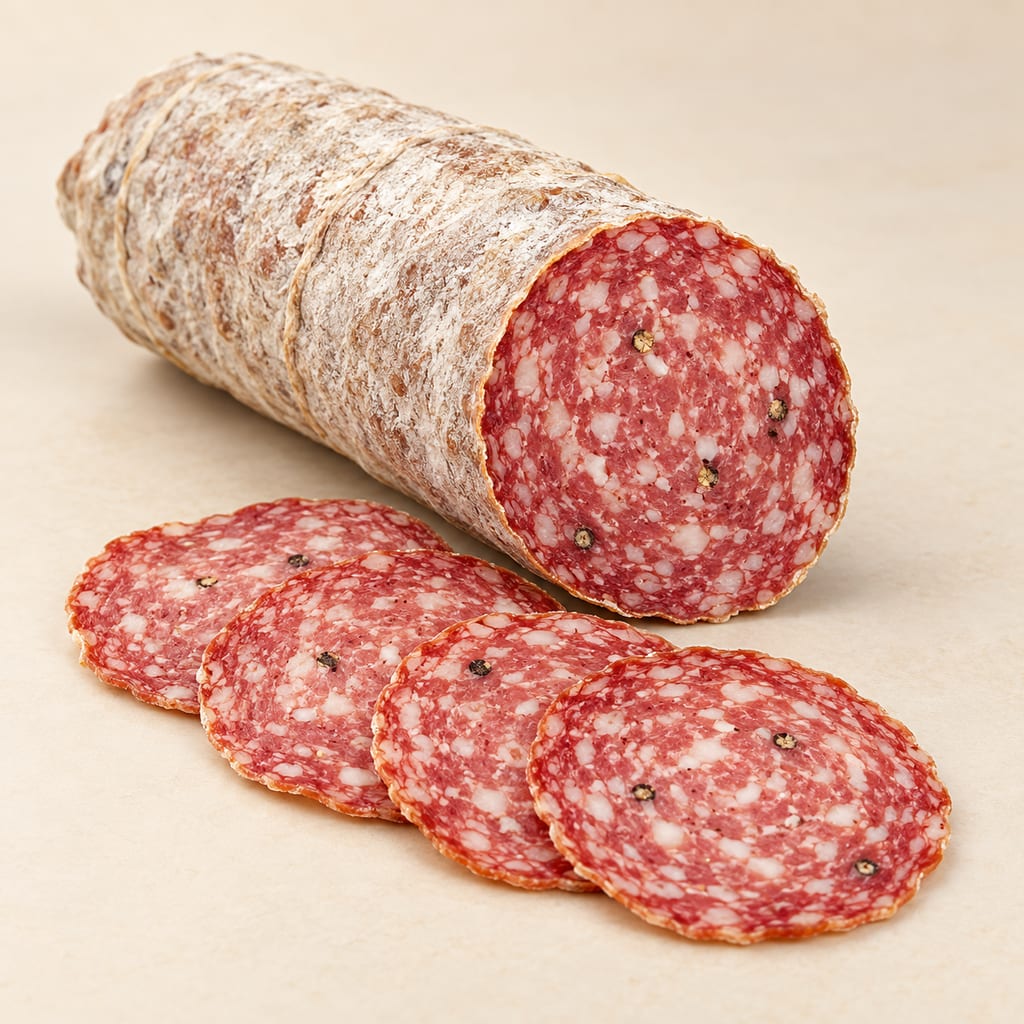
Genoa-style salami, red-wine method
Pork, beef and back fat ferment with a named starter, cure and red wine before the sausages dry in casings. This contemporary formula uses no wood-smoke stage.
 FermenteaWhere food goes to change
Processing aids
A 60 mm natural dried casing gives wide salami its animal-derived envelope and approximate stuffed diameter; its exact animal source and length depend on the chosen product.
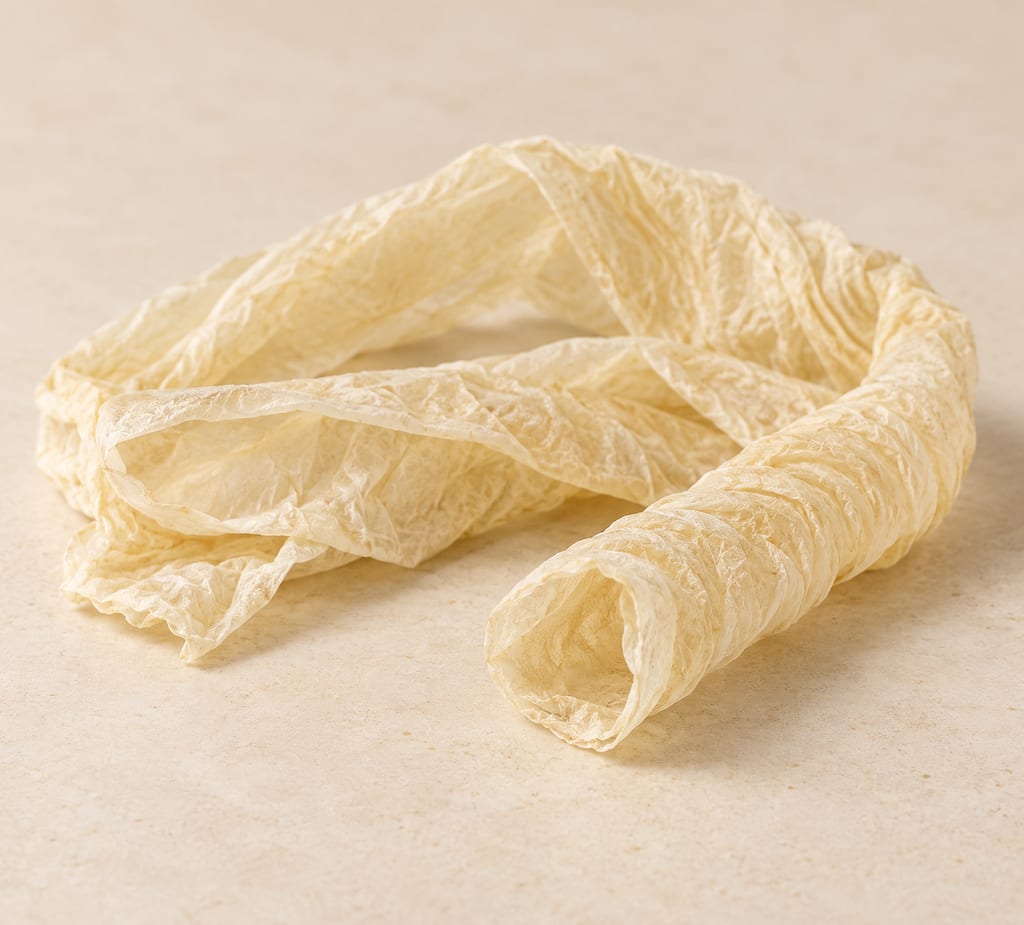
A natural dried casing is a cleaned animal-derived envelope, prepared and dried before it reaches the sausage maker. The ingredient line for a Genoa salami recipe calls for “60mm Natural Dried Casings.” Its 60 mm calibre describes the approximate diameter of the casing when it is stuffed: it is a guide to the finished sausage's width, not the length of casing in the packet or the weight of meat it can hold. The recipe leaves its animal source and the amount to buy unspecified.
Natural casing is not simply an intact piece of intestine. The intestinal wall has several layers; commercial processing removes layers and leaves a strong collagen-rich submucosa as the casing material. Natural casings can come from different species and sections of the digestive tract, and those distinctions matter: a small intestine casing, a large intestine casing, a bung, or a bladder is not one interchangeable product. The phrase “natural dried casing” describes the material and preservation form, but by itself does not name the animal or anatomical part.
The current market offers examples that fit the recipe's description. One manufacturer sells a 60 mm natural air-dried hog casing as a compressed 10 metre strand, describing it as usable for dry, semi-dry and smoked sausages. Its current instructions call for five minutes in warm water before stuffing. Another manufacturer makes natural dried pork casings across a broad calibre range and recommends a five-to-ten-minute soak in warm drinking water. These demonstrate what a modern dried casing may be; neither proves which product the Genoa recipe author intended. A nominal diameter alone cannot settle that question.
People have used natural casings to hold sausage mixtures for centuries. The practice makes practical use of an animal part that can be cleaned and prepared as a flexible food envelope. Across time and place, sausage makers have filled casings with many mixtures: chopped meat, fat, blood, offal, grain, salt and seasoning. Some are cooked soon after stuffing; others are salted, smoked, fermented or dried. The casing serves as the vessel that gives these mixtures a portable, sliceable form.
Historical evidence needs careful boundaries. Ancient and medieval references to stuffed meat or sausages establish that cased preparations existed, but they do not establish that people used today's commercially graded 60 mm casing, nor that they made the same kind of fermented Genoa salami. The International Natural Sausage Casing Association's history overview recounts examples from the ancient and medieval record and notes that salted casings became a trade commodity in late medieval Europe as demand outgrew supply. This is useful context for the history of casing use and trade, not a documented origin story for this specific dried product. The modern 60 mm dried casing should be understood as a contemporary product specification within a much older category.
Natural casing production has also changed with hygiene practice and processing technology. Modern industry guidance describes cleaning, scraping, defatting and washing the raw material before preservation and grading. Salt is a traditional preservation treatment; drying after salting is another recognized form. A casing may therefore be supplied wet and salted, or already dried and ready for rehydration. Those formats have different handling directions even when both are natural and close to the same diameter.
A casing begins its work before the sausage is hung. It contains the soft meat mixture during stuffing, gives it a cylindrical shape and helps it retain that shape while the mixture firms. It also has to tolerate filling pressure and remain with the sausage as the meat contracts during drying. Natural casing's collagenous structure gives it strength and flexibility; in its natural form it can transmit moisture and smoke. The exact permeability and mechanical behaviour vary with the source material and processing, so a maker should choose a casing intended for the particular sausage and follow its product instructions.
The diameter influences the pace of drying. Water inside a salami must migrate outward and leave through its surface. A wider sausage has a longer path from the centre to the outside, and drying studies summarized by the American Meat Science Association report that larger-diameter sausages dry more slowly. The study comparison includes sausages in the approximate 52 mm and 73 mm size range; it supports the general relationship but does not give a guaranteed drying schedule for a 60 mm Genoa salami.
Slow, even moisture loss matters to texture. If the surface dries too rapidly early in the process, it can harden into a crust or ring while the centre remains wetter. That hardened layer slows further moisture movement and can leave the sausage unevenly dried. The Food and Agriculture Organization's small-scale sausage guide describes this case-hardening risk and explains why drying conditions are staged. A 60 mm casing therefore signals a wide format that needs a drying plan appropriate to the sausage, rather than a promise that the sausage will be ready after a fixed number of days. Recipe composition, chamber conditions and the specific casing all matter too.
The casing also affects how the maker handles the finished sausage. Natural casing is edible in many products, but dried or cured salami casings may be peeled according to personal preference or product design. Current dried casing listings describe them as edible and peelable. A recipe that says to remove the casing at service, or a product whose casing is designed to be peeled, should be followed on its own terms; there is no universal serving instruction that follows from “natural.”
This envelope also shapes how the sausage is served. A broad casing produces broad slices with a different proportion of edge to centre than a narrow link. The contrast is visible on a plate, but it begins in the geometry of drying: water from the centre of a wide salami has farther to travel before leaving its surface. Changing calibre therefore changes the format and the process together; it is more than a cosmetic substitution.
The Genoa recipe's method says to soak the casing in lukewarm water for five to ten minutes. That brief soak is consistent with manufacturer directions for dried casing: water restores flexibility so the material can be opened, fitted to a stuffing horn and filled. The Sausage Maker's current 60 mm hog-casing listing calls for warm, not hot, water for five minutes, with a separate tip recommending approximately 100°F water for one to five minutes. DUCASI's dried pork casing sheet specifies warm drinking water at 20–25°C for five to ten minutes, then draining. These are product instructions, not a universal formula; “lukewarm” in the recipe does not specify a number of degrees.
Salted natural casing is a different starting material. A 60/65 mm beef middle sold by Weschenfelder is packed and cured in salt; the seller tells customers to rinse off the salt and soak the casing in warm water for at least an hour, preferably overnight. That longer preparation should not be transferred to a dried casing simply because the calibre is similar. Conversely, the short dried-casing soak should not be assumed suitable for every salted casing. The supplier's label and instructions identify the product actually in hand.
The recipe's 1 kg batch lists casing as an ingredient but gives no length, number of pieces or weight. A current 10 metre strand listing claims a large stuffing capacity, while other suppliers sell different lengths and shapes. Those pack-specific capacities cannot be converted into a recipe-specific purchase quantity without knowing the intended sausage length and how much casing the maker uses. A maker should source enough of the chosen product for the desired links and account for its stated packing format; the recipe itself does not settle the amount.
The first distinction is between a natural animal casing and an artificial casing. Modern sausages may also use manufactured collagen, cellulose or plastic casings. These differ in origin and function. Collagen casings are made from processed animal collagen, often from hides; cellulose and plastic casings are manufactured materials, and some are intended to be removed after processing. They can be uniform in size and useful in production systems designed around them, but they are not the same ingredient as a natural dried intestine casing. A recipe that names natural casing should not silently be rewritten to mean any casing of the right diameter.
Within natural casings, calibre, shape, source section and preservation state narrow the choice. A straight casing can hang differently from a curved round; a thick or thin wall can affect strength and how the casing follows shrinkage. Manufacturers sell products for particular applications, including wide salami and dry sausage. Some dried natural casings are supplied in long compressed strands that the maker cuts to the desired length. Salted middles or other natural casings may instead be sold in a measured hank or bundle and need rinsing and soaking. At equal calibre, these are still different products with different preparation.
The 60 mm figure is a nominal stuffed diameter, not a guarantee that every casing will produce a perfectly identical salami. Natural materials have variability, and the sausage mixture, stuffing pressure and drying conditions influence the result. Product grades and instructions can help match the casing to the intended process, but the recipe does not specify a brand, grading, source animal, intestinal section or whether 60 mm is an exact or nominal supplier size. Those details remain open unless the recipe author or its original supplier link confirms them.
Large natural casings are used for wide salami and other dry sausages, as well as some cooked or smoked products, depending on their construction and the producer's instructions. FAO's technical guide lists pig bungs among products used for dry sausages and describes beef middles as a different casing category. Product manufacturers list beef middles for dried salumi and summer sausage, while suppliers of dried hog casing recommend their products for dry, semi-dry and smoked sausages. These examples show the breadth of the casing trade, not a single universal use for every 60 mm casing.
For this Genoa salami, the casing is the envelope that shapes the meat and stays with it through fermentation and drying. Its broad size affects the finished format and drying pace; its dried condition makes the brief rehydration step plausible. The practical choice still begins with the actual product: confirm its source and calibre, read its label, and follow its preparation instructions. “Natural dried casing, 60 mm” is enough to identify the role and approximate width, but not enough to identify every feature of the casing or calculate a purchase quantity.
The recipe and comparator listings do not establish the casing's exact animal source, organ, supplier or purchase quantity. Do not infer those from the 60 mm size. Natural casings are animal-derived food materials and should come from a reputable food supplier; preserve and prepare them according to that supplier's instructions. No shelf life or storage condition can be assigned to this unspecified product from the recipe wording alone.
The recipe does not identify its casing supplier, animal source, production place or exact quantity; a current Spanish-sourced hog SKU is only a comparator.
Pork, beef and back fat ferment with a named starter, cure and red wine before the sausages dry in casings. This contemporary formula uses no wood-smoke stage.
No community contributions have been published for this entry yet.
Sign in to contribute. Published comments and photos are free to read.
2 Guys & A CoolerIngredient context · Process
Genoa SalamiExact 60 mm natural dried casing wording and 5–10 minute lukewarm soak; no length or count.
Cited in: A shaped skin for a wide salami; Rehydration is product-specific; Limits and handling
European Natural Sausage Casings AssociationIngredient context · Process
Community Guide to Good Practice for Hygiene in the Production of Natural Sausage Casings, version VIIndustry definition, natural casing processing and dried form.
Cited in: A shaped skin for a wide salami; An old practice, with a modern product distinction; Choosing among natural and manufactured casings; Limits and handling
DUREX NV / DUCASIIngredient context · Process
Dried Pork CasingsContemporary comparator: dried pork casing calibre range and 20–25°C, 5–10 minute soak; not recipe identity.
Cited in: A shaped skin for a wide salami; Rehydration is product-specific
The Sausage MakerIngredient context · Process
60mm x 32ft Natural Dried CasingsContemporary 60 mm hog casing comparator; current SKU size, intended use and warm-water directions.
Cited in: A shaped skin for a wide salami; Why the wall and width matter; Rehydration is product-specific; Uses beyond this recipe; Limits and handling
Food and Agriculture OrganizationIngredient context · Process
Small-Scale Sausage Production: Sausage CasingsNatural casing structures, functions, animal and organ distinctions.
Cited in: An old practice, with a modern product distinction; Why the wall and width matter; Choosing among natural and manufactured casings; Uses beyond this recipe
Food and Agriculture OrganizationIngredient context · Process
Small-Scale Sausage Production: DryingRapid outer drying can impede later moisture migration.
Cited in: Why the wall and width matter
American Meat Science Association / J.C. ActonIngredient context · Process
The Chemistry of Dry Sausages1977 review reports casing diameter affects drying rate; cites earlier Keller and Palumbo studies.
Cited in: Why the wall and width matter
HBS-NatuurdarmenIngredient context · Process
Natural casings: GeneralTrade calibre is diameter when stuffed; natural casing traits.
Cited in: A shaped skin for a wide salami
Natural Casing Co.Ingredient context · Process
Our ProductsBeef-middle product comparator, not identity of recipe casing.
Cited in: Choosing among natural and manufactured casings; Uses beyond this recipe
WeschenfelderIngredient context · Process
Beef Middle Casings, 60/65mmSalted beef-middle contrast and longer preparation directions.
Cited in: Rehydration is product-specific; Choosing among natural and manufactured casings
International Natural Sausage Casing AssociationIngredient context · Process
History of sausage casingsBroad historical overview, not origin proof for 60 mm dried product.
Cited in: An old practice, with a modern product distinction