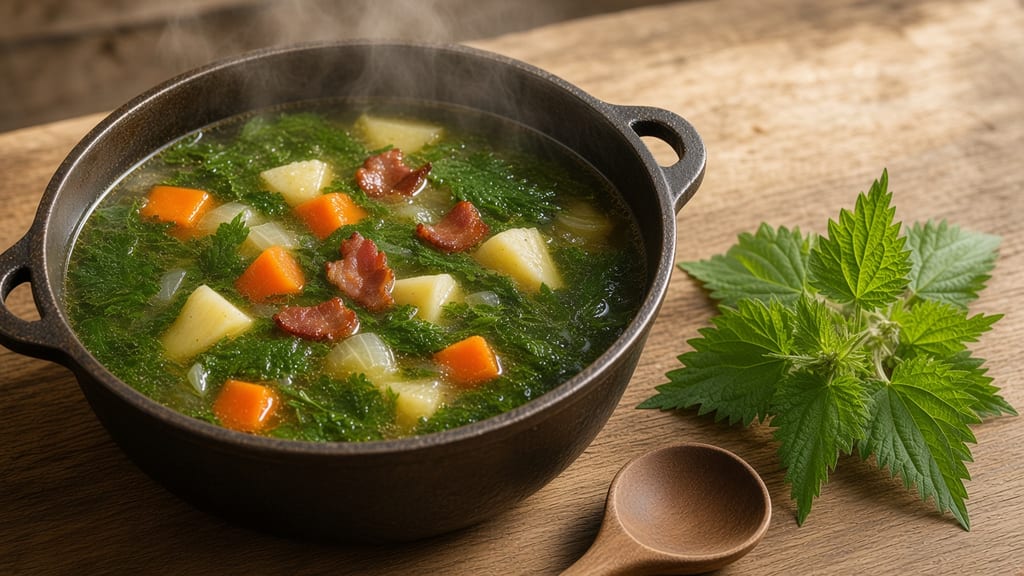
Spring nettle pottage (modern reconstruction)
Young stinging nettle shoots cooked with bacon, onion, garlic and three roots into a thick spring soup, from a Danish Viking museum's recipe, with a meat-broth variation and ember-baked turnips.
 FermenteaWhere food goes to change
Substrates
A source-linked account of common stinging nettle as a food plant and spreading perennial, with regional cooking reports, handling cautions and cultivation limits.
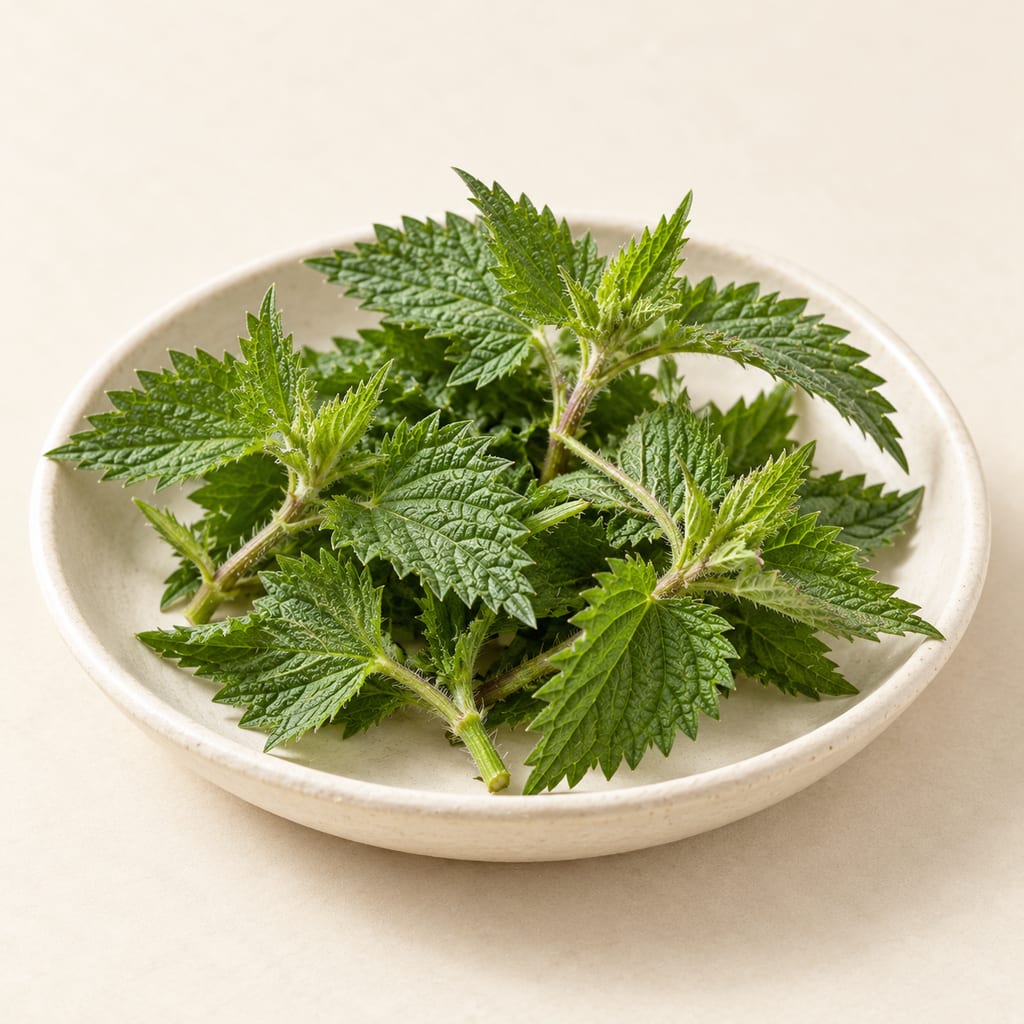
The common ingredient name can refer to more than one plant. The research below concerns the particular taxon and uses named in its sources; it does not identify every ingredient sold under this name.
Kew accepts Urtica dioica L. and describes it as a perennial or rhizomatous plant native across Europe to Siberia and western China, and northwest Africa. The RHS distinguishes common stinging nettle from the annual Urtica urens, also called small stinging nettle. The shared word nettle can cover more than one species, so a food report using a common name does not by itself verify a plant.
A Natural Nations educational sheet reports cooked nettle leaves used as a vegetable, in soup and omelettes in Spain, Sweden and the UK. Its UK soup example uses fresh tips and describes adding leaves to simmering soup before puréeing. Woodland Trust likewise names Urtica dioica and describes leaf tips in soup, tea and other leafy-green dishes. The food preparations summarized here concern leaves or tips; the cited accounts provide no root-preparation method. These are regional culinary reports, not a single method shared across all nettle traditions.
The Natural Nations sheet suggests fresh tips in spring before flowers for its soup account; the RHS describes flowers from late spring to early autumn. Woodland Trust separately lists leaves, stems, shoots, flowers and seeds as edible parts and favors young tips for tender leaves. These different source scopes do not establish a universal harvest calendar or root preparation method. The Scottish National Dictionary records nettle-kail as a historical Scots term for broth made from nettle tops, with nineteenth-century examples; that lexical record does not prove a continuous tradition or identify a particular gathered specimen.
The RHS identifies stinging hairs on leaves and stems and advises gloves and protective equipment when handling the plant. The Natural Nations soup account also recommends gloves for raw material and says its leaves lose their lacerating effect once cooked; it gives a ten-minute simmer in that particular recipe. Those are the sheet's statements, not an independently tested universal time or temperature for removing stings or controlling other hazards. No foraged specimen can be identified or declared safe by this article, and no medicinal benefit is claimed.
The RHS profile describes Urtica dioica as a spreading-rooted perennial with creeping horizontal stems. It lists full shade, partial shade or full sun; chalk, clay, loam or sand; moist but well-drained or well-drained conditions; and acid, neutral or alkaline pH. It assigns H7 under the RHS UK hardiness scheme. Its cultivation notes say the plant thrives in nitrogen-rich, moist but well-drained soil and self-seeds freely; it spreads by roots, horizontal stems and seed. The RHS lists it as generally pest-free and disease-free, while noting that it can be difficult to control and is useful to butterfly and moth caterpillars.
RHS describes new growth each spring and flowers from late spring to early autumn, but the reviewed pages provide no sowing calendar, spacing, quantified irrigation, greenhouse or container regimen, or productive leaf-yield schedule. The garden profile supports a wildlife planting context; it does not give a managed food-crop containment design. Local collection rules, contamination and conservation status were not assessed.
No local specimen, subspecies or cultivar was assessed; a common-name food report is not specimen identification.
The food sources do not establish a universal cooking endpoint, raw-handling procedure, contamination check or storage life.
The reviewed food accounts concern leaves and tips; no root-preparation account was found in these sources.
The reviewed horticultural pages do not quantify greenhouse, container, irrigation, sowing, yield or food-crop containment methods.
Local harvest permissions and conservation status were not assessed.
The underlying plant account received a partial source review. Its review scope is described in the original plant article.
The available research does not establish a single origin for this ingredient.
Young stinging nettle shoots cooked with bacon, onion, garlic and three roots into a thick spring soup, from a Danish Viking museum's recipe, with a meat-broth variation and ember-baked turnips.
No community contributions have been published for this entry yet.
Sign in to contribute. Published comments and photos are free to read.
Royal Botanic Gardens, Kew, Plants of the World OnlineIngredient research
Urtica dioica L.Cited in: Scope of this account; Name and species boundary; Research gaps
Royal Horticultural SocietyIngredient research
Urtica dioica: detailsCited in: Name and species boundary; Season and plant parts in food accounts; Handling and limits of cooking reports; Growing in a garden; Unspecified cultivation conditions; Research gaps
Royal Horticultural SocietyIngredient research
Stinging nettlesCited in: Name and species boundary; Growing in a garden; Unspecified cultivation conditions; Research gaps
Natural Nations / Learning Through LandscapesIngredient research
Stinging Nettle Information SheetCited in: Food reports and source-described preparation; Season and plant parts in food accounts; Handling and limits of cooking reports; Research gaps
Woodland TrustIngredient research
Seven edible weeds: foraging in your gardenCited in: Food reports and source-described preparation; Season and plant parts in food accounts; Research gaps
Dictionary of the Scots LanguageIngredient research
nettle-kailCited in: Season and plant parts in food accounts; Research gaps
FermenteaResearch provenance
Common stinging nettle (Urtica dioica): original plant researchCited in: Research status