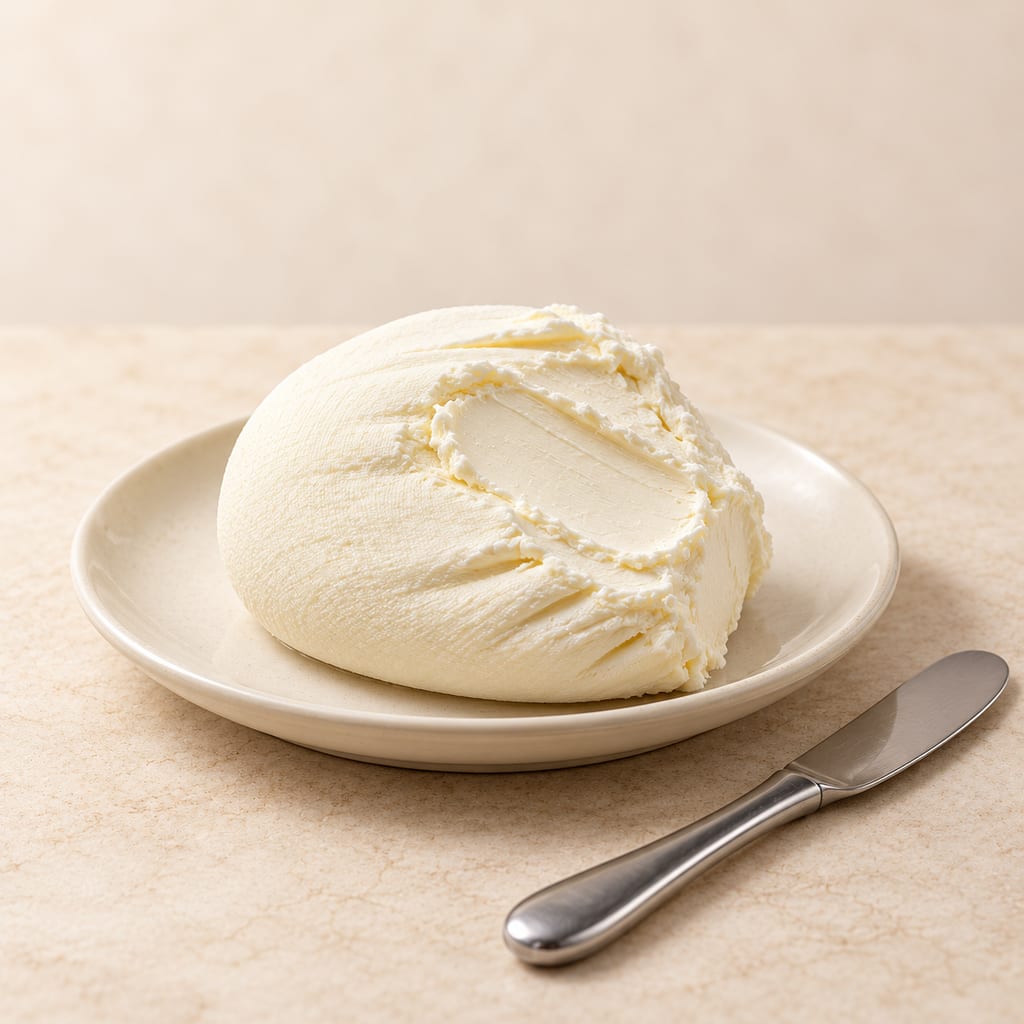
Cream cheese
A fresh cultured-cream spread, set gently and drained in muslin in the refrigerator. This home method uses light cream and a small amount of cultured buttermilk.
 FermenteaWhere food goes to change
Substrates
Liquid pasteurized cream used for cultured fresh cheese, with a fat grade whose meaning differs between markets.
Light cream is liquid dairy cream with a comparatively modest fat content. It pours rather than holding the shape of a spooned cultured cream. Its pale colour and smooth body come from a mixture that still contains water, milk proteins, lactose and minerals as well as fat. In a drink it brings colour and richness; in a cultured cheese it becomes part of a different structure, held together by acidified milk proteins.
The light cream used in the Canadian cream-cheese preparation is pasteurized, but its fat percentage is unrecorded. This matters because the name has different meanings in different markets. A familiar label can seem more precise than it is. Here the dependable identity is the one the preparation actually gives: pasteurized liquid light cream, used as the starting dairy material for a cultured, drained fresh cheese.
The cream also has a different job from the small addition of cultured buttermilk, sour cream or cheese starter. It supplies most of the batch. The addition introduces the culture that starts souring it. Ordinary liquid cream and already cultured cream therefore occupy different places in this preparation, even though both appear among its ingredients.
In the United States, light cream is a defined grade with at least 18% but less than 30% milk fat. The same standard permits the names coffee cream and table cream. It requires pasteurization or ultra-pasteurization and allows homogenization. These are rules for products sold under that American name; they do not establish the composition of an older Canadian ingredient.
Retail light cream in Ontario typically contains 5–6% fat. It is a different retail product from half-and-half, table cream and whipping cream, and provincial legislation governs retail and food-service cream types. The Canadian federal compositional standard defines cream more broadly through the separation of milk constituents to raise its fat content.
A person buying cream for an older formula consequently needs more than a name shared between countries. The carton's declared fat level and treatment tell the reader what is actually available. Differences in those cartons may help explain differences in texture.
Cream can separate from milk because milk fat and milk’s watery phase differ in density. When unhomogenized milk stands, fat rises toward the surface, where it can be skimmed. A centrifugal separator speeds the division by rotating milk and directing the resulting streams through separate outlets. The cream is the stream richer in fat; skim milk is the companion stream with much of that fat removed.
Mechanical separation offered an alternative to leaving milk to stand and skimming the cream that rose to the surface. Gustaf de Laval and Oskar Lamm obtained the patent in 1878, and AB Separator was founded in 1883. The machine became common on Swedish farms around the turn of the twentieth century. Those dates belong to that industrial history, rather than marking the first human use of cream.
Modern separation also makes standardization possible. A dairy can blend a lower-fat stream into a richer one to obtain the desired cream composition. Cream sold in a carton is therefore not necessarily the unchanged top layer skimmed from a pail. Separation and blending allow different grades to serve different uses, from enriching a beverage to whipping or making a cultured product.
Cream is an oil-in-water emulsion. Small droplets of milk fat are dispersed through a continuous watery phase. Their surfaces carry membranes and proteins that help keep the droplets dispersed. The mixture can look uniform to the eye while containing physically different components. It is useful to picture the droplets within the liquid, rather than imagining cream as a block of fat merely softened with water.
Milk proteins contribute their own behaviour. Casein occurs in particles called micelles, while whey proteins remain in the serum. Lactose and dissolved minerals accompany them. Separating cream concentrates fat but does not remove every other milk component. Those remaining proteins and sugars are central when cream becomes a fermented food: cultures have a substrate to use, and acidification can alter the protein structure.
Processing changes this arrangement. Homogenization breaks fat globules into smaller droplets and changes the material at their surfaces. Heat can change protein structure and interactions. The consequences include differences in emulsion stability and in the body of products made from it. These general mechanisms explain why two creams with similar names can behave differently without identifying the treatment of the historical batch.
Pasteurization is a controlled heat treatment used to reduce microbial hazards. Homogenization is a mechanical treatment used to reduce fat-globule size and limit separation. They answer different questions: how the dairy material has been heat-treated, and how its fat is dispersed. A carton may declare both, but the presence of one term is not a substitute for the other.
Cream processing depends on intended use. The Canadian Dairy Commission describes different choices for whipping creams and other grades because an alteration that improves stability can also change whipping behaviour. A cream selected for pouring, a cream intended to whip and a cream intended for culturing need not have identical treatment. Fat percentage alone is an incomplete description of that functionality.
For the Canadian cream-cheese preparation, pasteurization is explicit and homogenization is not. No additional heat schedule is supplied for the purchased cream in that formula. The useful reading is to retain the stated ingredient and recognize what remains unspecified. Adding a modern processing preference would change the evidence behind the recipe, even if that preference is common elsewhere.
J. A. Elliott and D. B. Emmons included cream cheese in Home-made dairy products, an Agriculture Canada household booklet copyrighted in 1978 and reprinted in 1981. Its wider concern was making cultured dairy and cheese in a home kitchen with deliberate cultures, basic measuring equipment and attention to sanitation. The cream-cheese method gives light cream a specific place within that practical account.
The batch begins with 1 L of pasteurized light cream at 22°C and a 20 mL addition of fresh cultured buttermilk, sour cream or cheese starter. It is held at 22°C until a firm coagulum forms, usually after 14–16 hours. The coagulum is then broken gently and drained in muslin in the refrigerator. When drainage slows, the curd is stirred and hung again overnight.
These stages move from liquid cream to a set mass and then to a concentrated spread. They do not include churning the fat into butter, cooking a cut cheese curd or ripening a rind. The result belongs among fresh cultured cheeses. The booklet supplies a household method and a short instruction to refrigerate and use the cheese within a few days; it supplies no tested shelf-life study.
In dairy fermentation, acid production changes the environment around casein. As acidification proceeds, the particles become less stable and can associate into a gel. That network holds liquid and dispersed material within it. The visible set is therefore a change in the milk proteins, with fat carried within the resulting structure, rather than fat droplets simply becoming butter.
Cream-cheese texture depends on more than acid alone. Experimental cream-cheese research has examined interactions among fat, protein, acidity and texture in controlled formulations. Such work shows why composition and processing have to be considered together. Its measured formulations, heat treatments and separation equipment differ from a household muslin bag, so its numbers do not transfer to a household batch.
The distinction is useful when interpreting a soft or firm result. A cream with a different fat level brings a different balance of fat and protein into the same starting volume. Heat history can alter protein interactions, and the handling of a formed gel can change its body. Without measurements of the actual batch, none of those possible influences can be singled out as its demonstrated cause.
After the cream sets, drainage removes whey. Whey carries water and soluble milk components away from the retained curd. The spread becomes more concentrated as that liquid leaves. This is a physical separation following fermentation; the bag does not create the acid or identify the organisms that produced it.
Gentle breaking and stirring change how liquid can leave the set mass. They also disturb its protein network. A gel that has been broken and gathered behaves differently from an untouched set in a glass. That helps explain why a drained spread and a spooned cultured cream can begin with related dairy materials yet reach different consistencies.
The refrigerator is part of the booklet’s drainage arrangement. Its overnight hanging instruction should be read with that location intact. Moving the bag to a warm room would change the process rather than merely change its convenience. The formula gives no measured drained yield, moisture percentage or acidity endpoint, so the finished spread should not be assigned a commercial cream-cheese specification.
Read the product name together with its fat declaration, ingredient list and heat-treatment statement. Plain pouring cream, cultured sour cream, whipping cream and sweetened dessert cream serve different purposes. A product that contains extra ingredients may also behave differently from a plain liquid cream. The historical formula provides no evidence for treating every white dairy liquid as equivalent.
Beyond fermentation, cream enriches beverages, soups, sauces, desserts and baked foods. In these uses, fat contributes richness while the liquid and milk solids also enter the dish. Heating, mixing and the other ingredients determine what happens next. A cream that is suitable for whitening coffee does not automatically have the structure needed for a whipped topping.
For cultured foods, the same care with identity matters. Liquid cream is the material being inoculated; sour cream is already a fermented product; butter is made by disrupting cream’s emulsion through churning. Understanding these separate forms makes a recipe easier to interpret and prevents a processing term from being mistaken for an ingredient specification.
Cream contains milk proteins and is a milk allergen. Separating fat from milk does not make the resulting cream suitable for someone with a milk-protein allergy. Milk allergy and lactose intolerance are different conditions; the cream’s fat grade alone does not establish how much lactose it contains or justify a lactose-free claim.
Follow the carton’s refrigeration and use instructions, and keep equipment that contacts pasteurized cream clean. Pasteurization does not protect the cream from contamination introduced afterward. The historical booklet likewise emphasizes preventing contact between pasteurized dairy material and unsanitized equipment. Its finished-cheese instruction must remain distinct from the manufacturer’s directions for an unopened carton.
The historical cream's fat percentage, animal species, homogenization and detailed heat treatment are unrecorded. The starter's organisms and a validated shelf life for the finished cheese are also not established.
milk
The Canadian household booklet documents this use; no precise origin or historical cream composition is established.
A fresh cultured-cream spread, set gently and drained in muslin in the refrigerator. This home method uses light cream and a small amount of cultured buttermilk.
No community contributions have been published for this entry yet.
Sign in to contribute. Published comments and photos are free to read.
Agriculture CanadaIngredient context
Home-made dairy products, Publication 1669Printed pp.3–6: household equipment, sanitation, dairy material, culture growing and troubleshooting. Printed pp.7–10: starter uses, cottage cheese and cream cheese. Historical household instructions; no new process validation.
Cited in: Cream before it becomes cheese; Pasteurization and homogenization do different work; A Canadian household use; Draining concentrates the curd; Milk allergy and refrigerated handling
Canadian Dairy CommissionIngredient context
CreamCream processing, oil-in-water emulsion, standardization and different cream uses. Varieties gives Ontario light cream typically5–6%; no assignment of this grade to historical recipe.
Cited in: Cream before it becomes cheese; A name that changes at the border; Separating the rich stream; Pasteurization and homogenization do different work; Choosing cream for its intended use
U.S. FDA regulation; Cornell Legal Information Institute transcriptionIngredient context
21 CFR §131.155: Light creamU.S.18–<30%milkfat; pasteurized/ultrapasteurized; may homogenize; coffee cream/table cream permitted names.
Cited in: A name that changes at the border; Choosing cream for its intended use
Canadian Food Inspection AgencyIngredient context
Canadian Food Compositional Standards, Volume 7: Dairy Products§7.1.0 current milk standard species scope;§7.1.2 skim milk≤0.3%fat;§7.1.11powder;§7.1.15addedsolids;§7.2.1cream separated to increase fat. Modern standards do not measure historical batch.
Cited in: A name that changes at the border; Choosing cream for its intended use
Tekniska museetIngredient context
Gustaf de Laval – The milk-cream separatorMilk-cream separator section: gravity skimming; two separator outlets; deLaval/Lamm1878patent;1883ABSeparator; Swedish farm adoption. Museum industrial history, not a first-food claim.
Cited in: Separating the rich stream
Tetra Pak, Dairy Processing HandbookIngredient context
The Chemistry of MilkGeneral milk emulsion, casein/whey proteins, lactose, acid gel formation and effects of heat. Not a measured endpoint for these source batches.
Cited in: Fat suspended in water; Acid gives the cream another structure
Health CanadaIngredient context
Unpasteurized or raw milkMilk section: pasteurization and harmful raw-milk microorganisms; choose labelled pasteurized milk.
Cited in: Pasteurization and homogenization do different work; Milk allergy and refrigerated handling
Government of Canada PublicationsIngredient context
Home-made dairy products / by J.A. Elliott and D.B. EmmonsPublication authors, publication and reprint metadata.
Cited in: A Canadian household use
Wisconsin Center for Dairy ResearchIngredient context
Yogurt Monograph: ProductionGeneral dairy gel structure, protein concentration, heat/protein interactions.
Cited in: Acid gives the cream another structure
Food ChemistryIngredient context
The effect of pH on the fat and protein within cream cheese and their influence on textural and rheological propertiesControlled cream-cheese formulations show how pH and composition affect fat and protein structure, texture and rheology; the experimental conditions do not establish a household cream-cheese process.
Cited in: Acid gives the cream another structure
Food and Agriculture OrganizationIngredient context
Small-Scale Dairy Farming Manual, Volume 1, Technology Unit10.3: Small Scale Cheese MakingGeneral acid/enzyme coagulation, curd/serum separation and handling. No thresholds imported.
Cited in: Draining concentrates the curd
Wisconsin Center for Dairy ResearchIngredient context
Yogurt Monograph: RheologyGeneral gel disruption by stirring and fluidity; not culture identification.
Cited in: Draining concentrates the curd
Health CanadaIngredient context
Milk – A priority food allergenMilk-protein allergy, label checking and distinction from lactose intolerance.
Cited in: Milk allergy and refrigerated handling