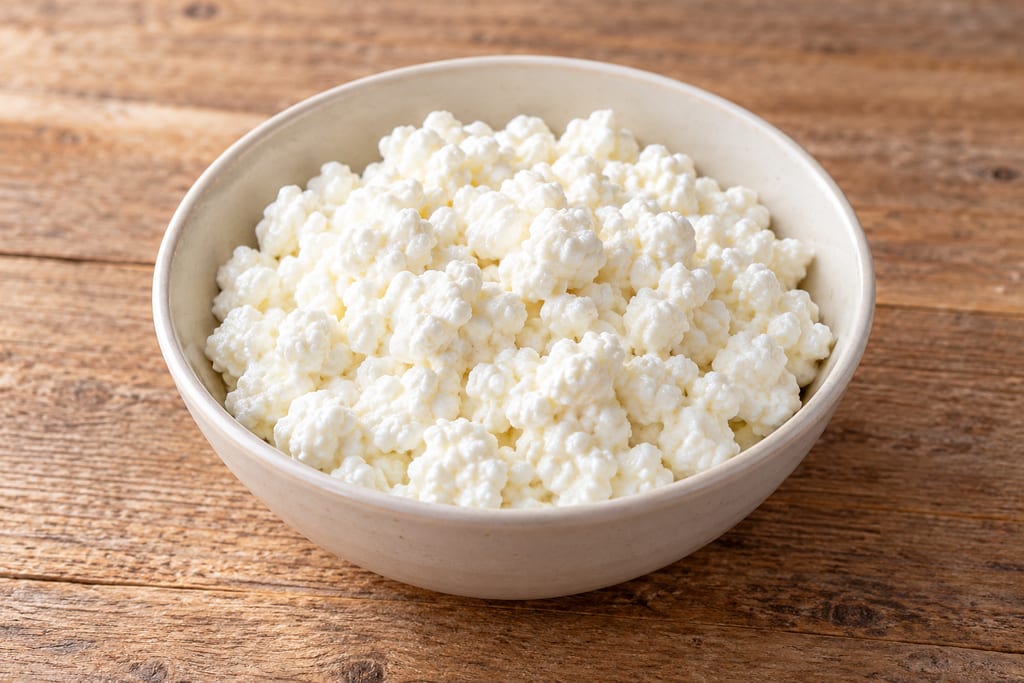
Cottage cheese, long-set
Skim milk is cultured slowly, cut into curds, warmed and drained to make fresh cottage cheese. Cold-water washing softens its flavour before cream and salt are added.
 FermenteaWhere food goes to change
Substrates
Liquid milk with most fat removed and a pasteurizing treatment applied, used as a protein-rich base for fresh curds.
Skim milk is the milk stream left after most of the fat has been separated. It remains a liquid dairy food containing water, lactose, proteins and minerals. Removing cream changes its richness and appearance, but leaves the components that make it useful for a cultured curd. In cottage cheese, that lean starting material becomes the curd before cream is added separately, if the preparation calls for it.
Compared with whole milk, skim milk can appear more translucent and slightly bluish. Fat globules contribute to milk’s opacity and colour, so reducing them changes the way light passes through the liquid. The colour is a property of the material rather than a measurement of its composition. A glance cannot determine the precise fat content or reveal its heat treatment.
The pasteurized skim milk named in the Canadian household cheese formula is a liquid ingredient. Its name supplies two pieces of information: most fat has been removed, and a pasteurizing treatment has been applied. It does not give a measured fat percentage, animal species or detailed processing history for that particular batch.
Milk fat is less dense than milk’s watery phase. In milk that has not been homogenized, it can rise toward the surface, forming a cream layer that can be skimmed. This household separation leaves a leaner milk below. The operation takes advantage of a physical difference already present in milk rather than fermenting or chemically destroying its fat.
Centrifugal separation made that division faster. Tekniska museet describes how a rotating container directs materials of different densities into different parts of the separator. Separate outlets carry cream and skim milk away. Its account records Gustaf de Laval and Oskar Lamm’s 1878 patent and the formation of AB Separator in 1883, followed by widespread use on Swedish farms around the turn of the century.
The machine’s history is not a birthplace claim for skim milk. Gravity skimming preceded it. What changed was the equipment and the scale and regularity with which the two milk streams could be obtained. In modern dairy production, separation also supports standardization: streams with different fat contents can be blended to obtain a chosen product composition.
Food standards give commercial names a more exact meaning within a jurisdiction. Canada’s current incorporated compositional standard sets a maximum of 0.3% milk fat for skim milk. The Canadian Dairy Commission’s representative beverage-milk account describes skim milk at 0.1% fat. A legal ceiling and a typical example are different kinds of figure, and neither is a universal analysis of milk sold elsewhere.
These modern definitions help a shopper understand labels, but they do not measure the milk in an older recipe. The historical cottage-cheese formula names skim milk without giving its composition. Attaching a current retail percentage to that source would create precision it does not contain. The useful qualification is the one actually documented: liquid pasteurized skim milk.
Read the rest of a carton as well as its fat description. A flavoured milk, a product with added milk solids, a concentrated milk and a plain liquid skim milk need not have the same composition. Food standards may also be limited to a particular animal milk. Their scope should not silently supply an unstated species to a different historical preparation.
Skimming principally changes the fat fraction. Lactose remains dissolved in the watery phase, and milk proteins remain dispersed through it. Skim milk is therefore neither water with the flavour of milk nor a protein isolate. It retains a mixture of components whose different roles become apparent in fermentation and cheesemaking.
Casein occurs in micelles, small particles containing proteins and associated minerals. Whey proteins occupy the serum. Lactose supplies sugar that dairy cultures can ferment. These components respond differently to heating, acidification and separation, which is why removing cream is only one of the operations that can change milk.
Milk composition varies with the animal and with factors such as breed, feeding and lactation. Representative dairy tables explain general behaviour but do not guarantee the analysis of an individual carton. For a source recipe, an unreported protein or lactose percentage should remain unreported. The name of the ingredient cannot establish every property relevant to the final curd.
Pasteurization applies a controlled heat treatment to reduce harmful microorganisms. Skimming separates components by their physical properties. One changes the microbial condition of the milk; the other changes its fat composition. A description of either operation alone leaves the other question unanswered.
Commercial pasteurization is a system of controls. Canadian guidance discusses temperature, holding time, flow, pressure relationships and prevention of contact between raw and treated milk. Equipment and records help establish that the process reached the product throughout. A published industrial schedule is therefore not simply a number to approximate in a household saucepan.
Heat treatment can also affect proteins and later processing behaviour. The words pasteurized and ultra-pasteurized should not be assumed to describe identical treatment. When a cheese preparation specifies its milk, that choice belongs with the method. The Canadian cottage-cheese formula already calls for a pasteurized input; the booklet’s separate discussion of home pasteurization does not automatically add another step to that batch.
In an acid-set cheese, lactic cultures use milk sugar and produce acid. As the milk acidifies, casein particles become less stable and aggregate. A network forms within the liquid, retaining serum and milk solids. The fat need not be abundant for this to happen, because the main curd-forming structure is protein.
The resulting set contains liquid that can be expelled. Cutting exposes more surface, while subsequent stirring and heating can encourage whey to leave the curd. The retained pieces become firmer and more concentrated. These physical stages follow acidification; they do not replace the starter’s role in forming the initial curd.
Cottage cheese makes the distinction visible. It is a fresh curd that can be cut, cooked, washed and drained before a dressing is added. Cream dressing changes richness and texture afterward. Starting with skim milk lets the curd-making stage and the later addition of fat remain separate operations, rather than requiring all fat to enter with the original milk.
The household booklet Home-made dairy products, by J. A. Elliott and D. B. Emmons, was copyrighted in 1978 and reprinted in 1981. Its long-set cottage-cheese method begins with 1 L of pasteurized skim milk and 3–10 mL of active starter at 20–22°C. It expects coagulation in 14–16 hours before the curd is cut.
The method gives the curd further handling: roughly 15 mm cuts, a rest, gentle stirring and a gradual rise to 55°C over two hours. Washing and draining follow, then cream and salt to taste and immediate refrigeration in small containers. The booklet also offers a different inoculation and warmer setting option, which belongs to its own stated conditions rather than being combined with the long-set route.
These directions document one household use of the ingredient. They provide no measured milk composition, starter identity or product-specific refrigerated shelf life. The source’s general cheese-yield estimate is not a measurement of this cottage-cheese batch. Keeping those distinctions allows the practical method to remain intact without giving it an experimental precision it never claimed.
Skim milk powder has had water removed and must be reconstituted before it resembles liquid milk. Its concentration and heat history differ from those of a fresh liquid input. That difference matters when interpreting a method, even though the two materials can share much of their underlying dairy composition.
The Canadian booklet cautions against skim milk powder in its cottage-cheese method, while allowing reconstituted powder for growing starter and for some other dairy products. Those instructions are compatible because the uses differ. A medium suitable for multiplying a culture is not automatically the substrate specified for producing a particular cut curd.
Modern dairy processing also uses concentrated and fractionated milk components in controlled formulations. Their existence does not establish a home replacement ratio. When a recipe names liquid pasteurized skim milk, substituting a powder, concentrate or protein-enriched product changes more than the shopping format. It changes the material entering the process and needs evidence for that particular make.
Dry-curd cottage cheese and dressed cottage cheese illustrate different finished forms. The curd can be left without a cream dressing or mixed with one after drainage. The pieces remain recognizable, while the surrounding dairy material changes their richness and the way they move on a spoon. Fat content and eating texture can therefore be adjusted at a later stage.
Other cultured dairy foods handle their gels differently. A stirred cultured milk breaks its network but retains the serum; a strained food removes liquid; a cut and cooked fresh cheese develops separate curd pieces. Skim milk can enter several kinds of product, yet the stages applied to it determine the result. A shared starting ingredient is not a complete description of the food.
This is also why a watery or firm result cannot be explained by fat content alone. Protein concentration, heat treatment, acidification and handling all matter.
Liquid skim milk is also a beverage and an ingredient in dairy manufacture and cooking. Its water can hydrate a mixture, its proteins contribute structure and its lactose participates in the behaviour of heated foods. Removing most fat changes richness but leaves several functional components that still matter in a dough, sauce or cultured product.
The Canadian Dairy Commission describes fluid milk in yogurt, cheeses, frozen desserts and other formulated foods. These uses show the breadth of milk as a raw material. They do not mean a household skim-milk carton can replace every dairy ingredient without changing the result. A cream filling, a fresh curd and a drink ask different things of their milk components.
For selection, begin with the preparation’s actual ingredient description, then check the carton’s identity and treatment. Plain liquid pasteurized skim milk is a more specific request than any low-fat dairy drink. Added flavour, sweeteners or milk solids introduce further variables that a source formula may not address.
Skim milk remains a milk allergen because its proteins remain after cream is separated. Milk-protein allergy is different from lactose intolerance. Lactose is a sugar in the milk’s watery phase, so skimming does not make ordinary milk lactose-free. A product needs its own composition and label evidence before such a claim is made.
Choose pasteurized milk and follow the producer’s refrigeration and use instructions. Keep utensils and containers that touch it clean, and prevent contact with raw-milk equipment. A treated ingredient can be contaminated afterward. The handling of the starting carton and the refrigerated life of a homemade cheese are separate questions; one does not establish the other.
There is no supported precise birthplace for this ingredient. Canada documents its use in the selected household cheese method, while Sweden supplies evidence about a particular separator’s industrial history. Neither association turns the milk into a uniquely local food or supplies its unrecorded animal species. The page’s geography can preserve a documented use while acknowledging the broader, unlocated identity of skim milk itself.
milk
The Canadian household booklet documents this use; no precise birthplace or animal species for the historical ingredient is established.
Skim milk is cultured slowly, cut into curds, warmed and drained to make fresh cottage cheese. Cold-water washing softens its flavour before cream and salt are added.
No community contributions have been published for this entry yet.
Sign in to contribute. Published comments and photos are free to read.
Canadian Dairy CommissionIngredient context
Liquid Whole MilkSkim beverage example0.1%fat; representative composition, bluish transparency, pasteurization/homogenization and uses.
Cited in: Milk after most of the fat is removed; What a skim-milk label means; Pasteurization is a separate operation; Beyond the cheese vat; Milk proteins, lactose and cold storage
Canadian Food Inspection AgencyIngredient context
Canadian Food Compositional Standards, Volume 7: Dairy Products§7.1.0 current milk standard species scope;§7.1.2 skim milk≤0.3%fat;§7.1.11powder;§7.1.15addedsolids;§7.2.1cream separated to increase fat. Modern standards do not measure historical batch.
Cited in: Milk after most of the fat is removed; What a skim-milk label means
Tekniska museetIngredient context
Gustaf de Laval – The milk-cream separatorMilk-cream separator section: gravity skimming; two separator outlets; deLaval/Lamm1878patent;1883ABSeparator; Swedish farm adoption. Museum industrial history, not a first-food claim.
Cited in: From standing milk to a separator; Milk proteins, lactose and cold storage
Canadian Dairy CommissionIngredient context
CreamCream processing, oil-in-water emulsion, standardization and different cream uses. Varieties gives Ontario light cream typically5–6%; no assignment of this grade to historical recipe.
Cited in: From standing milk to a separator; Pasteurization is a separate operation
Tetra Pak, Dairy Processing HandbookIngredient context
The Chemistry of MilkGeneral milk emulsion, casein/whey proteins, lactose, acid gel formation and effects of heat. Not a measured endpoint for these source batches.
Cited in: The sugar and proteins stay in the milk; Why skim milk can form a cheese curd; Beyond the cheese vat; Milk proteins, lactose and cold storage
Food and Agriculture OrganizationIngredient context
Milk compositionGeneral composition variation with species,breed,feeding,lactation; not exact historical batch analysis.
Cited in: The sugar and proteins stay in the milk
Health CanadaIngredient context
Unpasteurized or raw milkMilk section: pasteurization and harmful raw-milk microorganisms; choose labelled pasteurized milk.
Cited in: Pasteurization is a separate operation; Milk proteins, lactose and cold storage
Canadian Food Inspection AgencyIngredient context
Dairy processing: High temperature short time (HTST) pasteurization systemsIndustrial time/temperature/pressure/flow and segregation controls; no home schedule supplied by this article.
Cited in: Pasteurization is a separate operation
Food and Agriculture OrganizationIngredient context
Small-Scale Dairy Farming Manual, Volume 1, Technology Unit10.3: Small Scale Cheese MakingGeneral acid/enzyme coagulation, curd/serum separation and handling. No thresholds imported.
Cited in: Why skim milk can form a cheese curd
Canadian Dairy CommissionIngredient context
Cottage CheeseFresh cottage-cheese curd manufacture, acid set, cut/cook/wash/drain, dry-curd and cream dressing forms.
Cited in: Milk after most of the fat is removed; Why skim milk can form a cheese curd; Curds with or without a dressing
Agriculture CanadaIngredient context
Home-made dairy products, Publication 1669Printed pp.3–6: household equipment, sanitation, dairy material, culture growing and troubleshooting. Printed pp.7–10: starter uses, cottage cheese and cream cheese. Historical household instructions; no new process validation.
Cited in: Milk after most of the fat is removed; Pasteurization is a separate operation; A Canadian cottage-cheese batch; Liquid milk and powder are different forms; Milk proteins, lactose and cold storage
Government of Canada PublicationsIngredient context
Home-made dairy products / by J.A. Elliott and D.B. EmmonsPublication authors, publication and reprint metadata.
Cited in: A Canadian cottage-cheese batch
Food and Agriculture OrganizationIngredient context
Small-Scale Dairy Farming Manual, Volume1, Technology Unit10.1: Starter Culturespp181–193: starter role, physical forms, classification and medium/propagation distinctions. Old taxonomy and schedules not assigned to exact subject.
Cited in: Liquid milk and powder are different forms
Canadian Food Inspection AgencyIngredient context
Dairy processing: Non-thermal processing systemsFermentation and slow vat; Starter preparation: acid-development rate, inhibitors/phages, controlled medium and hygiene, manufacturer instructions. Industrial guidance, no universal home limits.
Cited in: Liquid milk and powder are different forms
Wisconsin Center for Dairy ResearchIngredient context
Yogurt Monograph: ProductionGeneral dairy gel structure, protein concentration, heat/protein interactions.
Cited in: Curds with or without a dressing
Wisconsin Center for Dairy ResearchIngredient context
Yogurt Monograph: RheologyGeneral gel disruption by stirring and fluidity; not culture identification.
Cited in: Curds with or without a dressing
Health CanadaIngredient context
Milk – A priority food allergenMilk-protein allergy, label checking and distinction from lactose intolerance.
Cited in: Milk proteins, lactose and cold storage