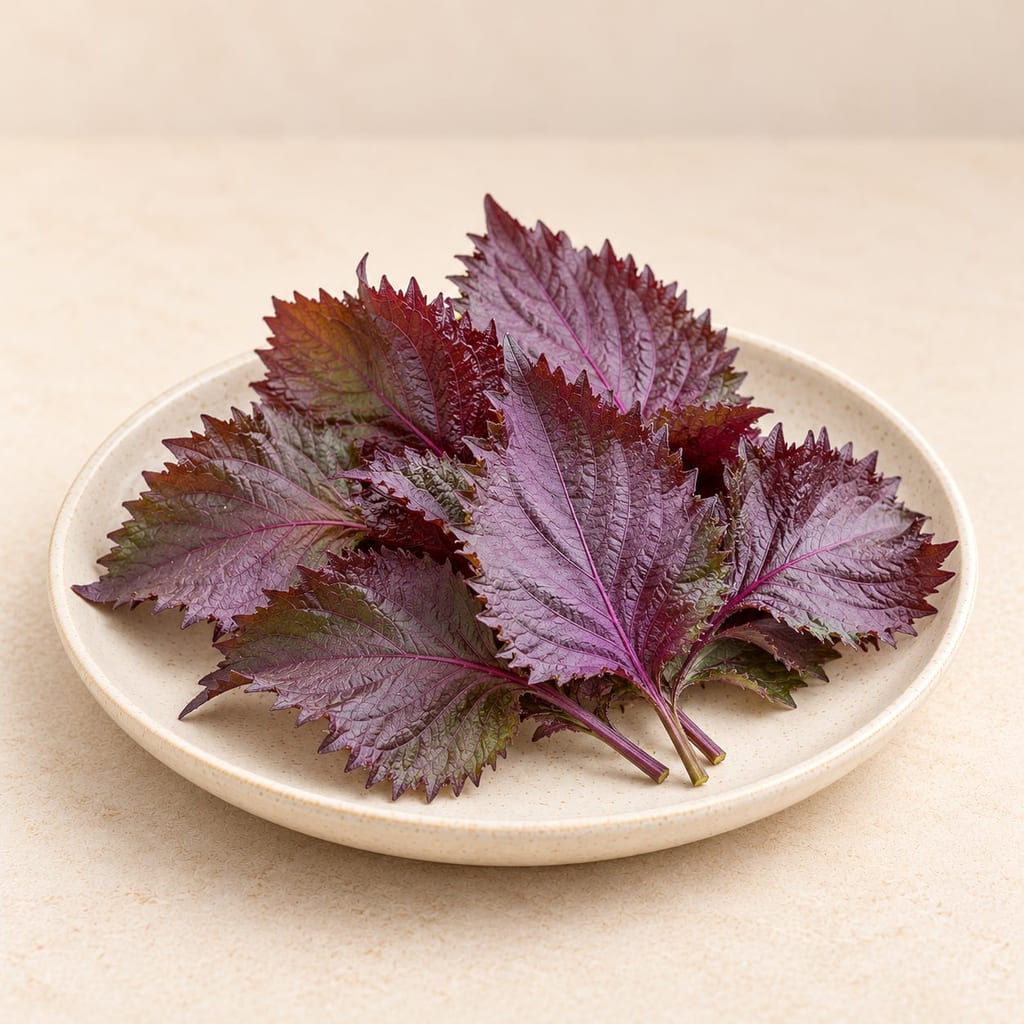
Red perilla
Red perilla is the purple-leaved form of Perilla frutescens used as a fresh aromatic leaf and as a color-giving herb in some East Asian foods. This page distinguishes that form from green perilla leaves and from perilla seed.
 FermenteaWhere food goes to change
Spices and aromatics
A guide to Perilla names, food uses and regional cultivation reports, with cultivar and plant-part boundaries kept visible.
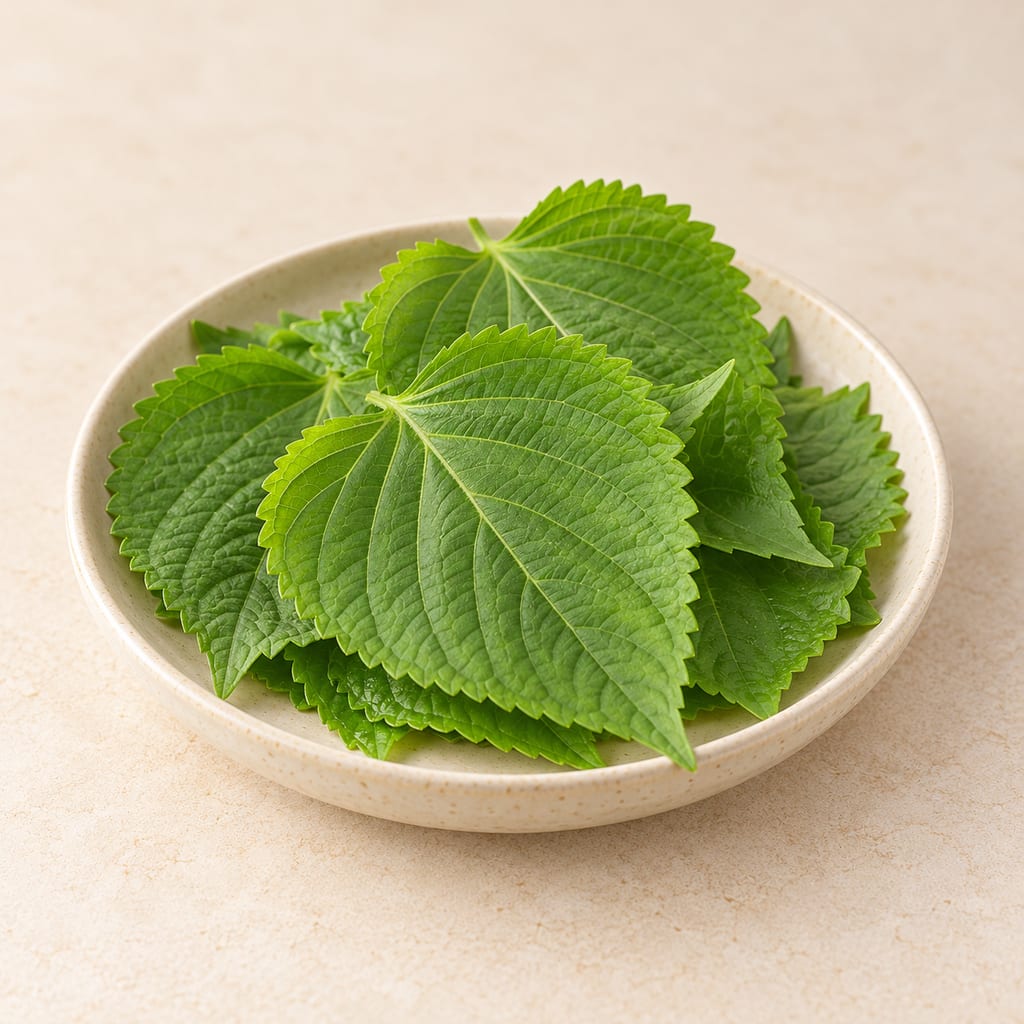
Kew accepts Perilla frutescens (L.) Britton and lists var. crispa, var. frutescens and var. hirtella as accepted infraspecific taxa. Shanghai Digital Flora labels its species page 紫苏; Taishan sources also use “shiso”/紫苏 for both the species entry and cultivated var. crispa because of their similar appearance and taste. The names “shiso,” “zǐsū” and 荏 do not establish a particular variety, cultivar or food ingredient. A name match does not tell which plant or cultivar a dish used.
PROSEA describes leaves, inflorescences, fruits, seeds and seedlings used as flavouring or garnish in Japanese, Korean and Vietnamese foods, including rice accompaniments, noodles, fish, fried foods, cakes and drinks. Taiwan’s Agriculture Knowledge Portal describes leaves served with fish or meat, seeds eaten or pressed for oil, and certain tender wrinkled green-leaf forms used raw. These source descriptions apply to the named crop forms; they do not establish the identity or food suitability of an unknown wild plant.
The Taishan article reports spring and summer shoots sold locally and stewed with river snails or duck, while noting that its zǐsū name covers both the species and cultivated var. crispa. Supplementary Table S3 gives the P. frutescens row a different part—roots—and lists direct eating, stir-frying and cold-tossing. Its legend says an asterisk marks a non-native species, and this Perilla row is starred. The row is coded “Yes” in the “Medical plant” column; that source classification is not evidence of clinical efficacy. The row lists CFSI 850.50, Order 6 and voucher specimen ZSY-049. The article describes CFSI as a Cultural Food Significance Index; it is a cultural food-use measure, not a safety or efficacy rating. The authors state that voucher specimens were deposited in the Herbarium of South China Agricultural University (CANT), so ZSY-049 is the voucher code, not a respondent identifier. The narrative and table do not support one settled species-specific plant part or recipe. These are ethnobotanical records, not instructions for gathering or eating plants.
Japan’s Ministry of Agriculture, Forestry and Fisheries describes shiba-zuke as vegetables such as eggplant and cucumber salted with shiso leaves, and notes Ohara as a regional red-shiso crop. This is regional food context for shiso; it does not resolve the botanical taxon or cultivar behind each ingredient or product called shiso. The MAFF page separately presents a household recipe. This article describes the association and does not reproduce or validate that process.
PROSEA describes perilla as a seed-grown annual and reports sunny or partly sunny conditions, sandy soil rich in organic matter, pH 5–7.5, and an ecological range of mean annual rainfall from (500–)1,000–2,000 mm and mean annual temperature from (6–)12–18°C. It gives about 20°C as optimal for germination and growth and says higher temperatures are tolerated; the same profile advises that temperatures should not fall below 10°C. These are profile-level ecological and crop statements, not guaranteed garden limits or a universal frost-survival threshold. PROSEA says warm days and adequate moisture favour leafy growth and short days trigger flowering; it reports a critical day length near 14 hours and six to nine short days for induction. Do not treat those values as household lighting controls.
PROSEA describes direct sowing or nursery raising to five or six leaves before transplanting. In its leaf-crop example, rows are 40 cm apart and plants are thinned to 12 cm; flower-head production uses wider rows. It reports leaf harvest from about three months after germination, flowering after roughly four months if plants are left undisturbed, and mature seed about six weeks after flowering. These are crop-profile timings, not a local calendar. Taiwan’s agency advises a warm, full-sun site, regular watering when the medium surface dries or leaves begin to wilt, and notes fast summer growth and possible storm damage. It gives no container dimensions. PROSEA records commercial greenhouse production in Japan with added heat, lighting and controlled irrigation, and deep-flow hydroponics in Korea; it supplies no home greenhouse recipe.
PROSEA reports perilla naturalized in parts of the United States and Ukraine; Kew also lists introduced regions. That does not establish invasive status in every locality. No reviewed source provides a universal frost-survival, heat or humidity threshold, a tested home container size, or a reliable method for identifying culinary cultivar or chemical type in a wild specimen. PROSEA repeats a belief that serving perilla with raw seafood prevents food poisoning; that belief is not evidence of pathogen control, and perilla does not make raw seafood safe. No health benefit or wild-foraging recommendation is made here.
The Taishan narrative describes shoots while Table S3 lists roots for the species row; resolution needs taxon- and voucher-linked source clarification.
Taishan uses 紫苏 for both the species and cultivated var. crispa; exact cultivar identity in market foods is unknown.
No local specimen identification or source-backed wild-foraging safety assessment is included.
PROSEA’s crop thresholds are not validated as home limits; container dimensions and a home greenhouse regime remain undocumented.
Table S3 marks the Perilla row as non-native with an asterisk; Kew’s broad native distribution does not settle status at the specific Taishan collection locality.
The underlying plant account received a partial source review. Its review scope is described in the original plant article.
The available research does not establish a single origin for this ingredient.
Red perilla is the purple-leaved form of Perilla frutescens used as a fresh aromatic leaf and as a color-giving herb in some East Asian foods. This page distinguishes that form from green perilla leaves and from perilla seed.
No community contributions have been published for this entry yet.
Sign in to contribute. Published comments and photos are free to read.
Royal Botanic Gardens, Kew, Plants of the World OnlineIngredient research
Perilla frutescens (L.) BrittonCited in: Names and taxon boundaries; Food and growing limits; Research gaps
Plant Resources of South-East Asia (PROSEA), hosted by Pl@ntUse / PlantNetIngredient research
Perilla frutescens (PROSEA)Cited in: Food uses recorded in different places; Growing reports and their scope; Propagation, harvest and protected production; Food and growing limits; Research gaps
Shanghai Chenshan Botanical Garden / Shanghai Chenshan Plant Science Research CenterIngredient research
上海数字植物志: 紫苏 Perilla frutescensCited in: Names and taxon boundaries; Research gaps
Taiwan Ministry of Agriculture, Agriculture Knowledge PortalIngredient research
紫蘇 — Agriculture Knowledge Portal plant entryCited in: Names and taxon boundaries; Food uses recorded in different places; Propagation, harvest and protected production; Research gaps
Zhang et al., Frontiers in Sustainable Food SystemsIngredient research
An ethnobotanical study on wild edible plants in Taishan County, Guangdong, ChinaCited in: Names and taxon boundaries; Taishan reports and a plant-part conflict; Research gaps
Zhang et al., Frontiers in Sustainable Food Systems / FigshareIngredient research
Data Sheet 1: supplementary Tables S1–S3Cited in: Taishan reports and a plant-part conflict; Research gaps
Japan Ministry of Agriculture, Forestry and FisheriesIngredient research
しば漬け(しばづけ)京都府 — Our Regional CuisineCited in: A Kyoto pickle context; Research gaps