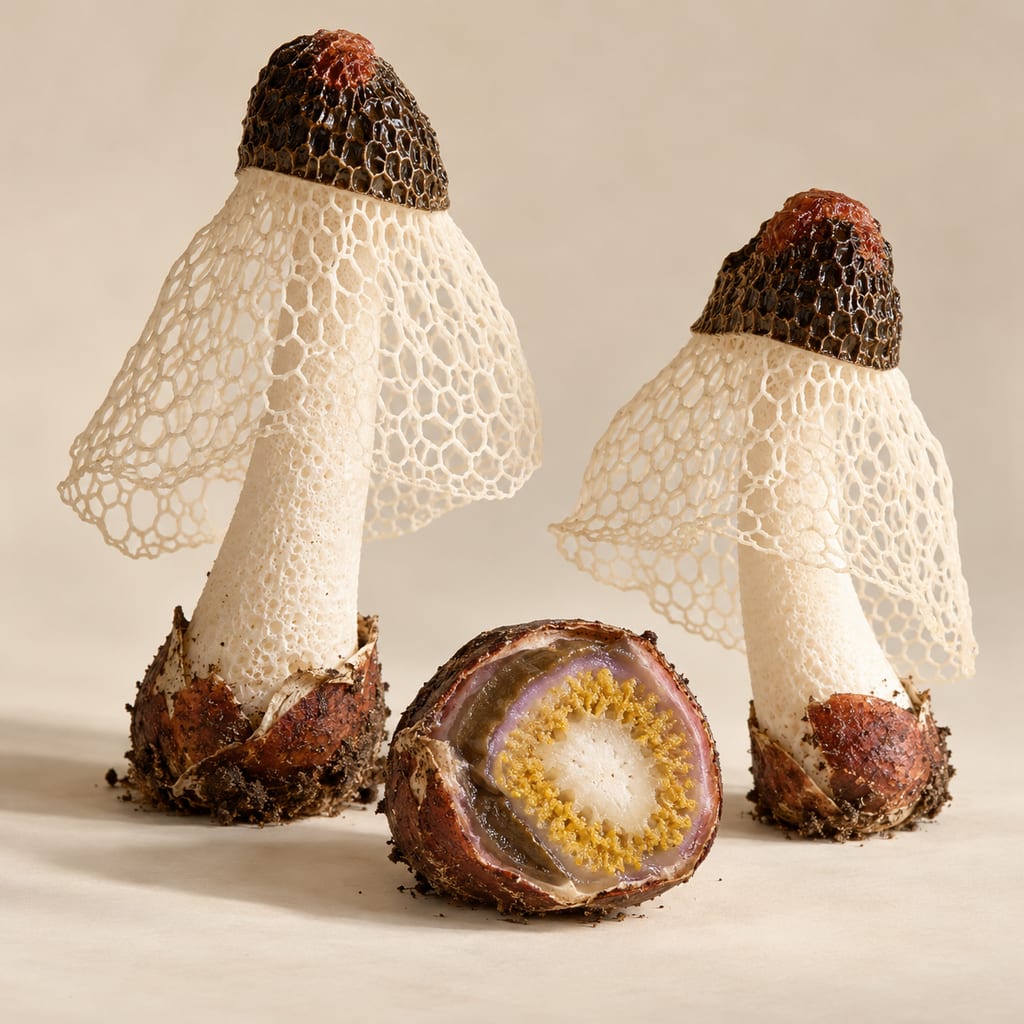
What the mushroom is
Phallus rubrovolvatus is a bamboo fungus of the family Phallaceae. A 2024 paper gives its author citation as Phallus rubrovolvatus (M. Zang, D.G. Ji and X.X. Liu) Kreisel. Older literature calls it Dictyophora rubrovolvata, which is a synonym. The Chinese name is hongtuo zhusun. The catalogue lists its common names as bamboo fungus and zhusun and its supply as regional cultivation.
The catalogue treats the name as a research label that has not been validated against the current taxonomic authorities, and this page keeps the same status.
Sources for this section
Range
The 2024 paper describes the species as endemic to the temperate regions of southwest China. The catalogue records the regions as China and the international dried food trade. The dried trade is recorded in the catalogue, but the sources do not show which dried products come from this species.
Sources for this section
Market products and identity
A 2023 taxonomic revision examined products sold as P. indusiatus or bamboo fungus in China. Using morphology and ITS-LSU sequences, it found that most of them were P. rubrovolvatus, P. echinovolvatus or P. cremeo-ochraceus. A product label therefore does not show which species it came from. The catalogue makes the same point: Chinese products often labelled P. indusiatus belong to several distinct species, and the strain or product has to be identified.
Sources also say the volva of this species is often discarded as a by-product, because it has an unpleasant flavour and is hard to process.
Sources for this section
Cultivation
The catalogue records regional cultivation. Yellow rot is a known disease of cultivated material, and a 2021 study described the yeast Saccharomycopsis phalluae as its cause. One source reports annual production in Guizhou province of about 10,000 tonnes, but that figure was not checked against a primary record.
Sources for this section
Identification and safety
Inclusion in the catalogue does not establish identity, edibility or a safe preparation. The catalogue keeps its review labels as supplied, and none of them is a safety assessment. This page gives no edibility verdict for any product or wild specimen. Identifying a product as this species needs specimen-level or molecular identification, and the strain should be stated when the product is named.
Sources for this section
Open questions
The sources do not give the preparation, drying method or storage of the commercial product. They also do not show how much of the dried trade is this species. The Phallus indusiatus-labelled products sold in China and abroad still need checking against this revision.
Sources for this section
Places
Southwest China
Documented use · Region evidenceEndemic region named in a 2024 taxonomic paper; the food record is from China in general.
China
Documented use · Country evidenceCatalogued commercial bamboo-fungus food; identified in market-product research.