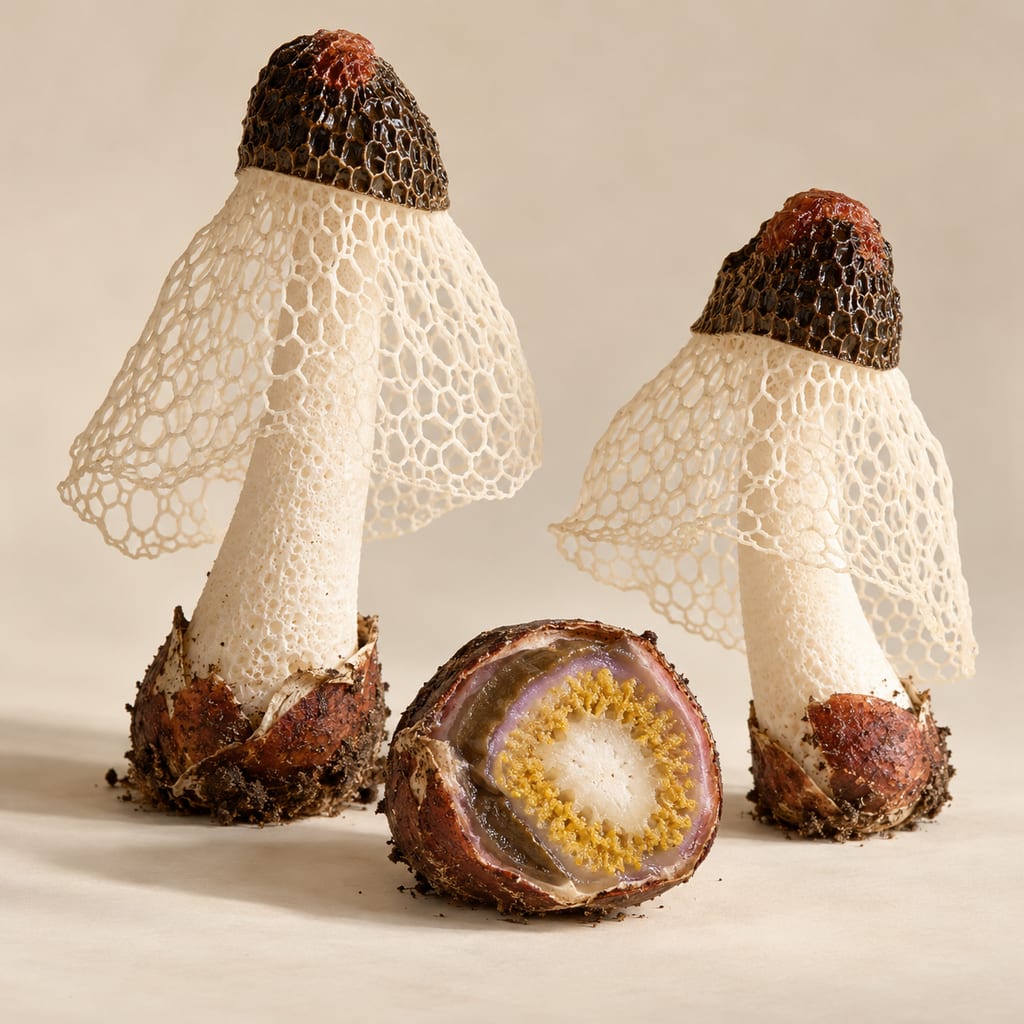
Phallus rubrovolvatus
Phallus rubrovolvatus, called hongtuo zhusun in Chinese, is a bamboo fungus of temperate southwest China that is sold dried. Many market products labelled P. indusiatus have been found to be this or related species.
 FermenteaWhere food goes to change
Mushrooms
Pine-associated false truffle, Rhizopogon songmaodan, is a hypogeous fungus of pine forests in southwest China, sold at wild mushroom markets as a delicacy. It was described as new in 2021, and its safety has not been studied in the sources reviewed.
Rhizopogon songmaodan is a false truffle, an underground fungus that forms ectomycorrhizal partnerships with pines. The fruit body grows below ground. It was described as a new species in 2021 from specimens collected in southwest China.
The species is sold at local wild mushroom markets, where it is treated as a delicacy. The 2021 description reports high market demand for its fruit bodies and suggests that it could be cultivated in southwest China.
Wang, Yu, Perez Moreno and Colinas described the species as Rhizopogon songmaodan sp. nov. in Mycorrhiza in 2021, based on morphology and molecular phylogenetics. It belongs to subgenus Versicolores. The catalogue records the scientific name as a research label rather than a reconciled accepted name, so records should be checked against current taxonomy.
The genus Rhizopogon belongs to the family Rhizopogonaceae. The 2021 description raised the number of Rhizopogon species known from China to ten.
The species forms ectomycorrhizal links with Pinus armandii, confirmed by comparing sequences from fruit bodies and root tips. In a greenhouse, spore inoculation succeeded with P. armandii and P. yunnanensis. The fruit bodies were found in P. armandii forests in southwest China, with collection recorded between March and July.
Pines are the main mycorrhizal partners of the genus as a whole, and the genus includes false truffles associated with firs and Douglas-firs.
The 2021 description says the fungus is considered a delicacy in its region and cites its high market demand. The record gives no culinary details: it does not describe how the fruit body is prepared, cooked or preserved.
Within the genus, Rhizopogon roseolus is the best-known edible species. Wikipedia describes it as a delicacy in Japan, where it is called shoro, and notes that it has been cultivated in pine plantations in Japan and New Zealand. Wikipedia also says that the genus is considered edible, but that most members are not held in high culinary esteem. Those statements concern other species and do not establish the properties of R. songmaodan.
The authors suggest the species is a good cultivation candidate in southwest China, citing how easily pines can be inoculated and the strong market demand. The sources reviewed do not record a cultivation trial beyond the greenhouse spore inoculation, and they give no yield figures.
The 2021 record gives no toxicity data and no safety assessment for this species. No source reviewed gives a cooking method or a safe quantity. Its sale as a delicacy does not establish that it is safe to eat in every case.
Appearance, smell and taste do not establish that a false truffle is safe to eat. Identify wild truffles with a qualified expert, and follow official food safety advice before eating any wild fungus.
The sources do not give culinary preparation, local names, nutritional content, or a dated history of sale for this species. The 2025 paper that lists it among four well-supported Chinese Rhizopogon species was seen only in a search summary and is not used as a source here. These gaps are unknown, not negative findings.
Found at local wild mushroom markets and in Pinus armandii forests in southwest China. The catalogue places the record in Yunnan.
Phallus rubrovolvatus, called hongtuo zhusun in Chinese, is a bamboo fungus of temperate southwest China that is sold dried. Many market products labelled P. indusiatus have been found to be this or related species.
No community contributions have been published for this entry yet.
Sign in to contribute. Published comments and photos are free to read.
Mycorrhiza (Springer), via FAO AGRISTaxonomy · Habitat · Use · Cultivation
A new edible Rhizopogon species from Southwest China, and its mycorrhizal synthesis with two native pinesRhizopogon songmaodan sp. nov., 2021, Mycorrhiza 31(1): 85-92, DOI 10.1007/s00572-020-00996-2
Ectomycorrhizal with Pinus armandii; spore inoculation succeeded with P. armandii and P. yunnanensis
Found at local wild mushroom markets and in Pinus armandii forests in Southwest China, March to July
Considered a delicacy in the region; high market demand; authors suggest cultivation potential
Cited in: Overview; Taxonomy; Habitat and partners; Use and market; Cultivation; Safety; Open questions
WikipediaGenus · Edibility
RhizopogonGenus is considered edible but most members are not held in high culinary esteem
Mycorrhizal partners mainly Pinaceae; R. roseolus is a delicacy in Japan (shoro) and has been cultivated in pine plantations in Japan and New Zealand
Cited in: Taxonomy; Habitat and partners; Use and market; Safety