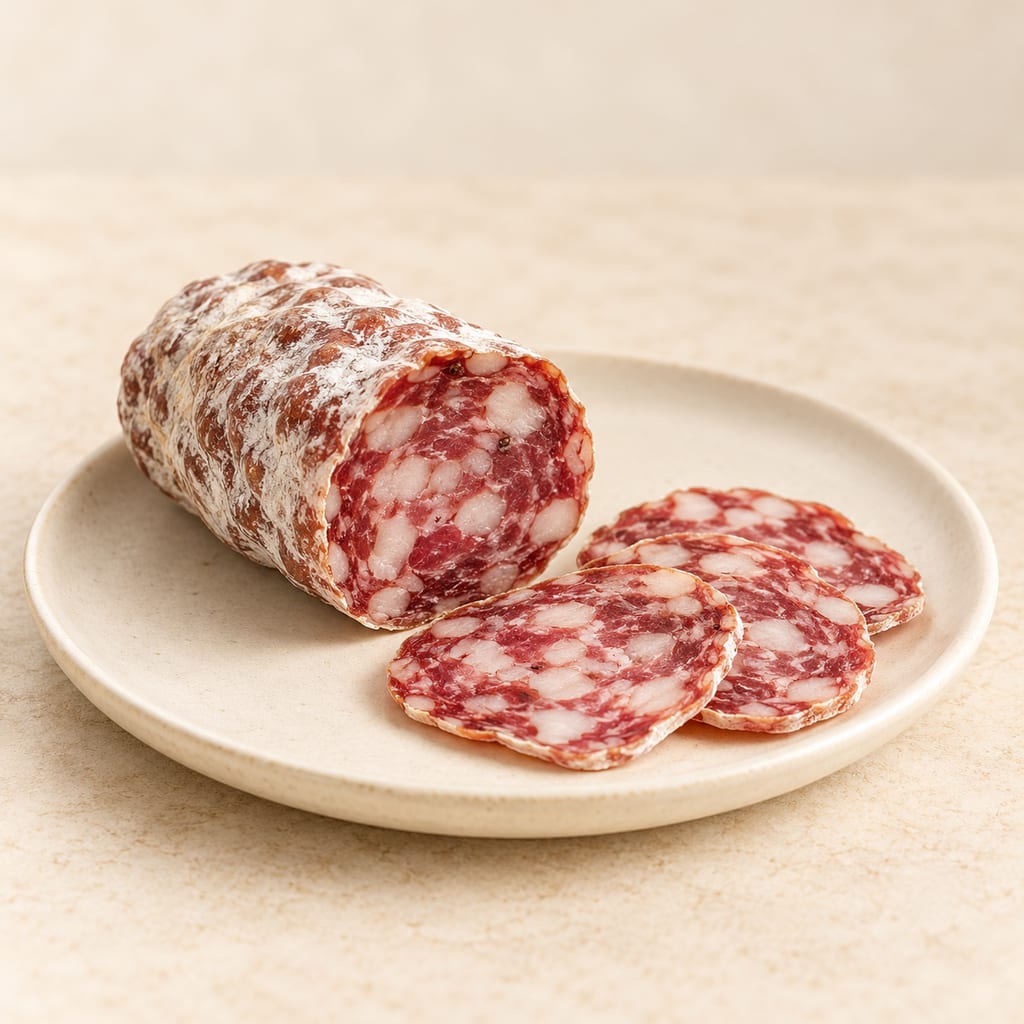
Saucisson sec, starter-cultured
Saucisson sec is a French dry sausage of seasoned pork and fat. This version uses Flavor of Italy starter, white wine and an optional Mold 600 surface culture.
 FermenteaWhere food goes to change
Processing aids
Non-edible fibrous sausage casings with an inner protein treatment that helps them stay against the meat as it dries and shrinks.
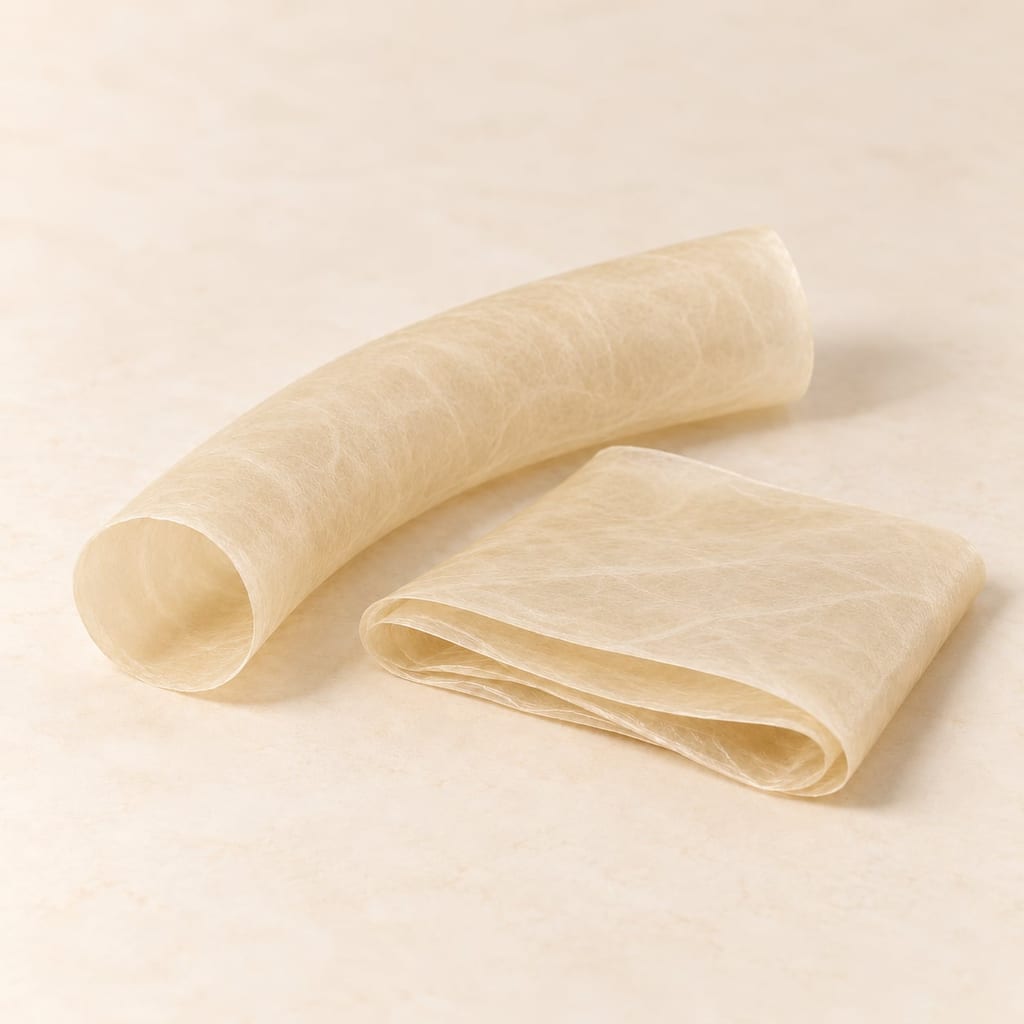
Protein-lined casings are manufactured sausage skins with an inner treatment intended to help the meat remain attached as it dries. In the Saucisson Sec preparation that names this ingredient, the linked example is The Sausage Maker’s clear, 61 mm fibrous casing, SKU 17-2015. The seller describes a vegetable-protein lining. It is a non-edible casing, removed before the sausage is eaten.
The supplied material is a dry, empty tube that lies flat when unfilled. Filling turns it into the outer form of a sausage; drying then changes the meat inside that form. The inner surface is intended to remain against the contracting meat. “Protein-lined” describes that inner treatment, while “fibrous” describes the supporting casing family. Neither word identifies a fermenting organism.
Manufactured casing history includes several distinct developments. Kalle dates its seamless Nalo casing to 1929. The company describes passing liquid viscose through a ring-shaped nozzle to make a continuous tube; Nalo abbreviates the German word nahtlos, meaning seamless. Its modern fibrous construction adds reinforcing paper to a cellulose-based material.
Keeping a casing attached during dry-sausage production posed a further problem. Henry J. Rose and Albin F. Turbak’s US patent, filed in 1964 and published in 1967 for Tee Pak, describes coating the inner surface with protein and liquid smoke. The treatment was intended to remain attached through soaking and follow the meat’s shrinkage. This documents an adhesion technology, rather than the first manufacture of all protein-lined casings. Its gelatin examples do not establish the composition of today’s vegetable-protein product.
The word fibrous can sound as though a casing is simply woven cloth. In the cellulose-based construction described by Kalle, paper reinforces the formed casing. The resulting material combines a tubular food-contact surface with the strength of its supporting fibres. Its purpose is to hold a repeatable shape through filling and subsequent processing.
Viscofan’s 2020 material account identifies abaca paper as a principal raw material for its fibrous range. Abaca comes from Musa textilis, a herbaceous plant grown for its fibres. The company values the resulting paper’s mechanical strength and resistance to moisture. It also notes uses in filter papers and other demanding paper products. This is a specific manufacturer’s explanation of its raw material; it does not identify the paper or plant fibre inside SKU 17-2015. “Fibrous” alone is too broad to make that botanical identification for an unlabelled casing.
A dry sausage contracts as water leaves it. A casing intended for that application must accommodate the changing product beneath it. Strong contact can be useful while the sausage develops, but removing the casing is another operation with a different requirement. A material that releases readily from a cooked slicing sausage may behave differently around a long-dried salami.
Manufacturers therefore sell degrees of adhesion rather than one universal surface. Viskase describes treatments ranging from easy release to high meat adhesion. Viscofan distinguishes its high-cling Securex range from Regular and easier-peeling Zip products. These are commercial families with their own specifications. The names show why colour or diameter cannot identify a casing’s behaviour: two similar-looking tubes may be selected for different contact and peeling demands. The appropriate choice depends on the sausage and its intended processing and presentation.
A useful inner coating has to remain present when an empty casing is prepared for stuffing. The Rose and Turbak patent describes a difficulty with older gelatin coatings: water soaking could remove much of the material that supplied adhesion. Simply starting with more coating did not solve every manufacturing constraint.
Their disclosed approach combined a soluble protein with liquid smoke and dried the coating so it became less soluble. The patent describes a moving tube receiving an internal coating before drying. The relevant idea is an engineered interface that can survive preparation and then remain against the meat. It is not a home coating recipe. The modern seller’s vegetable-protein declaration is a separate formulation statement, without a disclosed protein source or manufacturing method. Gelatin, smoke treatment and the patent’s other ingredients cannot be assigned to that product from a shared functional name.
A sausage casing and a sealed storage bag have different jobs. In a drying process, water must be able to leave the food through the system selected for it. Viskase describes smoke, oxygen and water-vapour permeability in its fibrous family, alongside separate barrier options. The existence of both options matters: an outwardly similar casing may be designed for a different balance of transfer and retention.
The Viscofan Globus range likewise separates fibrous casings from barrier bags and polymer casings. Its fibrous options include versions intended for dry products, stronger meat cling and easier peeling. A protein lining is therefore only one part of a product specification. It does not supply a measured water-vapour transmission rate, a smoke treatment or a mould-control system. Those properties need the information for the particular casing, rather than assumptions based on the word fibrous.
Adhesion depends on the material being enclosed as well as the casing. ViskoTeepak describes a cooked-sausage complaint in which casing stopped following the meat surface. Its investigation associated the separation with a film from inconsistent fat, rather than a change in the casing. The case explains how a surface layer can interrupt contact even when the casing itself meets its specification.
Another reported trial worked initially but became difficult to peel when commercial production began in a different season. The company connected changed temperature and humidity with evaporation, shrinkage and final calibre. These are manufacturer troubleshooting accounts for different products, not trials of the 61 mm dry-sausage casing. The casing has to work with the particular mixture, room and process. An adhesion claim does not remove the need to assess that whole combination.
Fibrous casings reach the maker in several forms. Cut lengths may be supplied open, tied or clipped; reels serve further conversion, while shirred material is gathered into compact sticks for filling. The presentation changes the preparation work. Oversea’s range distinguishes soaking directions for cut and shirred casings, and Viskase distinguishes dry material from pre-moisturized products that do not require the same preparation.
The intended stuffing diameter is also a working dimension, not merely a package description. Viskase warns that filling below or above the recommended diameter can affect performance. Clips need the right size and pressure to close the tube without damaging it. Those considerations explain why the purchased format and its instructions matter. They do not establish a fill pressure or clip setting for another brand. A familiar diameter does not make two differently prepared casing products interchangeable.
The removal stage also influences the form supplied to a producer. A casing for a sausage sold as an intact unit and one used on a large log for factory slicing can face different handling and presentation requirements. Viscofan describes fibrous casings as a way to control shape and obtain consistent slices. Maintaining a regular calibre can matter to portioning, while the chosen adhesion level determines how removal fits into that workflow. These are processing choices, rather than evidence that every product needs the strongest possible cling.
Clear, mahogany, red and black are among the appearances available in commercial fibrous ranges. Printing can add another visible layer. A coloured or printed casing may help a producer distinguish products, but its appearance does not identify the adhesion treatment beneath it. A plain casing can have a specialized inner surface, and a strongly coloured one can be selected for quite another job.
Viskase lists anti-mould treatments as optional features, alongside colour, smoke and flavour transfer options. These are separate product choices. A protein lining should therefore not be described as a mould starter, an anti-mould coating or a smoke-flavour treatment without an explicit product specification. In a sausage made with an exterior mould culture, the casing choice and the inoculated organism still need separate identification. The white coating on a finished salami cannot reveal which manufactured casing lies underneath it.
The Sausage Maker describes its linked product as open at both ends and gives an approximate capacity of two and a half pounds. The listing explicitly qualifies capacity by the density of the filling, link length and how tightly it is stuffed. Capacity is therefore an estimate, rather than a fixed meat-to-casing ratio.
Its preparation direction is a warm-water presoak at approximately 100°F for thirty minutes, followed by filling and closing with a clip or twine. Those are seller instructions for the listed product. Other fibrous ranges offer different prepared formats and directions, so this soak is not a universal rule. The seller says refrigeration is unnecessary for the unused casing but provides no definite shelf-life duration. Protected storage instructions for other manufacturers’ casings help explain attention to moisture and physical damage; they do not create a missing expiry date for this SKU.
In Eric’s Saucisson Sec, the casing contains a pork-and-fat mixture with seasoning, curing ingredients, a bacterial starter and a separately described mould culture. The casing’s role is mechanical. The starter acts within the meat mixture; the mould culture concerns the exterior; the tube keeps the stuffed preparation together. These materials are not substitutes for one another.
The recipe names the 61 mm example, directs a lukewarm soak, then moves through stuffing, removal of trapped air and weighing. That makes casing preparation part of an ordered workflow rather than an isolated packaging choice. In a later reply, the author says protein-lined casings adhere better than collagen in this preparation while saying both can work. This is a narrow account of his practice. It is not evidence that every collagen casing has the same properties, or that changing the casing preserves a recipe’s fermentation and drying performance.
Fibrous casing is a processing material rather than a portion of the finished meal. The linked product is labelled non-edible, and Viskase’s fibrous brochure says its casings must be removed before eating. This differs from familiar narrow natural or edible strand-collagen casings that may remain around a sausage when served.
The Sausage Maker’s guide also distinguishes fibrous, cellulose, plastic and flat-collagen forms from edible categories. The appearance of a thin skin is not enough to decide which has been used. Identifying the casing and following its removal directions is more reliable than judging it by colour, translucency or the food inside. Slicing a sausage while a casing is still present during production does not turn that casing into an edible ingredient.
The seller’s vegetable-protein description does not name the plant source, quantify the coating or supply an allergen and cross-contact statement. It cannot establish soy-free, wheat-free, gluten-free or vegan suitability. A cellulose-based shell and a protein-containing inner surface are separate materials; information about one does not completely describe the other.
The retail listing also leaves the exact manufacturing location and launch date unstated. The US patent documents a historical technical approach, and other manufacturers document their own fibrous families. Neither supplies the missing formulation or provenance of this purchased product. Its useful identity remains precise without those guesses: a non-edible protein-lined fibrous casing, illustrated by the named 61 mm product, intended to maintain contact with meat during drying.
The linked product declares vegetable protein but does not identify its source or provide an allergen or cross-contact statement.
The linked SKU does not identify its manufacturing country; retailer location and other manufacturers’ histories do not establish it.
Saucisson sec is a French dry sausage of seasoned pork and fat. This version uses Flavor of Italy starter, white wine and an optional Mold 600 surface culture.
No community contributions have been published for this entry yet.
Sign in to contribute. Published comments and photos are free to read.
The Sausage Maker
Clear Fibrous Protein-Lined Casings 61mmSKU 17-2015 is a non-edible, clear fibrous casing with a declared vegetable-protein lining. The seller gives dimensions, approximate fill capacity, soaking and closing instructions and says refrigeration is unnecessary; full coating composition and allergens are not disclosed.
Cited in: A casing that stays against a shrinking sausage; Why the lining survives preparation; The linked 61 mm product before stuffing; What the product name leaves unspecified
Kalle Group
Fibrous casingsCompany account dates the seamless Nalo casing to 1929 and describes wood cellulose, viscose extrusion and reinforcing fibre paper. This history concerns Kalle’s product family, not the origin of the linked retail SKU.
Cited in: From seamless cellulose to an adhesive inner surface; Paper gives the tube its structure
United States Patent Office / Google Patents
Casing for preparation of dry sausagesProtein and liquid-smoke coatings are described for cellulose and fibre-reinforced cellulose casings, with adhesion during sausage shrinkage. The patent’s gelatin examples are not the declared vegetable-protein formulation of the modern retail product.
Cited in: From seamless cellulose to an adhesive inner surface; Why the lining survives preparation; What the product name leaves unspecified
Viscofan
Commercial and supply management — Annual Report 2020The company identifies abaca paper from Musa textilis as a principal fibrous-casing raw material and explains mechanical and moisture resistance. This is Viscofan’s material account, not a composition declaration for SKU 17-2015.
Cited in: Paper gives the tube its structure
Viskase
FibrousManufacturer family includes graduated meat adhesion, smoke/oxygen/water-vapour permeability, separate barrier options and optional anti-mould treatments. These are product-family options, not specifications for every protein-lined casing.
Cited in: Cling and peeling are different requirements; Water transfer is a product property; Colour and surface treatment are separate choices; What the product name leaves unspecified
Viscofan
Corporate Products Brochure — Fibrous CasingsFibrous range distinguishes Securex high adhesion, Regular and easy-peeling Zip, with other treatments and ready-to-use formats. Selection balances adhesion and removal; the brochure does not identify The Sausage Maker product.
Cited in: Cling and peeling are different requirements; Dry pieces, prepared sticks and the stuffing diameter
Viscofan Globus Group
PackagingFibrous product options include Regular, Zip and Securex, printing and conversion into cut pieces or preshirred forms. Separate casing and barrier-bag categories serve different packaging functions.
Cited in: Water transfer is a product property; Colour and surface treatment are separate choices
ViskoTeepak
ViskoTeepak Complaint Approach - Article 1Manufacturer case accounts describe adhesion affected by a fat film and by changed production weather, with a recommendation for trials at the intended production scale. These cooked/smoked-sausage examples are not tests of the linked dry-sausage casing.
Cited in: The meat and the room also affect contact
Oversea Casing Company
Fibrous CasingsDistinguishes regular, peelable and meat-cling treatments, cut/tied/clipped/shirred formats, soaking requirements and protected dry storage for its range. Its directions do not replace the purchased product’s instructions.
Cited in: Dry pieces, prepared sticks and the stuffing diameter; The linked 61 mm product before stuffing
Viskase
FIBROUS CasingsThe 2021 brochure distinguishes pre-moisturized from dry casings, emphasizes recommended stuffing diameters and clip settings, and calls for protected storage and removal before eating. Storage durations apply to its own products.
Cited in: Dry pieces, prepared sticks and the stuffing diameter; Remove the casing and keep its composition distinct
2 Guys & A Cooler
Saucisson SecRecipe names 61 mm protein-lined sausage casings, lukewarm soaking, stuffing and weighing. A 2024 author reply attributes better adhesion than collagen to this casing in that recipe; it is not a controlled comparison.
Cited in: A casing that stays against a shrinking sausage; Its role in saucisson sec
The Sausage Maker
Are Sausage Casings Edible? A Guide to Every Casing TypeSupplier guide distinguishes natural and strand-collagen casings from fibrous, cellulose, plastic and flat-collagen products that it says should be removed. A casing’s material and product instructions determine its handling.
Cited in: Remove the casing and keep its composition distinct