Accepted name and plant scope
Kew accepts Aspalathus linearis (Burm.f.) R.Dahlgren and lists 11 nomenclatural synonyms. A 2025 wild-population study distinguishes four variable forms or ecotypes—Bush, Prostrate, Erect and Salignus—and reports that the commercial cultivar Nortier derives from the Erect form. These names describe different taxonomic or horticultural levels; a tea label or unexamined plant does not establish its accession or ecotype.
Sources for this section
Regional history and food use
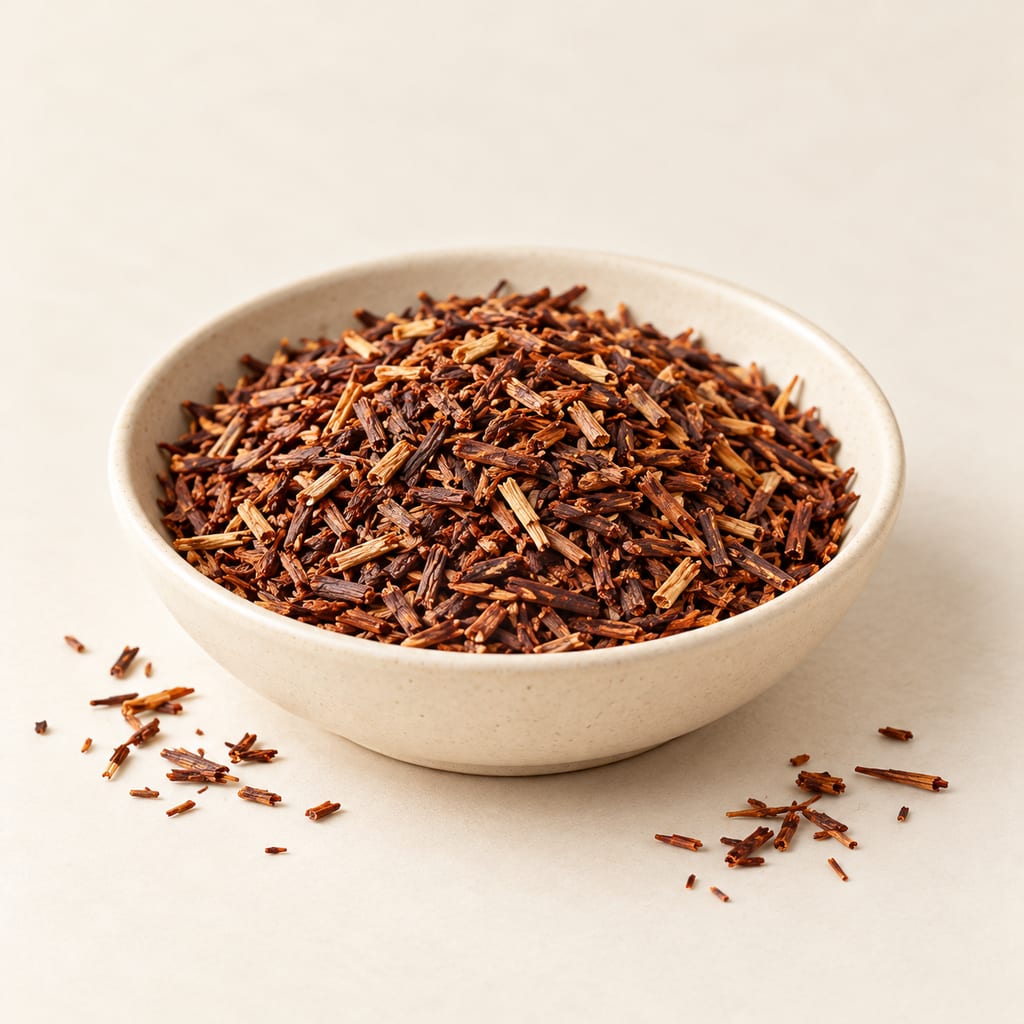
The South African crop brochure identifies rooibos leaves and stems as tea material. A 2014 report combines literature review with community and stakeholder interviews in named South African regions. It records community interviewees connecting rooibos knowledge to KhoiSan communities and its transfer to European settlers, while industry interviewees considered the historical link inconclusive. The report also cites a 1772 beverage account, whose original text was not independently examined. These are attributed report findings, not a settled origin or exclusive ownership claim.
For Cederberg, the same report records interview accounts of wild collection in January–February with hand harvesting and a two-year rest, and of cultivation planting in August–September with first harvest after three years. These local accounts are not a universal calendar or gathering permission. The report describes tea use across its interview regions, but does not establish national prevalence. It does not provide a complete consumer batch with quantities, yield, ordered steps and storage.
Sources for this section
Cultivation evidence and its limits
The dated 2012-revised agriculture brochure describes dryland production in a wet-winter region, 250–400 mm annual rainfall, deep sandy well-drained soil at pH 4.5–5.5, sowing in seedbeds or nurseries in February–March, and transplanting in July–August. It says producers do not irrigate in the system it describes. These are crop-guide statements, not universal home-growing thresholds. A 2023 soil study's abstract reports a KCl pH optimum of 4.5 and a 90%-yield range of 4.2–4.7 from boundary-line analysis of 120 commercial plantations; its full methods and data were not inspected, so those figures are not potting-mix targets.
A full 2023 field study followed young plants at one Nardouwsberg, Western Cape site during the unusually dry 2016/17 season (98.9 mm recorded rainfall). Deeper soil profiles retained more water, and unfertilised plants in the deeper profile produced more shoot biomass and longer taproots under that trial's conditions. The site recorded daily air extremes of 47.49°C and 6.44°C; these observations are not heat or frost limits. The study is not a mature-crop yield guarantee. The sources do not establish a home container or heated/unheated greenhouse protocol, measured humidity or light requirement, or frost-survival temperature.
Sources for this section
Processing terminology and evidence gaps
The 2014 report calls traditional rooibos processing “fermentation.” A 2019 laboratory paper's abstract reports endogenous enzymes participating in phenolic oxidation during simulated fermentation. The full paper was not retrieved, and this evidence does not establish whether microorganisms participate in commercial batches. The report describes green rooibos as skipping oxidation, a product distinction rather than a household method. No complete consumer preparation, storage duration, safety endpoint or home-scale processing design was verified; commercial processing descriptions are not instructions.
Sources for this section
Research gaps
No complete consumer tea batch with quantities, steeping conditions, yield and storage was verified.
The soil pH paper and enzyme-oxidation paper were available only as abstract or selected-excerpt evidence; no microbial conclusion or universal pH target is established.
No universal light, humidity, frost or heat tolerance, productive container trial, or heated/unheated greenhouse method was found.
The report's interview accounts and historical source references do not establish national prevalence, a single origin, present-day collection rights or exclusive ownership.
Sources for this section
Research status
The underlying plant account received a partial source review. Its review scope is described in the original plant article.
Sources for this section
Places
Unknown
Relationship not established · Place not establishedThe available research does not establish a single origin for this ingredient.