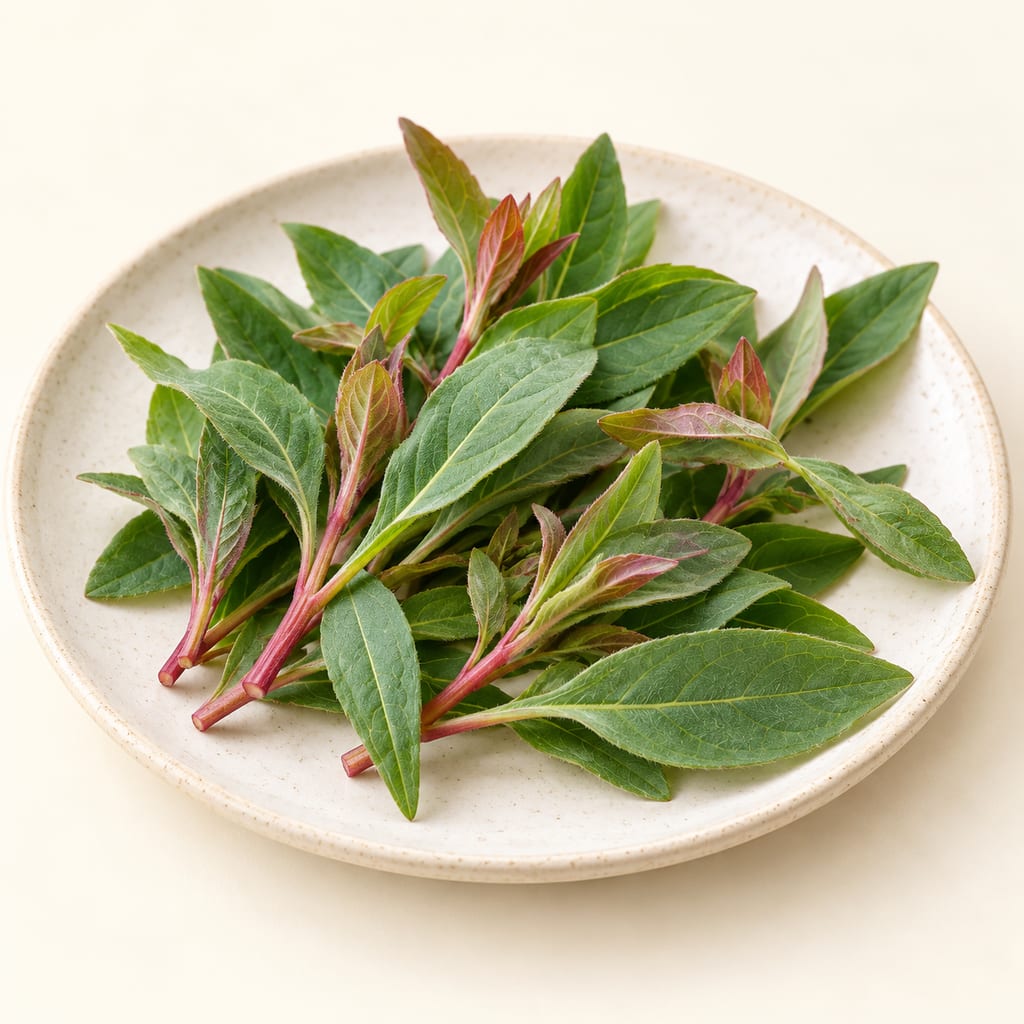
Dwarf fireweed
Dwarf fireweed (Epilobium latifolium) is a northern wild herb whose tender leaves and flowers appear in distinct Arctic food traditions.
 FermenteaWhere food goes to change
Spices and aromatics
Heartleaf saxifrage is a small Arctic perennial whose soft, toothed leaves are recorded as food among Naukan and Chukchi communities. The botanical name appears as Micranthes nelsoniana and Saxifraga nelsoniana in different references.
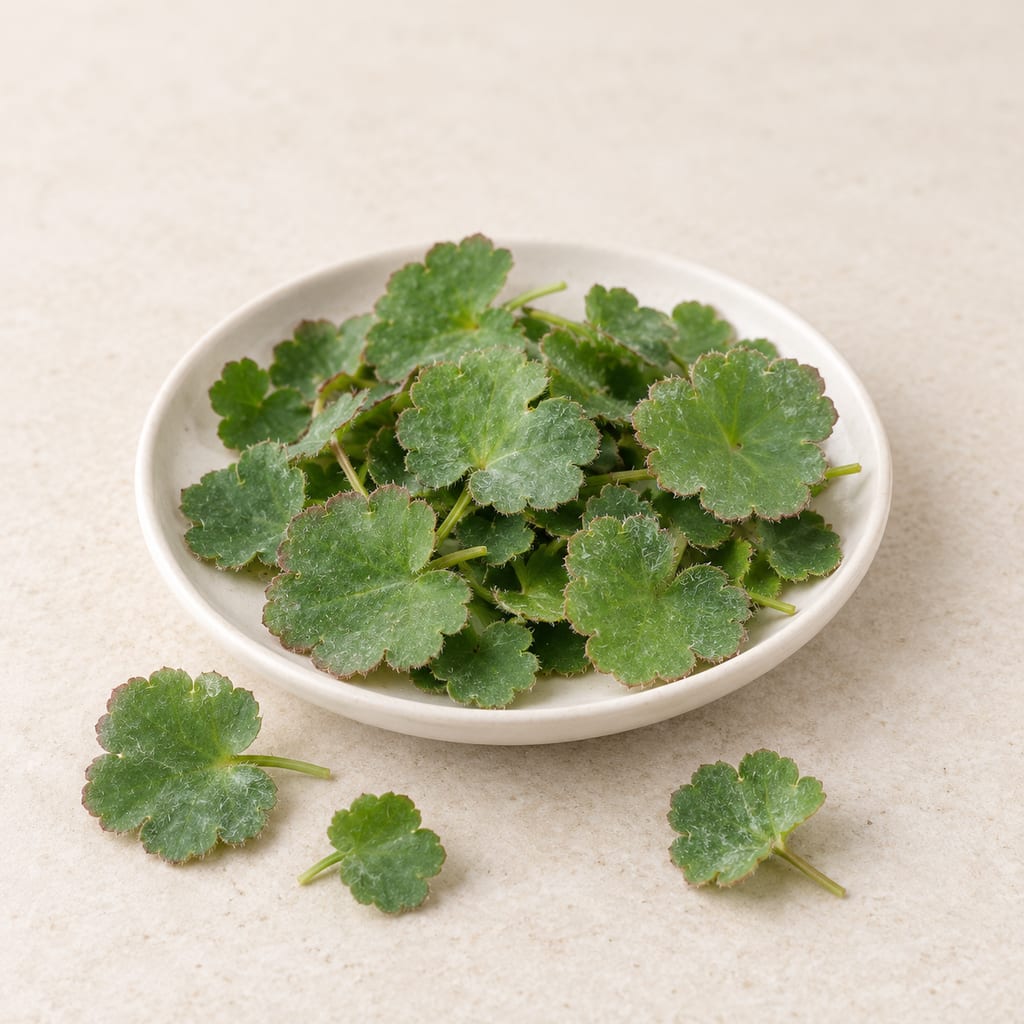
Saxifrage leaves appear in a distinct northern food tradition, not as a generic salad green. The National Park Service’s 1997 Russian-language ethnobotany manual, translated and botanically edited for its 2014 English edition, describes the use of heartleaf saxifrage among Central Siberian Yupik communities in Chukotka. It records fresh leaves covered with warm sea-mammal oil and leaves preserved in oil served with dried sea-mammal meat. Its account also says the flowers can flavor and tint the oil. The manual uses broad wording about groups across Chukotka; this ingredient page does not turn that summary into a claim that every household or community prepares the plant alike.
Research focused specifically on Naukan ethnobotany adds a time-bounded perspective. Jernigan and colleagues worked in 2014–2016 with Naukan speakers, combining interviews, participant observation and collected plant vouchers. Their tables identify Saxifraga nelsoniana, named siiqnaq, as edible in both the past and present categories reported by participants. The study’s use values describe how often a use was reported in that sample, not how many people in a whole population eat the plant or how commonly it is served now. The article also places plant knowledge in the history of forced relocation: in 1958 residents were moved from Naukan, and language and subsistence practices changed. That history helps explain why a record of remembered use and a record of current practice are related but not identical.
The ELOKA plant page presents separate Naukan and Chukchi descriptions. It attributes to Naukan speakers a summer leaf harvest and the name sivughaq for leaves stored in seal oil, sometimes with Rumex arcticus and Petasites frigidus. It says that dish is eaten with dried meat or frozen meat or fish. Its Chukchi account describes dry leaves stored in seal or walrus oil and served with other foods. These accounts document community knowledge and terminology. They do not establish one shared recipe for all Yupik or Chukchi people, and they do not erase differences in language, local environment or household practice.
The ingredient called saxifrage leaves here is the foliage of heartleaf saxifrage, a low Arctic perennial placed by the Flora of North America in the genus Micranthes as Micranthes nelsoniana. Ethnobotanical sources also use Saxifraga nelsoniana D. Don, and the older name Saxifraga punctata subsp. nelsoniana appears in the National Park Service manual. These names are not a licence to treat every plant called saxifrage as food: the page concerns this documented species and its leaves. “Heartleaf” and “brook” saxifrage are common English names; they are more informative than the bare word saxifrage, which can refer to many plants.
The leaves arise in a basal rosette close to the ground. The National Park Service account describes them as small, slightly fleshy and roughly heart-shaped, with large pointed teeth around the edge. Their upper surfaces are dark green, while the undersides and margins can be reddish brown. The whole plant has a fine covering of short hairs. Flora of North America records variation in leaf thickness and hairiness across the species and its recognized varieties, so no single photograph or colour should be treated as a field identification test. The ELOKA page’s photo, credited to Kevin Jernigan, shows the soft, scalloped foliage in its living tundra setting.
The local names are important evidence, not decorative synonyms. ELOKA records Naukan сӣқнақ, transliterated siiqnaq, and Chukchi сипъэт, sip’et. The 2014 National Park Service manual gives a Naukan form in its own transcription, alongside a Central Siberian Yupik name. A later paper also records siiqnaq for Saxifraga nelsoniana. These spellings come from separate publication systems; the sources do not provide a single normalized orthography. This page keeps the Naukan term attached to the Naukan account and does not borrow a neighboring community’s name as if it were interchangeable.
The food part described in these sources is the leaf, not the root or flower. ELOKA says Naukan gather leaves in mid to late summer, when they have become thick and velvety, and choose sunny weather so the leaves are dry. Its Chukchi account likewise emphasizes gathering dry leaves. These details explain a reported preference for leaf condition and weather; they are not a calendar that applies to every year or every site. Arctic seasons vary with local conditions, and the page gives no temperature, size, yield or maturity threshold for harvest.
The leaves are small and close to the ground, which makes their identity and cleanliness especially important. Their basal rosette can be viewed as a botanical feature, but the source does not provide an illustrated field key separating edible heartleaf saxifrage from every similar plant. A reader should not identify a wild leaf from this prose or from the generated product image. Correct species identification needs an authoritative regional field guide or a qualified local expert. The ingredient name also should not be used to justify collecting in a protected site, on land where gathering is not permitted, or in a way that ignores local stewardship.
The records describe gathered foliage rather than a cleaned, graded, chopped or dried commodity. They do not specify washing, trimming, blanching, leaf-to-oil ratios or a post-harvest sorting procedure. Nor do they report a commercial form on shelves. Consequently, this page does not prescribe those steps or imply that a supermarket product sold under an unrelated saxifrage name would be equivalent. The relevant comparison is between the species and form named in the source, not between common names alone.
The ethnobotanical sources describe two related forms: fresh leaves eaten with sea-mammal oil, and leaves held in oil for later meals. In the Naukan account on ELOKA, the stored leaves may be combined with Rumex arcticus and Petasites frigidus; the named dish is sivughaq. The National Park Service manual also records leaves under warm oil, with the flowers described as lending aroma and a green tint. These descriptions show the leaf’s place in a mixed food and the role of oil as the surrounding medium. They do not give a standardized amount of oil, ratio of leaves, vessel size, duration, temperature or acidity.
Oil storage should not be relabelled as fermentation simply because it keeps a seasonal plant for later. The cited sources do not report a measured pH, microbial culture, fermentation time course or other evidence that acid fermentation is the preservation mechanism. Jernigan and colleagues discuss animal-fat soaking among regional storage methods in general, but their Saxifraga entry specifically records leaves stored in seal oil and eaten with meat. This page therefore treats the method as an ethnobotanically documented storage form, not a tested preservation recipe.
The blend is also not a universal ingredient list. ELOKA says the Naukan preparation can include Rumex and Petasites, while other accounts differ in the species named and in the foods served alongside. The linked preparation record for Arctic dock is a separate food entry; it does not mean every saxifrage preparation contains dock. Nor should Petasites, seal oil or frozen meat be added to a modern recipe merely because they appear in one local account. Each source supports a particular description in a particular cultural and geographic context.
The recorded serving partners are dried, frozen or otherwise prepared meat and fish, with sea-mammal oil as part of the food. The 2014 manual describes dried sea-mammal meat; ELOKA names dried meat, frozen meat and fish, and other foods. The leaves are thus documented as part of a meal and as a stored seasonal green, not only as an ingredient mixed into other dishes. The sources do not supply a tasting vocabulary such as bitter, sour or grassy, so this page does not invent one. They describe the leaves as retaining taste in oil, but give no sensory panel or universal flavour profile.
A food use recorded in an ethnobotanical source is not an instruction to reproduce the associated preparation outside its knowledge system. No quantities, timing or modern substitutions are supplied here. Seal and other sea-mammal oils have specific cultural, ecological and regional contexts; a generic cooking oil is not a documented equivalent. Likewise, this page does not prescribe a substitute leaf. Another Saxifraga or Micranthes species may share a common name or a similar-looking rosette without sharing the same identity or food record.
Saxifrage leaves have no established role in brewing or fermentation in the sources cited for this page. Their inclusion in an oil-stored dish does not imply that they acidify, ferment or preserve another ingredient. Where a separate recipe uses the leaves, that recipe must state its own amounts and method, cite the relevant source, and keep its process distinct from the ingredient’s botanical identity. The ingredient page’s job is to explain what the leaf is and how it is documented, not to create an unrecorded preparation.
Micranthes nelsoniana belongs to a northern and alpine flora, with a range extending through parts of North America and Eurasia. The National Park Service manual describes it as a common tundra plant in the southeastern Chukotka Peninsula, especially in moist settings: river and creek banks, temporary ponds, gravel bars and wet tundra meadows. That ecology is consistent with the plant’s low rosette and slightly fleshy leaves, but habitat alone cannot identify it. Other saxifrages occupy the same broad landscapes, and several have similar compact growth or toothed leaves.
For a food record, the distinction between a botanical species and a local food name matters. Flora of North America uses Micranthes nelsoniana as its accepted name and lists Saxifraga nelsoniana D. Don as a synonym. ITIS likewise treats the latter name as a synonym, while taxonomic treatments differ over some varieties and combinations. The National Park Service manual gives a third historical combination, Saxifraga punctata subsp. nelsoniana. A field label, photograph caption or common name may reflect the taxonomy used when it was written. This page therefore gives the scientific synonymy explicitly and avoids claiming that all entries under “saxifrage” refer to this same species.
The manual’s botanical description is useful for understanding the edible part: leaves are produced in a basal rosette, while the flowering stem rises above it and carries a cluster of white flowers. It places the plant in moist tundra, not in a cultivated leaf crop with standardized varieties. The literature describes gathering from naturally occurring plants; no commercial cultivar, grading scheme, farm production standard or managed harvest scale was found in the sources reviewed. That absence limits advice about availability and market quality, rather than proving that no small-scale cultivation or sale exists.
No commercial grade or package specification was found for this leaf in the reviewed sources. The studies describe wild-collected material and use within local foodways. A small, fresh green leaf in a field guide is not proof that a bag labelled “saxifrage” contains Micranthes nelsoniana. If the ingredient is encountered outside its documented region, the botanical name, harvest source and intended food form need to be explicit. The ELOKA note that wet leaves may spoil during storage supports the importance of dryness in the reported preparation, but it does not say how dry the leaf must be or how spoilage was judged.
The references do not publish a shelf life, storage temperature, water activity, acidity target, validated container or pathogen test for the oil-stored leaves. They also do not say whether that traditional storage was chilled, frozen, fermented, or kept under another locally controlled condition in each household. Do not infer room-temperature stability or use the historical description as a home-canning or preservation protocol. A cultural record can describe a successful practice without providing the controls needed to reproduce it safely in another place with different ingredients, oil, containers and temperatures.
Little is published on the flavour chemistry or nutritional composition of the leaves themselves. The National Park Service describes the flowers tinting and flavouring oil, a report of use rather than a chemical analysis. No processing standard compares raw, oil-stored or other leaf forms. The leaves are documented as fresh and oil-stored foliage, while their physical changes during storage and the factors that set shelf life are not established.
The sources cited here document food use but are not comprehensive toxicology or food-safety assessments. They do not establish a universally safe serving, a maximum amount, a profile of interactions with medicines, a complete allergen assessment, advice for pregnancy or childhood, or a clinical benefit. Nothing in this record should be read as a medical claim or a guarantee that a wild plant is safe to eat. The structured allergen field is empty because no specific allergen is established in the reviewed references; that is not evidence that allergy is impossible.
Identification is a central safety limit. This page concerns Micranthes nelsoniana and its cited synonyms; it does not apply to every Saxifraga species, every plant marketed as saxifrage, or any unrelated plant that shares a translated common name. The available botanical descriptions are not a complete field-identification guide, and the generated image is editorial art, not a diagnostic reference. A photograph of a leaf can help readers understand the documented ingredient form, but it cannot confirm a wild specimen or a food-grade source.
Oil storage is a second gap. The ethnographic descriptions do not provide the microbiological evidence, storage controls or process validation needed to judge modern shelf stability. They should be read as documentation of knowledge within specific northern communities, not as proof that leaves stored in any oil under any household conditions are safe. This record gives no recipe, time, temperature or storage limit. No specific toxin was identified in the cited edible-plant literature, but the scope of those works does not justify a blanket safety conclusion.
The available record is strong enough to identify the documented species, leaf part, harvest season and community-associated forms of use. It is not strong enough to quantify nutritional content, frequency across all households, commercial availability or contemporary preservation safety. Future research could refine those questions with community-led documentation and appropriately designed botanical and food-safety studies. Until then, the page keeps its claim narrow: heartleaf saxifrage leaves are an ethnobotanically documented food, with unresolved safety and preservation details.
This row locates the cited community-specific accounts, not every use of saxifrage across the Arctic. The Russian manual and Naukan study differ in scope, time and terminology.
Dwarf fireweed (Epilobium latifolium) is a northern wild herb whose tender leaves and flowers appear in distinct Arctic food traditions.
No community contributions have been published for this entry yet.
Sign in to contribute. Published comments and photos are free to read.
Exchange for Local Observations and Knowledge of the Arctic (ELOKA), National Snow and Ice Data CenterIdentity · Traditional use · Harvest · Storage · Names · Image reference
Saxifraga nelsonianaThe page identifies the plant as Saxifraga nelsoniana and gives Naukan siiqnaq and Chukchi sip’et names.
Its Naukan account describes mid-to-late-summer harvest of thick, velvety leaves in sunny weather, storage in seal oil sometimes with Rumex arcticus and Petasites frigidus, and serving with dried meat or frozen meat or fish.
Its Chukchi account describes gathering dry leaves and storing them in seal or walrus oil to serve with other foods.
The page credits the plant photograph to Kevin Jernigan; it is used as a linked reference and subject guide, not as proof of food safety.
Cited in: A food in Naukan and Chukchi accounts; What heartleaf saxifrage is; The harvested leaf and its season; Fresh leaves and leaves stored in oil; Serving context and what the sources do not prescribe; Choosing, handling and preservation limits; Safety and evidence gaps
National Park Service, Shared Beringian Heritage Program, United States Department of the InteriorIdentity · Botany · Habitat · Traditional use · Foodways · History
Edible Plants Used by Siberian Yupik Eskimos of Southeastern Chukchi Peninsula, RussiaThe manual identifies Micranthes nelsoniana as heartleaf or brook saxifrage and lists Saxifraga nelsoniana and Saxifraga punctata subsp. nelsoniana as names used in botanical references.
It describes small, slightly fleshy, heart-shaped basal leaves with pointed teeth, dark green upper surfaces and reddish-brown undersides and margins.
It records use of fresh leaves with warm sea-mammal oil and preserved leaves with dried sea-mammal meat; it also reports use of the flower to flavor and tint oil.
The book was originally printed in Russian in 1997 and its translated edition is from 2014; the prose reports tradition, not a validated modern preservation process.
Cited in: A food in Naukan and Chukchi accounts; What heartleaf saxifrage is; The harvested leaf and its season; Fresh leaves and leaves stored in oil; Serving context and what the sources do not prescribe; Range, habitat and botanical limits; Choosing, handling and preservation limits; Safety and evidence gaps
Journal of Ethnobiology and EthnomedicineEthnobotany · History · Names · Current and past use
Naukan ethnobotany in post-Soviet times: lost edibles and new medicinalsThe 2014–2016 study combined interviews, participant observation and voucher specimens; its table identifies Saxifraga nelsoniana, Naukan siiqnaq, as edible in both current and past use categories among those interviewed.
The authors describe a critically endangered language and the forced 1958 relocation from Naukan, factors relevant to how current and remembered uses are interpreted.
The article reports use values, not population-wide prevalence, servings or safety; this page does not turn those interview results into a universal claim.
Cited in: A food in Naukan and Chukchi accounts; What heartleaf saxifrage is; Fresh leaves and leaves stored in oil; Serving context and what the sources do not prescribe; Safety and evidence gaps
Flora of North America, hosted by eFloras.orgTaxonomy · Botany · Identification
Micranthes nelsonianaThe Flora of North America treats Micranthes nelsoniana as the accepted name and lists Saxifraga nelsoniana D. Don and Saxifraga punctata subsp. nelsoniana as synonyms.
It describes basal, round-to-kidney-shaped leaves with crenate margins and variable thickness and hairiness, which supports the botanical description and the caution against using a common name alone.
Cited in: What heartleaf saxifrage is; Range, habitat and botanical limits; Safety and evidence gaps
Integrated Taxonomic Information SystemTaxonomy · Identity
ITIS Report: Saxifraga nelsonianaThe ITIS record lists Saxifraga nelsoniana D. Don as a synonym of Micranthes nelsoniana var. nelsoniana and uses heartleaf saxifrage as an English common name.
This older database treatment is cited alongside the Flora of North America because taxonomic sources differ in how narrowly they recognize varieties.
Cited in: Range, habitat and botanical limits