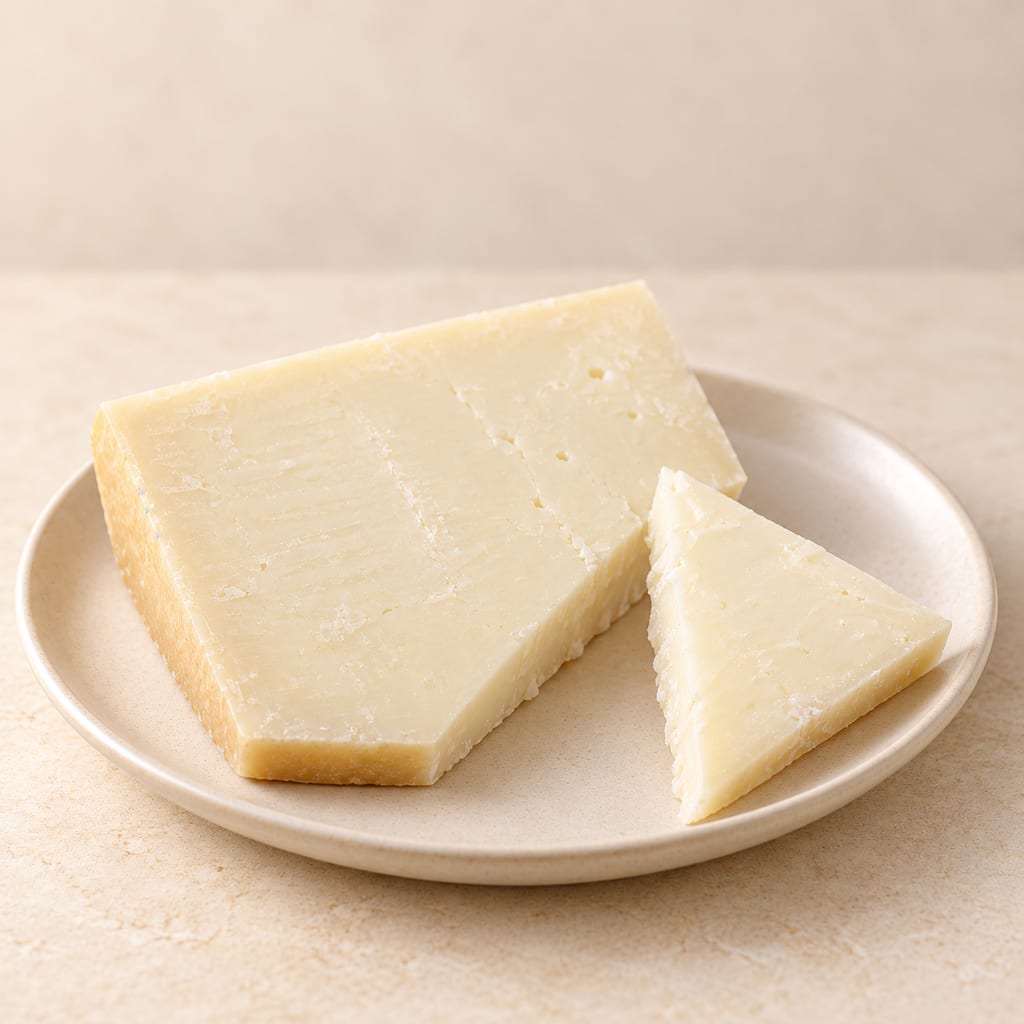
Kefalotyri, Cypriot method
Kefalotyri is a hard sheep-and-goat-milk cheese made in Cyprus as well as Greece. This Cypriot method cooks and presses the curd, then brines, coats and matures the cheese.
 FermenteaWhere food goes to change
Substrates
Sheep and goat milk supplies the proteins, fat, lactose and minerals from which small-ruminant cheeses are made. Its proportions and composition vary; no fixed ratio is established here.
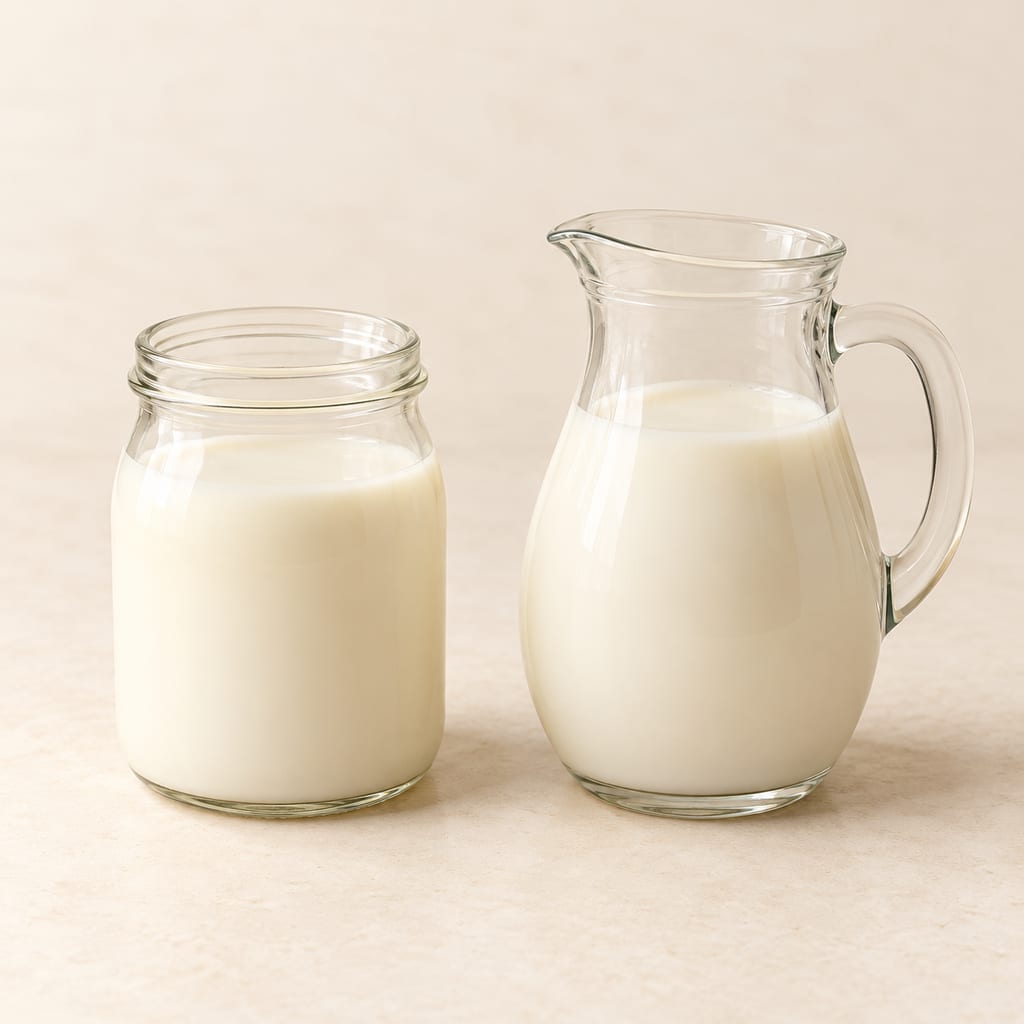
Sheep and goat milk brings together two domestic dairy species: the sheep, Ovis aries, and the goat, Capra hircus. Both supply milk used in cheese, but their names do not describe one standard composition. No breed, season, fat standardization or production lot is established for the ingredient here.
The recorded use is the Cypriot method for Kefalotyri. FAO names its raw material simply as sheep and goat milk. It gives no ratio and does not clarify whether that wording requires a blend or describes available alternatives. An equal mixture would be an invented formula, as would a fixed sheep-majority proportion.
Keep that uncertainty with the ingredient when reading the cheese method. It is possible to explain what the two milks contribute without inventing how much of either was used. The source identifies the animals more clearly than it identifies the supply, and its cheese associations with Cyprus and Greece do not locate a particular batch of milk.
Keeping livestock and using their milk are related activities, but archaeological evidence for one does not automatically establish the other. Animal remains can reveal herding; traces of milk fats in pottery provide another kind of evidence for how people used their animals and vessels.
Craig and colleagues examined remnant fats from vessels at two early farming sites in central and eastern Europe dated5900–5500calBC. Their abstract describes the residues as best explained by milk and suggests small-scale dairying, perhaps involving sheep or goats, within a mixed farming economy. The species attribution remains cautious.
That evidence gives sheep and goat dairying a deeper context than the history of modern cheese labels. It does not identify the first mixture of their milks, demonstrate a Kefalotyri recipe or trace the ingredient here to those communities. The useful connection is a long history of obtaining food from living dairy animals, distinct from a claim about one blend's birthplace.
Sheep and goats can supply milk in places where the grazing, climate or investment needed for cattle is difficult to provide. FAO describes small-ruminant dairying in marginal environments and the importance of quantities suited to immediate household use. Milk can be one output alongside meat, fiber and other products.
The same broad animal category includes specialized dairy production. Breeding, feeding and management affect both milk supply and how long a herd or flock produces it. A household keeping a few goats and a specialized dairy flock are different production systems, even when both contribute milk to cheese.
FAO associates much sheep dairying with the Mediterranean and Near East. That regional context helps explain the prominence of sheep milk in cheese traditions. It is not a certificate of origin for this ingredient, and it does not assign a Mediterranean breed, farm or seasonal production pattern to the milk in the documented Cypriot method.
Milk's familiar appearance hides differences in its solids. Sheep milk generally contains more protein and fat than goat milk, making it useful for concentrated dairy foods such as cheese and yogurt. Goat milk also supports a wide range of cheesemaking traditions, but it should not be treated as compositionally identical to sheep milk.
Species is only part of the explanation. Breed, diet, stage of lactation, farming conditions and season influence milk's composition and sensory properties. These influences can change the material a cheesemaker receives while the animal names on the ingredient line remain the same.
For a mixture, the proportions of the two supplies would matter, along with the composition of each. Because neither proportion nor batch analysis is given here, a precise fat, protein or solids figure would be misleading. Published species averages help explain tendencies; they cannot serve as a specification for an unspecified combination.
Milk contains several structures rather than a uniform solution of every component. Fat is dispersed in globules, while much of the protein occurs in casein micelles. Other components remain in the liquid phase. This organization helps explain why separation, coagulation and heating do different things to the same milk.
Roy and colleagues' comparative review describes differences between species in both composition and structure. Fat-globule and casein characteristics add information that a total fat or protein figure alone cannot provide. The review also emphasizes variation within a species rather than treating every animal's milk as one fixed material.
Its tables bring together findings from different studies, not measurements from the linked Kefalotyri milk. They explain why two milks with a similar appearance can behave differently in processing. A photograph can show the liquid's visible form, but it cannot establish a blend ratio, protein distribution, heat treatment or microbiological quality.
In rennet cheesemaking, casein micelles become part of an aggregated network that holds fat and moisture. That gel needs enough strength to be cut without breaking into excessive fine particles. It must also release whey through syneresis, the contraction and drainage that helps concentrate the curd.
Rako and colleagues studied sheep milk from Dalmatian Pramenka flocks on three Croatian farms. Across their lactation groups, composition changed and the laboratory gels became firmer and released more whey as lactation progressed. Their findings connected processing behavior with the actual milk being examined.
The relationships were not a universal formula for every sheep milk, still less for an unspecified sheep-goat combination. The study itself discusses differences from previous findings. Its useful lesson is that a dairy ingredient changes over production, and that measuring how a gel forms and drains can reveal differences that an animal name cannot predict.
Seasonal milk variation includes changes in the material itself. Li and colleagues examined sheep and goat milk from New Zealand across seasons, studying composition and physical properties as well as the response of proteins to heating. The work distinguishes the two species while retaining the context of that production system.
They found differences in mineral and protein distributions, including what was associated with micelles and what remained soluble. Fatty-acid composition also varied, with consequences for milk fat's melting properties. Casein micelle size and fat-globule size added further physical differences.
These findings show why a fixed total-solids number cannot describe all seasonal processing behavior. They do not establish a universal spring or autumn rule for milk elsewhere. Lambing and kidding patterns, location and management matter. The unspecified milk here has no recorded season, so seasonality provides a source of variability rather than predicting its composition or prescribing a seasonal blend.
A cheesemaker wants to know how much curd milk will supply and how it will behave during manufacture. Fat and protein measurements can help, but prediction equations depend on the material and processes from which they were developed. A formula established for cow milk is not automatically appropriate for sheep or goat milk.
Pazzola's review examines methods used to study coagulation and cheese yield in the two small-ruminant species. Laboratory tests can distinguish the beginning of clotting, the development of firmness and later gel behavior. Those are related measurements, not one interchangeable definition of good cheesemaking milk.
The review also identifies breed-related variation in goat milk and limits in transferring cattle-based methods. For the reader, this means that neither a familiar rennet dose nor a projected yield can be derived from the words sheep and goat alone. A supported method and the actual milk supply provide the context needed to interpret those measurements.
Yield, clotting time and curd firmness describe different outcomes. Keeping their meanings separate makes a milk specification more useful than a single claim that it is suitable for cheese.
Lactic acid bacteria use lactose to produce lactic acid. In cheese, that activity changes acidity and the mineral environment of casein, affecting the curd that forms and drains. Rennet setting, bacterial fermentation and the physical release of whey are distinct operations that interact throughout manufacture.
Not every milk component remains in the cheese in its original proportion. Much casein and fat is concentrated in the curd, while whey carries water and soluble material away. The handling of that curd helps determine how much moisture and dissolved material it retains.
This is why the nutritional or compositional description of fluid milk cannot simply be assigned to its finished cheese. It is also why milk lactose does not disappear merely because rennet has set a curd. Fermentation, drainage and any later washing need to be understood in the actual method before describing the resulting cheese's composition.
Sheep and goat milk contain proteins capable of causing allergic reactions. They should not be offered as reliably safe substitutes for a person with cow-milk allergy. Spuergin and colleagues compared purified caseins and human sera and found substantial cross-reactivity among the cow, sheep and goat proteins in their tests.
Individual patterns can also differ. Muñoz Martín and colleagues described a child who reacted to sheep and goat dairy while tolerating cow-milk products. That case does not estimate how common the pattern is, but it shows why tolerance of one species cannot settle every dairy allergy question.
These findings support a clear ingredient declaration rather than a claim that all affected people react identically. The ingredient contains milk, whatever proportion of the two supplies is eventually established. Fermenting or making cheese from it does not justify removing that declaration or treating the finished food as suitable for a milk-allergic person.
Heat treatment and dietary tolerance answer different questions. FDA explains that allergenic milk proteins remain present in both raw and pasteurized milk. Choosing raw milk does not avoid those proteins, and pasteurization is not a process for making a milk ingredient non-allergenic.
FDA also distinguishes lactose intolerance from allergy. Lactose is milk sugar, while allergy involves an immune response to proteins. Pasteurization does not lower milk's lactose concentration. Any claim about the lactose in a later fermented product requires evidence for that product and its processing rather than an assumption based on heat treatment.
Pasteurized milk still needs appropriate refrigeration and protection after treatment. Reducing pathogens through a controlled heat process does not make milk immune to later contamination or spoilage. The label's treatment information, storage directions and milk declaration therefore remain useful together, rather than one replacing the others.
The FAO Kefalotyri entry documents milk used without heat treatment. That is a description of the traditional method, not a safety validation for a home batch. CDC warns that raw milk and its products may carry Campylobacter, Listeria, Salmonella and other pathogens, and that good farm practice cannot guarantee their absence.
Use pasteurized dairy and a supported cheesemaking process. New Mexico State University's home guidance addresses milk treatment, clean food-contact equipment and careful culture and curd handling as separate responsibilities. Neither the presence of starter bacteria nor the production of a firm curd removes those requirements.
The documented cheese's cooking, salting and ripening conditions should not be turned into universal safe limits for sheep-goat milk. Smell, taste, curd appearance and a home acidity reading cannot establish that pathogens have been controlled. No generic milk-blend shelf life or safe maturation schedule is established by the source's broad raw-material wording.
milk
No geographic origin or manufacturing location is established for this unspecified ingredient. Recipe geography does not identify its supply.
Kefalotyri is a hard sheep-and-goat-milk cheese made in Cyprus as well as Greece. This Cypriot method cooks and presses the curd, then brines, coats and matures the cheese.
No community contributions have been published for this entry yet.
Sign in to contribute. Published comments and photos are free to read.
FAOIdentity · History · Fermentation function · Handling
The technology of traditional milk products in developing countries — FAO, 1990, §4.17 KefalotyriNames sheep and goat milk without a ratio or clarification of blend versus alternatives; milk receives no heat treatment in historical method; cheese geography is distinct.
Cited in: Two dairy animals named, without a fixed proportion; The traditional method does not resolve raw-milk risk
NCBIIdentity · History · Fermentation function · Handling
Ovis aries — NCBI Taxonomy 9940Database current species name for domestic sheep; no breed identified.
Cited in: Two dairy animals named, without a fixed proportion
NCBIIdentity · History · Fermentation function · Handling
Capra hircus — NCBI Taxonomy 9925Database current species name for domestic goat; no breed identified.
Cited in: Two dairy animals named, without a fixed proportion
FAOIdentity · History · Fermentation function · Handling
Small ruminants — Gateway to dairy production and productsHousehold and small-ruminant production systems; Mediterranean sheep dairying; not ingredient-lot origin or current production rankings.
Cited in: Milk production fits the household and its land
FAOIdentity · History · Fermentation function · Handling
Milk composition — Gateway to dairy production and productsSpecies, breed, feeding and lactation affect composition; sheep milk generally richer in fat/protein; differing regional uses.
Cited in: Similar white liquids, different distributions of solids
Frontiers in NutritionIdentity · History · Fermentation function · Handling
Composition, Structure, and Digestive Dynamics of Milk From Different Species—A Review — Debashree Roy, Aiqian Ye, Paul J. Moughan and Harjinder Singh, 2020Comparative composition and dispersed structures; cross-study review, not a batch specification.
Cited in: Milk is an organized dispersion
Food Technology and BiotechnologyIdentity · History · Fermentation function · Handling
Effect of Sheep’s Milk Composition on Strength and Syneresis of Rennet-Induced Milk Gel During Lactation — Ante Rako, Milna Tudor Kalit and Samir Kalit, 201942 bulk milk samples, Dalmatian Pramenka flocks on three Croatian farms; lactation-related composition and laboratory gel differences; study-specific findings.
Cited in: Rennet sets a network that must survive cutting
FoodsIdentity · History · Fermentation function · Handling
Seasonal Variations in the Composition and Physicochemical Characteristics of Sheep and Goat Milks — Siqi Li et al., 2022The abstract and conclusions describe seasonal differences in New Zealand sheep and goat milks, including composition, mineral and protein distribution, and fat properties. The findings describe that production system, not a universal seasonal calendar.
Cited in: Season can change more than the volume collected
AnimalsIdentity · History · Fermentation function · Handling
Coagulation Traits of Sheep and Goat Milk — Michele Pazzola, 2019Reviews sheep and goat milk coagulation measurements and cheese-yield predictions; equations developed for cow milk are not generally transferable.
Cited in: Cheese yield needs more than a cattle-based shortcut
Antiquity; Newcastle University author repositoryIdentity · History · Fermentation function · Handling
Did the first farmers of central and eastern Europe produce dairy foods? — Oliver E. Craig et al., 2005Original abstract: residues at two early Neolithic sites5900–5500calBC consistent with dairying, perhaps sheep/goat; not exact blend or Kefalotyri lineage.
Cited in: Dairying leaves evidence different from animal bones
Allergy; PubMed original abstractIdentity · History · Fermentation function · Handling
Allergenicity of alpha-caseins from cow, sheep, and goat — P. Spuergin et al., 1997Purified casein and human sera tests demonstrate cross-reactivity; no universal clinical prediction.
Cited in: Both milks require an honest allergy description
Allergologia et Immunopathologia; PubMed original abstractIdentity · History · Fermentation function · Handling
Selective allergy to sheep’s and goat’s milk proteins — T. Muñoz Martín et al., 2004Case report of sheep/goat reactions with cow-milk tolerance; not prevalence evidence.
Cited in: Both milks require an honest allergy description
FDAIdentity · History · Fermentation function · Handling
Raw Milk Questions & Answers — updated November 1, 2011Pasteurization does not remove allergenic milk proteins or change lactose concentration; pasteurized milk still needs refrigeration.
Cited in: Pasteurization does not remove milk allergy or lactose
Microbiology SpectrumIdentity · History · Fermentation function · Handling
The Basics of Cheesemaking — Paul S. Kindstedt, 2013Acidification alters casein mineral state and curd; distinction between acid and enzyme coagulation.
Cited in: Fermentation and drainage redistribute milk components
New Mexico State University ExtensionIdentity · History · Fermentation function · Handling
Making Homemade Cheese — Guide E-216, revised by Nancy C. FloresProtect cultures from contamination; food-contact hygiene, milk treatment and cheese handling address separate hazards.
Cited in: The traditional method does not resolve raw-milk risk
CDCIdentity · History · Fermentation function · Handling
Raw Milk — January 31, 2025Raw milk may carry pathogens; farm hygiene cannot guarantee safety; choose pasteurized dairy.
Cited in: The traditional method does not resolve raw-milk risk