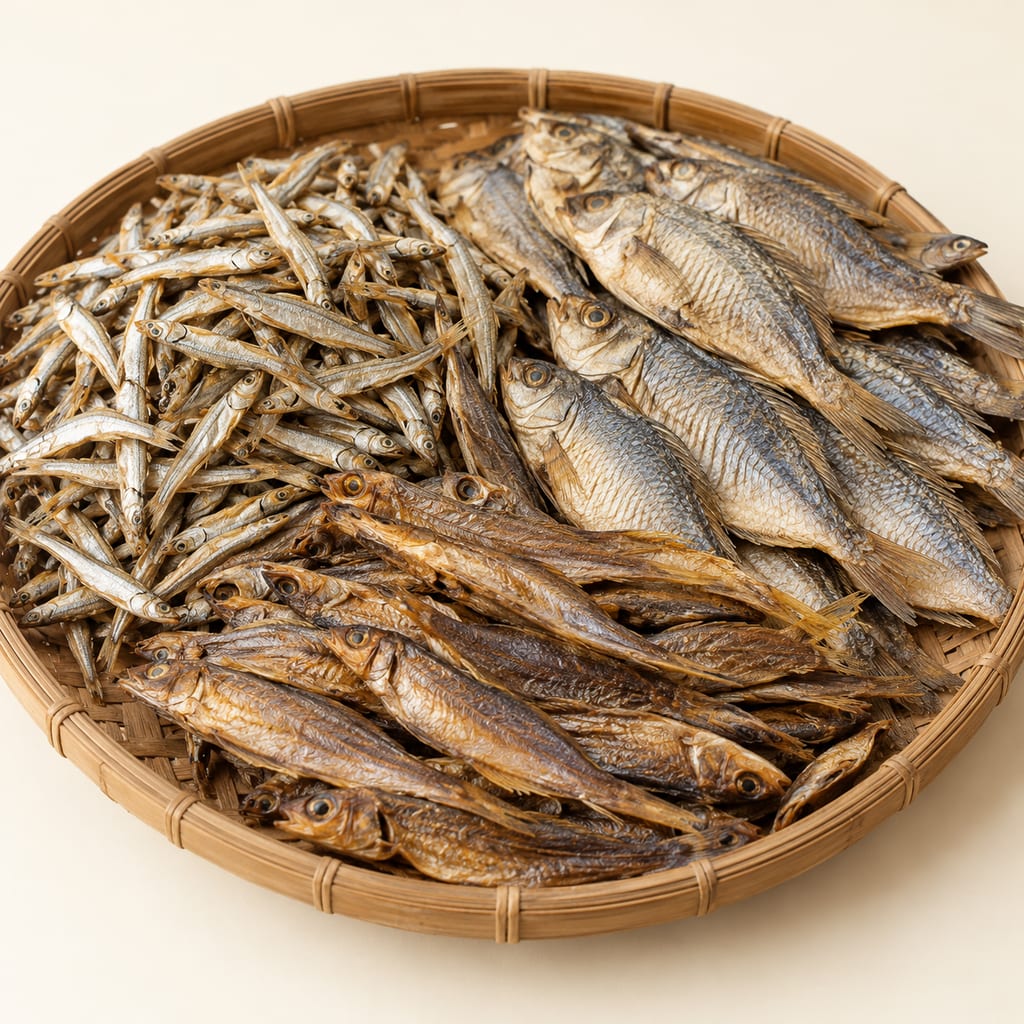
Solar-tent dried usipa, utaka and ndunduma
Small Lake Malawi fish, usipa, utaka and ndunduma, dried on racks inside UV-treated polythene solar tents. Tested in Malawi as a drier, less lossy alternative to open sun drying on racks.
 FermenteaWhere food goes to change
Substrates
Utaka is a small cichlid of Lake Malawi, from the genus Copadichromis, sold dried in Malawi. It is one of the small fish that solar tents were tested on alongside usipa and ndunduma.
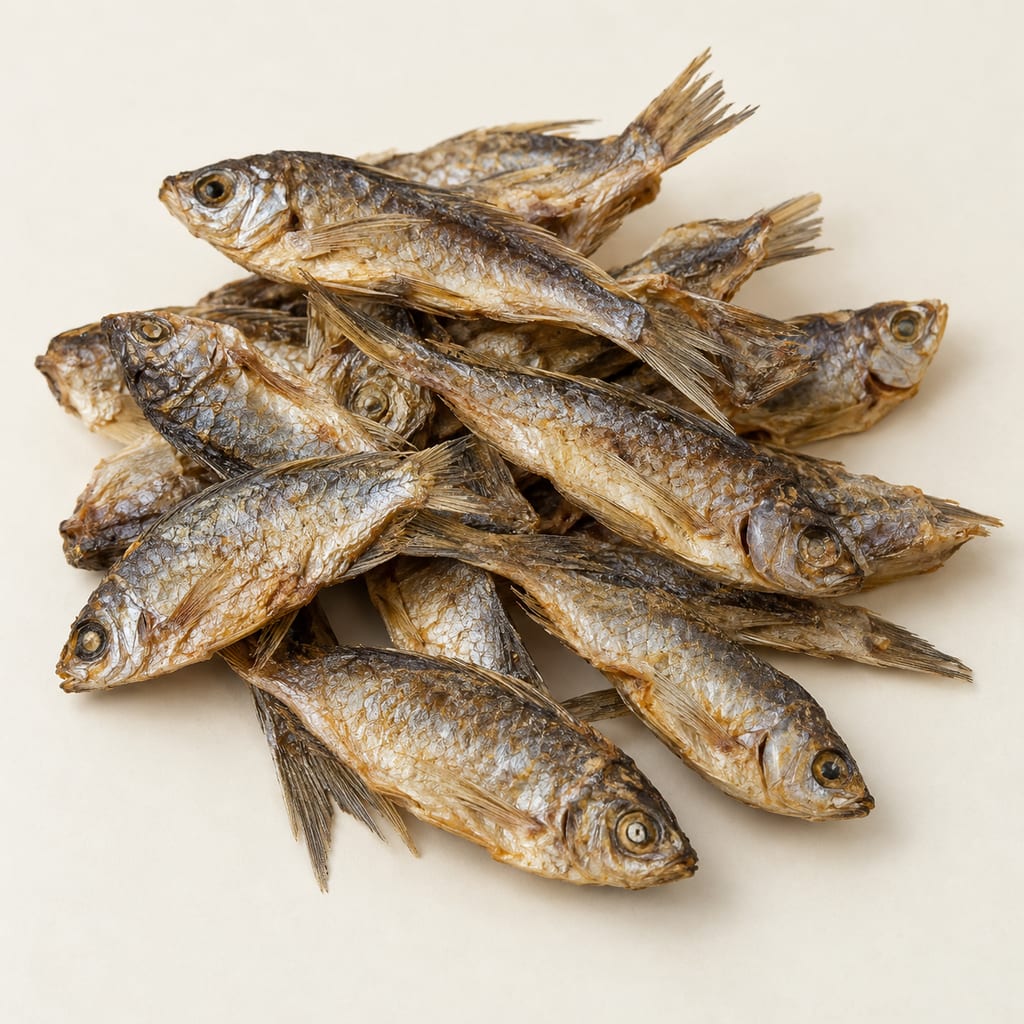
Utaka is the common name for fish of the genus Copadichromis, a group of cichlids endemic to Lake Malawi. The species most often named in the sources is Copadichromis virginalis, described by Iles in 1960. FishBase describes it as a freshwater, demersal fish that lives on sand, and gives a maximum length of 13.2 cm total length, with a length at first maturity of 10.6 cm.
The name does not pick out one fish. The IDRC project listed the species as Copadichromis spp., and the solar-tent study worked on C. virginalis, collected from the Cape Maclear landing sites in the south of the lake. FishBase, by contrast, places the species at the north end of Lake Malawi. The two sources therefore disagree about where the fish were taken, and the difference matters for anyone sourcing the fish. This page records both places and does not resolve them.
In Malawi the name utaka is used alongside usipa and ndunduma for small dried lake fish. The three are different fish: usipa is a cyprinid, Engraulicypris sardella, while utaka and ndunduma are cichlids from different genera. FishBase lists the local names Chakhuta and Chezichezi through its FAO link, and the Ark of Taste does not cover utaka at all.
Dried small fish from the lake are often sold under one market word. Anyone writing a label or a recipe should name the genus or the species, and say which lake fish was dried, because the sources show that the species differ in their drying and bacterial results.
FishBase gives the nutritional content of the fresh fish per 100 g wet weight: protein 18.5 per cent, calcium 231 mg, iron 2.02 mg, zinc 3 mg and omega-3 fatty acids 0.485 g. Those are fresh-fish figures, and they are not comparable with the dry-basis figures from the drying study. Drying concentrates the protein: in the utaka study the dried fish held about 62.9 per cent crude protein and about 23.2 per cent fat, with moisture of about 7.2 per cent in the solar-tent product.
The figures show why dried small fish are valued as a protein food in the regional diet. They do not show how a given batch will keep. Moisture and bacterial load are measured separately, and the sources do not give a storage limit that a home cook can rely on.
The solar-tent study tested utaka against open sun drying. The tent was a UV-treated polythene enclosure over a wooden frame, with low inlet vents and high outlet vents and racks inside. The utaka dried in the tent held about 7.2 per cent moisture, against 16.3 per cent for fish dried in the open, and ash was lower in the tent product. Total viable count was 2.2 x 10^2 CFU/g in the tent product against 4.1 x 10^5 CFU/g in open sun-dried fish. The authors report no E. coli, Salmonella or Shigella in the tent product, and they attribute the difference to lower moisture.
Those results come from one study with unreported sample sizes and some conflicting figures between its abstract and results. In a sensory test with ten adult volunteers, overall acceptability was 3.8 on a five-point scale for tent-dried utaka and 2.2 for open sun-dried fish. The IDRC project reports that solar-dried small fish of this kind kept for seven weeks against three weeks for sun-dried fish, under its own storage conditions.
Utaka is also a subject of Malawian smoking research. A study compared a traditional brick kiln, the Food Research Institute improved smoking kiln and a modified smoker for utaka and usipa at Nkhotakota and Bunda. The full text of that study could not be read for this page, so its wood-use and sensory figures are not used here. Its existence is recorded because it is the basis for a smoked-fish preparation of utaka.
Keep the preparation tied to its study: a sun-dried, a tent-dried and a kiln-smoked utaka are three different products.
FishBase lists utaka as used for commercial fisheries and the commercial aquarium trade. It gives the fishing vulnerability as low, at 18 out of 100, and assesses the species on the IUCN Red List as Near Threatened under criteria A2bd, in an assessment dated 22 June 2018. The sources do not give catch volumes for utaka alone, and the solar-tent work reports dried-fish output for the programme, not for each species.
Because utaka is harvested with usipa and ndunduma in the same catches, a catch figure for small dried fish cannot be assigned to one species. Processors and buyers should keep the species name with the lot.
FishBase does not list the diet items for utaka, giving only a trophic level of 3.0 with a standard error of 0.32. No source in this record gives a sample size for the utaka drying study, a drying duration for the tent, or a moisture target for the fish. The IDRC and solar-tent figures are project results, and this page keeps them attached to their studies.
No source in this record establishes a place.
Small Lake Malawi fish, usipa, utaka and ndunduma, dried on racks inside UV-treated polythene solar tents. Tested in Malawi as a drier, less lossy alternative to open sun drying on racks.
No community contributions have been published for this entry yet.
Sign in to contribute. Published comments and photos are free to read.
FishBaseIdentity · Biology · Fisheries
Copadichromis virginalis: Lake Malawi utakaScientific name Copadichromis virginalis (Iles, 1960); maximum 13.2 cm TL; length at maturity 10.6 cm; sand-dwelling demersal freshwater cichlid
Endemic to the north end of Lake Malawi; names Chakhuta and Chezichezi via FAO link
Nutrients per 100 g wet weight: protein 18.5 per cent, calcium 231 mg, iron 2.02 mg, zinc 3 mg, omega-3 0.485 g
Fishing vulnerability 18 of 100; IUCN Near Threatened, A2bd, 22 June 2018
Cited in: A small sand-dwelling cichlid; Names and what it is confused with; Its food value; Fishery and conservation; Unknowns
International Journal of Marine ScienceQuality · Safety · Method
Nutritional, Microbial and Sensory Quality of Solar Tent Dried (Samva Nyengo) and Open Sun Dried Copadichromis virginalis-Utaka (Pisces; Cichlidae)C. virginalis collected at Cape Maclear landing sites; solar tent 200 micron UV polythene; inlet and outlet vents
Moisture 7.22 against 16.31 per cent; ash 14.48 against 21.97; protein 62.89 and fat 23.24 per cent in tent product
Total viable count 2.2 x 10^2 against 4.1 x 10^5 CFU/g; sensory 3.8 against 2.2 with ten volunteers
Cited in: A small sand-dwelling cichlid; Its food value; Drying it in a solar tent; Smoking and other preparations; Unknowns
International Development Research Centre (IDRC)Method · Markets
Better processing and marketing of healthy fish products in MalawiSpecies list including Copadichromis spp. (utaka)
Shelf life seven weeks for solar-dried against three weeks for sun-dried fish
Cited in: A small sand-dwelling cichlid; Names and what it is confused with; Drying it in a solar tent; Fishery and conservation