
Spices and aromatics
Wild garlic
A source-linked account of ramsons as a European spring woodland plant and culinary leaf, with cultivation limits and serious wild-harvest lookalike warnings.
Scope of this account
The common ingredient name can refer to more than one plant. The research below concerns the particular taxon and uses named in its sources; it does not identify every ingredient sold under this name.
Sources for this section
Name and plant identity
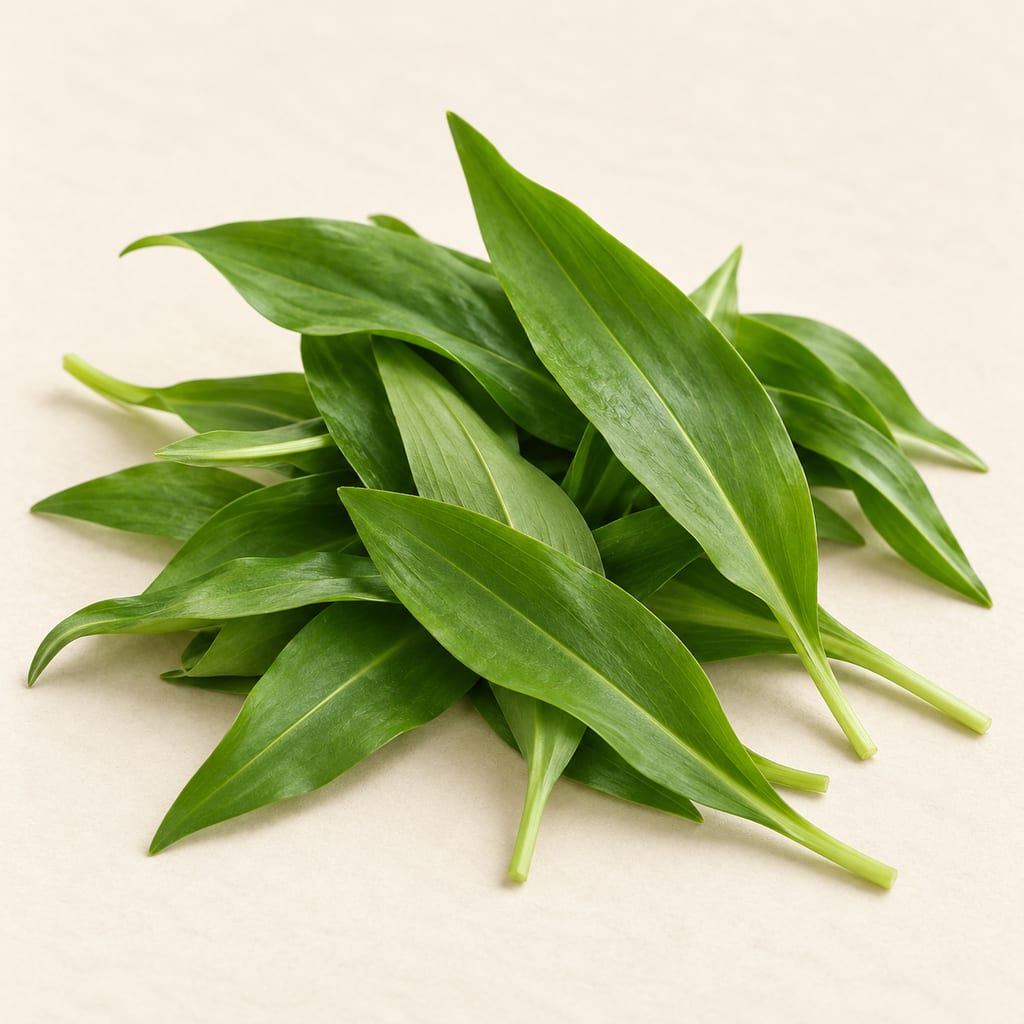
Kew accepts Allium ursinum L., a bulbous perennial in the temperate flora of Europe and the Caucasus. Ramsons, bear's garlic and wild garlic are common names; the German food sources use Bärlauch. A common name does not establish the identity of a gathered plant. The RHS describes paired leaves and white star-shaped flowers, while Kew supplies the taxonomic and range context.
Sources for this section
Culinary context
The inspected Austrian Agency for Health and Food Safety (AGES) page presents Bärlauch as a spring leaf for cream soup. Its household account removes the leaf stems, briefly blanches and cools the leaves, then adds them near the end of a potato, stock and cream soup. This records one regional cooking example; the page does not identify gathered plants or validate a foraging decision. It does not establish that all parts of the species are used as food.
Sources for this section
Garden habit and growing conditions
In the RHS profile, ramsons grow in moist, well-drained ground and tolerate full sun or partial shade; listed soil types include clay, chalk, loam and sand, with acid, neutral or alkaline pH. The RHS assigns H7 in its UK hardiness scheme, which it describes as hardy in the severest European continental climates below -20°C. This is a horticultural rating, not a measured limit for every site or plant. The RHS advice describes new leaves in late winter or early spring, flowering in spring, and foliage dying back as summer progresses.
Sources for this section
Propagation, spread and limits
The RHS describes spread by seed and underground bulbils and warns that established colonies can be difficult to control. Its pages do not provide a quantified seed-starting protocol, container depth, greenhouse regime, photoperiod, or production schedule. No frost-free or heated-house requirement, local collection permission, or site-specific ecological status was established in this review.
Sources for this section
Lookalike risk and gathering boundary
Germany's Federal Institute for Risk Assessment warns that ramsons leaves can be confused with lily-of-the-valley (Convallaria majalis) and the very poisonous autumn crocus (Colchicum autumnale); severe and fatal poisonings have occurred. BfR also explains that a smell test can mislead when leek odour from a previous test remains on the hands. Neither smell, season, habitat, a photograph nor this article is an identification method. When identity is uncertain, do not eat the leaves; BfR points readers toward controlled crops or specialist shops as alternatives.
Sources for this section
Research gaps
No specimen-level botanical identification, local foraging permission, or site contamination assessment is provided.
The inspected sources do not define a universal greenhouse, container, irrigation, or productive-yield protocol.
The AGES page is a culinary example, not a validated foraging or preservation process; no storage life is established here.
Local conservation and invasive-species status were not assessed.
Research status
The underlying plant account received a partial source review. Its review scope is described in the original plant article.
Sources for this section
Places
Unknown
Relationship not established · Place not establishedThe available research does not establish a single origin for this ingredient.
Community
No community contributions have been published for this entry yet.
Share what you made
Sign in to contribute. Published comments and photos are free to read.
Sources
Royal Botanic Gardens, Kew, Plants of the World OnlineIngredient research
Allium ursinum L.Cited in: Scope of this account; Name and plant identity; Research gaps
Royal Horticultural SocietyIngredient research
Allium ursinum: detailsCited in: Name and plant identity; Garden habit and growing conditions; Propagation, spread and limits; Research gaps
Austrian Agency for Health and Food Safety (AGES)Ingredient research
Bärlauch-CremesuppeCited in: Culinary context; Research gaps
Royal Horticultural SocietyIngredient research
Wild garlic and crow garlicCited in: Garden habit and growing conditions; Propagation, spread and limits; Research gaps
German Federal Institute for Risk Assessment (BfR)Ingredient research
Wild garlic confusion often leads to poisoningCited in: Lookalike risk and gathering boundary; Research gaps
FermenteaResearch provenance
Ramsons (Allium ursinum): original plant researchCited in: Research status