
Preservation catalogue
Cold without winter: from pond ice to the kimchi refrigerator
Ice once came off frozen ponds and ships. Breweries, a Geelong inventor and a Munich professor built machines that replaced it, and a home refrigerator now shapes which bacteria work in a jar of kimchi.

Historical interpretation: blocks of pond ice stacked beside a frozen pond, the cold that machines later replaced.
Ice cut from a pond and sold in Calcutta
In the winter of 1846–47, ice-cutters were at work on Walden Pond. Thoreau's chapter on the pond in winter has them there, and has the people of Calcutta drinking Walden water. The ice trade that sent New England ice to India began with Frederic Tudor. His first Calcutta voyage sailed from Boston on 12 May 1833 in the brig Tuscany, with 180 tons of ice loaded. About 100 tons were still aboard when the ship arrived.
Natural ice was a business tied to the calendar, because the crop depended on a hard winter. The trade declined in the 1880s as commercial refrigeration spread.
A machine on the Barwon River
James Harrison was born on 17 April 1816 in Bonhill, Dunbartonshire, and died on 3 September 1893 at Point Henry, in the Geelong area. The committee of the James Harrison Museum says his machine at Rocky Point on the Barwon River, running from 1851, was the first mechanical ice-making machine in the world. Dates differ here. One account puts the first working machine in 1851 and the first commercial machine in 1854; a plaque gives 1854 for the invention.
The patents also vary by a year between accounts. One lists a Victorian patent of 1855 for an ether system, a London process patent of 1856 (No. 747) and a London apparatus patent of 1857 (No. 2362). Museums Victoria, which holds a model of the machine, describes patents in Australia and Britain in 1856 and 1857, and calls the machine one of Victoria's few internationally significant nineteenth-century inventions. A brewery commissioned a beer-cooling machine from Harrison in 1856, and Victoria Ice Works opened in Melbourne in 1859.
His attempts to ship meat were less tidy. In 1873 he prepared the sailing ship Norfolk for an experimental beef shipment to Britain. The ice ran out faster than expected, and the experiment failed. He also won a gold medal at the Melbourne Exhibition for frozen meat that stayed edible for months.
Linde and the brewery
Carl von Linde was a lecturer at the Technische Hochschule in Munich from 1868 and a full professor from 1872. His first refrigeration machine dates to 1873. It used dimethyl ether and was built by Maschinenfabrik Augsburg for the Spaten Brewery. The same account gives 1876 for the first reliable and efficient compressed-ammonia refrigerator.
Accounts differ on which machine counts as the first commercial one. One account says the ammonia machine was sold to the Dreher Brewery in September 1876, after a Bavarian patent awarded on 25 March 1876, and ran there until 1908. Whether the Spaten machine of 1873 or the Dreher machine of 1876 came first depends on the source. Breweries are among the earliest buyers in every account, from Harrison's 1856 commission to the Spaten and Dreher machines.
Linde gave up his professorship in 1879, the year he founded the Gesellschaft für Lindes Eismaschinen AG in Wiesbaden, the company now known as Linde plc. He returned to the Munich post in 1888.
Moving heat instead of making cold
Harrison's ether system and Linde's dimethyl ether and ammonia machines share one design: a refrigerant circulates through a loop that carries heat out of a space and drops it somewhere else. The ideal cycle has four steps. A compressor draws vapour from the evaporator and raises its pressure. A condenser cools the hot vapour back into liquid and releases the heat elsewhere. An expansion valve lets the liquid's pressure fall, and the fall cools it, leaving a mix of low-pressure liquid and vapour. The evaporator then takes heat from the space that needs cooling, and that heat transfer is the cooling effect.
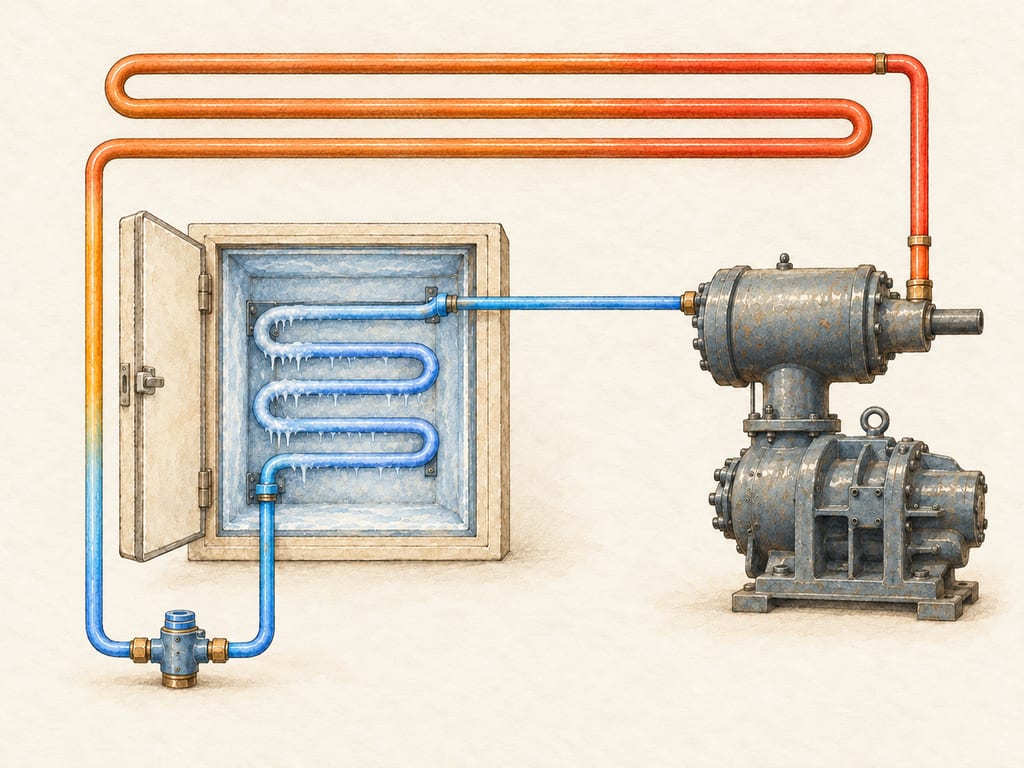
In an industrial refrigeration engine room, the compressor is a heavy steel casing driven by an electric motor.
From the brewery to the kitchen
The domestic refrigerator arrived in the early twentieth century, and its dates are contested. Kelvinator was among about two dozen home refrigerators introduced to the US market in 1916.
General Electric's Monitor Top of 1927 took its name from its top-mounted compressor, which looked like the gun turret on the Civil War ironclad USS Monitor. Its price is given two ways: about $300 for the first models in one account, and around $525 at launch in another, falling to as low as $200 within a few years.
What a cold shelf does and does not do
Chilling slows biology and leaves most of it running. Refrigeration strongly slows enzyme activity but does not eliminate it, even below freezing. Lower storage temperatures lengthen the lag phase of microbes, the pause before they begin to multiply, and slow their growth. Low temperature in general practically does not destroy microorganisms or enzymes; it depresses their activity.
Listeria is the standard example. It is among the microbes that grow in the cold: a French medical note lists Listeria monocytogenes at 0 °C and even −1.5 °C, and says such microbes still multiply, though slowly, between +10 °C and −1.5 °C.
Nonproteolytic Clostridium botulinum, which includes type E, has a minimum temperature for growth and toxin formation of 3.3 °C. The same French note gives +3.3 °C for type E. Smell, taste and bubbles do not tell you whether food is safe.
Four degrees, five degrees, eight
The agencies give different numbers, and each is for its own country and its own purpose. The FDA Food Code in the United States requires cold food to be held at 5 °C or below. Cold-holding guidance for North Carolina inspectors describes the limit moving from 7 °C to 5 °C. USDA's Food Safety and Inspection Service says the refrigerator should be at 4.4 °C or below and the freezer at −18 °C or below, and recommends an appliance thermometer.
In the United Kingdom, government guidance says to set the fridge to 5 °C or below. Chilled food must be kept at 8 °C or below, which is a legal requirement in England, Wales and Northern Ireland and a recommendation in Scotland. A Welsh citizen-science study gave volunteers fridge thermometers. Of the 201 participants who responded, 127 (63 per cent) had a fridge above 5 °C.
The FDA's 5 °C and the USDA's 4.4 °C differ by about 0.6 °C. These are cold-holding limits for food safety, and they say nothing about how a ferment in the fridge behaves.
Kimchi in the cold
Cold changes a ferment, and kimchi gives the clearest evidence in this story. In a 1991 study by Cho and Rhee, kimchi was fermented at 30, 21, 14 and 7 °C. Changes in pH and acidity were most prominent at 14 °C, and Leuconostoc mesenteroides and Lactobacillus brevis formed most of the volatile acids. At that temperature, a sample inoculated with Leuconostoc mesenteroides had a higher acid content than the others.
Two later studies point the same way. A 2020 study by Lee, Haque and Cho fermented kimchi at 8, 15 and 25 °C, and the pH fell from 6.17 to 3.92, 3.79 and 3.48, after 54, 30 and 24 days. Colder kimchi reached its acidity later, but acid production did not stop. A 2008 study of kimjang kimchi linked a predominance of Lactobacillus sakei to fermentation at 5–9 °C and storage at −2 °C. The kimchi cooled to 3.2 °C during the first 20 days and then held near 1.6 °C.
The studies show that temperature changes which bacteria dominate. None of them tested refrigerator storage as a variable.
A refrigerator built for kimchi
Korean makers went further and built a refrigerator for one food. Accounts of its start disagree. One account says GoldStar, now LG, introduced the term in 1984 with the 45-litre GR-063, which had a stainless interior. Another places the first launch in 1995, when WiniaMando introduced its Dimchae brand in November or December, with model CFR-052E. By November 2007 more than a dozen makers, including Samsung and LG, built them, and designs had moved from top-loading lid types to drawer and stand types.
A Samsung chest model has two top-opening insulated compartments holding eight removable rigid lidded bins. Upright drawer types also exist, and the bins, locks and colours vary by maker and generation. The machine manages fermentation change, but nothing shows that all kimchi keeps for the same time.
The thread through all of this is that cold is a rate, not a switch. A fridge slows enzymes and microbes, and it favours some bacteria over others. It does not stop them, and an appliance thermometer shows what temperature the shelf really holds. Whether a given home refrigerator setting gives a given kimchi the same result as the laboratory temperatures above is not tested in the studies described above.
Related
Read more
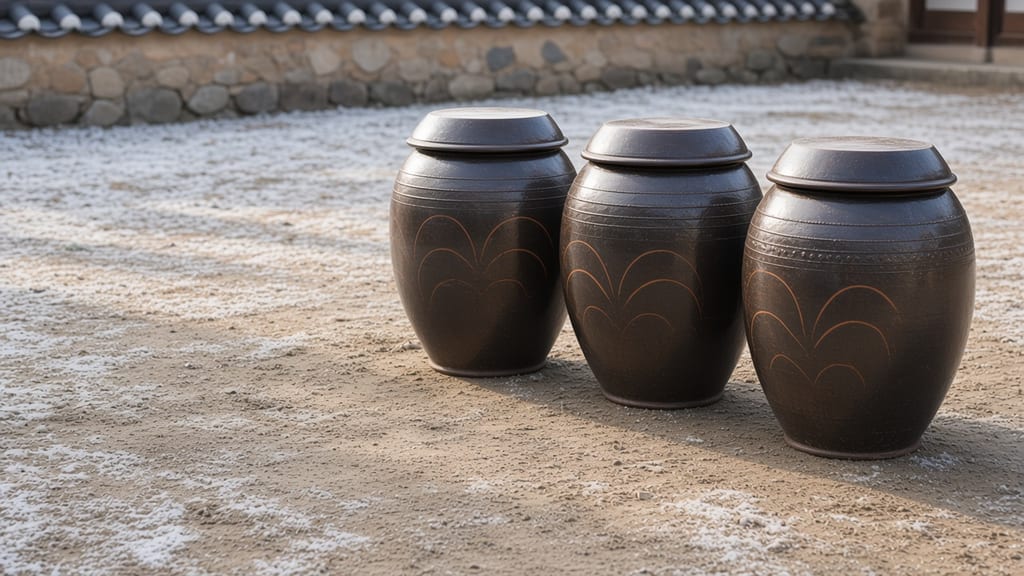
Kimjang and the buried jar: winter kimchi in Joseon Korea
In 1766 chilli entered a Korean kimchi recipe for the first time. Joseon households made winter kimchi in late autumn and kept it in onggi jars buried in straw, at a few degrees above freezing until spring.
Community
No community contributions have been published for this entry yet.
Share what you made
Sign in to contribute. Published comments and photos are free to read.
Sources
Museums Victoria
Refrigeration and James Harrison (Museums Victoria article)Cited in: A machine on the Barwon River
Museums Victoria
Harrison's refrigeration machine model (Museums Victoria item)Cited in: A machine on the Barwon River
Wikipedia
James Harrison (engineer)Cited in: A machine on the Barwon River; Moving heat instead of making cold
Korean Journal of Food and Cookery Science, vol. 7, no. 1, pp. 15–25, 1 February 1991 (Cho Y and Rhee HS)
Effect of Lactic Acid Bacteria and Temperature on Kimchi Fermentation (I)Cited in: Kimchi in the cold
USDA Food Safety and Inspection Service
Refrigeration & Food SafetyCited in: Four degrees, five degrees, eight
GOV.UK
Food hygiene for businesses: Chilling and freezingCited in: Four degrees, five degrees, eight
INFLIBNET ebook platform, Chapter 12 of Principles of the Food Processing & Preservation (Aparna Kuna)
Low Temperature Preservation and ProcessingCited in: What a cold shelf does and does not do
Bulletin de l'Académie nationale de médecine, 2001, 185(2): 287–299 (R. Rosset)
Croissance microbienne et froid. Étude du cas particulier de Listeria monocytogènes (Microbial growth and cold: the case of Listeria monocytogenes)Cited in: What a cold shelf does and does not do
Journal of Microbiology 46: 590–593, 2008
Microbial population dynamics and temperature changes during fermentation of kimjang kimchiCited in: Kimchi in the cold
Brookston Beer Bulletin, 11 June 2026
Historic Beer Birthday: Carl von LindeCited in: Linde and the brewery
ZERO2FIVE, Cardiff Metropolitan University, 3 June 2024
Research study finds 71% of household fridges tested operating at unsafe temperatureCited in: Four degrees, five degrees, eight
Journal of Applied Biological Chemistry 63(4): 429–437, 2020 (Lee HY, Haque MA, Cho KM)
Changes in physicochemical property and lactic acid bacterial community during kimchi fermentation at different temperaturesCited in: Kimchi in the cold
Course module page hosted at home.iitk.ac.in
Lecture 31: Refrigeration CycleCited in: Moving heat instead of making cold
U.S. Food and Drug Administration
BAM Chapter 17: Clostridium botulinumCited in: What a cold shelf does and does not do
North Carolina cold-holding inspection guidance (ncrla.org)
Cold Holding Inspection GuidanceCited in: Four degrees, five degrees, eight
Albany Institute of History & Art
GE Monitor Top Refrigerator (50 Objects)Cited in: From the brewery to the kitchen
Gaps
- Dates for Harrison's first machine (1851 or 1854), Linde's first machine (1873 or 1876) and the first kimchi refrigerator (1984 or 1995) differ between accounts.
- The FDA and USDA figures were confirmed through secondary sources and excerpts, and the Monitor Top price is given two ways.
- Cold storage of sauerkraut and other ferments was not researched.
Updated 2026-10-29