
Preservation catalogue
Kimjang and the buried jar: winter kimchi in Joseon Korea
In 1766 chilli entered a Korean kimchi recipe for the first time. Joseon households made winter kimchi in late autumn and kept it in onggi jars buried in straw, at a few degrees above freezing until spring.
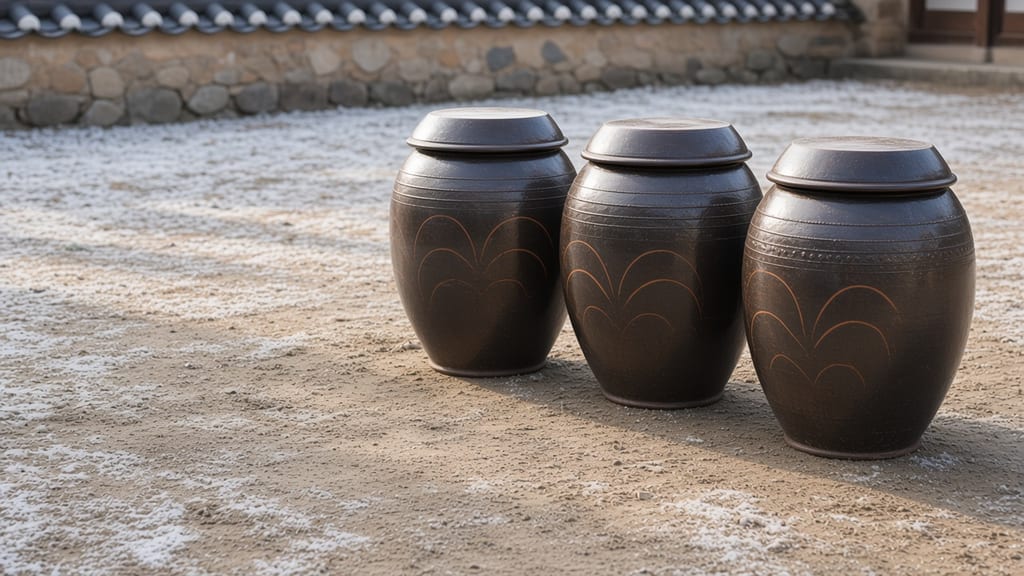
Four sizes of jar
Dok, jungduri, batangi, hangari. A Korean farming song of the early nineteenth century names four sizes of earthenware jar in one line, from the largest to the smallest, and tells the household to fill them all with kimchi before winter. The next lines say where they go. Build a straw shed on the sunny side of the yard, wrap the jars in straw and bury them deep.
The song is Nongga wollyeongga, a month-by-month calendar of farm work attributed to Jeong Hak-yu. Its tenth-month verse is a storage plan written as poetry. The jars, the shed, the straw and the hole in the ground were the Joseon answer to a hard problem, which was how to keep vegetables edible through months of frozen fields.
By the time the song was written, those jars held something new. Fifty years earlier, in 1766, the scholar Yu Jung-rim had expanded an older household manual into Jeungbo sallim gyeongje, and in it chilli appears in kimchi for the first time in any surviving Korean text. This article follows that change and the custom that carried it, kimjang, the late-autumn making of winter kimchi, and the buried onggi jar that let a family eat it until spring.
What did the 1766 book change?
Sallim gyeongje, the manual Yu expanded, dates from about 1715 and was written by Hong Man-seon. Its kimchi contain no chilli. The Encyclopedia of Korean Culture finds none in the cookbooks of the seventeenth century either. Eumsik dimibang, written around 1670, and Yorok, from late in the same century, season their kimchi with cheoncho, the Korean name for Sichuan pepper, and with fennel. Yorok alone gives eleven kimchi.
Jeungbo sallim gyeongje is different. Its cucumber kimchi, hwanggwa damjeo, slits young cucumbers three times and fills them with a little chilli powder and four or five pieces of garlic before boiling salted water goes over them. Encykorea calls it the first recorded kimchi made with chilli powder. The book writes the chilli as 蠻椒, barbarian pepper, a name that labels it as a foreign plant.
A second recipe goes further. Chim nabok hamjeo, a salted radish kimchi, uses radish with its leaves and stems, the green seaweed cheonggak, pumpkin and aubergine. The seasoning is chilli, Sichuan pepper and mustard with plenty of garlic juice. The encyclopedia compares it with chonggak kimchi, the small whole radish kimchi still made today.
The same book lists dongchimi, the clear radish water kimchi, along with a cabbage kimchi, Yongin oiji, a winter aubergine kimchi and kimchi made with abalone and with oysters. The National Institute of Korean History notes that the cabbage kimchi, songchimjeo, is among them.
None of this is the red cabbage kimchi of a modern Korean table. Chilli in 1766 is a seasoning that sits next to the older spices, not a replacement for them. The radish kimchi still carries Sichuan pepper, and garlic juice does as much work as the chilli.
Where did the chilli come from?
The National Institute of Korean History places chilli's arrival in Korea around the Imjin War, the Japanese invasions of 1592 to 1598, and says it came through Japan. Within a generation it was known and distrusted. In Jibong yuseol, an encyclopedic miscellany of 1614, the scholar Yi Su-gwang described the plant and warned that it was poisonous.
That gives a gap of about 150 years between the first written notice of chilli and the first written chilli kimchi. Cookbooks record what households already did, often late, so the gap says more about the surviving books than about kitchens. It is still the only dated evidence there is.
A group of food researchers rejects this account. In the Journal of Ethnic Foods in 2015, Kwon Dae Young and colleagues argued that gochu grew in Korea long before 1592 and that the Japanese-introduction story is wrong. Their papers are a real position in the literature, but the national reference works have not adopted it. What both sides accept is narrower. The earliest kimchi recipe that names chilli is in the 1766 book.
What was kimjang?
Joseon writers called the bulk making of kimchi in late autumn chimjang, from the characters for soaking and storing. The modern word kimjang descends from it. Dongguk sesigi, a record of seasonal customs compiled in 1849, calls kimjang and the making of soy sauce and pastes the two great tasks of the household year.
The same text describes the Seoul custom. Households put radish, cabbage, garlic, pepper and salt into onggi jars, and the pepper by then meant both Sichuan pepper and chilli. The timing is fixed by the weather. Kimjang falls around Ipdong, the solar term that marks the start of winter in early November, late enough that the vegetables will not sour quickly and early enough that the cabbage has not frozen in the field.
UNESCO, which inscribed kimjang on its Representative List of the Intangible Cultural Heritage of Humanity in 2013, describes it as the end point of a year-long cycle. Households salt shrimp and anchovies for jeotgal in spring and buy sea salt in summer. In late summer they dry red chillies and grind them to powder. In late autumn the cabbage and radish come in, and families decide the day by watching the weather forecast for the date and the temperature.
The listing treats kimjang as shared work. Relatives and neighbours make kimchi together and divide it, and methods pass from mother-in-law to daughter-in-law within a family. South Korea added kimchi making itself to its list of national intangible heritage on 15 November 2017.
Those descriptions belong to the modern practice. For the eighteenth century the written record is thinner. It gives the recipes, the jars and the season, and the farming song gives the storage plan, but no Joseon source counts how many heads of cabbage a household salted.
What went into the jars?
The cabbage was not the dense, tightly wrapped napa of today. The Encyclopedia of Korean Culture describes a semi-heading Seoul cabbage that stayed in use into the 1960s, with looser leaves and a more open head. Radish was the steadier winter crop, and many of the old kimchi are radish kimchi.
The quantities are rare in the texts, and the oldest is very old. Sanga yorok, a book of about 1450 that the encyclopedia names as the first Korean cookbook with kimchi recipes, gives a cabbage kimchi, chimbaekchae, with three hop of salt to one dongi of cabbage. Both are old volume measures, and neither converts cleanly to modern units.
Salted seafood arrived in kimchi in the decades after 1766. Gyuhap chongseo, a woman's household manual of 1809, has a seokbakji, a kimchi of chunky cut vegetables, made with jeotgal and chilli. Imwon sipyukji, Seo Yu-gu's agricultural encyclopedia of the early nineteenth century, gives a seokbakji with salted seafood and an abalone shell placed in the jar. The encyclopedia reads the shell as a check on acidity, because its calcium carbonate would react with the acid of a souring kimchi.
Read in sequence, the books show the kimchi of a Joseon winter changing over about sixty years. Chilli appears in 1766. Salted seafood joins it by 1809. Cabbage gains ground but does not yet dominate. The buried jar stays the same throughout.
Why bury the jar?
The farming song gives the instruction in one line. Build a gaga, a temporary shed, on the sunny side, wrap the jars in straw and bury them deep. The straw and the shed stood between the jars and the frost, the snow and the rain.
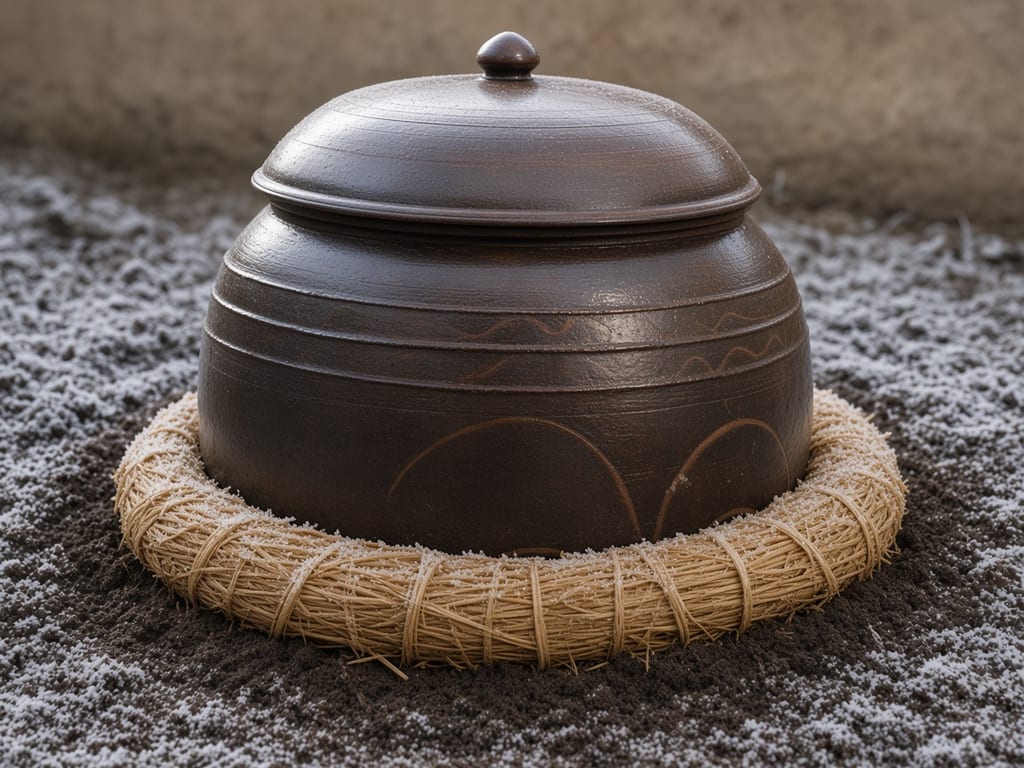
The reason for burying the jar is temperature. The National Institute of Korean History says winter ground temperature in Korea stays at around 0–1 °C, and that a buried kimchi jar cools to that level. In that narrow band just above freezing, kimchi sours slowly and does not turn to ice.
Burial for storage is older than kimchi with chilli. Xu Jing, a Song envoy who visited Goryeo in 1123, wrote in his illustrated account of the country that chestnuts could be had even in summer, because Koreans kept them in earthenware crocks buried in the ground for years.
The packing mattered as much as the hole. The encyclopedia describes jars filled tight and topped with ugeoji, the coarse outer leaves stripped from the cabbage, to keep air off the kimchi beneath.
What makes a good onggi?
Onggi is the general name for Korean earthenware, the brown pottery of storage jars, sauce crocks and water vessels. The National Institute of Korean History describes it as clay fired below 1,200 °C and calls the fired body porous. On its account, microscopic pores let the pot breathe, passing air but holding liquid, and that keeps food fresh for longer. The claim is widely repeated in Korea. The sources read here state it but do not measure it.
Potters and households had their own standards. The Encyclopedia of Korean Culture records the lore that the best kimchi jar comes from the first firing of early spring, made with clay dug just after the ground thaws.
Onggi was everyday equipment at every level of society. Seo Yu-gu, writing in Imwon gyeongjeji, described the handles on each side of a jar, and noted that once a jar fell it broke and was useless, although such jars were the most important things in daily life. The royal kitchen and the offices that ran court ceremonies kept 104 pottery artisans on staff to meet the demand for storage jars, and the palaces had their own sauce-jar warehouses.
The four names in the farming song run from the large dok down to the small hangari. The song gives the names but not the volumes, and no source read here supplies them.
What happens inside a buried jar?
The chemistry is the same in a buried jar as in a refrigerator box. Cheigh and Park's 1994 review of kimchi science describes a fermentation started by the microbes already on the raw vegetables and seasonings, then gradually dominated by lactic acid bacteria. Sugars are used up, ascorbic acid changes, organic acids build up and the texture softens.
Temperature decides the pace. In 2008 a team of Korean microbiologists followed a kimjang kimchi fermented the traditional way, in a jar underground. Its temperature fell by about 0.3 °C a day for the first 20 days, from the warmth of making to 3.2 °C, and then held steady at around 1.6 °C. The authors reported fermentation at 5–9 °C and storage near −2 °C and found that Lactobacillus sakei dominated.
They called burial a very efficient way to handle fermentation and storage together, and they presented their measurements as information for engineers building temperature control into kimchi storage. The hole in the ground had done the work of a two-stage programme. It let the kimchi ferment while it cooled and then held it cold.
The Encyclopedia of Korean Culture gives a working figure for quality. Kimchi kept at about 5 °C is at its best for four to six weeks. That is a statement about flavour, not a safety limit.
What replaced the hole in the ground?
Apartment blocks have no yard. As Korean cities grew after the 1960s, households moved jars into sawdust or rice husks in a corner, or into double-walled boxes of expanded polystyrene, and then into the kimchi refrigerator, an appliance designed to copy the buried jar.
A 2012 study tested the modern appliance against the old pattern. Researchers stored kimjang kimchi for six months under four regimes. The best was the one closest to a buried jar, five days at 10 °C to ferment, then storage at −2.5 °C. Kimchi stored cold from the start ripened later, and among those direct cold settings −1 °C did better than −2.5 °C.
Modern food-safety advice is separate from the history. Colorado State University Extension tells home cooks to keep finished kimchi tightly covered in the refrigerator, pressed under its liquid, and to discard it if mould appears on the surface. It gives a final salt content for kimchi of 2–5%. A jar in a yard is a historical method, not a recommendation.
The kimchi refrigerator and the history of mechanical cold in general are covered in the Fermentea article on refrigeration. The appliance did not end kimjang. UNESCO's 2013 listing describes a practice still organised around the same late-autumn date, the same shared work and the same salted seafood bought in spring.
The jar in the yard
The 1766 book did not invent kimjang, and the buried jar was centuries old before chilli reached Korea. What changed in the late eighteenth century was what went into the jar. Chilli entered as one seasoning among several, then stayed.
The farming song's four jars are still the clearest picture of the system. A household filled them in the tenth month, set them in the ground under straw on the sunny side of the yard and ate from them until spring. A kimchi refrigerator sold in Seoul today has the same job.
Related
Discussed in this article
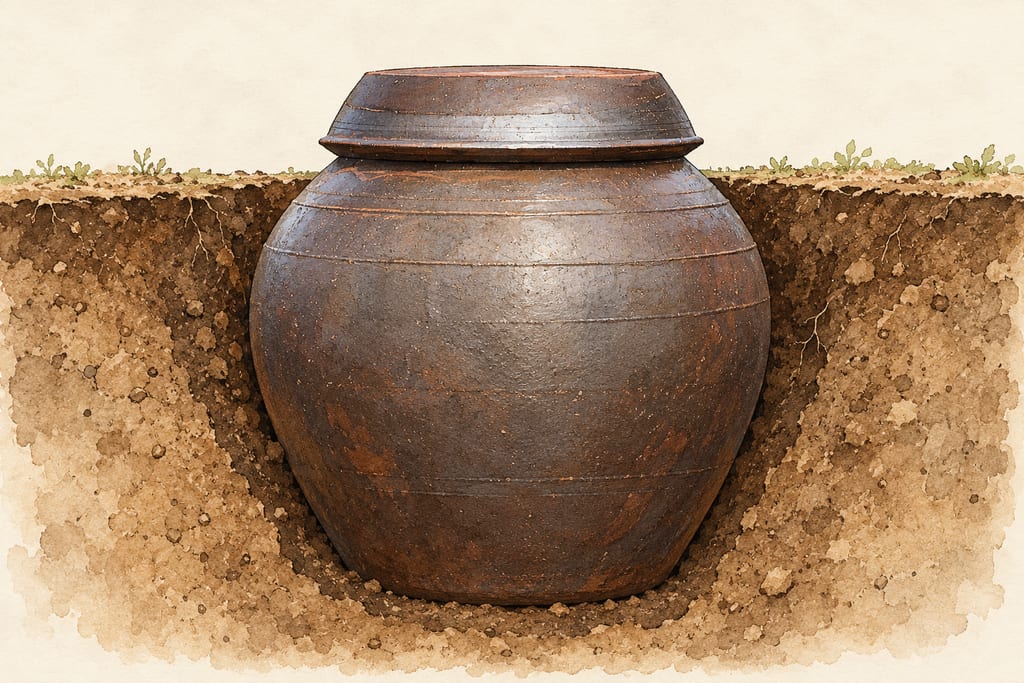
Buried winter kimchi jar
A traditional Korean onggi used in winter kimjang for kimchi storage could be buried to moderate temperature. The sources support the practice but not one standard burial depth or jar profile.
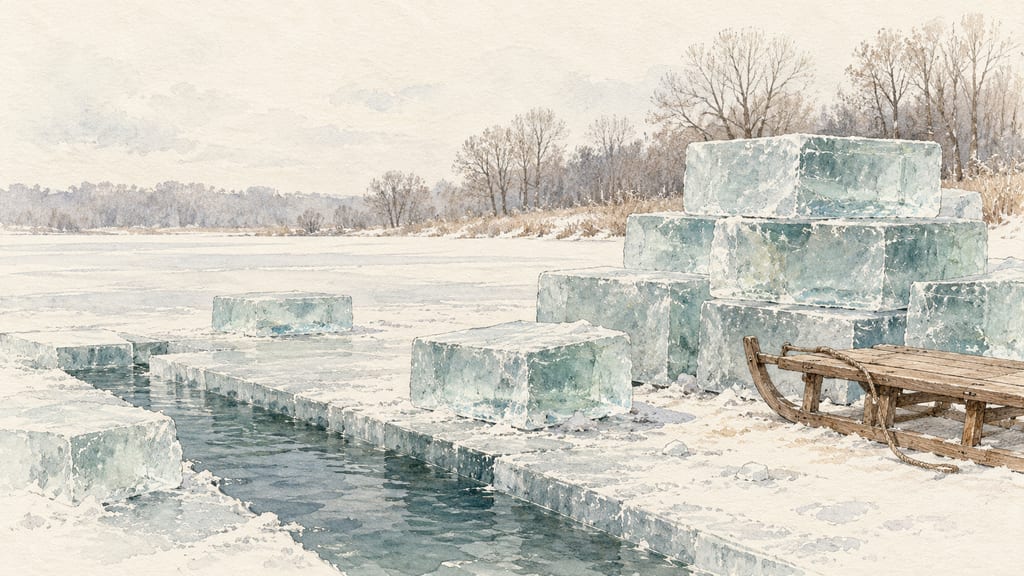
Cold without winter: from pond ice to the kimchi refrigerator
Ice once came off frozen ponds and ships. Breweries, a Geelong inventor and a Munich professor built machines that replaced it, and a home refrigerator now shapes which bacteria work in a jar of kimchi.
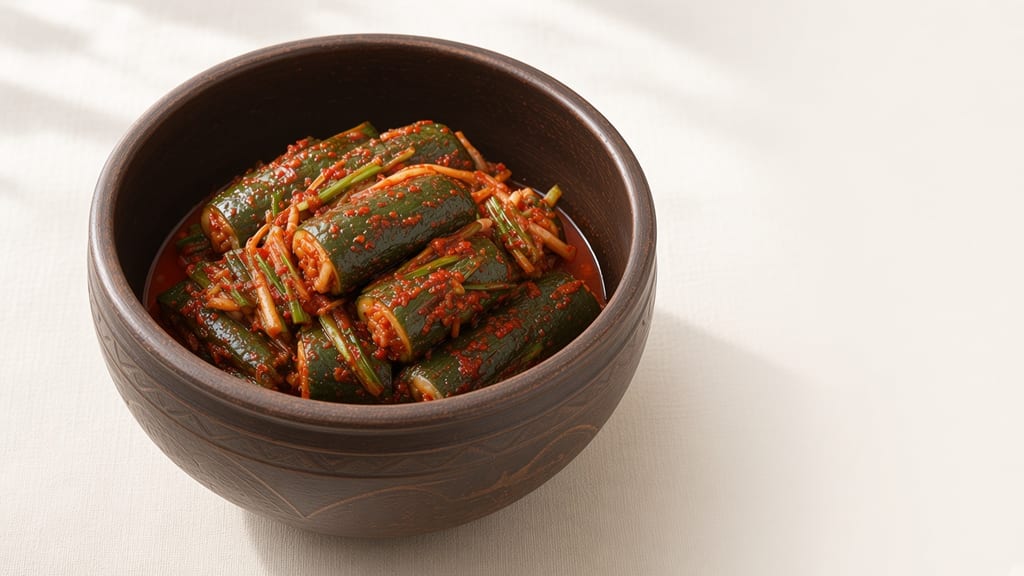
Hwanggwa damjeo (1766 cucumber kimchi with chilli)
Hwanggwa damjeo is a cucumber kimchi from Yu Jung-rim's Jeungbo sallim gyeongje of 1766. Slit cucumbers are packed with chilli powder and garlic, scalded with hot salted water and sealed overnight.
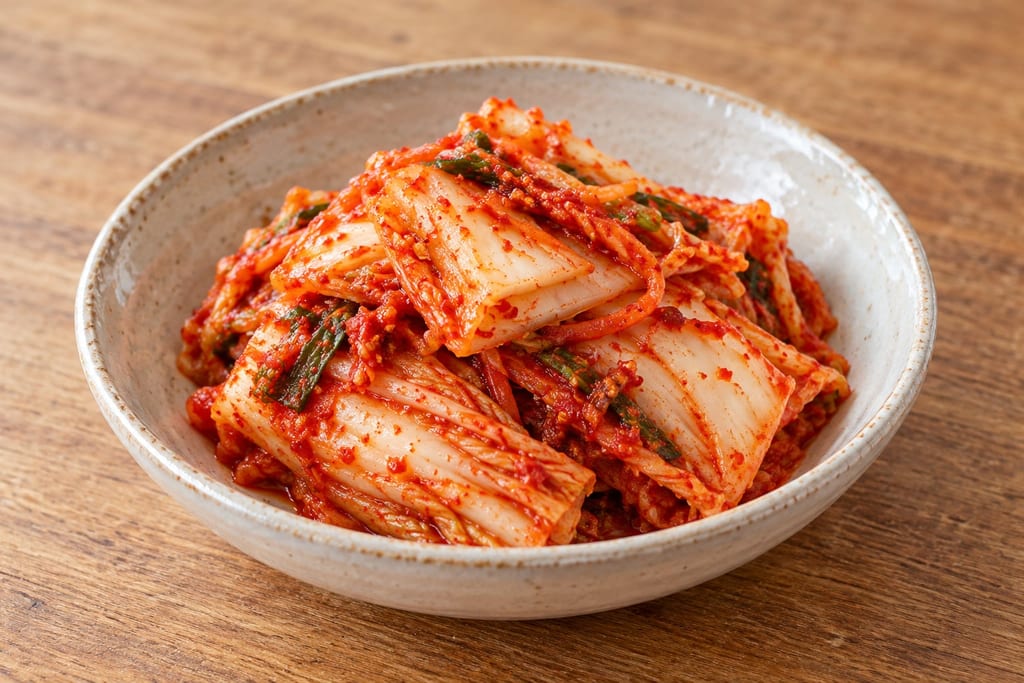
Kimchi
Kimchi is a Korean preserved vegetable food, most often cabbage, salted and seasoned, then fermented by the lactic acid bacteria that arrive with the vegetables. Some studies test added starter cultures, but a home jar is usually spontaneous.
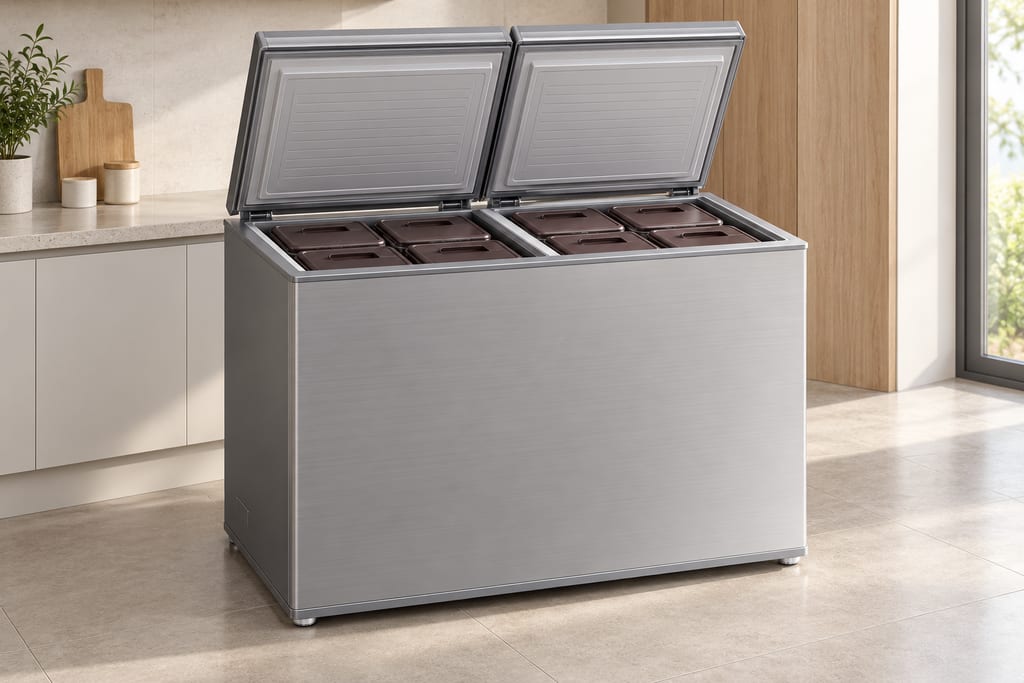
Kimchi refrigerator
A Korean kimchi refrigerator uses separate cooled compartments and removable lidded bins to ferment or hold kimchi. Models vary; it is a modern appliance, not an onggi or buried crock.
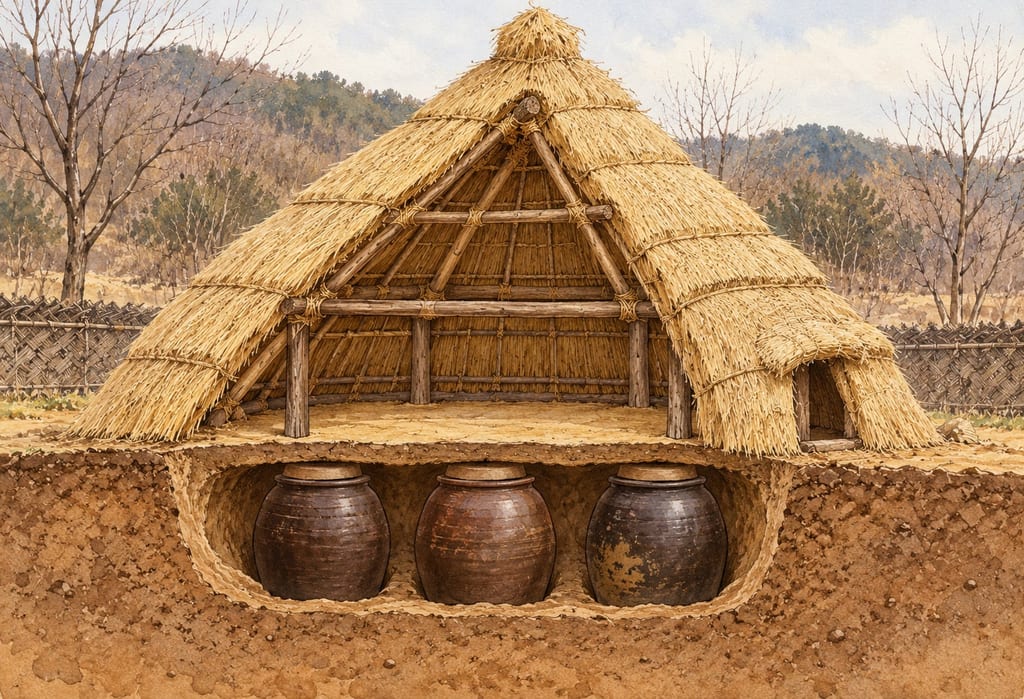
Kimchi-gwang (Korean kimchi storehouse)
A Kimchi-gwang is a small storehouse built over buried kimchi jars. Korean references describe a framed, thatch-roofed shelter with a tight side entrance, mainly in Gyeonggi-do.
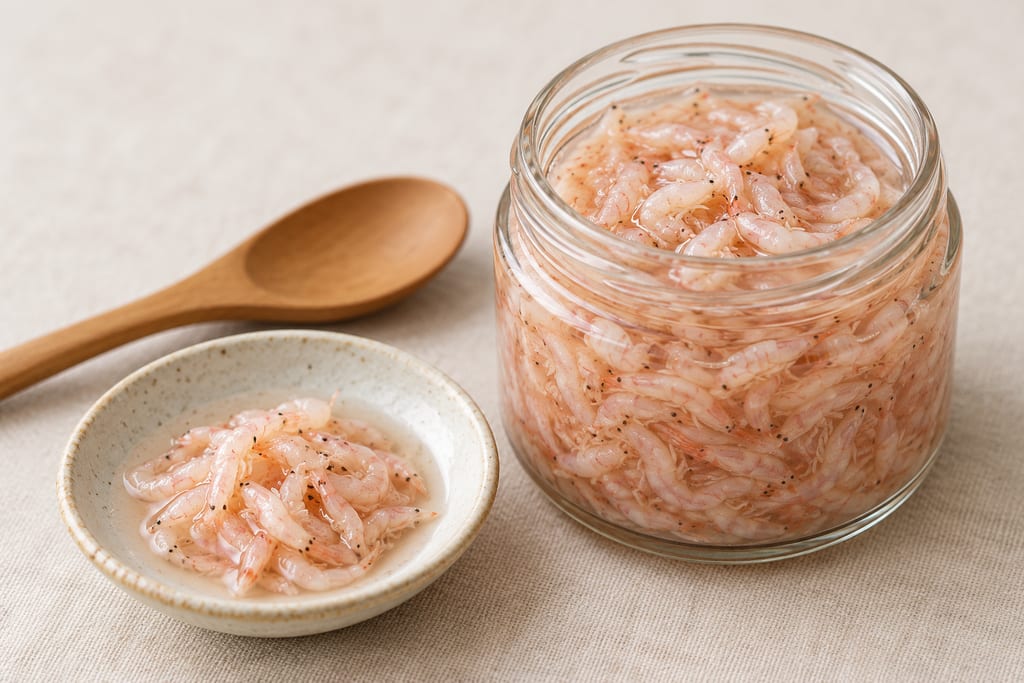
Saeujeot (Korean salted fermented shrimp)
Korean fermented seafood made by salting whole small shrimp and maturing them in their own brine, used as a seasoning, in kimchi and with pork.
Community
No community contributions have been published for this entry yet.
Share what you made
Sign in to contribute. Published comments and photos are free to read.
Sources
UNESCO Intangible Cultural Heritage
Kimjang, making and sharing kimchi in the Republic of KoreaCited in: What was kimjang?; What replaced the hole in the ground?; The jar in the yard
Encyclopedia of Korean Culture, Academy of Korean Studies
김치 (Kimchi)Cited in: Four sizes of jar; What did the 1766 book change?; Where did the chilli come from?; What was kimjang?; What went into the jars?; Why bury the jar?; What makes a good onggi?; What happens inside a buried jar?; What replaced the hole in the ground?; The jar in the yard
Encyclopedia of Korean Culture, Academy of Korean Studies
김치 담그기 (Kimchi making)Cited in: What did the 1766 book change?; What was kimjang?; What went into the jars?; The jar in the yard
Joseon Wangjo Sillok Wiki, Academy of Korean Studies
침채 (沈菜)Cited in: Four sizes of jar; What did the 1766 book change?; What was kimjang?; What went into the jars?; Why bury the jar?; The jar in the yard
National Institute of Korean History
우리역사넷: 고추와 김치Cited in: What did the 1766 book change?; Where did the chilli come from?
National Institute of Korean History
Earthenware (The Story of Culture and Arts)Cited in: Why bury the jar?; What makes a good onggi?
Critical Reviews in Food Science and Nutrition 34(2):175–203, 1994 (Cheigh HS and Park KY)
Biochemical, microbiological, and nutritional aspects of kimchiCited in: What happens inside a buried jar?
Journal of Microbiology 46(5):590–593, 2008 (Lee D, Kim S, Cho J and Kim J)
Microbial population dynamics and temperature changes during fermentation of kimjang kimchiCited in: What happens inside a buried jar?
Journal of Ethnic Foods, 2015 (Kwon DY and colleagues)
History of Korean gochu, gochujang, and kimchiCited in: Where did the chilli come from?
Journal of the Korean Society of Food Science and Nutrition 41(11), 2012
Comparison of fermentation properties of winter kimchi stored for 6 months in a kimchi refrigerator under ripening mode or storage modeCited in: What replaced the hole in the ground?
Colorado State University Extension
Understanding and Making KimchiCited in: What replaced the hole in the ground?
Gaps
- Nongga wollyeongga is dated 1816 by the Encyclopedia of Korean Culture and about 1819 by the Sillok wiki; other accounts place it in the 1840s.
- No source read here gives volumes for the four jar sizes or household quantities for an eighteenth-century kimjang.
- The claim that onggi walls breathe is stated by the National Institute of Korean History but not measured in any source read here.
- The Japanese-introduction account of chilli and the opposing case for native gochu were read in summary and abstract only.
Updated 2026-10-30