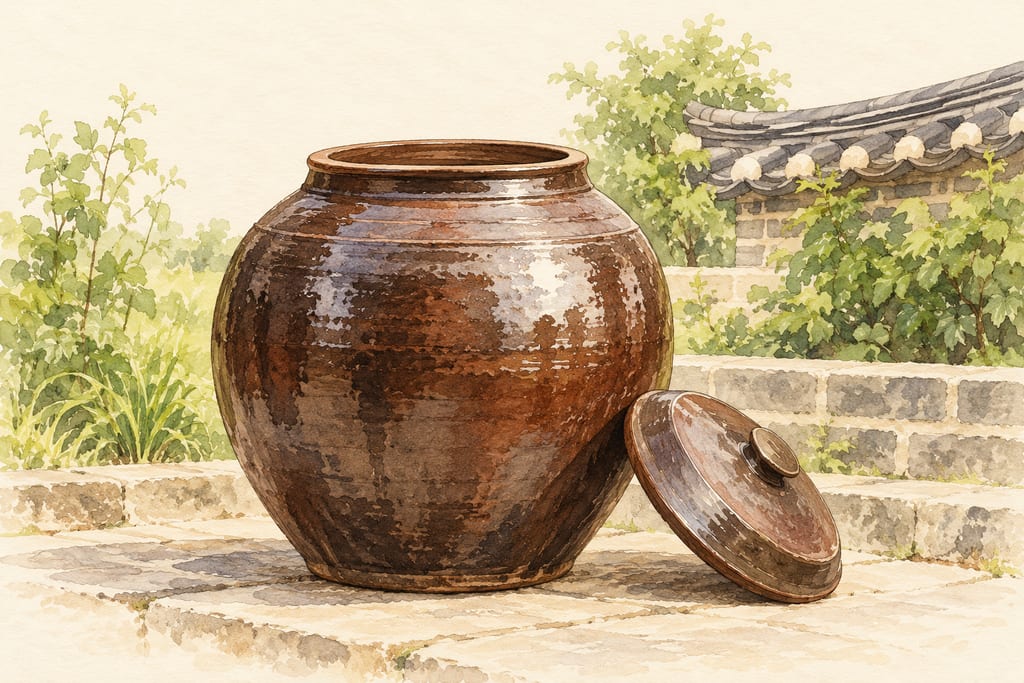
Onggi
Korean earthenware jars, glazed or unglazed, used to ferment and store kimchi, soy sauces and pastes. Their form and wall properties vary with the potter, firing and intended use.
 FermenteaWhere food goes to change
Equipment · Jars, pots and crocks
김장독 땅 묻기
A traditional Korean onggi used in winter kimjang for kimchi storage could be buried to moderate temperature. The sources support the practice but not one standard burial depth or jar profile.
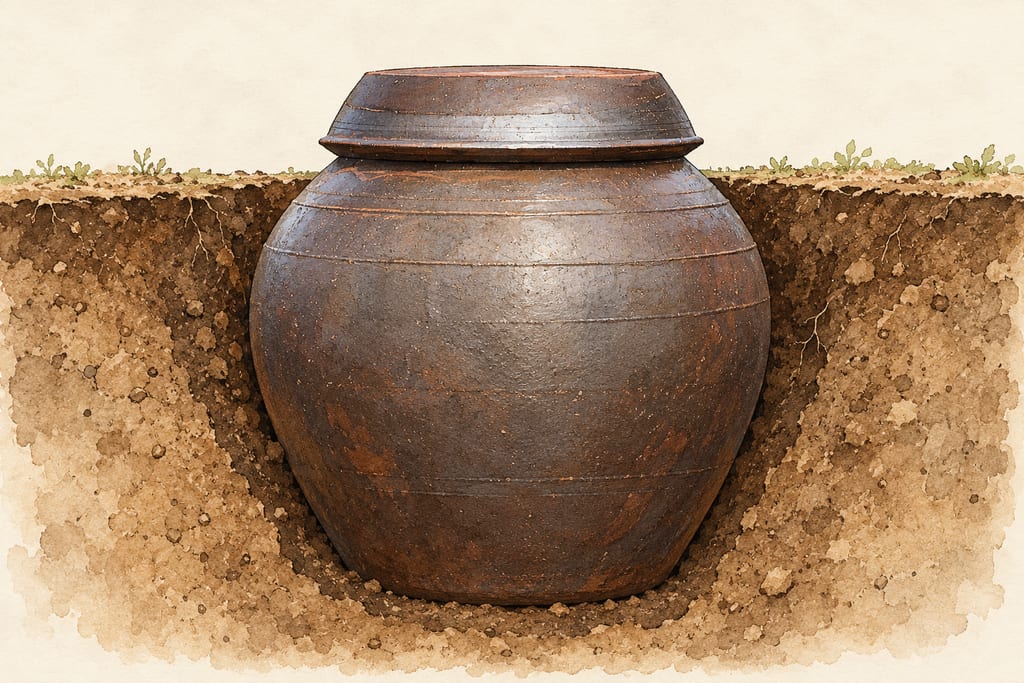
Kimjang prepares kimchi for the winter months. In Korea, some large earthenware jars used for winter kimchi were placed underground so the contents would remain cold through the season. The British Museum notes that large onggi jars were sometimes buried to keep pickled kimchi cold, and UNESCO’s Kimjang materials include a photograph captioned as burying a kimchi jar for winter. These references support burial as a real practice, not as a universal rule for every kimchi or every Korean household.
The Smithsonian’s field monograph adds an important geographic qualification: apart from the southernmost provinces, where winters are milder, winter kimchi jars were seldom placed on the jangdokdae outdoor platform. They were buried or kept in basements and kitchen storage rooms. Thus a jar standing above ground in a courtyard and a jar placed for winter storage represent different settings. The sources support no single solution across Korea.
Onggi is Korean earthenware used for domestic food storage. The British Museum’s dated example is a large lidded, glazed, high-fired jar made in Korea between 1875 and 1925. It measures 97.7 centimetres for the body and 113.8 centimetres with its lid, but this is one museum object, not a specification for all kimchi jars. The Smithsonian study also cautions that jars for kimchi were not interchangeable in use with jars for sauces and grains.
A cutaway illustration can explain the documented placement: soil surrounds the buried body while the opening and lid remain available at the surface. It is an interpretive diagram of the relationship between vessel and ground, not a measured reconstruction. The sources do not establish an exact burial depth, a single amount of exposed jar, or a universal lining or insulation. The illustration therefore leaves the boundary approximate and avoids showing a specific shelter or straw covering.
These sources document the material tradition and historical winter use, but they do not give a standard capacity, supplier, current commercial reach, or maintenance routine. They also show regional and household variation: some winter kimchi jars were buried, while others were stored in basements or indoor rooms. Nothing here establishes a precise thermal performance or a modern food-safety procedure.
The item is the earthenware vessel. The earth around it is part of a documented storage setting, not an additional feature built into every jar. These sources describe winter kimchi storage as a practice with regional and household variation; they do not establish one vessel or placement for every kimchi.
The cited sources describe Korean onggi and winter kimchi storage. They do not localize a single burial method to a specific locality.
Korean earthenware jars, glazed or unglazed, used to ferment and store kimchi, soy sauces and pastes. Their form and wall properties vary with the potter, firing and intended use.
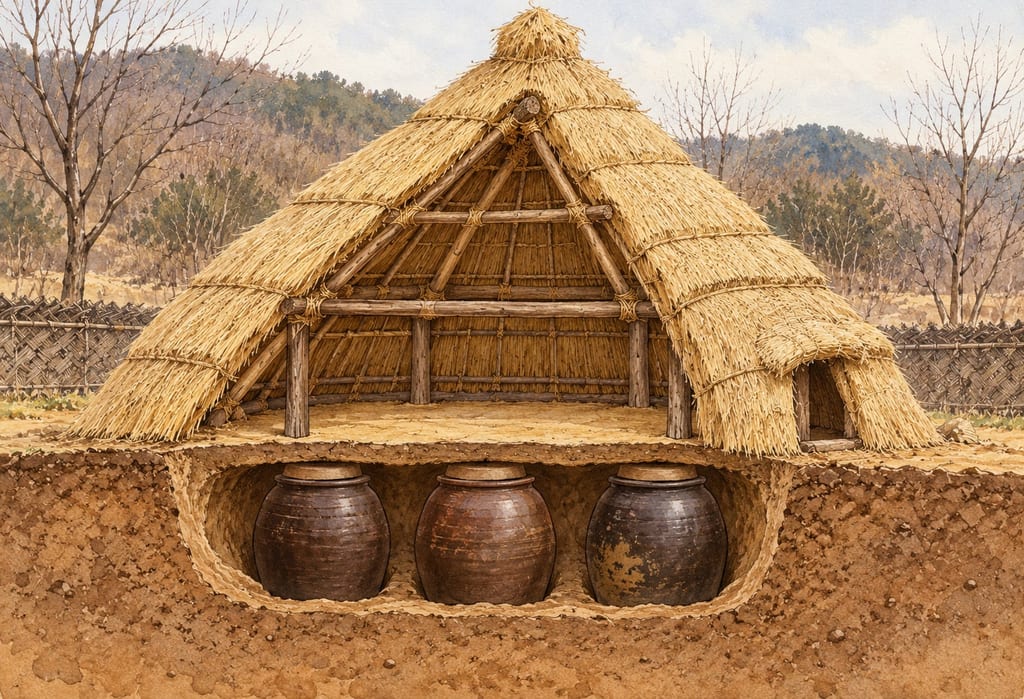
A Kimchi-gwang is a small storehouse built over buried kimchi jars. Korean references describe a framed, thatch-roofed shelter with a tight side entrance, mainly in Gyeonggi-do.
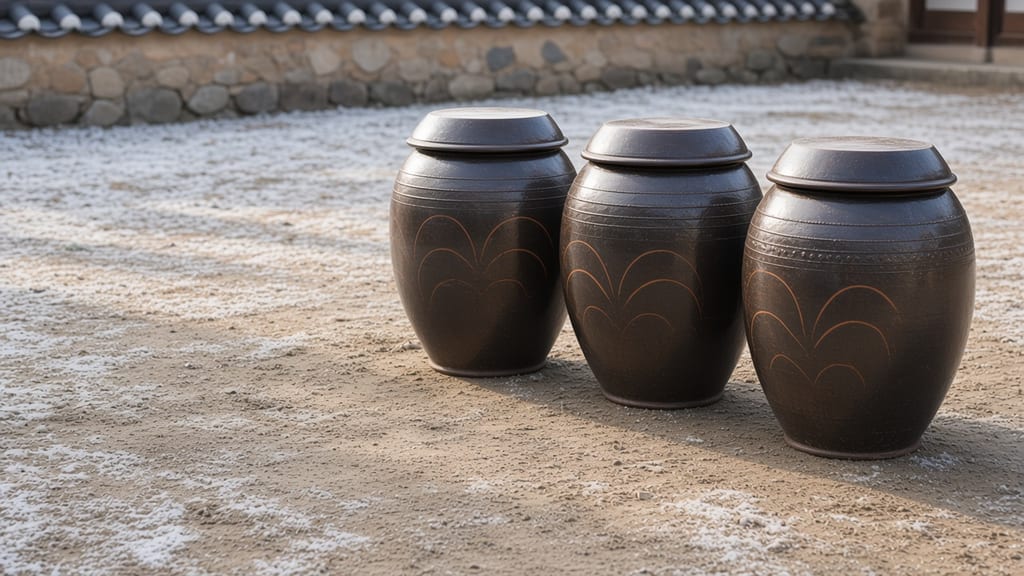
In 1766 chilli entered a Korean kimchi recipe for the first time. Joseon households made winter kimchi in late autumn and kept it in onggi jars buried in straw, at a few degrees above freezing until spring.
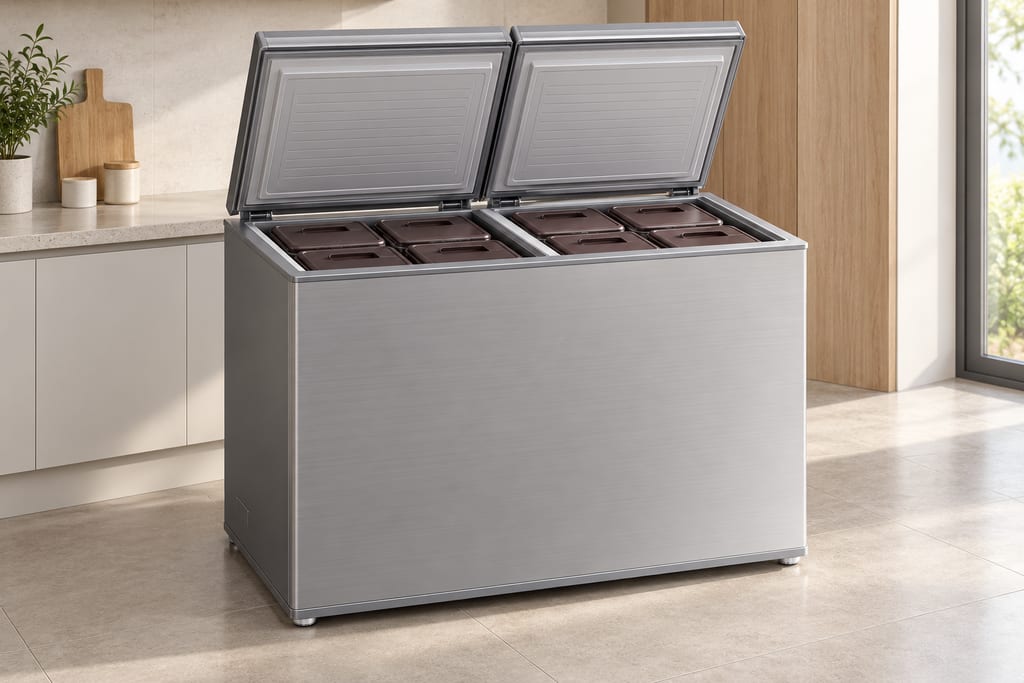
A Korean kimchi refrigerator uses separate cooled compartments and removable lidded bins to ferment or hold kimchi. Models vary; it is a modern appliance, not an onggi or buried crock.
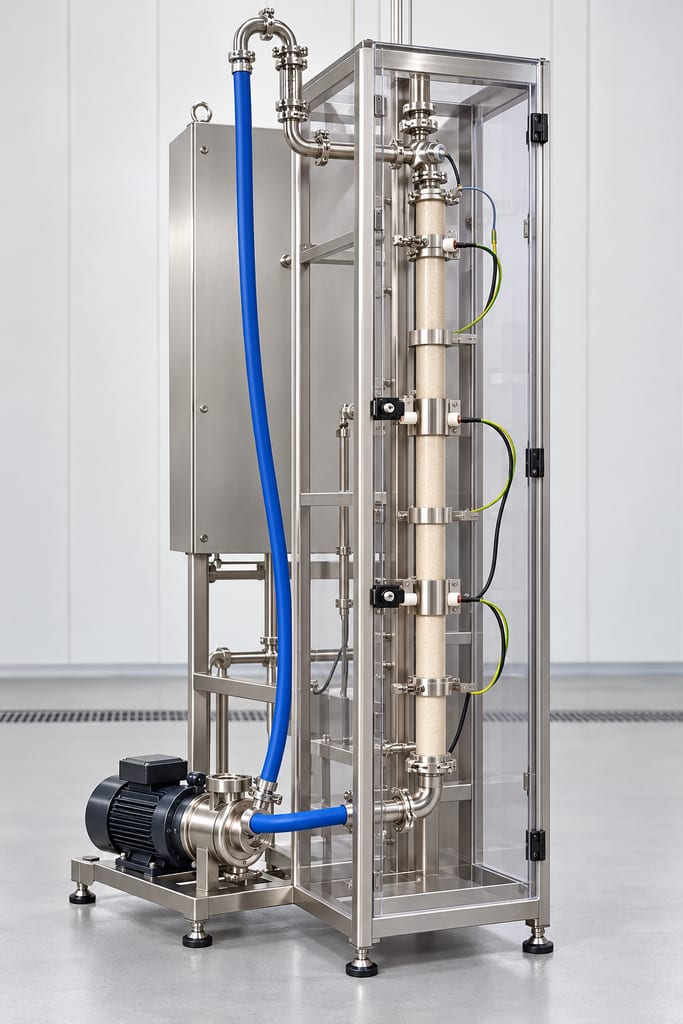
An ohmic heater passes electric current through conductive food so electrical resistance generates heat inside the product.
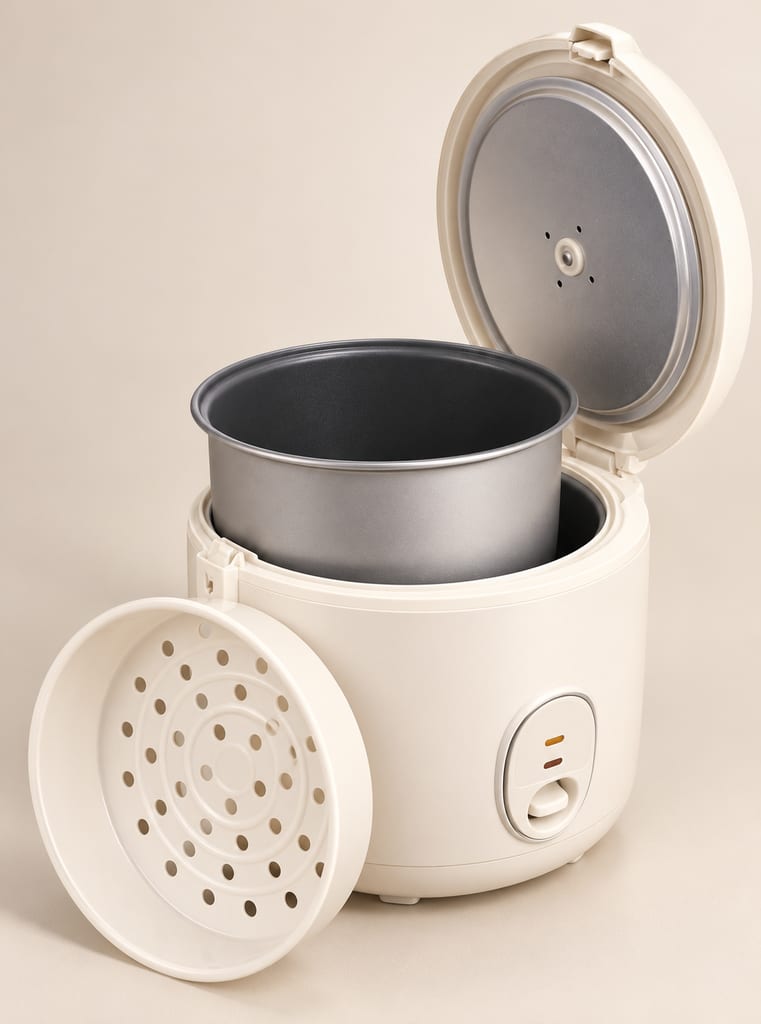
A modern electric pot that cooks rice and may provide a model-specific keep-warm stage. Documented Japanese and Korean recipes use it for koji amazake, sikhye and ssal-jocheong; measure warm settings rather than assume.
No community contributions have been published for this entry yet.
Sign in to contribute. Published comments and photos are free to read.
The British MuseumObject description · Materials · Dimensions · Use
jar (옹기항아리 甕器缸), 1990,1114.9.a-bThe museum describes this Korean onggi as glazed, high-fired earthenware, made in Korea and dated 1875–1925.
The object is 97.7 cm high as a body and 113.8 cm including lid; its mouth is 37 cm across.
The curator notes that large onggi were sometimes buried to keep pickled kimchi cold.
Cited in: Winter storage and regional setting; Vessel form and an explanatory cutaway; Limits of the record
Smithsonian Institution, Smithsonian Folklife StudiesTraditional use · Regional variation · Form
The Korean Onggi PotterThe Smithsonian study records Korean domestic onggi food jars and documents fieldwork in six South Korean provinces.
The monograph explains that true winter kimchi jars, except in the mildest southern provinces, were seldom on jangdokdae; they were buried or kept in basements and kitchen storage rooms.
The same source distinguishes jars used for kimchi from sauce and grain jars, warning against treating every household jar as a kimchi jar.
Cited in: Winter storage and regional setting; Vessel form and an explanatory cutaway; Limits of the record
UNESCO Intangible Cultural HeritageContext · Winter storage
Kimjang, making and sharing kimchi in the Republic of KoreaUNESCO's Kimjang materials describe burying a jar of kimchi to sustain a household through winter; the image caption credits the Cultural Heritage Administration of Korea, 2013.
Cited in: Winter storage and regional setting; Limits of the record
Korea.net, official website of the Republic of KoreaTerminology · Regional variation · Traditional use
Onggi, traditional earthenware vessel in KoreaThe article says larger kimchi dok were buried or partly buried for aging and storage until spring, while smaller kimchi danji were used in warmer months.
It supports burial as a documented Korean practice, not a universal placement or precise depth.
Cited in: Winter storage and regional setting; Limits of the record