Current flows through the food
An ohmic heater makes the food part of an electrical circuit. Electrodes contact the product, and an applied current passes through its conductive liquid or mixture. The food’s electrical resistance converts electrical energy into heat by the Joule effect. This is why the method is also called direct electrical resistance heating. Unlike a jacketed kettle or an indirect heat exchanger, the central heating action takes place within the product instead of beginning at a hot wall and moving inward.
The term describes a family of processing systems rather than one standard machine. Ohmic equipment may hold a batch between electrodes or pump food continuously through an electrode-equipped chamber. Reviews place investigations of food ohmic heating as far back as the nineteenth century, but the available evidence does not settle a single inventor, first commercial unit or country of origin. Current examples range from research rigs to manufactured continuous-flow heat exchangers.
Sources for this section
Batch chambers and continuous-flow heaters
In a batch design, a fixed charge of food remains in a chamber while electrodes pass current through it. A chamber can use parallel or curved electrodes, and the vessel may include stirring. A 2021 study at Chungnam National University describes a batch ohmic-vacuum system with a polymer chamber, a pair of curved stainless-steel electrodes, an overhead stirrer and a separate power supply. It is a specific experimental assembly, not a universal shape for batch heaters.
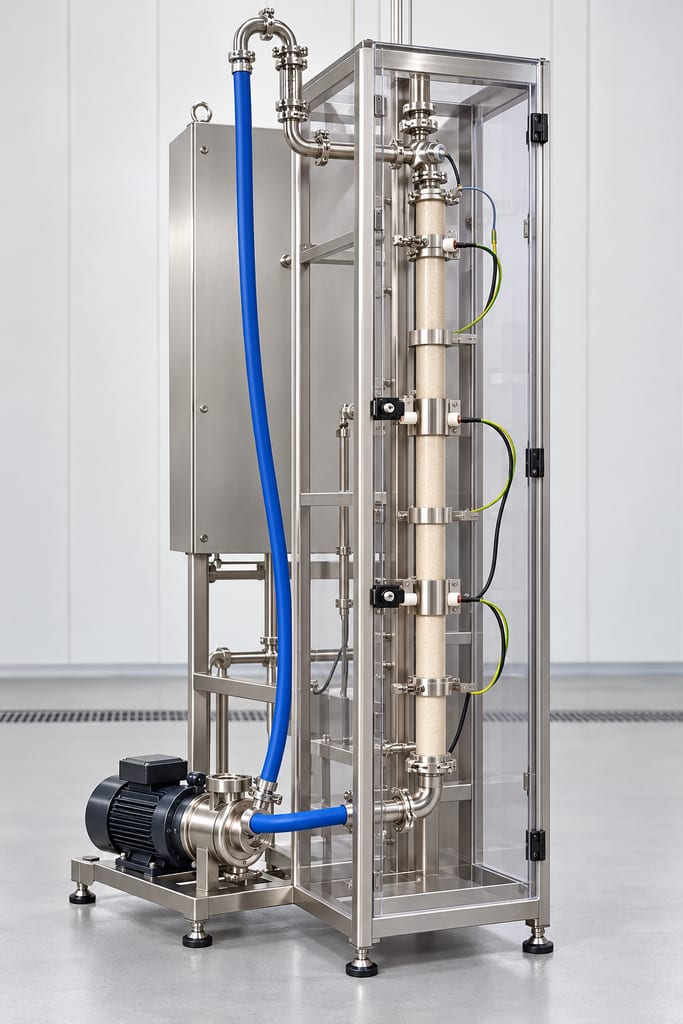
A continuous-flow system instead moves product through a treatment chamber with a pump. One Sheffield Hallam University pilot used three electrodes arranged along a long PEEK-insulated chamber: the middle electrode divided the path into two heating sections. The plant also had feed and collection tanks, a pump, temperature probes and a control system. Its chamber was reported as 1.5 metres long and 2 centimetres in diameter; those dimensions describe that research unit alone. A separate Czech Technical University page documents another continuous rig, with perforated electrodes and different flow paths. The contrast matters: the name refers to how heat is produced, not to one geometry or production scale.
Sources for this section
Conductivity shapes heating
The food’s electrical conductivity affects how readily current flows and how quickly heat is produced. Water and dissolved ions contribute to conductivity, while a formulation’s salt, acidity, structure and temperature can change it. In a 2024 tomato-basil-sauce pilot, the authors report that salt and ionic spices raised the sauce’s conductivity despite its olive oil. That observation belongs to this formulation; it does not mean every sauce, particle or oil-containing food will behave alike.
A liquid with suspended pieces is more complicated than a uniform liquid. Solid and liquid phases may conduct differently, so the electric field and temperature can vary across the product. Research on multiphase food has measured temperature differences between its solid and liquid portions; agitation or other system changes can affect those differences. Ohmic heating can generate heat throughout a conductive product, but that does not guarantee identical temperatures everywhere. Product composition, particle size, electrode arrangement and flow all matter when engineers assess a system.
Sources for this section
Electrical power needs process control
An ohmic line needs more than electrodes. The power supply sets the electrical input; a flow system also needs a pump, a treatment chamber and instruments that measure the product and operating conditions. Depending on the design, temperature probes, flow measurement and automated controllers can adjust power as product conductivity or inlet conditions change. The research rig at Sheffield Hallam University used optical-fibre temperature sensors, thermocouples and a programmable controller alongside its three-electrode chamber.
That team used tomato-basil sauce to compare several control approaches in a pilot run. The experiment held the flow at 1 litre per minute and targeted an outlet temperature of 90°C; controllers were evaluated over six-minute operations. Those figures describe a particular study, not a recipe or a safe schedule for another product. The authors identify holding tubes and further lethality assessment as future work. A heater’s ability to warm food is not, by itself, evidence that a specific product has received a validated pasteurization or sterilization treatment.
Sources for this section
Food uses and process boundaries
Manufacturers list ohmic systems for pumpable foods such as soups, sauces, purées and fruit preparations, including products with suspended pieces. JBT Marel currently lists its Sterideal Ohmic heat exchanger and describes use with liquid, semi-liquid and viscous products. A JBT report also places its product in a Parma technology centre for customer testing. These examples establish current commercial equipment and applications; they do not establish one capacity, cost or formulation suitable for every installation.
Ohmic heating is a thermal process: the current is used to heat food. It is distinct from pulsed-electric-field treatments that use brief, high-field pulses for different purposes, and from microwave heating, where electromagnetic energy couples to the product. It can be integrated into a wider process line, but downstream holding, cooling and product-specific process design remain separate engineering decisions. One manufacturer’s product name or pilot result should not be read as a general process guarantee.
Sources for this section
Electrode materials, limits and documented places
Electrodes must conduct electricity while remaining compatible with the food and the operating conditions. Published designs use different electrode materials, including stainless steel and titanium-based materials. Reactions at electrodes and electrode erosion are recognized engineering concerns; fouling and uneven residence times can also affect operation in some continuous systems. These are reasons that the chamber, electrode material, frequency, flow and controls are selected together, rather than assuming that any conductive mixture can be heated uniformly in any machine.
The contemporary examples are tied to documented research, not to traditional food-use territories. A tomato-sauce continuous-flow pilot was studied at Sheffield Hallam University in the United Kingdom; a separate batch system was studied by researchers at Chungnam National University in South Korea. A JBT Marel report identifies a customer-testing technology centre in Parma, Italy. These country-level records show where modern equipment or research is documented. They do not claim that ohmic heating originated in any of these countries.
Sources for this section
History
A 2024 technology review says food-preservation research on ohmic heating dates to the nineteenth century, but the sources consulted do not identify a single inventor, first machine or place of origin. Current examples include research pilot plants and a commercially listed continuous-flow heat exchanger.
Equipment details
SizeNo type-wide dimensions are established. One 2024 pilot heating chamber was 1.5 m long and 2 cm in diameter; that measurement describes its chamber only.
PowerElectric Alternating current is used in documented systems. Voltage, frequency and power are designed for the product and equipment; the 10 kW figure in a 2024 study is the ceiling of one pilot plant, not a standard rating.
How you get oneBought, manufactured JBT Marel currently lists the Sterideal Ohmic heat exchanger as a commercial product. Configuration, throughput, price and suitability are supplier- and product-specific; no general specification applies to every ohmic heater.
Made of
- Insulating polymer chamber — Contains the food between electrodes in some designs
A 2024 continuous-flow pilot used a PEEK chamber; other chamber designs vary. - Food-contact electrodes — Transfer current into the conductive food
One 2024 pilot described titanium oxide electrodes; a 2021 batch research system used stainless-steel electrodes. These are examples, not a single required material. - Conductive food — The electrical load in which heat is generated
The food's electrical conductivity depends on its composition and temperature; suitability is formulation-specific.
Places
United Kingdom
Documented use · Country evidenceA continuous-flow pilot was studied at Sheffield Hallam University; this documents modern research, not the method's origin.
South Korea
Documented use · Country evidenceA batch ohmic-vacuum apparatus was studied by researchers at Chungnam National University; this is not an origin claim.
Italy
Documented use · Country evidenceJBT Marel reports customer testing at its Research Technology Center in Parma; this records a specific modern test site.