
Programme
A wound on a clock: how potatoes, yams and cassava heal after harvest
Every root crop is cut and bruised at harvest, and each gets a short window to seal the damage. The heat, the humidity and the days differ by crop, and for cassava the benefit is still argued over.
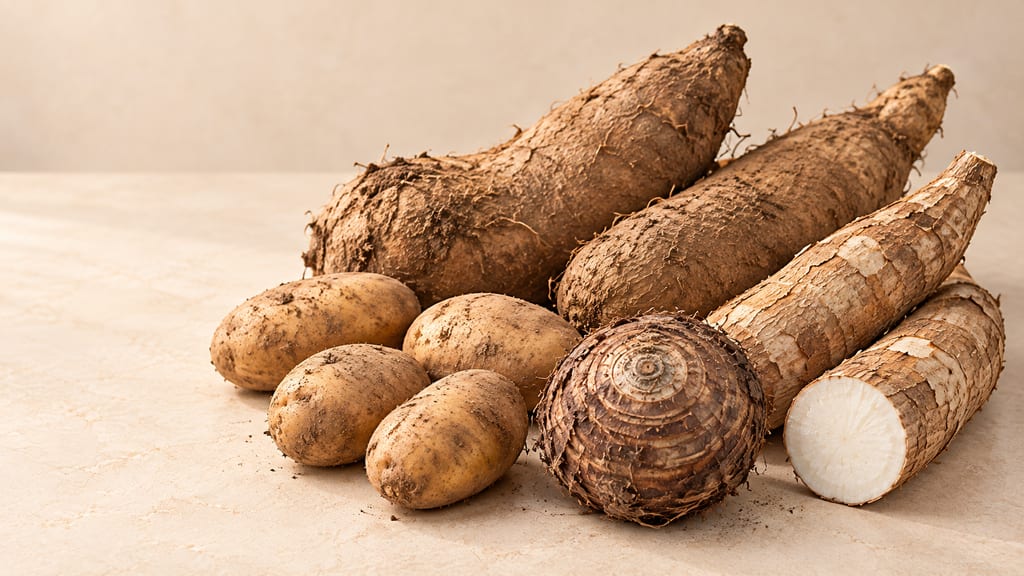
Potato, yam, cassava and a taro corm: four root crops that each heal their harvest wounds on a different schedule.
A clock that starts at harvest
Dig up a cassava root and a clock starts. Deterioration can begin as quickly as 24 hours after harvest, and most varieties have spoiled within three to four days. The root has not been left in the sun or forgotten in a heap. It has only been lifted, and lifting damages it: cut ends, knocks and abrasions, the mechanical damage that cassava deterioration is strongly associated with.
Every root and tuber crop takes that kind of damage at harvest, and most can answer it. Held warm and humid for several days, a wounded tuber grows a new protective layer of cells over the injury. That is curing. Potato, yam, cassava and cocoyam all get the treatment in one form or another, but the heat, the humidity and the number of days differ so much that no single 'tuber' setting suits them all. The evidence behind each crop differs as well, and for cassava and cocoyam it is thinner than the tidy tables suggest.
How a tuber closes a wound
A wounded tuber does not wait for rot to arrive. Cells at the wound suberize, which means they deposit suberin, a protective coating built from phenolic and fatty-acid compounds. Beneath it a cork cambium forms and grows new protective tissue. Warmth and humidity are what curing supplies, and a store or enclosure that holds both is how it is done.
In potato the repair runs in stages, and each stage protects against different organisms. In experiments at 18 °C and 98% relative humidity, tubers became resistant to the soft-rot bacterium Erwinia carotovora once the phenolic part of the suberin was in place, after about 2–3 days. Resistance to the fungus Fusarium sambucinum came only after the fatty-acid part (the aliphatic part) was laid down, after 5–7 days. A wound is not protected against everything at once.
Age matters too. The older the tuber, the less well a wound heals.
Potato: cool, damp and patient
Potato is cured cooler than the tropical crops: about 15–20 °C for five to ten days. The humidity figure depends on where you look. One FAO chapter gives 90–95% relative humidity and another gives 85–90%, so the honest range is 85–95%. The same chapter adds that in practice the curing period generally runs from 5 to 20 days.
Curing ends and storage begins, and the store temperature is a separate choice. At 4 °C sprouting stops while rot and respiration continue at low levels. At 10 °C sprouting, rot and respiration are all moderate. A sprout suppressant, if one is used, goes on only after curing is finished. In the tropics, holding potatoes at 10–15 °C generally needs refrigeration.
Sweet potato is a different plant with its own, warmer curing regime, and it is not covered here.
Yam: cure first, then let it breathe
Yam is cured hotter and damper than potato: about 32–40 °C at 90–100% relative humidity. The FAO table gives one to four days, and its field notes say a yam stack should be left for about four days. A programme working on yam storage in West Africa gives a much longer figure, holding tubers under high humidity for 10–14 days before moving them to a more ventilated, lower-humidity store. The two figures do not agree.
On-farm trials on white yam in Ghana between 2000 and 2003 put limits on the heat. Ordinary ambient temperatures proved sub-optimal, and temperatures above 37 °C were too high, which is below the top of the FAO range. Pits, clamps and modified rooms held enough humidity to bring about curing. Plastic bags were excessive and caused rapid rotting, and pits did better than barns. The trials concluded that curing can be set up in communities with few resources.
The yam barn
Once cured, yam needs air. The traditional answer is the yam barn: a vertical or nearly vertical wooden framework to which the tubers are fastened one by one with string. Frames are usually 1–2 metres high and can reach 4 metres, built from poles 5–10 centimetres thick set about a metre apart. Short exposure to the sun may help curing, but for long storage the tubers must be shaded from direct sunlight.
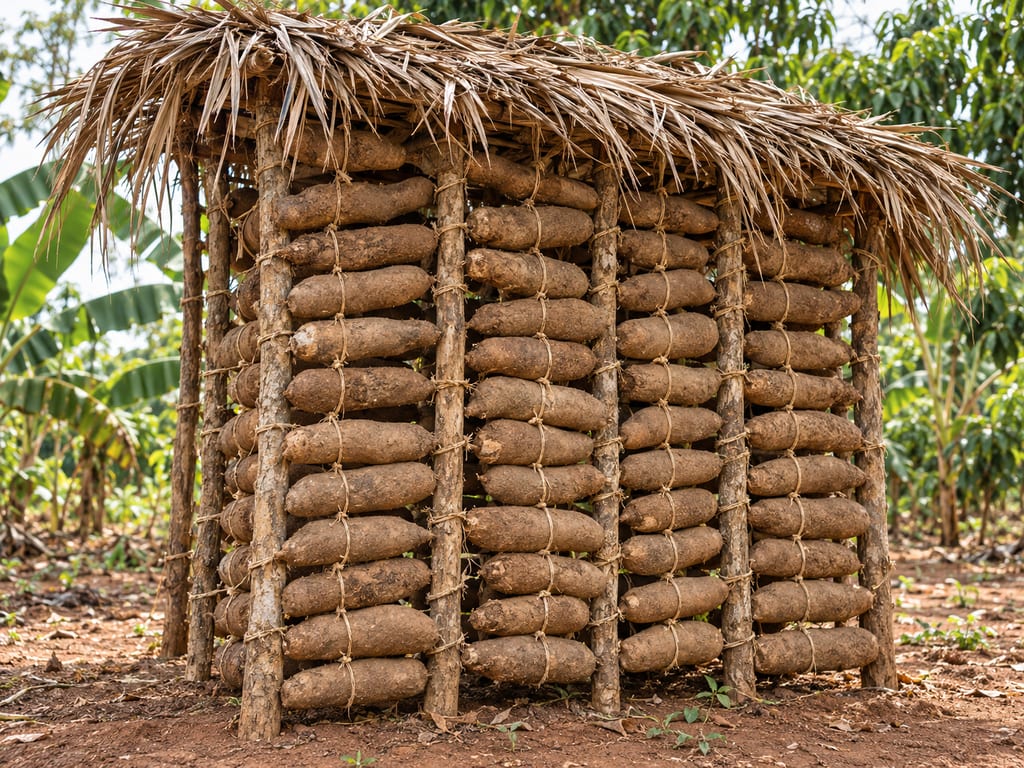
The design rules are plain: adequate ventilation, a way in to inspect each tuber, and protection from the sun. The West African storage advice adds two more: cover the tubers with woven sacking, and avoid condensation, because condensation promotes rot growth. On research stations that combination of humid curing followed by a ventilated store cut losses by more than 15%. On-farm trials in Ghana and Nigeria were at an early stage, with a reduction of about 10% anticipated, and the CSIR Crop Research Institute has adapted wooden barns using local materials.
Cassava: does curing help?
The FAO table gives cassava about 30–40 °C at 90–95% relative humidity for two to five days. The cassava literature gives different timings for the wound itself. A wound periderm formed around v-shaped cuts within four to seven days at 35 °C in one trial from 1976, and in seven to nine days at 35 °C or 10–14 days at 25 °C in another from 1985. The FAO's cassava text says that forming this periderm, curing in other words, has been found to suppress physiological deterioration. The researcher behind the 1970s work also reported that curing prevents the onset of the primary deterioration and reduces secondary losses, and recommended a separate curing stage in simple field clamps or boxes packed with moist material.
The problem is the clock from the first section. Physiological deterioration, the discolouration that spoils a cassava root, commonly appears within 72 hours of harvest, and discolouration is visible at three days. It is driven by an oxidative burst, a surge of reactive oxygen species in the damaged tissue. A 2023 study found those species more strongly related to deterioration than the wounding itself, and another review notes that wound repair can occur if the root remains attached. Held below 80% relative humidity, roots generally deteriorate throughout the storage tissue within three to four days.
The sources agree that curing can suppress deterioration and disagree about how much of the problem wounding explains. A periderm takes four to fourteen days to form, which is slower than the deterioration that can start in one to three days. Whether curing mainly protects tissue that has not yet turned, or can also hold back damage already under way, is not settled, and the controlled trials behind the periderm figures are decades old. Storing cassava in plastic bags with a fungicide extends storage to about two weeks, which shows how short the window is even with help.
Cocoyam: the gap in the table
Cocoyam is missing from the FAO's curing tables. In West Africa the name usually means one of two related plants, taro (Colocasia) or tannia (Xanthosoma). Figures for taro exist, but they disagree with one another and most cannot be tied to a named plant, so none is given here. Anyone setting up a cabinet for cocoyam should begin with a trial on their own crop rather than borrow a target from yam or potato.
What a store has to do
The four crops want different things. Potato needs about 15–20 °C, while cassava and yam need 30–40 °C. A cabinet for mixed roots therefore needs separate zones or separate runs, with a controller that can hold each target. Air movement and the way crates are packed matter as much as the set point, because condensation trapped against the roots promotes rot.
The practical test is the crop itself. Record the harvest timing, the wounds and the loss after storage, and compare them with an uncured control. That comparison is also what the literature lacks: for cassava, a recent controlled trial of cured against uncured roots; for yam, an explanation of why one source cures for four days at most and another for up to fourteen; and for cocoyam, any trustworthy curing condition at all.
Related
Discussed in this article
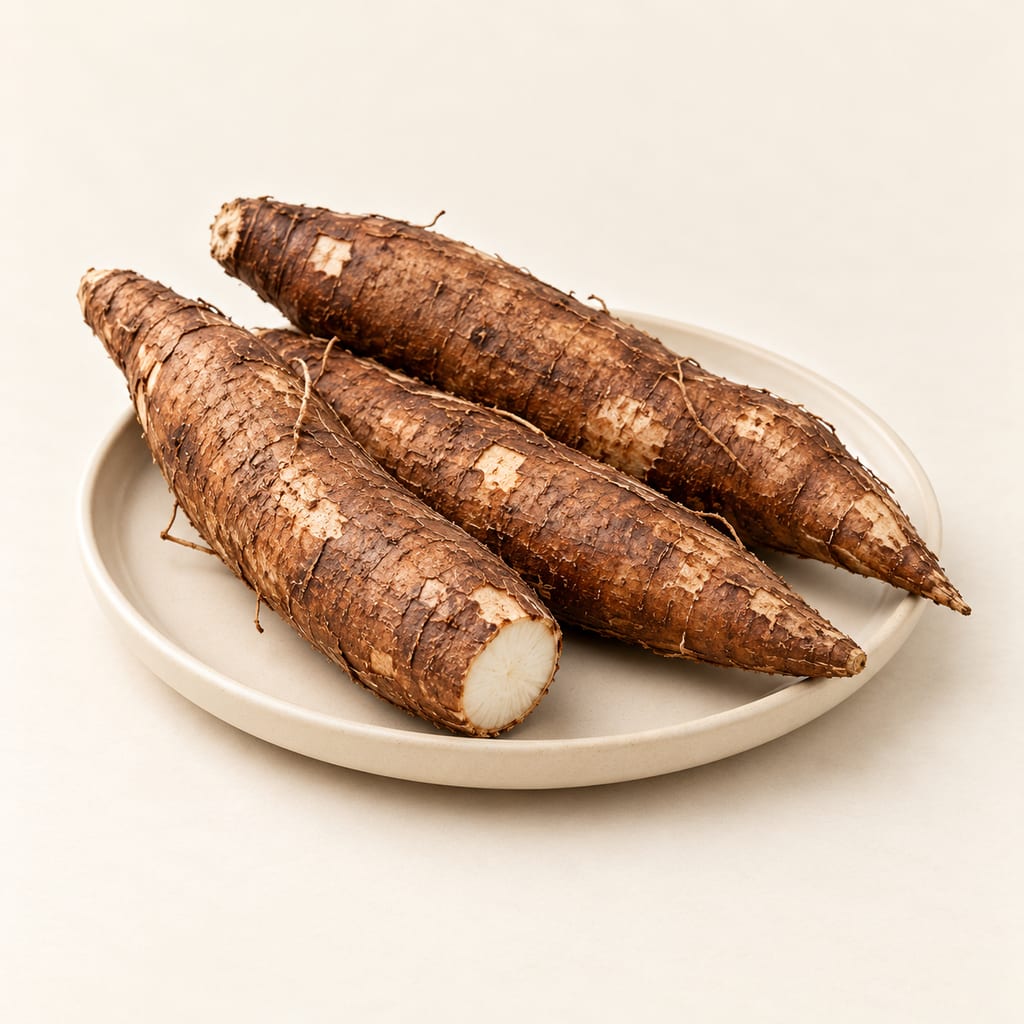
Cassava
Cassava is the starchy root of Manihot esculenta, transformed across Africa into fermented doughs, granules and flours through distinct processes whose safety depends on thorough cyanogen removal.
Community
No community contributions have been published for this entry yet.
Share what you made
Sign in to contribute. Published comments and photos are free to read.
Sources
FAO
Section 2: Curing root, tuber and bulb cropsCited in: A clock that starts at harvest; How a tuber closes a wound; Potato: cool, damp and patient; Yam: cure first, then let it breathe; Cassava: does curing help?; Cocoyam: the gap in the table; What a store has to do
FAO
Chapter 3 - Principles of Storage for Roots and TubersCited in: How a tuber closes a wound; Potato: cool, damp and patient; Cocoyam: the gap in the table
FAO
Post-harvest deterioration of cassava - Physiological deterioration in cassava: biochemistry of the processes involvedCited in: A clock that starts at harvest; Cassava: does curing help?
FAO
Post-harvest deterioration of cassava - General conclusionsCited in: A clock that starts at harvest; Cassava: does curing help?
D. Rees, Natural Resources Institute, University of Greenwich, via the ADM Institute for the Prevention of Postharvest Loss
How understanding the biology of the crop can help us reduce losses of yams during on-farm storage in West AfricaCited in: Yam: cure first, then let it breathe; The yam barn; What a store has to do
Acta Horticulturae 682 (Bancroft, Crentsil, Panni, Aboagye-Nuamah and Krampa, 2005)
The influence of postharvest conditioning and storage protocols on the incidence of rots in white yams (Dioscorea rotundata Poir.) in GhanaCited in: Yam: cure first, then let it breathe; What a store has to do
Physiological and Molecular Plant Pathology (Lulai and Corsini, 1998)
Differential deposition of suberin phenolic and aliphatic domains and their roles in resistance to infection during potato tuber (Solanum tuberosum L.) wound-healingCited in: How a tuber closes a wound
The Plant Journal (Woolfson and colleagues, 2018)
Differential induction of polar and non-polar metabolism during wound-induced suberization in potato (Solanum tuberosum L.) tubersCited in: How a tuber closes a wound
Acta Physiologiae Plantarum (Djabou and colleagues, 2017)
Cassava postharvest physiological deterioration: a complex phenomenon involving calcium signaling, reactive oxygen species and programmed cell deathCited in: Cassava: does curing help?
Frontiers in Microbiology (Wahengbam and colleagues, 2023)
Reactive oxygen species turnover, phenolics metabolism, and some key gene expressions modulate postharvest physiological deterioration in cassava tubersCited in: Cassava: does curing help?
Gaps
- No curing condition for cocoyam was found in the FAO tables, and the taro figures found elsewhere disagree and mostly do not name the plant.
Updated 2026-10-29