
Programme
Three years without the fish: Japan's regional fish sauces
Akita closed its sandfish fishery in 1992 and the sauce makers who relied on it vanished. The story of shottsuru, ishiri and ikanago shoyu, and why no single method describes them.
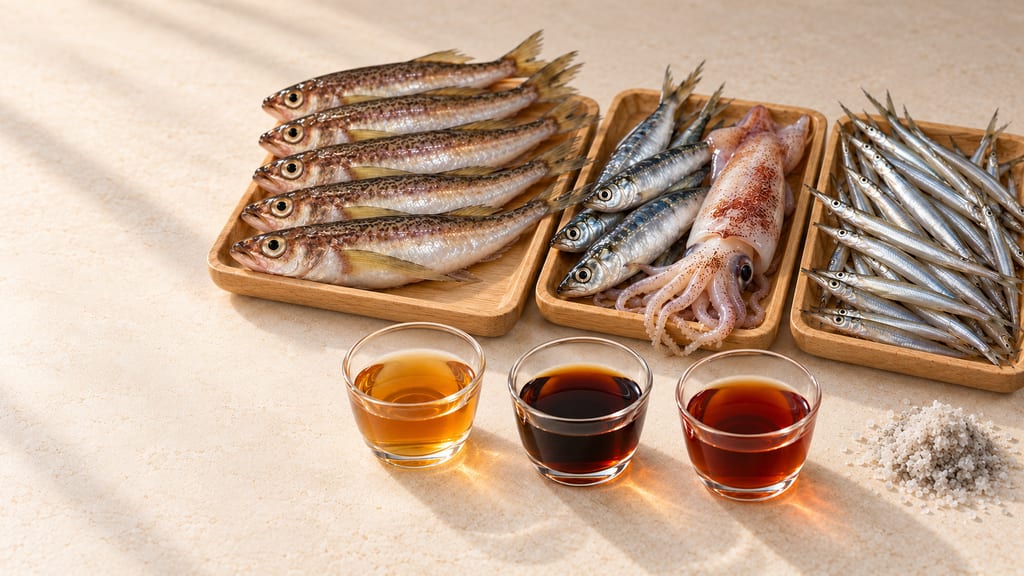
Sandfish, sardines, squid and sand lance, the raw materials of Japan's three regional fish sauces, beside a cup of each sauce.
The fishery that closed
In September 1992 Akita banned fishing for hatahata, the Japanese sandfish. The ban lasted until September 1995. While it ran, the makers of shottsuru who used no other fish disappeared for a time, and as stocks fell the price of hatahata rose.
That episode is a good way into Japanese fish sauce, because the sauce is easy to treat as a single product with a single method. It is not. Shottsuru is counted as one of Japan's three major fish sauces, alongside ishiri, from Noto, and ikanago shoyu, from Kagawa. They start from different fish and different parts of fish, their names overlap, and the accounts of how they are made do not add up to one process. This article keeps the three apart.
Three sauces, overlapping names
Shottsuru belongs to Akita. Its best-known fish is hatahata (Arctoscopus japonicus), the fish at the centre of shottsuru nabe, a hotpot, though the ministry also names other fish. The ministry sets the sauce apart from soy sauce made from grain and from fish pickled in rice.
Ishiri and ishiru are the Noto names, and which one is used depends on the locality. The sauce is made from squid viscera or from whole sardines and other fish. The ministry treats the origin of Noto fish sauce as uncertain. The names do not stay in Noto, either. In Noshiro and Hachimori, in Akita, shottsuru was once called ishiru or ishiro.
Ikanago shoyu comes from Kagawa. Ikanago is the Japanese sand lance, a small fish, and a 1993 article in the Brewing Society's journal discusses the sauce beside the Akita and Noto sauces. Even its name is unsettled. Some accounts describe steeping the fish in a soy-based liquid, a different thing from fermenting fish in salt, so a bottle labelled ikanago shoyu needs its own evidence before it is called a fish-fermented sauce.
How Akita rebuilt its sauce
A 2017 history of shottsuru traces it to the coastal Araya and Hamada area, a place of fishing and salt-making where salted fish broke down on its own. Households in Oga and Tenno made it long ago. Commercial production began around 1985, and some low-quality product circulated. From 2002 a research centre supported makers aiming at a better sauce.
The range of fish has widened since. Commercial shottsuru now comes from char at Kakunodate, cod at Nikaho and horse mackerel at Kazuno, as well as hatahata. A newspaper report from 2018 adds that many commercial products use blue-skinned fish such as mackerel, sardine and saury. It lists the pressures on the sauce: changing diets, a shrinking customer base and catches that rise and fall. In 2016 a Shottsuru Study Group formed to work on quality, uses, sales and a regional brand, with a logo and an application for geographical indication among its aims.
One maker shows how narrow the supply is. At Moroi Jozo in Oga, third-generation president Hideki Moroi began making shottsuru when sales of the firm's miso and soy sauce shrank. In 2018 the firm used only hatahata and salt, and aged the sauce for more than three years. Hatahata is available for about two winter months and the catch itself lasts about three weeks. One tonne of fish yields at most about 500 litres. Output was about 15 tonnes a year, which made shottsuru nearly half of the company's sales. Shottsuru cannot be mass-produced, and it has also been adopted as a potato-chip flavour.
Where the liquid comes from
A salted fish turns into a liquid because its protein is broken down, and salt does not do that work itself. Enzymes do. Some are the fish's own, called endogenous, and a maker can also add enzymes. Salt and the choice of raw material then affect how far the protein is hydrolysed and how many free amino acids are released. Raw material matters here: squid viscera and whole sardines are different starting points, and so are hatahata and sand lance.
The ministry's account of Noto sauce reflects this. It describes different maturation accounts for sardine and squid sauces, followed by drawing off the liquid and further processing. It gives no maturation periods, and it does not claim that every producer heats, filters or matures a sauce the same way. Japanese fishery sources more broadly keep several processes apart: rice-fermented fish, salted products changed by microbes and the fish's own enzymes, reused microbial brines and mould-ripened fish. They should not be collapsed into one.
Salt and time, as each account gives them
Several figures circulate for these sauces. None is a method. Regional accounts put the salt in Akita shottsuru near 20% of the weight of the fish, in Noto squid innards near 18%, and in whole sardines near 20%. These percentages could not be traced to a named producer or to the ministry pages, so they give a rough scale and nothing more.
The most detailed account is a reconstruction of Kagawa producer practice from the 1993 article. It layers three parts ikanago to one part salt by weight, which is about 33% salt relative to the fish, or 25% of the whole mix. After about a week at about 30 °C the mash is mixed from the bottom, then stirred every 5 to 7 days for two months and monthly after that. It stays at about 30 °C for at least six months. The liquid is drained through cloth or lightly pressed and left to settle for several days, then heated to about 90 °C for about two hours, rested, decanted, filtered through diatomaceous earth and bottled.
That describes one producer's work as it was reconstructed. It has not been checked as safe for a household kitchen, and none of the sources sets a safe salt level, pH, temperature or time for making fish sauce at home. Time varies more than salt does: at least six months in the Kagawa account, more than three years at one Akita maker.
What lives in the mash
Two microbiology studies of fish sauce mash do not say which sauce they followed, so none of what follows has been shown for shottsuru or ishiri in particular. They show what can happen in a salted fish mash.
In one, researchers followed a mash for eight months. In the first four weeks counts fell and Staphylococcus species dominated. Between weeks four and six, bacteria that tolerate or need salt multiplied and Tetragenococcus halophilus became the dominant one. By week six, bacteria that do not need salt had fallen away, with Bacillus subtilis the most common of those isolated. T. halophilus went along with more lactic acid and a lower pH.
The same species has a harmful side. In the other study, twelve histamine-producing isolates from a mash holding more than 40 mg of histamine per 100 g were all T. halophilus. The representative strain, FS-4, carries the gene for a histidine decarboxylase, an enzyme that makes histamine. A mash inoculated with it accumulated more than 100 mg per 100 g in 7 days at 30 °C, while a sterile mash, treated with gamma radiation above 10.0 kGy, accumulated none, which points to microbes as the cause. A starter of a different T. halophilus strain, NBRC12172, suppressed the build-up, but only when its biomass was more than 1,000 times that of the histamine producers.
So the same species can help or harm, depending on the strain. Smell and taste cannot tell you which, and neither study is a guide to making fish sauce at home.
At the table, and what is still unknown
In the kitchen the sauces work as seasonings. Ishiri goes into hotpots, simmered seafood and shellfish dishes, dipping sauces and pickled vegetables, and shottsuru has its own hotpot. Shottsuru has a documented Akita history, makers who can be named and a record of what happened when the fish ran short.
Much remains open. There is no verified producer specification for Akita or Noto and no household procedure for any of the three. The ikanago sauce lacks a settled account of which products are fish-fermented and which use prepared soy sauce. For now, the safest reading is that Japanese fish sauce is a set of regional practices, each tied to its fish and to its people, and that a figure from one cannot be carried to another.
Related
Read more
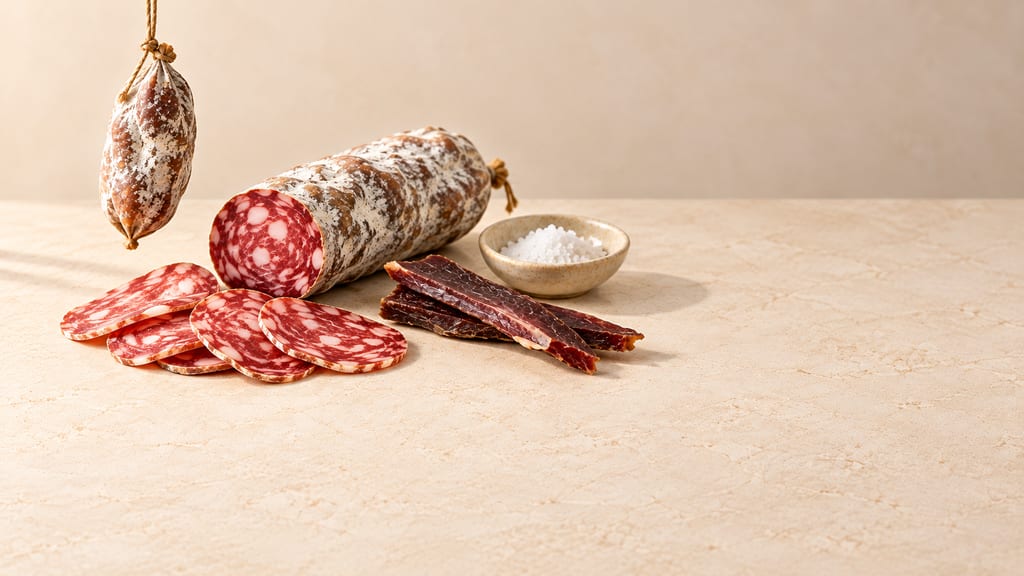
Fermented meat around the world
Dry salami, sour pork with rice, matured sheep and aged blubber follow different paths from animal to food. Their stories connect microbes with climate, slaughter, migration and the meals people share.
Community
No community contributions have been published for this entry yet.
Share what you made
Sign in to contribute. Published comments and photos are free to read.
Sources
Ministry of Agriculture, Forestry and Fisheries, Japan
Shottsuru NabeCited in: Three sauces, overlapping names; At the table, and what is still unknown
Ministry of Agriculture, Forestry and Fisheries, Japan
Ishiri / IshiruCited in: Three sauces, overlapping names; Where the liquid comes from; At the table, and what is still unknown
Ministry of Agriculture, Forestry and Fisheries, Japan
Fishery fermented foodCited in: Three sauces, overlapping names; Where the liquid comes from
Brewing Society of Japan
魚醤(瀬戸の魚醤油、いかなご醤油について) / Fish Sauce (“Seto fish sauce, ikanago shoyu”)Cited in: Three sauces, overlapping names; Salt and time, as each account gives them; At the table, and what is still unknown
Akita research report 19:57–66 (2017)
しょっつるの歴史と将来 (History and future of shottsuru)Cited in: Three sauces, overlapping names; How Akita rebuilt its sauce
Nikkan Kogyo Shimbun (via Newswitch), 19 January 2018
日本三大魚醤『しょっつる』、ポテトチップス味にも採用(ハタハタ禁漁を超えて)Cited in: The fishery that closed; How Akita rebuilt its sauce; Salt and time, as each account gives them
Journal of General and Applied Microbiology 58(4):273–281 (2012)
Bacterial communities in fish sauce mash using culture-dependent and -independent methodsCited in: What lives in the mash
Nippon Suisan Gakkaishi 81(1):97–106 (2015)
Isolation and identification of the causative bacterium of histamine accumulation during fish sauce fermentationCited in: What lives in the mash
Frontiers in Bioengineering and Biotechnology, 7 July 2016
Enzymes in Fish and Seafood ProcessingCited in: Where the liquid comes from
Gaps
- No Akita or Noto producer specification and no verified household procedure for any of the three sauces.
- The salt figures for Akita and Noto are not tied to a named source, and the Kagawa figures come from a producer reconstruction.
- The two bacteriology papers do not name their sauce, and the date Moroi Jozo began making shottsuru is not known.
Updated 2026-10-29