
Programme
Bagoong has no standard recipe, and the numbers show it
Philippine fish and shrimp pastes are salted at 1:3 or 2:5 and ripened for anything from 30 days to six months or more. Each source describes one batch, not a rule, and the pH figures do not even agree.
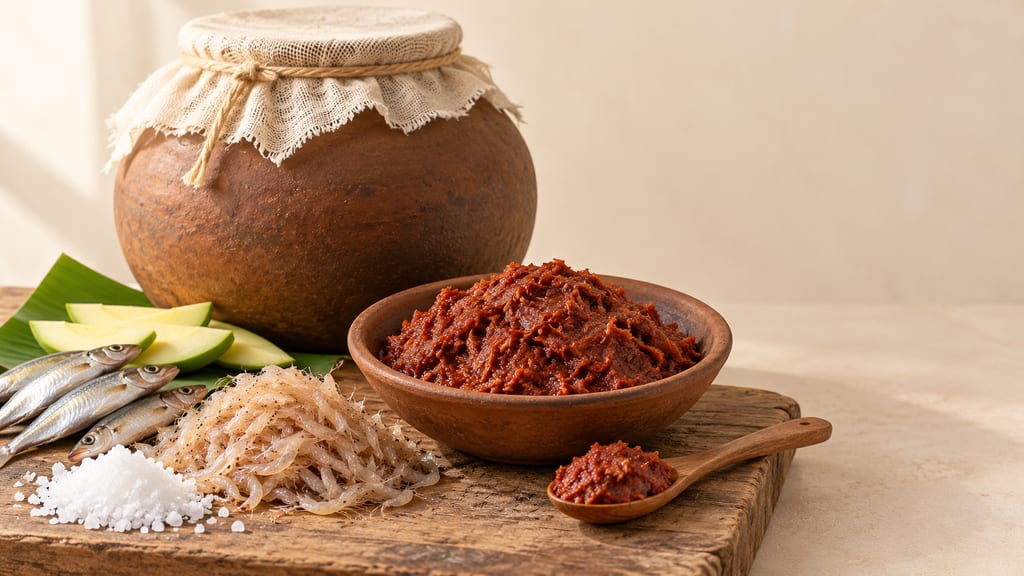
An earthenware jar, a bowl of bagoong alamang and the salt, small shrimp and small fish it is made from.
Thirty days or six months?
Ask three sources how long bagoong takes and you get three answers. The National Commission for Culture and the Arts puts fermentation at 30 to 90 days. A livelihood brochure from the Industrial Technology Development Institute of the Department of Science and Technology (DOST-ITDI) says at least six months. A 2013 Ghent University thesis, which collected shrimp pastes from producers in the southern Philippines, found makers who start a batch in February or March and let it ripen for about six months. None of them is wrong. They describe different pastes, made by different people from different animals, and each is a report on a batch rather than a rule for all of them.
That gap shapes everything below. Bagoong is the Philippine name for fish or shrimp that has been mixed with salt and left to ripen, and what has been written about it is a set of snapshots: a brochure, a book chapter, student theses, a few laboratory papers, a cultural encyclopaedia entry. Where they give numbers, this article sets them out one source at a time. It does not average them into a recipe, because nothing in them supports one.
Fish, shrimp and a red colour
Filipinos use one word for two families of product. Bagoong na isda is made from fish, bagoong na alamang from shrimp. The fish named in the cultural entry go by local names such as dilis, bolinaw, galunggong and sapsap, and those names do not say which species is in any given jar. Alamang are small shrimp of the genus Acetes.
The method described there is simple. Salt and seafood are mixed by hand and packed into large clay jars called bornay or tapayan. Angkak is added to make red bagoong. The finished paste goes onto the table with kare-kare and with green mango. Bagoong Pangasinan and Balayan are named as regional varieties.
A 1992 review of Philippine fish ferments drew a map of how far the process goes. Fish bagoong from the Tagalog provinces may be fully fermented and ground to a paste. In Ilocos and Pangasinan it is partly or fully fermented. In the Visayas and Mindanao it is less fermented, and may keep firm pieces of fish and visible salt. That is an older synthesis and not a current market survey, but it explains why two Filipinos can say "bagoong" and mean products with different textures and different ripening times.
Salt ratios, one batch at a time
The ratios in these sources are written two ways, salt first or seafood first, and most do not say whether they are by weight or by volume. Each is best read on its own terms.
The DOST-ITDI brochure for fish and small Acetes shrimp calls for 1 part salt to 3 parts washed, drained seafood by weight, which makes the mix 25% salt. The jar is wide-mouthed and covered with cheesecloth. The brochure says to stir weekly for the first two months, then monthly, and to wait at least six months. It gives no temperature.
The 1992 National Research Council chapter on Philippine fish ferments gives a range for fish bagoong, from 1:3 to 2:7, without saying whether it is mass or volume, and a ripening time of several months or longer.
The Ghent thesis recorded what four producers say they do. One used 1:3 salt to shrimp, plus sugar at 1:40 and a colouring. Two used 2:5. The fourth gave no ratio. The author's own laboratory trial used 100 g batches at 1:3 in clay pots at 30 °C for 10 days. It used the Belgian brown shrimp, Crangon crangon, in place of Acetes, a substitution the author warns changes the result.
A 2018 undergraduate fisheries thesis from Sarangani and General Santos tested Acetes paste at shrimp to salt ratios of 6:1, 3:1 and 2:1, sampling at day 0, 14 and 28. If those are weight ratios, the salt share runs from about 14% to 33%. The same work found that the length of sun-drying changes the texture of the paste, and it gives no temperature.
A 2026 paper from Indonesia tested rebon, the local name for Acetes shrimp, at 5%, 10% and 15% salt, for 30 days at room temperature. It is a study of terasi, the Indonesian paste, not of bagoong, but it is the only source here that varied salt across a wide, low range with a fixed time.
Set side by side, the Philippine descriptions cluster. If the NRC and Ghent ratios are by weight, 2:7, 1:3 and 2:5 correspond to about 22%, 25% and 29% salt. The one Philippine group that deliberately tested several levels went both below and above that band.
What happens in the jar
Bagoong is usually described as a fermentation, but the chemistry measured in these sources is hard to line up. The NRC chapter describes a sequence of organisms: aerobic ones predominate early, microaerophilic and anaerobic ones later, and total viable counts may decline. Both desirable and hazardous organisms were detected in Philippine pastes.
A 1980 paper analysed Philippine bagoong and found a pH of 5.2, 30.2% sodium chloride, 61.6% water and 22.8% ash. From it the authors isolated 40 bacterial strains. Bacillus, Micrococcus and Moraxella dominated, and some strains grew on media with more than 20% salt. The abstract does not say how old the paste was.
The Ghent thesis measured four shrimp pastes and got a mean pH of 7.47, a water activity of 0.71 and 13.93 g of sodium chloride per 100 g. Laboratory batches made from fresh raw shrimp without a starter finished near pH 7.2. The author concluded that acid fermentation did not occur, and credited the shrimp's own enzymes and microbes on its surface.
Those two sets of figures disagree on acidity by more than two pH units and on salt by more than a factor of two. The samples differ in age, in species and in method, and the right response is not to average them. Pastes sold under one name may differ widely in acidity and salt, and these sources do not show which kind is typical.
The liquid that rises: patis
Bagoong has a liquid relative. The cultural entry describes fermentation producing patis, which takes about half a year to a full year, and treats it as an associated product, not another name for the paste. Not every batch yields it.
The DOST-ITDI brochure treats the two as stages of one process. For patis, the mixture is left for 4 to 6 months until the solids settle, and the liquid is poured off. The same brochure re-brines the settled residue in a saturated brine, 1 part salt to 2 parts water, and ages it for a further 2 to 4 weeks. A 1980 analysis of patis found 29.1% sodium chloride and a pH of 5.1, close to the bagoong measured in the same paper.
What is known about safety, and what is not
The Philippines has two national standards for the product: PNS/FDA 36:2014, Salt Fermented Fish and Shrimps (Bagoong), Specifications, and PNS/FDA 37:2014, a recommended code of practice for processing and handling it. Their titles are confirmed in the Food and Drug Administration's listing. Their limits for salt, histamine and process conditions could not be retrieved, so none is quoted here.
The measurements that do exist are thin. In the 2018 Sarangani and General Santos work, histamine rose from 10.26–20.63 ppm at day 0 to 18.31–31.02 ppm at day 28, while microbial load did not change significantly. No source in this set gives a histamine limit for bagoong, a pH endpoint or a storage period.
A 2023 University of the Philippines Diliman thesis on burong isda, a separate preparation of rice, freshwater fish and salt made in Candaba, Pampanga, shows why that matters for related fish ferments. It found two small producers, most of those involved without formal food-safety training and neither meeting minimum good manufacturing practice. Retail samples exceeded limits: total aerobic counts of 1.9 × 10⁵ to 3.0 × 10⁶ CFU/g, coliforms at 6.3 × 10³ CFU/g in one sample, Staphylococcus aureus at 9.0 × 10² to 4.6 × 10³ CFU/g, and Salmonella detected in 25 g. Burong isda is not bagoong and shares no method or safety control with it, but it is the nearest Philippine microbiology of a salted fish product available.
One point needs saying plainly. The six months in the brochure is a ripening time, and the 30 to 90 days in the cultural entry is how long makers wait. Neither is a safety deadline. Smell, taste and the look of the paste do not show whether a batch is safe, and no source here shows that a paste at day 29 is unsafe or one at day 200 is safe.
Reading the figures
What the sources support is a family of practices. Philippine bagoong is made with roughly one part salt to between 2.5 and 3.5 parts of seafood, in clay jars, over a period that runs from a month to half a year or more. How far it ripens, how coarse it ends up and whether it is red depend on region, raw material and the maker. A ratio from one batch should travel with the conditions around it: the animal, the jar, the stirring, the time and the temperature. Taken alone, it is not a recipe.
The open questions are practical ones. No source here followed a household batch from start to finish, or tied a pH or histamine reading to a known salt level and age. Until someone does, the figures in this article describe how bagoong has been made and measured, not a method that has been shown safe.
Related
Read more
Fermented meat around the world
Dry salami, sour pork with rice, matured sheep and aged blubber follow different paths from animal to food. Their stories connect microbes with climate, slaughter, migration and the meals people share.
Community
No community contributions have been published for this entry yet.
Share what you made
Sign in to contribute. Published comments and photos are free to read.
Sources
National Commission for Culture and the Arts / Philippine Cultural Education Online
bagoóngCited in: Thirty days or six months?; Fish, shrimp and a red colour; The liquid that rises: patis
Industrial Technology Development Institute, Department of Science and Technology
Fish Processing (Livelihood Technology Brochure)Cited in: Thirty days or six months?; Fish, shrimp and a red colour; Salt ratios, one batch at a time; The liquid that rises: patis; Reading the figures
National Research Council (US), National Academies Press, 1992
Fermented Fish Products in the Philippines, in Applications of Biotechnology to Traditional Fermented FoodsCited in: Fish, shrimp and a red colour; Salt ratios, one batch at a time; What happens in the jar; Reading the figures
Ghent University, Faculty of Bioscience Engineering; hosted at Ghent University Library
Characterization of Salt-fermented Shrimp Paste from the PhilippinesCited in: Thirty days or six months?; Salt ratios, one batch at a time; What happens in the jar; Reading the figures
Thesis repository, thesis.msugensan.edu.ph
Acetes sp. shrimp paste from Sarangani and General Santos (BS Fisheries thesis, 2018; repository abstract)Cited in: Salt ratios, one batch at a time; What is known about safety, and what is not; Reading the figures
Journal of Tropical Food and Agroindustrial Technology (Rumiyati and Listyaningrum, 2026)
The Role Salt Of Controlling Total Microbial Count And Histamine In Shrimp (Acetes sp) PasteCited in: Salt ratios, one batch at a time
Nippon Suisan Gakkaishi 46(10):1235–1240 (Fujii, Basuki and Tozawa, 1980)
Chemical Composition and Microflora of Fish Sauce 'Patis'Cited in: What happens in the jar; The liquid that rises: patis
Food and Drug Administration Philippines
PNS/FDA 36:2014 and 37:2014 (bagoong specifications and code of practice), listed in Annex ACited in: What is known about safety, and what is not
University of the Philippines Diliman, University Library; Lyra Monica S. Cuellar, 2023
Process documentation and microbiological safety assessment of Burong Isda (Ophicephalus striatus) in Candaba, Pampanga — repository abstractCited in: What is known about safety, and what is not
Gaps
- The text of PNS/FDA 36:2014 and 37:2014 was not retrieved, so no official salt, histamine or process limit is given.
- No source here ties a pH, histamine or storage endpoint to a known salt level and batch age, and the 1980 and 2013 pH figures remain unreconciled.
- A University of the Philippines study on the best salt-to-shrimp ratio, delay before salting and ripening time was found only as a library record without results, and current home practice and market variation were not surveyed.
Updated 2026-10-29