
Preservation intake
Pasteurising juice with electric pulses, and the spores they leave alone
Pulses lasting a few microseconds, at tens of kilovolts per centimetre, punch holes in microbial cells. They help pasteurise juice and extract colour from grapes. They cannot kill spores unless heat does the work.
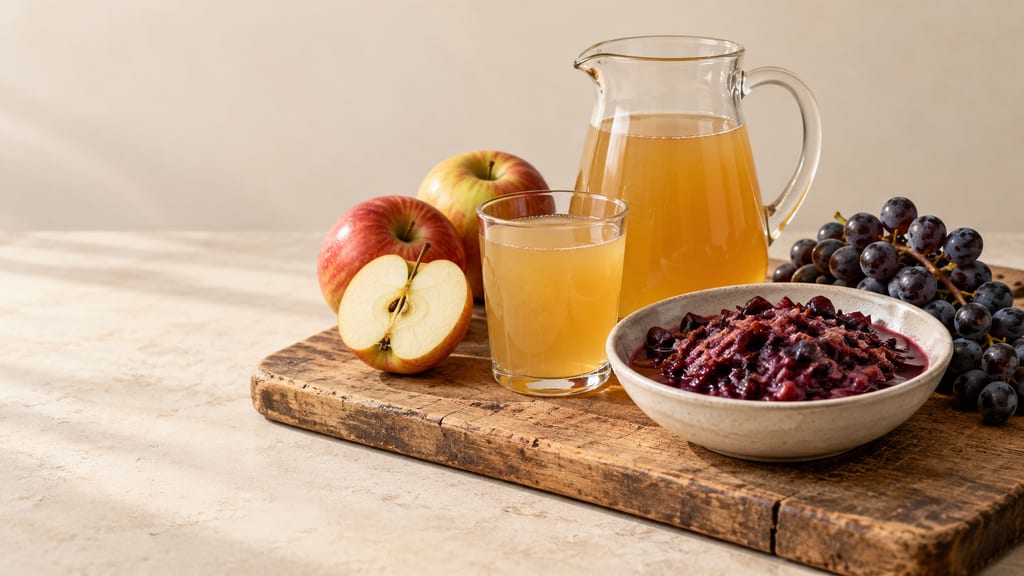
Apple juice and crushed red grapes, the two liquids in the story: one pasteurised with electric pulses, the other opened up for winemaking.
A juice that never meets a heater
Picture a pipe carrying apple juice past two metal electrodes set no more than 10 mm apart. Several thousand volts are switched across that gap for a few millionths of a second, again and again, while the liquid streams through. On the far side the juice carries fewer living microbes. The method is called pulsed electric field processing, PEF for short. It is usually described as non-thermal, although many juice treatments add mild warming, in the range of 50–60 °C.
Engineers describe the strength of a pulse in kilovolts per centimetre (kV/cm): the voltage across the gap divided by the width of the gap. Treatments aimed at microbes use fields of 10–80 kV/cm applied for 1–100 µs at a time. The total treatment time is the number of pulses multiplied by the width of each one, so a liquid that receives more pulses is treated for longer even though each pulse is vanishingly short.
How a pulse opens a cell
A microbial cell is held together by a membrane, and a strong enough field across it makes pores open in that membrane. This is electroporation. Depending on the field strength, the pores can be permanent, and a cell with permanent holes in its membrane dies. That is how the pulses reduce the number of living bacteria and yeasts in a juice.
Two things decide how much of that happens. The first is cell size: the smaller the target cell, the stronger the field has to be before pores form. The second is the liquid itself. A product with higher conductivity can be inactivated less at the same applied field strength, so the same machine can behave differently on two liquids that conduct electricity differently. This is why a PEF treatment is set for a particular food rather than for liquids in general.
What the pulses do for a juice
In practice PEF is used as a pasteurisation step, and the treated juice is kept chilled afterwards. Estimates of how long such a juice keeps its quality vary with the juice and the intensity of treatment. A natural pressed juice under good control may last 5–7 days. A juice with a pH below 4.5 may last about 3.5 weeks after a low-intensity treatment and up to 8 weeks after a high-intensity one, and the general range quoted is 1.5–4 weeks. These are quality estimates. They are not safety deadlines, and neither the smell nor the taste of a juice shows whether it is safe.
The pulses have limited effect on enzymes on their own. Enzymes are not a safety concern, but they change how a juice looks and tastes in storage, so processors tune the temperature at which the juice enters and leaves the treatment chamber to inactivate them. The published figures show how much of the work heat does. In apple juice, preheating to 50 °C and then applying 100 µs at 40 kV/cm cut peroxidase by 71% and polyphenol oxidase by 68%. Complete inactivation took 30 kV/cm for 1000 µs at 60 °C. In citrus juice, pectin methylesterase fell by about 81% at 25 kV/cm for 330–340 µs. One apple-juice treatment used 24.8 kV/cm over 60 pulses at 53.8 °C.
What these figures do not give is the full picture a cook or a regulator would want: a named microbe, in a named juice, at a stated pulse count and width, with the log reduction it achieved. A log reduction counts powers of ten, so a 3-log reduction removes 99.9% of the organisms. Published doses are scattered across different foods and machines, and they are not a recipe.
Spores need heat, and pulses alone do not kill them
The limit that matters most is spores. A bacterial spore is a dormant, tough form of a bacterial cell, and PEF does not lend itself to inactivating it. A treatment that relies only on the field leaves spores alive. Where spores are the target, the process has to bring heat as well, with the liquid entering the chamber at more than 75 °C.
A team at the Leibniz Institute for Agricultural Engineering in Potsdam and the Technical University of Berlin took this furthest in 2015. Their title calls the result an ultra-high-temperature process, and the name fits. They preheated saline water carrying spores, passed it through pulses of 10.26 kV/cm and let it leave hot. Spores of Bacillus subtilis, preheated to 80 °C and pulsed at 250 Hz with 8 µs pulses, fell by 3.5 log (give or take 0.3) by the time the liquid left at 112.4 °C. Spores of Geobacillus stearothermophilus, preheated to 95 °C and pulsed at 200 Hz with 6 µs pulses, fell by 3.2 log (give or take 0.4) at an outlet temperature of 131.7 °C.
The heat alone, without the pulses, achieved at most 0.2 log. The field and the heat together were needed. A drop of 3.5 log is roughly a 3,000-fold reduction, and the experiment used saline water, not a food. The authors tested fields of 10.26, 13.68 and 17.1 kV/cm and did not report how many pulses each spore received. The point for a reader is a simple one. PEF reduces vegetative cells in a chilled liquid, and it reduces spores only when strong heat is applied at the same time.
Opening the skins of red grapes
Winemaking offers a different use, where the target is the grape’s own cells instead of a microbe. A group at the University of Udine put crushed Rondinella red grapes through 400 Hz square-wave pulses at 1.5 kV/cm, with energy inputs of 2, 10 and 20 kJ/kg. The temperature of the mash rose by 3 °C at most.
Pressing yield, measured as a percentage of the grapes by weight, was 70.3 for untreated grapes and 79.7 for grapes treated with enzymes. The gentlest PEF treatment, 2 kJ/kg, gave 83.1. The yield fell as the dose rose, to 76.1 at 10 kJ/kg and 73.3 at 20 kJ/kg, so more energy bought a worse yield in the press.
The wine told a different story. After two months the wines from the 10 and 20 kJ/kg treatments held 219 and 225 mg/L of anthocyanins, the red pigments, against 166 mg/L in the untreated wine. After twelve months the total polyphenol index, a measure of phenolic compounds, was 43.6 and 44.8, against 31.7 in the untreated wine. Fermentation itself ran as usual, and the analysis found no significant iron, chromium or nickel release attributable to PEF.
Where the idea came from
The scientific record usually begins in 1967, when A. J. H. Sale and W. A. Hamilton published a paper in Biochimica et Biophysica Acta titled "Effect of high electric fields on microorganisms. I. Killing of bacteria and yeasts". A second paper followed in the same volume and a third in 1968. One later summary reportedly describes the kill as depending on the product of pulse length and pulse number, at fields up to 25 kV/cm, but that has not been checked against the original.
Other accounts reach back further, to patents from the early 1960s on using pulses to break open cells in food. Sources disagree on the dates.
What it means in practice
PEF is an industrial treatment for liquids that can be pumped. It does not replace refrigeration for a juice, and it does not sterilise on its own.
No regulatory authorisation for PEF-treated juice has been confirmed here, in the European Union or the United States. Acceptance depends on the product and the jurisdiction, and anyone who wants to sell PEF-treated food needs to check the rules where it will be sold.
Related
Discussed in this article
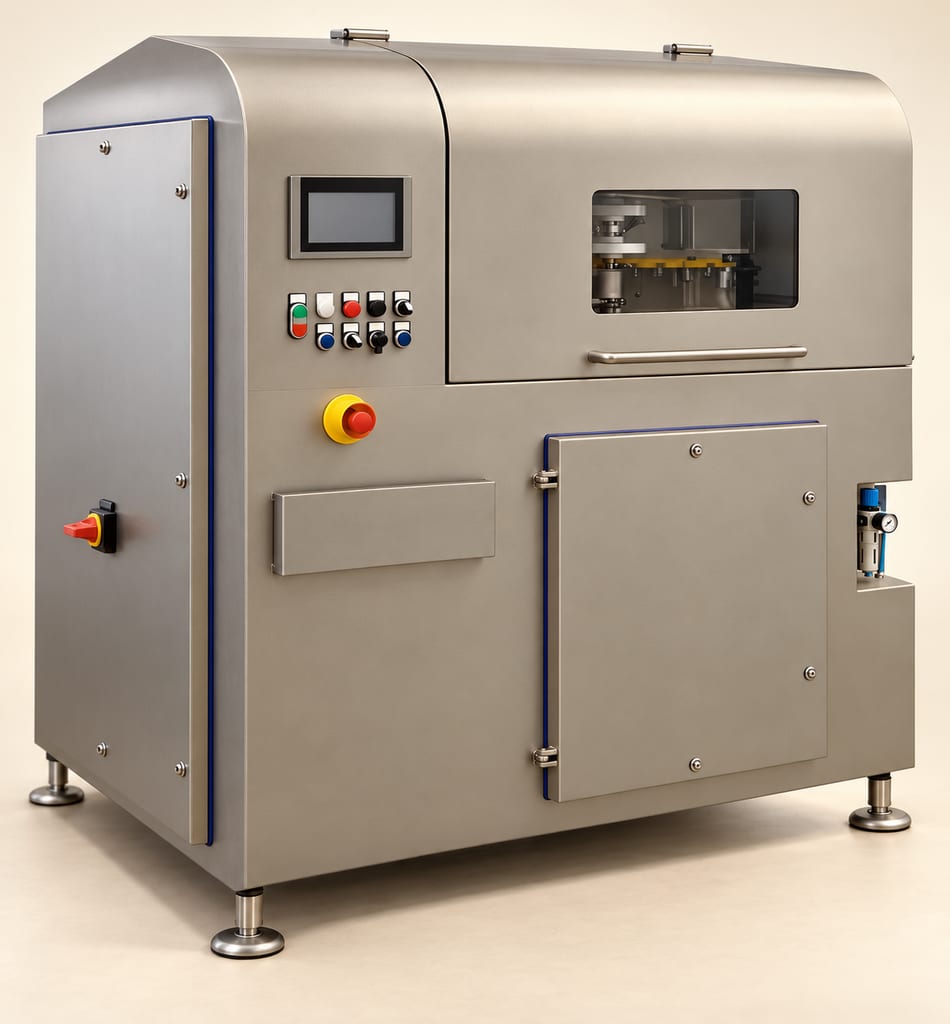
Pulsed electric field unit
A pulsed electric field (PEF) unit sends brief high-voltage pulses through food in a treatment zone. Systems may treat flowing liquids or batches; the result depends on the food, equipment and validated process.
Community
No community contributions have been published for this entry yet.
Share what you made
Sign in to contribute. Published comments and photos are free to read.
Sources
Elsevier / Academic Press (book chapter by Zhonglin Jin and Luz Bermudez-Aguirre, 2024)
Application of pulsed electric fields in food processing and preservationCited in: How a pulse opens a cell
Molecules 27(13):4031 (MDPI), 2022
Applications of Innovative Non-Thermal Pulsed Electric Field Technology in Developing Safer and Healthier Fruit JuicesCited in: A juice that never meets a heater; How a pulse opens a cell; What the pulses do for a juice
Frontiers in Microbiology 6:400, 2015
Sterilization of liquid foods by pulsed electric fields: an innovative ultra-high temperature processCited in: Spores need heat, and pulses alone do not kill them
Foods 9(4):414 (MDPI), 2020
Pulsed Electric Field Processing of Red Grapes (cv. Rondinella): Modifications of Phenolic Fraction and Effects on Wine EvolutionCited in: Opening the skins of red grapes
Campden BRI (blog, 10 January 2022)
Pulsed electric field processing: the potential in food processingCited in: A juice that never meets a heater; How a pulse opens a cell; What the pulses do for a juice; Spores need heat, and pulses alone do not kill them; What it means in practice
Biochimica et Biophysica Acta 148:781-788, 1967
Effects of high electric fields on microorganisms. I. Killing of bacteria and yeastsCited in: Where the idea came from
Gaps
- No source read gives pulse count, pulse width, a named microbe, a named juice and a log reduction together, so a dose for a given juice cannot be stated.
- How widely PEF is used commercially is not established, and no regulatory authorisation for PEF-treated juice has been confirmed in the European Union or the United States.
- The original 1967 paper and the early 1960s patents were not read, and the date at which the technique began is disputed.
Updated 2026-10-29