
Preservation catalogue
Fish on the ice: the race to freeze food fast
Freezing food is old. Freezing it fast enough to protect its texture, and selling it that way, is the 1920s idea that built an industry. The science explains why speed matters and where it stops.
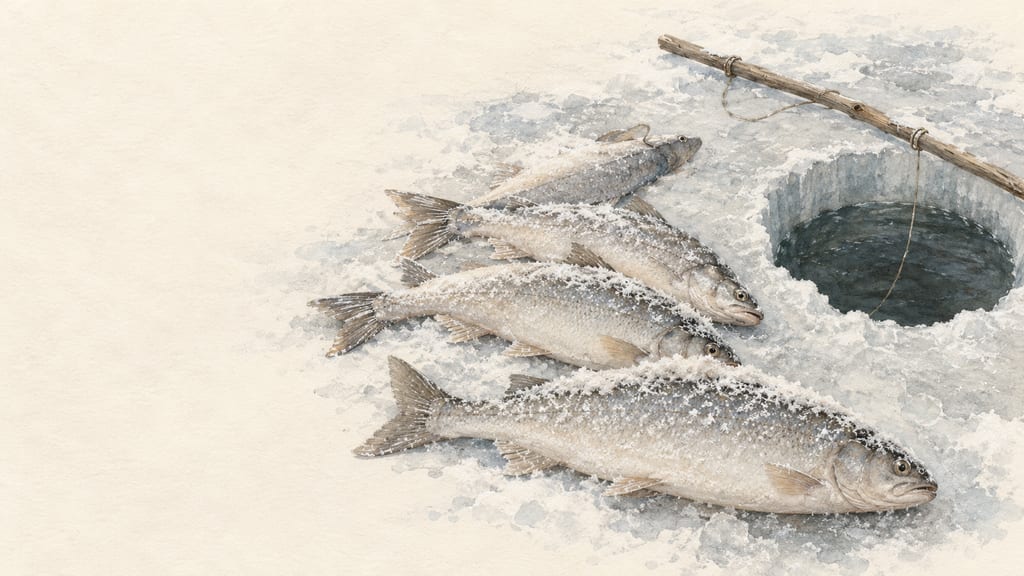
Fish left on surface ice freeze at once, the observation Clarence Birdseye is said to have turned into quick freezing; a historical interpretation, not a photograph.
Fish on the ice
When an Inuit fisherman in Labrador landed a fish through the ice, the cold did the rest. Left on the surface ice, the catch was flash frozen at once. A young Clarence Birdseye watched fishermen do this. He had been taught by the Inuit how to fish under very thick ice, and he turned what he saw into a machine, a company and an industry.
Freezing food was never the new part. People kept food frozen long before the twentieth century, by leaving it in cold air or on ice. What Birdseye industrialised was speed: freezing food fast enough to protect its texture, in a form uniform enough to sell. The rest of this story is about why speed matters, how the machines work, and what even the fastest freezing leaves undone.
What slow freezing does to food
Freezing turns the water in food into ice crystals, and how big the crystals grow depends on how long the food takes to freeze. Freezing produce as quickly as possible gives smaller crystals, and smaller crystals do less damage to cell walls. The thawed food is crisper and loses less liquid. University of Illinois Extension puts rapid freezing at −25 °C or lower.
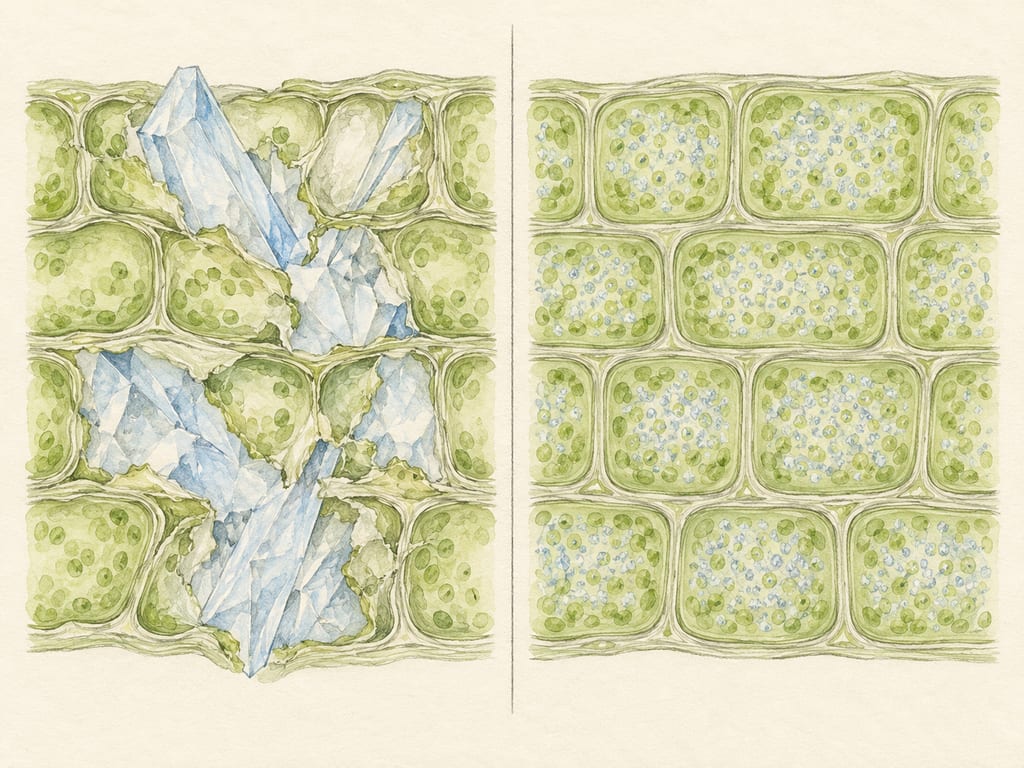
Measurements on strawberries show how steep the difference is. When the fruit took 12 hours to freeze, 20% of its weight dripped out as liquid on thawing. At 15 minutes the loss fell to 8%, and at 8 minutes in a cryogenic freezer it was under 5%. Slow freezing tends to produce large, uneven crystals.
Textbooks commonly place the zone of maximum ice crystal formation at about −1 to −5 °C, just below the freezing point of water. The advice that follows from the idea is simple: do not linger there.
A fish pressed between two plates
Birdseye's company, General Seafoods, was launched in 1924 to sell frozen fish. Two years later he introduced a quick-freeze machine with two plates. The patent that describes the method was filed on 18 June 1927 in Gloucester, Massachusetts, and granted on 12 August 1930 under the title "Method of preparing food products". At grant it was assigned to Frosted Foods Company, Inc.
The text is plain about what the machine does. Fish or meat is packed and squeezed between two opposed metal plates, or between conveyor belts, and freezes as a compact block. The patent's example is a block two inches thick, which freezes in about an hour and a quarter in a chamber colder than −18 °C. It adds that the figures can be varied widely.
Springfield, 1930
In 1930 shoppers in Springfield, Massachusetts, became the first Americans to find frozen food in their grocery stores. The company offered 27 items. To help sales, Birdseye created special display cases and leased them to the shops, so that the products sat in a cabinet that showed them off.
The business he started became a frozen-food industry, and the company that carries his name, Birds Eye Foods, still works in it.
Three ways to take the heat out
Fisheries engineers sort freezers into three basic kinds. An air-blast freezer blows a continuous stream of cold air over the fish. A contact freezer, Birdseye's kind, presses it between cold plates. An immersion or spray freezer immerses it in a cold medium or sprays it.
Air speed is a compromise. A design speed of 5 m/s works well between slow freezing at low speed and the cost of running big fans. Still air is a poor freezer: a single fillet takes four times as long to freeze in the relatively still air of a cold store as in a freezer built to move the air. Batch air-blast freezers run at air temperatures of −35 to −37 °C, and continuous ones at −35 to −40 °C. A batch plate freezer uses refrigerant at −40 °C, and one worked example for a horizontal plate freezer comes to one and three-quarter hours.
Cryogenic freezers go further. Liquid nitrogen boils at −196 °C at normal pressure, while mechanical refrigeration bottoms out around −40 °C. In a fluidised-bed freezer, where small pieces ride on a stream of cold gas, residence times run around 5–30 seconds. Faster is not always better, though. Some studies have found a drop in quality after liquid-nitrogen freezing, including cracking of products frozen at high rates.
What the freezer does not do
Frozen food is usually held at −18 °C or colder, a figure widely cited in the frozen-food trade. Cold storage protects the texture that fast freezing won. It does not make food safe.
Freezing is not a dependable way to kill bacteria. Organisms that survive it can grow again after thawing, and faster freezing improves texture without being a pathogen-kill treatment.
Raw fish is the exception: regulators have written specific freezing treatments to kill parasites in fish that will be eaten raw. In the European Union, for fishery products intended to be eaten raw, the rule for parasites other than trematodes is −20 °C for at least 24 hours or −35 °C for at least 15 hours. The rules also exempt products whose core reaches 60 °C or more for at least one minute, and a seller supplying anyone other than final consumers must include a document stating the freezing treatment used.
The United States sets its own terms in the FDA Food Code, here as adopted in Delaware, for raw, raw-marinated and partly cooked fish served ready to eat. Fish may be held at −20 °C or below for at least 168 hours (seven days). It may instead be frozen solid at −35 °C or below and held there for at least 15 hours, or frozen solid at −35 °C and then held at −20 °C or below for at least 24 hours. Molluscan shellfish, certain tuna species and some farmed fish are exempt.
The two regimes overlap without matching. At −20 °C the European rule asks for 24 hours and the American rule for seven days, unless the fish was first frozen solid at −35 °C. A seller or kitchen should follow the rule of its own jurisdiction and not mix the two.
Speed has a size
Taken together, the numbers show that freezing time depends on two things: how thick the piece is and what carries the heat away. A two-inch block between plates takes an hour and a quarter. Small pieces in a fluidised bed take seconds. A fillet in the still air of a cold store takes four times as long as in moving air.
That is why the fisherman's trick on the Labrador ice works, and why Birdseye's plates and the liquid-nitrogen freezers that came after share the same goal: get through the freezing zone before large crystals form. The same facts mark the limit. Fast freezing protects texture. Whether the food was safe before it went in, or what the freezing does to the organisms it carries, is a separate question.
Related
Discussed in this article
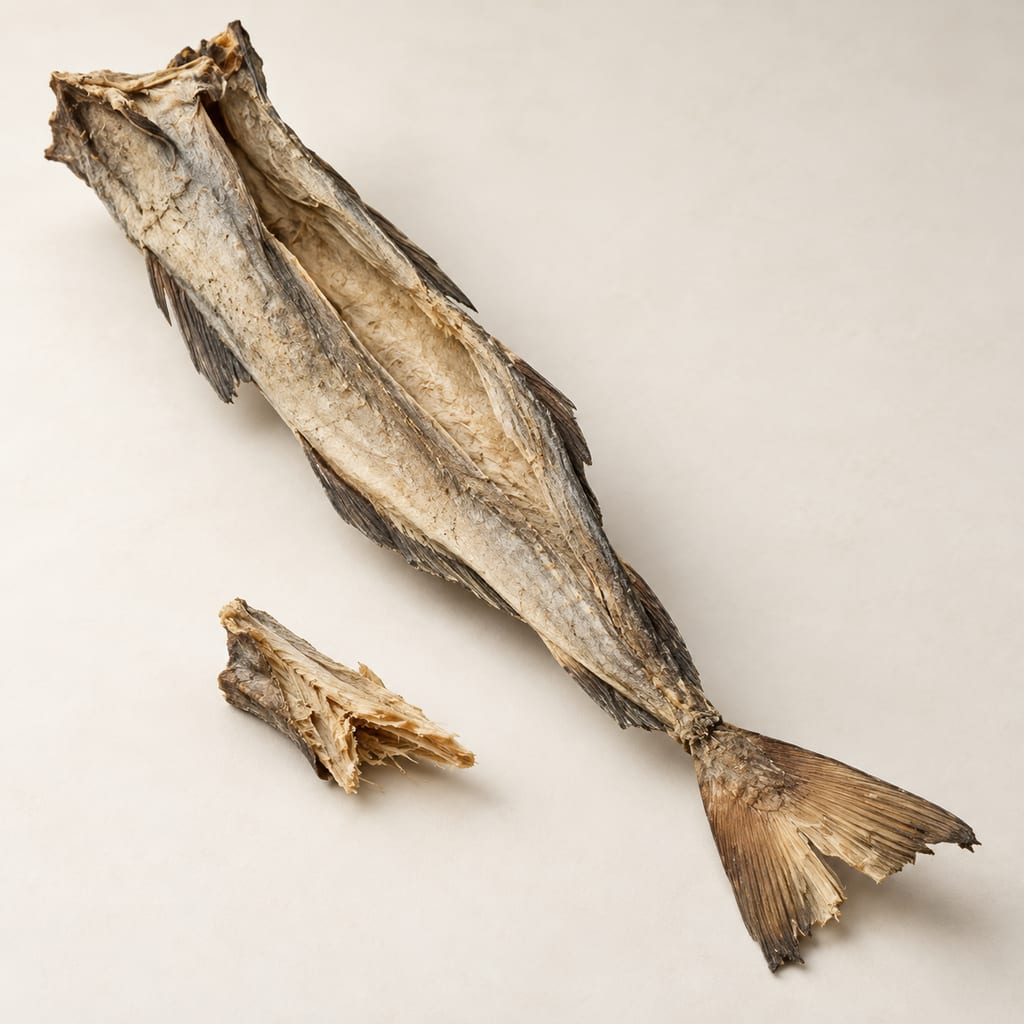
Stockfish
Cod hung on open racks in cold northern air until most of its water has gone, leaving a hard, light, unsalted fish that keeps and travels and must be soaked for days before cooking.
Community
No community contributions have been published for this entry yet.
Share what you made
Sign in to contribute. Published comments and photos are free to read.
Sources
National Inventors Hall of Fame
Clarence Birdseye (inductee)Cited in: Fish on the ice; A fish pressed between two plates; Springfield, 1930
Google Patents
US 1,773,079: Method of preparing food productsCited in: A fish pressed between two plates; Speed has a size
University of Illinois Extension
FreezingCited in: What slow freezing does to food; Speed has a size
IIR Encyclopedia of Refrigeration
Cryogenic nitrogen in the food and beverage industryCited in: What slow freezing does to food; Three ways to take the heat out; Speed has a size
Food and Agriculture Organization of the United Nations
Freezers (chapter 4 of Freezing and refrigerated storage in fisheries)Cited in: Three ways to take the heat out; Speed has a size
legislation.gov.uk
Commission Regulation (EU) No 1276/2011, amending Annex III to Regulation (EC) No 853/2004Cited in: What the freezer does not do
Legal Information Institute, Cornell Law School
16 Del. Admin. Code 3-402.11: Parasite destruction (Delaware adoption of the FDA Food Code)Cited in: What the freezer does not do
Gaps
- Accounts disagree on when Birdseye worked in Labrador and on the exact name and founding year of his first company, so none of these dates are given beyond 1924.
- No fish-specific, peer-reviewed freezing times were found; the figures here come from fisheries guidance and the patent's single example.
- The patent text available gives the plate temperature without readable signs, so it is not quoted.
Updated 2026-10-29