
Dry cassava meal (farinha)
Farinha · farinha · cassava farinha · dry cassava flour
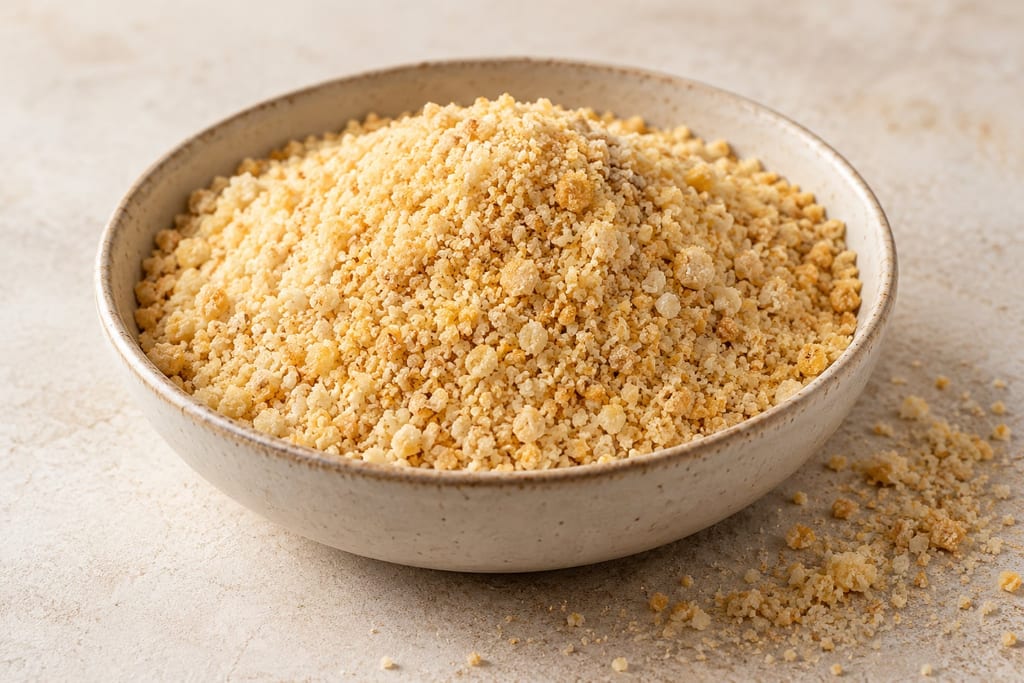
Farinha is a coarse, durable cassava meal made by grating, pressing, sifting and roasting or drying cassava. Processing is used to reduce cyanogenic compounds, but this account is not a validated detoxification procedure.
A meal that keeps
Farinha de mandioca is a coarse cassava meal that can be stored when properly dried and kept dry. FAO describes related processes in Brazil and West Africa, while distinguishing farinha from gari by the degree and duration of fermentation.
Farinha d'água is a separate soaked-root product. Names and methods vary by region.
Sources for this section
The documented sequence
The FAO account describes peeled cassava being grated, pressed to remove juice, sifted, then roasted while stirred into a free-flowing meal. Other descriptions include breaking up and sieving the pressed cake to remove coarse fibres and lumps.
This summary leaves out quantities, timing, temperature and equipment because the cited sources describe different settings and do not establish one universal procedure.
Sources for this section
Farinha, gari and farinha d’água
Gari is left longer and develops more sourness; the farinha process can have shorter fermentation. Farinha d'água is a separate soaked-root product. These distinctions mean that a broad farinha record should not be labeled uniformly non-fermented.
This entry covers dry farinha broadly and does not assign a fermentation stage to a particular version.
Sources for this section
Cyanogenic compounds
Cassava may contain cyanogenic compounds, and traditional processing is used to reduce them. The steps summarized here are not a validated detoxification protocol for any cultivar or batch.
Do not treat grinding alone as detoxification. This page does not give a validated procedure or critical limit, and home preparation of bitter cassava should not rely on this brief account.
Sources for this section
History
Farinha de mandioca is a coarse, storable cassava meal. FAO sources describe shorter fermentation than gari and separately identify farinha d'água, which begins with roots soaked in water. This record does not establish the fermentation state of a specific batch.
Ingredients
Scaling: source batch only
Method
Risks and precautions · Elevated risk
The catalogue says the full sequence of pressing and drying helps reduce these compounds, while grinding alone does not do so reliably.
Hazard sourceCassava can contain cyanogenic compounds. Traditional processing is used to reduce them, but this account gives no validated detoxification procedure or critical limit. Do not use this summary to prepare bitter cassava for eating.
- Wash and peel the cassava roots.
- Grate the peeled roots.
- Press the grated cassava to remove liquid.
- Break up the pressed cake and sift it to remove coarse fibres and lumps.
- Dry or roast the pressed, sifted mass into a granular meal.
Places
South America
Traditional preparation · Region evidenceThe catalogue places the process in Indigenous South America and the later tropics; it names no single locality.
Community
No community contributions have been published for this entry yet.
Share what you made
Sign in to contribute. Published comments and photos are free to read.
Sources
Food and Agriculture Organization of the United NationsMethod · History
FAO cassava processing (x5045e06)Cassava grated, pressed and dried or roasted into durable meal (farinha)
Cited in: A meal that keeps; The documented sequence; Farinha, gari and farinha d’água
Food and Agriculture Organization of the United NationsMethod · Safety
FAO cassava processing and cyanogen reduction (x5415e05)The complete sequence improves keeping and helps reduce cyanogenic compounds; grinding alone does not reliably
Cited in: A meal that keeps; The documented sequence; Farinha, gari and farinha d’água; Cyanogenic compounds