Sato dong
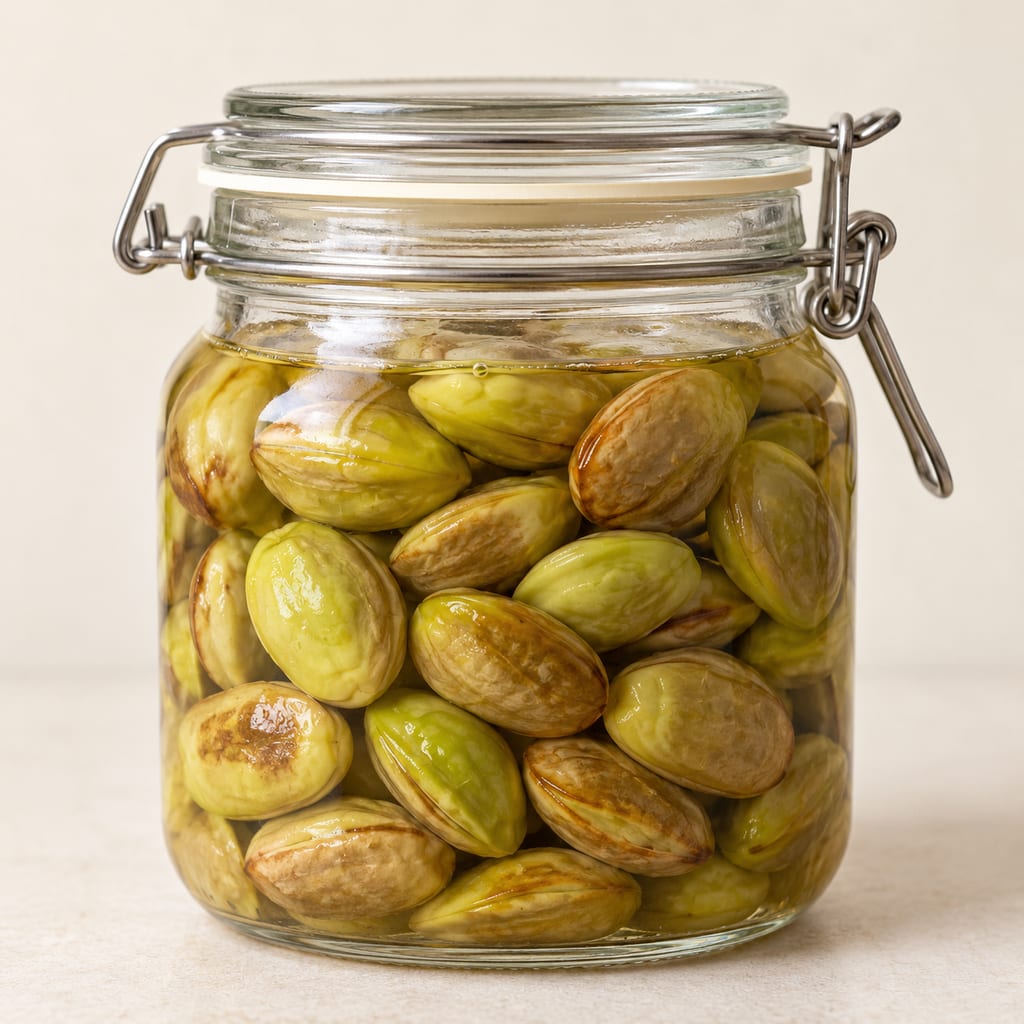
Thai pickle of stink bean seeds, Parkia speciosa, with the testa left on, held in a 10 percent salt brine in a glass jar in shade. JIRCAS records a three to four day ferment and a separate seven day flavour note.
 FermenteaWhere food goes to change
ลูกเนียงดอง · Look-niang-dorng · Pickled djenkol bean
A cultural account of luk niang dong, a Thai djenkol-bean pickle associated with southern Thailand. Not a recipe or eating recommendation: sources do not establish that pickling controls djenkolism.

Luk niang dong (ลูกเนียงดอง), also written Look-niang-dorng, is recorded by JIRCAS as a Thai pickle of the djenkol bean, the seed of Pithecellobium jiringa. JIRCAS describes green, solid beans in a cloudy, salty and slightly sweet liquid, and associates the product with nam prik, a chilli paste dip. This is a description of the source record, not advice to eat it.
The name is close to sato dong, but the two are different products made from different seeds. Djenkol is a seed, not the Parkia sato pod.
The Thai cultural encyclopedia associates the bean with southern Thailand. It describes the fermented product as common on the west coast, from Kraburi and Mueang Ranong through Phuket, and less popular on the east coast. The encyclopedia gives flowering from December to April and mature pods from May to August. Two southern market arrivals are recorded, February to March for seed from the lower south and June to July for seed from the upper south. These describe the plant and market supply, not a pickling calendar.
The encyclopedia lists several local names and separates neang dan and neang khao from neang nok and luk nang. The spelling and taxonomic names differ between sources, so a botanist should reconcile them before the taxon is normalised.
JIRCAS records a household product made by brining peeled djenkol beans and holding the container in shade for about ten days. It also reports a two-to-three-month storage period. The entry supplies no validated process endpoint or storage controls; those details are preserved here only as historical description, not directions.
A Thai cultural encyclopedia describes a different product tradition involving sprouted beans and a shorter fermentation period. The outlines are not interchangeable, and neither source establishes that either preparation prevents djenkolism. No preparation instructions or ingredient quantities are provided on this page.
Djenkol beans carry a documented hazard. The encyclopedia warns that high intake can injure the kidneys and cause painful, bloody or blocked urination. A clinical review reports sporadic djenkolism, acute kidney injury and urinary obstruction in Indonesia, Malaysia, southern Thailand and Myanmar. The review states that occurrence cannot be reliably predicted from quantity or preparation, and that alkali boiling is not established as prevention.
No inspected source shows that fermentation reduces this risk. No safe intake is established here, and the ten-day or five-to-ten-day durations are not safety endpoints.
The sources do not provide a validated household process, measurable safety endpoint, or controlled storage conditions. This entry therefore presents no equipment list, batch formula, or preparation steps.
The JIRCAS entry is based on a 1995 Kasetsart University compilation. No first attestation or origin date is given.
Scaling: source batch only
Djenkol bean consumption is associated with sporadic djenkolism, including kidney injury and urinary obstruction. The reviewed sources do not show that pickling prevents it.
Hazard sourceThe source gives no measurable endpoint, failure criteria or storage conditions.
Hazard sourceDo not treat this pickle as a safe food without specialist review of djenkolism risk. The source gives no control for it.
Control sourceDjenkol beans are associated with djenkolism. Read the hazard section before making or eating this pickle.
This is a research outline, not a tested household recipe.
Smell, taste or appearance do not establish safety.
The JIRCAS entry is a Thai home-industry product. It does not give a more precise origin.
Thai pickle of stink bean seeds, Parkia speciosa, with the testa left on, held in a 10 percent salt brine in a glass jar in shade. JIRCAS records a three to four day ferment and a separate seven day flavour note.
No community contributions have been published for this entry yet.
Sign in to contribute. Published comments and photos are free to read.
International Medical Case Reports JournalSafety
Djenkolism: case report and literature reviewDjenkol bean consumption is associated with sporadic djenkolism, a cause of acute kidney injury with urinary obstruction.
Cited in: What it is; Region, names and season; Methods as recorded; Hazard: djenkol and kidney injury; Equipment and limits
JIRCAS (Japan International Research Center for Agricultural Sciences), based on the Kasetsart University Institute of Food Research and Product Development 1995 compilationMethod · Identity · Uses · History
Look-niang-dorng (pickled djenkol bean), Database of Fermented Foods of ThailandPeeled djenkol beans, salt at about 10 percent of bean weight, sugar in the covering water, optional rice-wash water, shade, ten days.
Eaten with nam prik; home-industry product in Thailand.
Cited in: What it is; Region, names and season; Methods as recorded; Hazard: djenkol and kidney injury; Equipment and limits