
Salt-and-sugar cured egg yolks
Salt-and-Sugar Cured Egg Yolks
Whole egg yolks are buried in a dry bed of salt and sugar for four to seven days, then dried briefly. A modern preparation whose raw-egg risk the cure does not remove.
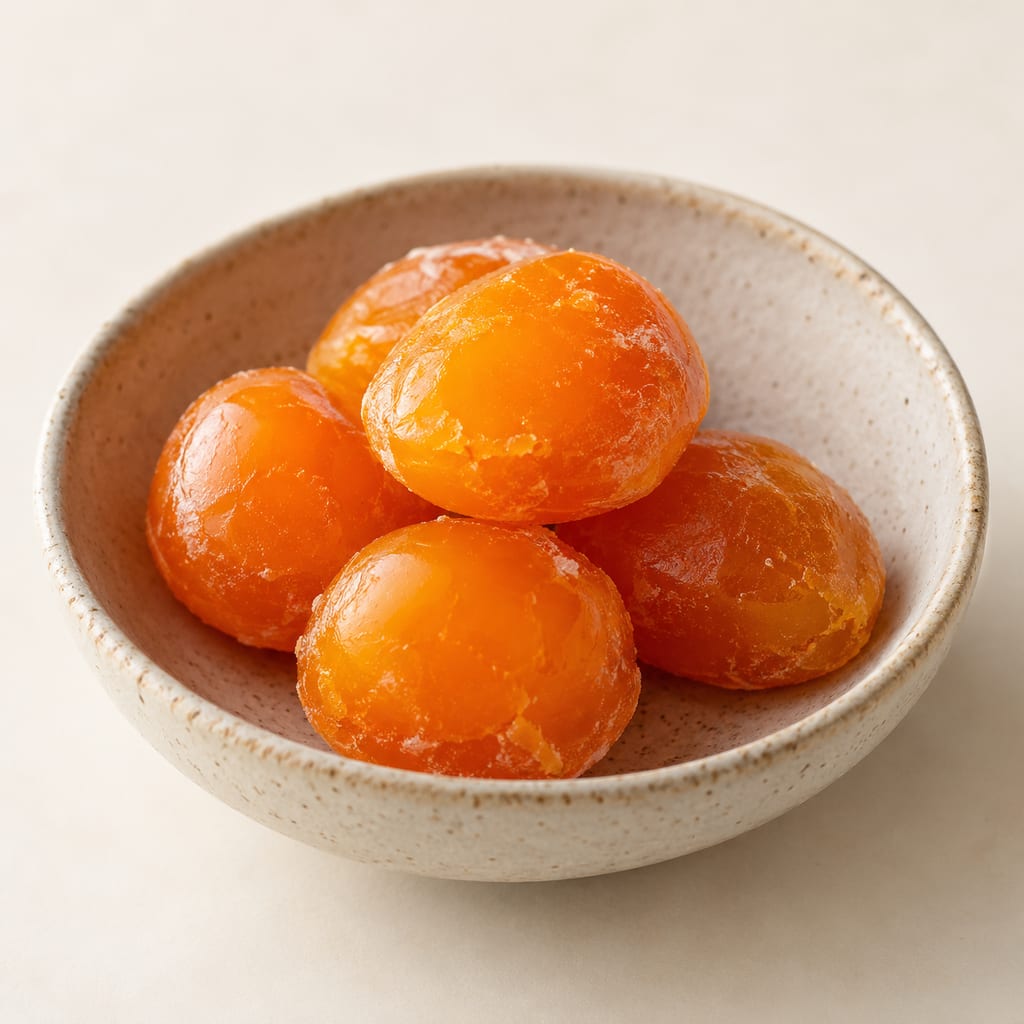
What these yolks are
Salt-and-sugar cured egg yolks are whole yolks buried in a dry mixture of fine salt and sugar, then dried briefly. The yolks firm into a dense, sliceable, amber-orange texture with a concentrated, savoury-sweet flavour. They are used grated over pasta or salads, in the way cured roe or aged cheese is used, in the reader's kitchen as a seasoning rather than as a main ingredient.
The method is a modern technique documented in a fermentation and modernist food reference and in a Utah State University extension egg-storage resource. It is a contemporary preparation, and the sources do not establish a long tradition for it.
Sources for this section
How the cure works
The salt and sugar draw water out of the yolk. Because the yolk is held in a dry bed of cure rather than in a liquid brine, the water leaves the yolk surface gradually, and the protein and fat structure becomes firmer. The cure bed is in contact with the yolk on every side, so the yolk must sit intact and fully covered.
The source gives four to seven days of refrigerated curing, followed by removal of the cure and a low drying stage. No fermentation is involved: the change is osmotic and physical, and the flavour comes from the concentration of the yolk and its salt.
Sources for this section
Safety and storage
Raw egg yolk is a food where the cure does not establish a pathogen kill step. The extension guidance on storing eggs safely is cited for that reason, and the page follows its caution: the yolks stay refrigerated throughout, and the method is not treated as a ready-to-eat process that makes raw egg safe.
Appearance, smell and taste are not evidence of safety. The sources give no validated shelf life for the cured yolk, so the page gives none. Those who cook with or eat the product should weigh the raw-egg risk for the people they serve.
Sources for this section
History
Source documents this preparation; no unsupported date or origin is claimed.
Ingredients
Scaling: source batch only
Method
Risks and precautions · Elevated risk
USU says clean, unbroken shell eggs may contain Salmonella and calls for thorough cooking; this recipe begins with raw yolks.
Hazard sourceThe recipe source describes a salt cure and low-temperature drying but does not establish pathogen reduction or a ready-to-eat egg process.
Hazard sourceKeep refrigerated as the recipe source directs; USU guidance calls for thorough cooking. Neither source validates this uncooked preparation as ready to eat.
Control sourceResearch draft; no professional process validation.
Texture is not a pathogen-control endpoint; room-temperature storage is unsupported.
The salt cure and source drying options are not a validated kill step and do not establish a ready-to-eat egg process; do not infer safety from texture or dryness.
- Mix salt and sugar and spread a layer in a non-reactive container.
- Make a shallow well for each yolk. Place one intact yolk in each well and cover fully.
- Refrigerate for 4–7 days, following the source range.
- Remove cure and dry by one source method; keep refrigerated as directed.
Conditions
Places
Unknown
Documented preparation · Place not establishedContemporary recipe; no place association.
Community
No community contributions have been published for this entry yet.
Share what you made
Sign in to contribute. Published comments and photos are free to read.
Sources
Modernist Food | FermentedInspiration
Salt-and-Sugar Cured Egg YolksSix yolks use 250 g each salt and sugar; refrigerated cure and low-dry options; refrigerated storage.
Cited in: What these yolks are; How the cure works; Safety and storage
Utah State University ExtensionSafety
Storing Eggs SafelyRaw shell eggs may carry Salmonella; guidance calls for prompt refrigeration and thorough cooking.
Cited in: Safety and storage