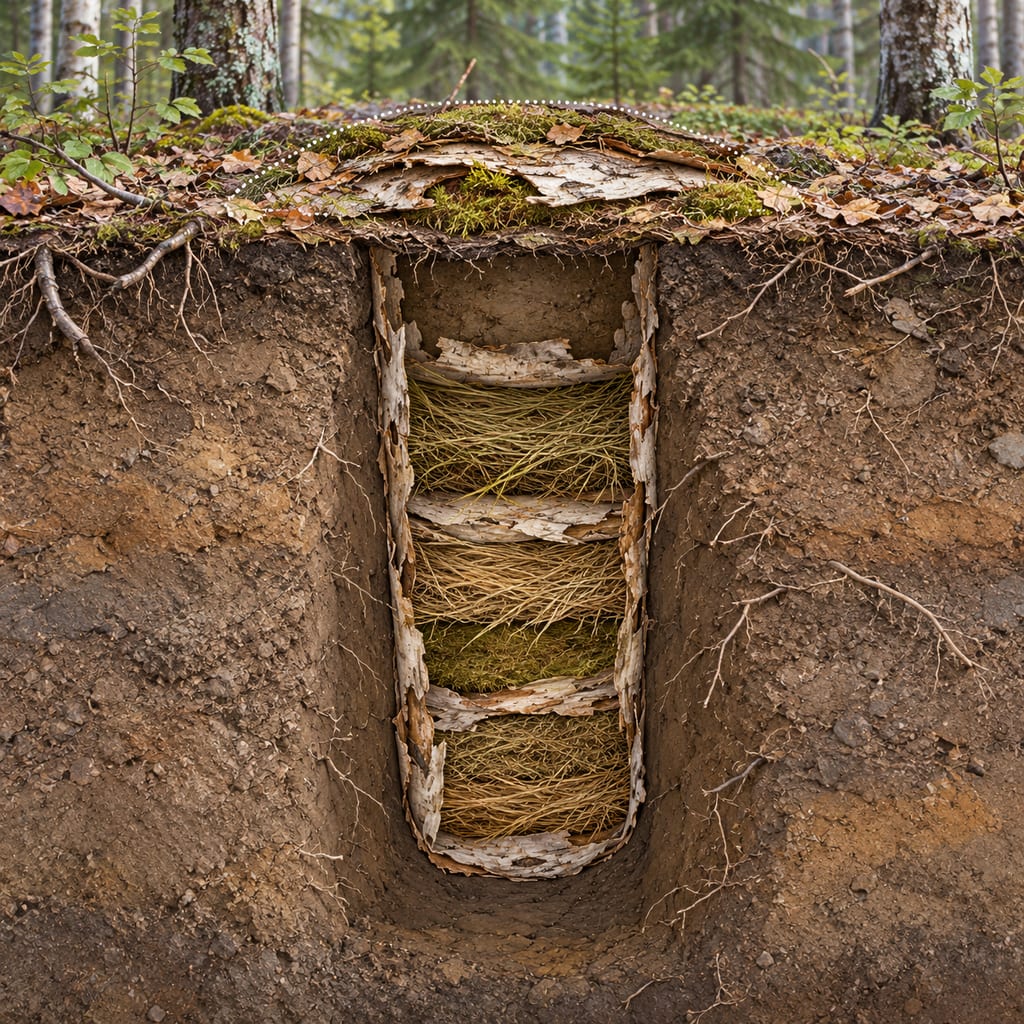
Dene birch-bark-lined cache
A Dene cache pit at Upper Cook Inlet, Alaska, initially dated to around 1,000 years ago. JBER documents a below-ground feature lined with birch bark and grasses; exact contents and construction details remain under study.
 FermenteaWhere food goes to change
Built structures · Pits and cavities
A large clay-lined depression built beneath some Alutiiq house floors in the Kodiak region, documented in Koniag contexts for food storage and possibly fermentation.
A clay-lined subfloor pit was part of a house, not a container that could be carried in from elsewhere. Alutiiq archaeological sources describe large depressions dug into the soil under household floors and lined with thick clay. The Alutiiq Museum identifies this form as typical of the Koniag tradition, the ancestral Alutiiq context named by its inventory.
The construction evidence is limited but specific: a depression, a thick clay lining, and a closure that could be a clay cap or a wooden or stone lid. The Native Village of Afognak reports Settlement Point examples 3 to 6 feet across and at least 1.5 feet deep. Those measurements belong to that archaeological context, not to every clay-lined pit.
Clay-lined features are not one interchangeable type. The Alutiiq Museum distinguishes the large Koniag subfloor pits from smaller Late Kachemak pits beside household hearths, which may have served as stationary cooking vessels for soups or stews heated with hot rocks. The Native Village of Afognak also describes smaller Late Kachemak floor pits lined with tan or yellow-brown volcanic ash clay, unlike the blue-gray glacial till clay used at the Koniag Settlement Point site.
This difference matters when reading an excavation. A clay surface or a pit shape alone cannot establish whether a feature stored food, fermented it, supported cooking, or served another purpose.
The Alutiiq Museum says foods could be stored or fermented in the cool ground. The Native Village of Afognak reports tentative evidence that salmon may have been placed in some Settlement Point pits; a sealed clay closure could have made an air-restricted chamber. That is a proposed use, not proof that all pits fermented fish or that one fermentation method was standard.
Archaeological contexts also warn against reading food use from form alone: the museum notes clay pits at Uyak that held burials. The page therefore treats the pit as a documented house feature and keeps its use tied to each source's level of certainty.
The available accounts do not give a general plan, a standard size, clay preparation, excavation tools, ground-stability requirements, or a modern structural design. The Settlement Point measurements should not be turned into a universal blueprint. The documented build sequence is only the observed feature: a subfloor depression, clay lining, and one of several closures.
The excavation photograph in the museum inventory shows clay-lined pit profiles at Malina Creek on Afognak Island. The site and profile are useful evidence, but no reuse license is stated for that image. This page cites the inventory rather than reproducing its figure; the museum's separate image policy governs reproduction.
The Alutiiq Museum identifies large clay-lined subfloor pits as typical of the Koniag tradition. Their exact dates and the use of individual pits are not established.
A build is made where it stands: moving it means building it again.
Figure 7.2 identifies the Malina Creek site, Afognak Island; this does not place every pit at that site.
Alutiiq Museum and Native Village of Afognak sources document house-floor pits in this archipelago and distinguish them from smaller Late Kachemak features.
A Dene cache pit at Upper Cook Inlet, Alaska, initially dated to around 1,000 years ago. JBER documents a below-ground feature lined with birch bark and grasses; exact contents and construction details remain under study.
CDC guidance depicts fish heads in a grass-lined hole in the ground and describes it as a traditional Alaska Native food-preparation method; it names no specific Nation or community.
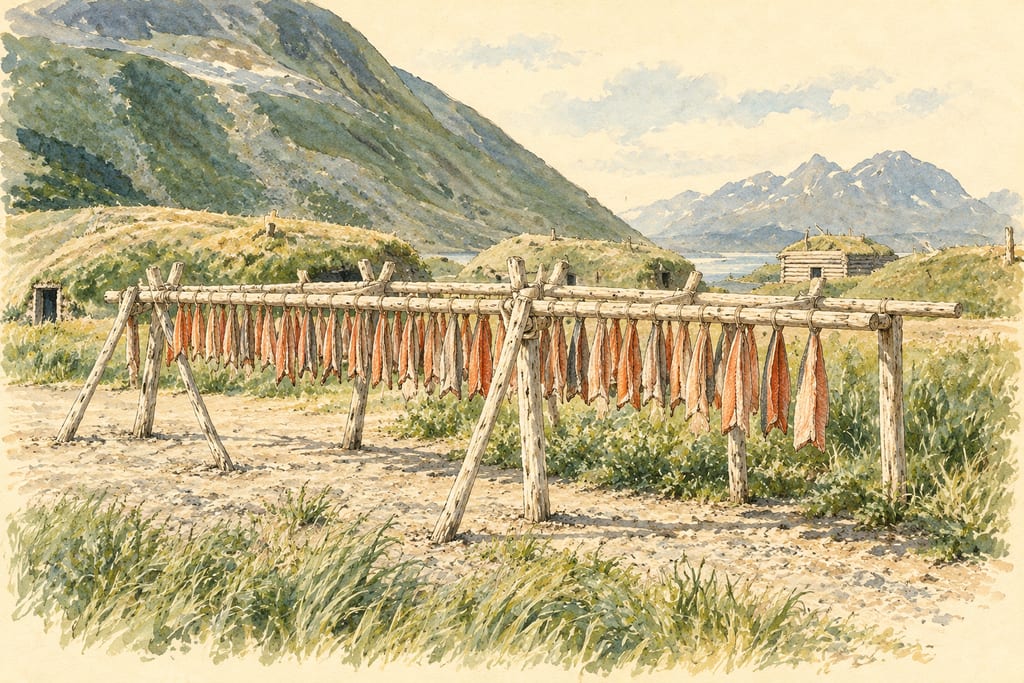
An Alutiiq initaq is a wooden hanging rack for air-drying fish around Kodiak. An 1889 Old Harbor photograph shows an open rail structure; the Alutiiq Museum documents contemporary spruce-pole or lumber racks and airflow-preserving covers.
No community contributions have been published for this entry yet.
Sign in to contribute. Published comments and photos are free to read.
Alutiiq Museum and Archaeological RepositoryForm · Use · Classification · Geography · Visual reference
The Alutiiq Technological Inventory — First Compilation, Chapter 7: Ceramics—AsutThe museum describes large clay-lined depressions dug into soil beneath household floors, typical of the Koniag tradition.
Foods could be stored or fermented in cool ground; some pits had clay caps and others stone or wooden lids.
At Uyak, clay pits also held burials, so the feature form alone does not identify its use.
Figure 7.2 is captioned as clay-lined pits in profile at Malina Creek, Afognak Island.
Cited in: A built-in feature beneath the floor; Different pits had different roles; Storage is documented; fermentation remains uncertain; What the record cannot reconstruct
The Native Village of AfognakForm · Geography · Dimensions · Use · Classification
Ancient Afognak: Precontact History and Archaeology of Afognak BaySettlement Point Koniag houses had large clay-lined storage or food-preparation pits within the house floors.
The source reports these Settlement Point features as 3–6 feet in diameter and 1.5 feet or more deep; smaller Late Kachemak pits are distinguished.
Salmon in the Koniag pits is tentative; a cool, sealed, air-free use is proposed rather than established for every feature.
Cited in: A built-in feature beneath the floor; Storage is documented; fermentation remains uncertain
The Native Village of AfognakComparison · Geography · Materials · Use
Litnik Archaeology: 2001 Tsunami SiteThe Native Village of Afognak's 2001 excavation report describes numerous smaller Late Kachemak subfloor pits lined with clayey volcanic ash, not blue-gray glacial till clay.
The report distinguishes these smaller pits from the larger and deeper Koniag Settlement Point storage pits.
One Tsunami-site pit had a stone-slab cover; the report says other covers may have been removed or wooden.
Cited in: Different pits had different roles; What the record cannot reconstruct
Alutiiq Museum and Archaeological RepositoryImage rights
Image Reproduction and Publication Fees and ConditionsThe museum's reproduction policy says it provides reproduction services only for images for which it holds copyright or a non-exclusive license, and requires users to obtain permissions when image rights belong to others.
The policy describes publication use as permissioned and subject to museum conditions; it is not an open reuse license for the inventory's Figure 7.2.
Cited in: What the record cannot reconstruct